How many degrees of separation?

8 01 2008

Late this afternoon I get an email from someone I don’t know. Let’s call him Mark. He addresses me by name and tells me that someone else (let’s call him Larry) from some company I’ve never heard of has recommended me for some proof reading work.

I’m intrigued, so I call Mark. I tell him I don’t know Larry or Larry’s company. Mark fortunately remembers that Larry actually got my name from someone else—let’s call him Rob S. Somewhere in the dim recesses of my brain I vaguely recall someone of this name—he was the contact person at a printing company. But I’ve never met Rob. I only know his name because I recall that a friend of mine—let’s call her Kris—mentioned him some years ago when I edited some company prospectuses for her.

So, I do some work for Kris back in 2000/2001. She mentions my work to Rob. Sometime between 2001 and 2008 (!), Rob—whom I’ve never met and never done any work for—mentions my name to Larry, who remembers it and mentions it to Mark, who has enough information about me to find my website and send me an email requesting an hourly rate quote for occasional proof reading!

What’s that? Four or five degrees of separation?

BTW, Mark’s happy with my hourly rate quote over the phone and is happy to hire me to do work for him on an ad hoc basis, purely based on a recommendation. That’s what it’s all about! Love it.

Update (1 February 2008): It’s happened again! This afternoon I get an email out of the blue from someone I don’t know (M) who works for a company (A) I’ve never worked for. It’s a pretty generic email asking about my availability for some Word template work. I’m not available, so I respond saying so. I get an email back thanking me for a suggestion I made, and stating “I heard you were the best Technical Writer around – obviously your commitment speaks for itself!”

So, taking the bait, I ask who they’d heard that from. The return email gives me a name (J) and company (C). I don’t know the name, and I’ve never done work for company C. BUT… I have worked with someone (F) who’s currently at company C. Now, before you think, “Ah! That’s easy!”, let me tell you that company C is a global company with some 15,000+ employees in numerous locations throughout the world (think of a company starting with C + oil and gas…). I last worked with F back in 2002 or thereabouts. And I’m not even sure that’s where the connection is.

Cue Twilight Zone music about now…


Bird bath

6 01 2008

Early this morning, while I’m reading the Sunday papers in bed, my husband called out that there were seven twenty-eights on the back lawn. “Nothing unusual about that”, thought I, “we often have native birds out the back.” (BTW, twenty-eights, also known as ring-necked parrots, are bright green with a flash of blue tail feathers, a black head, and a yellow neck band—pretty birds.)

So I got up and wandered out to find that this family of twenty-eights were happily ‘bathing’ in our back lawn! Despite the recent hot summer weather, part of our back lawn grows prolifically—I think it’s over the septic tank/leach drain!

These birds were turning themselves over and over in the long dew-covered grass, obviously having a bath… In the lawn!

They emerged looking pretty scraggly as they were quite wet and had fluffed out their feathers. They must’ve had a good old wash for at least 10 minutes before they flew away. I could only get a couple of photos as they were mostly hidden in the long wet grass.

Twenty eights having a bath


Evolution of a quilt: 7

6 01 2008

I realise that most of my recent posts have been on this quilt. That’s because it’s been the Christmas/New Year break for most businesses in Australia, including my clients. While I have done some paid work, most of the people I deal with on a daily basis have been on vacation. Many return to work tomorrow, so my work commitments will ramp up again and the quilt will have to wait for the weekends.

Anyhow, this weekend was the final onslaught for some time. I spent 8 hours just today on blanket stitching the outlines for the grape leaves, plus a couple of hours at a friend’s place yesterday. My ancient machine doesn’t do blanket stitch and she had kindly offered me the loan of hers at any time. And she told me to take the machine with me when I left her place yesterday to continue the stitching. Thanks Bobbie!

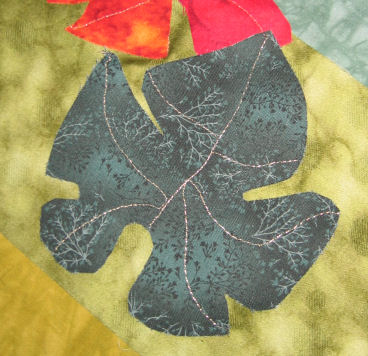
So, where did I leave off last time? Ah yes. Fusing the grape leaves down. I fused some, did free motion embroidery for the veins, laid out the next lot, fused them, created the veins, laid out some more, fused them, etc. The metallic thread kept getting caught in the eye of the needle, so off to the fabric store to buy some special “Metallic” sewing machine needles, with big eyes. That helped.

Grape leaf with gold metallic thread veins

Then came the blanket stitching using Bobbie’s machine…. Ten hours of it! Did I mention how long a quilt takes to construct? You could NEVER sell a quilt for what it costs in time! Even using machine techniques. God forbid how much a hand pieced and quilted quilt would be.

Some leaves with blanket stitch

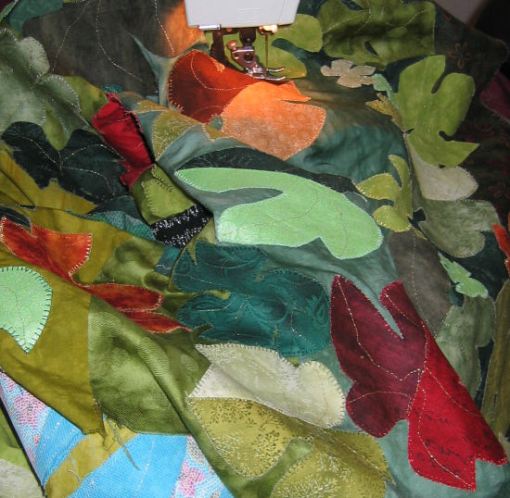
And the WIP (work in progress) quilt top under Bobbie’s sewing machine:

Work in progress

Links to all posts about this quilt


Evolution of a quilt: 6

4 01 2008

I spent some time on the dragonfly quilt yesterday, mostly learning how to work with monofilament and metallic threads!

HINT: If your metallic thread just doesn’t want to spend time in the eye of the needle, put it in the bobbin, then turn the fabric over and sew on the back! Experiment a bit first and make sure you know where the edges of your applique pieces are. I did this by stitching down the raw edge fused applique pieces with mononfilament thread in the top and a contrasting thread in the bobbin. When I turned over the top, I could see the outlines of each appliqued piece.

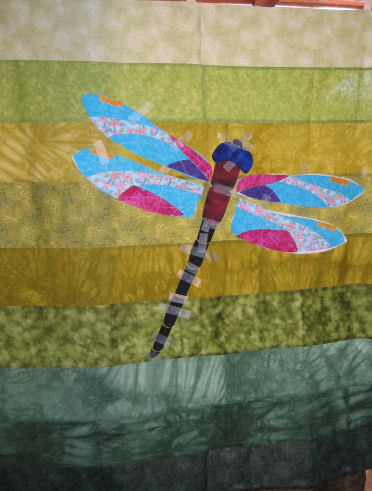
So here’s the progress so far… First picture is of the quilt top before arranging the applique pieces and fusing them on. Note the innovative use of the sliding glass door and window as a light box!

Background

Next came the placement of the dragonfly pieces (again, note the innovative use of magic tape!):

Placing the applique pieces

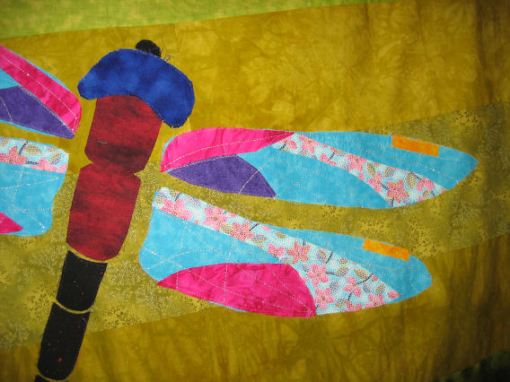
Oops! Forgot one step—I used silver metallic thread on the wings to create a sort of lace effect the other day. Here’s the result:

Silver metallic thread to create a lace effect

I then stitched down the applique pieces with monofilament thread in the top and a contrasting thread in the bobbin. For the dark body pieces, I used grey monofilament with black in the bobbin; and for the wings, clear monofilament with blue in the bobbin. This gave me stitching ‘boundaries’ on the back of the top.

Applique pieces stitched down with monofilament

I was on a roll, so next I tried putting the silver metallic thread in the bobbin case and sewing from the back. When I’d sewn with the silver thread earlier (on the wings), it had continually ‘stripped’ in the eye of the needle, so I tried the bobbin technique and it worked like a dream! I had to adjust the tension a bit, so experiment on scraps first. Here’s the test piece to see how it looked:

First try at stitching from the back

Once I had the hang of doing free motion embroidery with the feature thread hidden (!), I went ahead and added silver highlighting to both sides of the dragonfly’s body parts.

Here’s the back of the quilt top showing the outlines I stitched within—well, sorta stitched within! I know that the edges of the dragonfly’s body will be covered with a bias tape, so I wasn’t too concerned about being 100% accurate and within the lines.

Back of quilt top showing outlines for embroidery

Then I cut out and sewed a pale blue tulle over each wing to add to the lace effect, and to soften the brightness of the blues, pinks and purples.

Embroidered and tulled

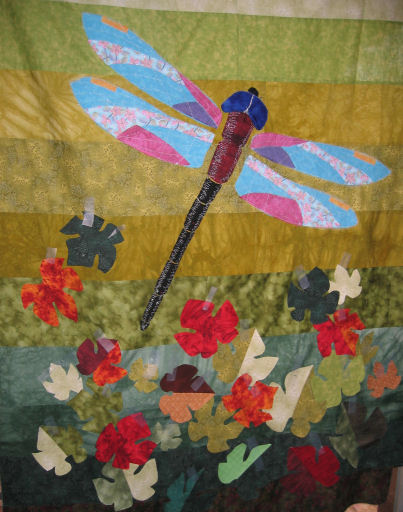
And the last steps I did before the heat and humidity stopped me working was to start placing and fusing some of the 70+ grape leaves to the background:

Placing the grape leaves

I’ve decided to only place the grape leaves in the lower part of the quilt. Two reasons: To create a feeling of leaf litter, and to let the dragonfly ‘fly’ and rise from the leaf litter.

Next immediate tasks:

  • Add gold metallic thread to the leaves I’ve already fused, emulating leaf veins
  • Place and fuse more leaves over the top of the existing ones

I might get some of this done today—it’s MUCH cooler than yesterday, and even though we’re going out for a couple of hours, I’m sure I’ll get some of this done. If I can, I’ll use the gold metallic thread as the top thread so I avoid having to outline each leaf in monofilament (70+ leaves outlined in monofilament = a lot of sewing!). Hopefully this will work—the gold metallic thread I have is thinner and less knobbly than the silver. Based on my last experience with the gold thread, I’ll have to experiment with the tension but that shouldn’t take too long to get right. And this time I’m not quilting through many layers of fabric either, so it should be a lot easier.

Links to all posts about this quilt


Evolution of a quilt: 5

30 12 2007

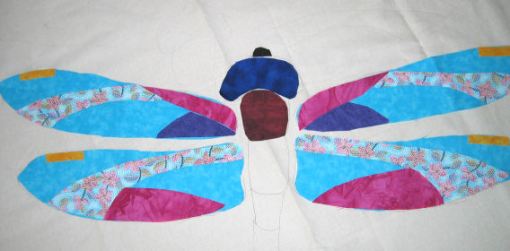
The last step before I finished yesterday evening was to use the remaining fusible web to create the dragonfly body and wing parts. I didn’t have enough fusible (back to the fabric shop tomorrow!) so was only able to get the wings completed, and a couple of small body parts. In the picture below, I’ve laid them out on top of the muslin which I won’t use now, but you can get a sense of how the dragonfly is coming together.

Fused wings

Still to do, but not in order…:

  • Finish applying fusible web to the remaining dragonfly parts
  • Position the dragonfly parts on to the background
  • Add some grape leaves (as required)
  • Possibly add some bunches of grapes,
  • Fuse applique all parts
  • Stitch the appliqued pieces down with monofilament thread so they don’t go anywhere!
  • Free motion embroider veins in the leaves and lace effect on the wings; if add grapes, free motion embroider light highlights (gold, silver metallic thread?)
  • Get some thin bias tape (gold, silver and black) and outline the dragonfly and other relevant bits with it
  • Add a border
  • Add batting and backing, and a hanging sleeve
  • Quilt the quilt
  • Add binding
  • Continue documenting the process!

Links to all posts about this quilt


Evolution of a quilt: 4

30 12 2007

Major setback: When I scattered the leaves over the muslin, there was a LOT of white poking through. Without creating hundreds more leaves, this wasn’t going to work. And even if I did create hundreds more leaves, I think the background would’ve been TOO busy and swamp the dragonfly (‘scuse the pun!).

So back to the drawing board… More thoughts, ideas, and possibilities later (and some more hours…) and I decided to use the remaining green fabrics and create a green gradient background for the dragonfly.

Some of the green fabrics laid out in a possible order:

Green fabrics for the background

The next step was deciding what to do with these fabrics. I thought of putting large patches of green over the muslin, then laying some leaves on it, but that looked weird. Next thought was to look at how I could cut the green fabrics in wavy lines so that I could get the effect of undulation (a la Ricky Tims). But I couldn’t figure out how to do that successfully! (Fortunately, I tested on small fabric scraps before cutting ANY of the green fabric!)

I then thought I could make uneven lines in the greens getting a geometric effect with long thin triangular shapes, but I tried that on four strips and it just didn’t look right, so I unpicked all those stitches and decided to go for very boring strip piecing of these 5 and 6″ strips…

Strip pieced background

Next: Create the dragonfly body and wing parts

Links to all posts about this quilt


Evolution of a quilt: 3

30 12 2007

In the previous two steps, I’ve got my inspiration and created the grape leaves for the background. Now to create the dragonfly…

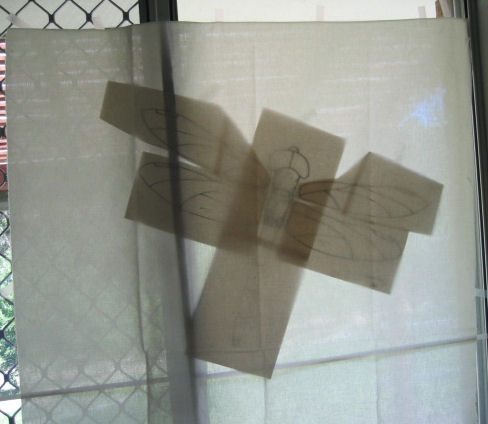
I found some pictures, traced the essential outlines so that you could tell it’s a dragonfly not a butterfly, assembled the pieces of paper, taped them to the window, overlaid them with quilter’s muslin, traced the design on to the muslin in pencil, rearranged everything and retraced the design on to the muslin in permanent marker.

Dragonfly drawing

Muslin overlaying the drawing

The reason I traced the lines in permanent fabric marker was so I could position the leaves on the muslin and applique them on without going too far into the area where the dragonfly would overlay the leaves—I needed to see where the dragonfly was going to go.

Next: The background dilemma

Links to all posts about this quilt


Evolution of a quilt: 2

30 12 2007

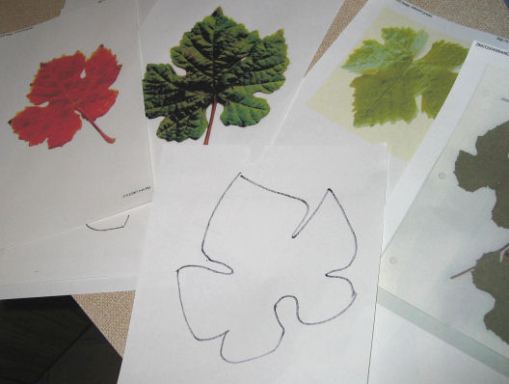
Grape leaves as a background! I like the idea… So off to the internet again to get some simple images of grape leaves that I can trace to get my outline. Not just one grape leaf either—I have to have a few variations of shape and size.

Grape leaves - inspiration

The first stage is finding suitable images (do you know how many pictures of dolmades there are???). Next, printing them off. Then I used the window as a light box and traced the outline of the photos on a sheet of paper with a black marker. Next, I photocopied these outline sheets at various increased and reduced sizes.

Then it was off to the fabric store (bliss!) to find suitable fabrics for vine leaves, and dragonfly wings, and to get some fusible web to trace the leaves on to in preparation for appliquing them on to the background. That all sounds so quick and easy, but believe me it wasn’t!

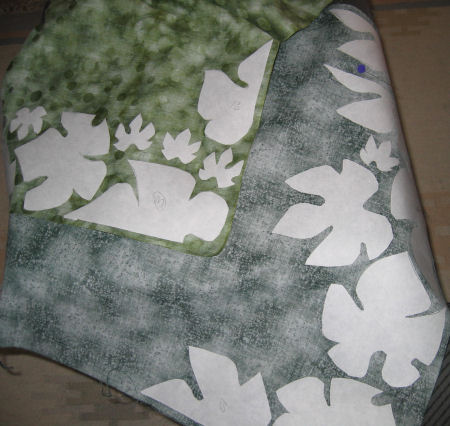
Here’s the fabric I chose sitting on top of the fusible web showing the outlines of some 70+ grape leaves that I’d traced, hoping that I’d have enough:

Fabrics

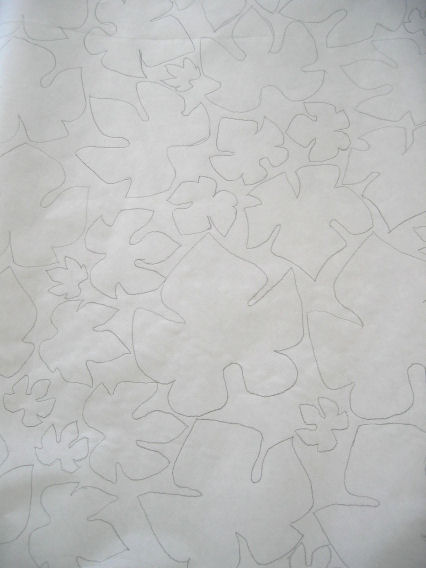
And here are some of the traced outlines making the best use of the available space:

Outlines of grape leaves

So now I have the fabric and the outlines traced on to fusible web. The next step is to cut out the tracings into individual leaves, then hot iron the fusible on to the backs of the various fabrics, then cut out each individual fabric leaf. Again, this took some hours…

Fusible web on backs of leaf fabrics

At the end, I had some 70+ leaves, about a third of which I had cut in half and joined together to get colour variation.

Grape leaves ready for fused applique

Next step: Create the dragonfly.

Links to all posts about this quilt


Evolution of a quilt: 1

30 12 2007

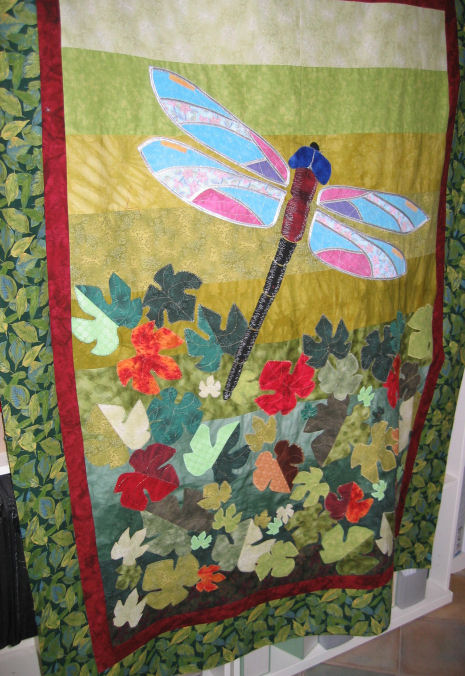
Since moving down south, we’ve discovered the delightful Scotts Brook wines, and I’ve been quite taken by the dragonfly logo. An idea for a quilt/wall hanging using the dragonfly has been brewing in my head for a few weeks now. With some time off over the Christmas break and with only a few social activities to attend, that idea has now started to come to fruition.

But I’m finding that without a pattern or instructions, the original idea has changed a lot since inception. That’s what this series of posts is about—how I’m going from an original idea to a finished product. It’s not finished yet, and may not be for quite a while, but I wanted to document the process, as even at this early stage, it’s changed a lot.

My original thought was to make a wall hanging using the dragonfly logo on the Scotts Brook wines, and sticking pretty much to that design. However, my husband—who’s much more artistic than me—suggested that making something that was almost all white wouldn’t be a good idea as it would look very bland. Between us we searched the internet for dragonfly quilts made in a stained glass style, and expanded the search to stained glass patterns, and images of dragonflies in all their forms.

After looking at all sorts of variations, we agreed that the dragonfly should be colourful and on an angle, and that some leaves should be in the background. However, we didn’t want the strappy leaves we saw in some designs we found as they aren’t in keeping with the local area. So I had a brainwave of creating a background of grape leaves! More in the next episode…

Original inspiration:

Scotts brook wine label

Some of the other inspirations:

Stained glass dragonfly Dragonfly with strappy leaf background

Links to all posts about this quilt


So darned secure…

30 12 2007

… you just can’t open it!

Why did a miniscule proportion of world’s population do such stupid acts as tamper with products that they’ve made it difficult for the rest of us? And why are companies so fearful of tampering and law suits that they make products that are almost impossible to open—by anyone?

I’m not arthritic and I can use my hands as well as I could when I was in my 20s, but in the past few days I’ve had two instances where getting a top off a product was more than difficult. It was frustrating, annoying, and in one case put my teeth at risk!

One instance was one of those ‘push down and turn to open’ lids that’s meant to keep children from consuming the contents. Well, I pushed down and turned about six times before I got the darned thing to open. And I swore a bit too.

The other was a plastic jar of what used to be called stewed fruit. It seems the two main producers of these ‘jars’ are using a seal that can only be opened by brute force. Here’s a picture of this ‘seal from hell’:

The safety seal from hell

So, what makes it nasty? See those two little bits that stick out? Well, there’s four of them, evenly placed around the seal.  But they are almost impossible to lift using my adult fingers, small though they are. Fingernails get broken in the process, and once I resorted to using a kitchen knife (NOT a sharp one), but that only put my eyes, face, arms, and hands under serious threat of mutilation. Only once have I been able to lift these tabs enough to pull them back to break the incredibly strong seal. And then the seal itself is a sod of a thing to remove without spilling the contents.

The only thing that works for me on this seal is my bottom front teeth! Yes, teeth. I’d like to see the manufacturers’ reactions if I sent them a bill for missing or broken teeth as a result of trying to consume their product!

I wonder how those with even slightly limited motor impairment get on. The elderly spring to mind, anyone with arthritis or lessened strength in their arms and hands, multiple sclerosis sufferers, and the like.

Design for usability and accessibility is not just for software—it’s for every product we use. This seal meets neither requirement—it’s not usable, and it definitely prevents the product from being accessible!

Just a little rant to finish off the year…