Vale Glynn Watkins

16 10 2008

Late on 9 October 2008 at age 82, Glynn Watkins passed away.

Those few words give no hint as to the loss I feel at his passing and the loss I will feel for many years. Glynn, his wife Shirl, and children Peter, David, and Gina, have been close friends of my family for nearly 50 years. Glynn and his family was present at all our major (and many minor) family events, and we were there for many of his family events too. In their retirement, Glynn and Shirl travelled to places near and far with my parents, a ‘habit’ that started when they travelled to New Zealand together for a couple of weeks back in the 1960s, leaving us kids with our respective grandparents.

So why was Glynn such an important person in my life? Other than being a close family friend for nearly 50 years, Glynn was my primary school headmaster (Waroona District High School) for some six years back in the day when the boss of the school was called a ‘Headmaster’ and not a ‘Principal’. Even though I was only very young, Mr Watkins, as we always called him then, was an incredible influence on my life. He showed me what a true educator and teacher was. He was my mentor, a man I looked up to and respected deeply. Unlike many headmasters of the time, Glynn took an interest in both the good kids and the bad—and all those in between. Being called to the Headmaster’s office was not necessarily a fearful time (unless of course, you’d done something wrong!). He would call you in to praise or congratulate you on an achievement, and would come into the classroom to take an active interest in the teaching and learning program. Maybe he was just checking on the new teachers—no matter, it always felt like he was really interested in what we were doing.

Outside school, he was still ‘Mr Watkins’, but I saw him in a more relaxed light, kicking a football with us kids, singing ditties with his good friend Moir (“Mud, mud, glorious mud. Nothing quite like it for cooling the blood…” [Flanders and Swann]), enjoying a quiet beer, trying to avoid exposing his lily-white skin to the summer sun in the local swimming holes and dams, and enjoying a laugh. And what a booming and infectious laugh he had.

The year I started high school, Glynn and his family were transferred to Manjimup Senior High School. But the friendship between our two families ran deep, and many happy hours were spent at each others’ places over the school holidays. He became ‘Mr Watty’ to me then.

Years passed and I became a high school teacher. Without realising it at the time, I’m sure that Glynn had a big hand in my belief that teaching was an honourable and worthwhile profession. His sense of fairness and his clearly defined lines between what you could and couldn’t do, became part of my teaching strategy. I hope that I emulated the great teacher he was, even a small way.

Over the years, ‘Mr Watty’ became ‘Glynn’, and I found out how proud he was of my achievements and those of my sister. He had no hesitation in handing out praise, and it was always sincere, never hollow. Even after he had retired from education, I never heard him speak an unkind word about any students he had in his care for so many years.

So who was this Glynn Watkins? The Glynn that the world saw was an incredible man—a gentle man in the truest sense of the word. He was an educator, an innovator, a mentor, a role model. He was incredibly well-respected in education circles, and was given the honour of Principalship of a brand new metropolitan high school where he was able to pick and choose his own staff (this is not something that happens in West Australian government schools, even now). His staff adored him, and, in all my years in government schools, I never heard a bad word about him, even when in the company of teachers who had no clue I knew him well. In 1987, his services to education in Western Australia were honoured with a Medal of the Order of Australia (OAM).

Glynn was a man who was never just an observer of life, never just standing on the sidelines; instead, he grabbed life with both hands and threw himself into everything he did, whether it was education and teaching (a vocation—not just a job—for Glynn), his roses and orchids, his singing, his public speaking, his Lodge and Probus club, his RAAF, and all the other things I’m not even aware of.

Most importantly though, Glynn was a family man who willingly made time for family and friends, no matter how busy he was. He loved Shirl deeply and profoundly, and they were true soulmates for more than 50 years of marriage. He loved his kids and grandkids with a passion and was incredibly proud of them. He delighted in sharing stories of their lives. And boy, could Glynn tell a story!

He was a superb raconteur, with a razor-sharp wit. He could grab hold of a room with the power and projection of his deep voice, then keep everyone enraptured and laughing for hours on end, just as he did even on his 80th birthday. Yet he was never egotistical about his abilities and never jumped up to take a microphone just because it was there. And it wasn’t just his speaking voice—those Welsh genes of his were an asset to the Perth Male Voice Choir.

Glynn, you were a man among men. A role model, a mentor, and a friend. If I was able to have two Dads, you would have been my second one. You will be deeply missed by those who had the honour and pleasure of being touched by your wit and humour, your compassion, and your friendship. This State has lost one of its true educators, and a great man.

To paraphrase the lyrics of Gilbert and Sullivan, Glynn was the “…very model of a modern Major-General.”

My deepest sympathy goes to Shirl, to Peter and David (my childhood ‘brothers’), to my ‘little sister’ Gina, and all your families.

Glynn Watkins on his 80th birthday, with proud daughter Gina

Glynn Watkins on his 80th birthday, with proud daughter Gina


Weekend away in Albany: Growers Day

13 10 2008

Back in 2000 I edited a PDS (Product Disclosure Statement) of an MIS (Managed Investment Scheme) for a company in the business of creating Australian Blue Gum tree farms. I bought a share in that particular offering, knowing that it was speculative and that it would be some 8 to 12 years before I saw any return (if any) on that investment. Since then, the company that set up the tree farm has changed hands several times and ‘my trees’ are now managed by a company in Albany, on the south coast of Western Australia.

This company sends out information each year on their free “Growers Day”—a day where investors like me get updates on our trees, and get taken out to view various aspects of the operations. Everything from pollination, to watching the final wood chip pile being loaded on to a ship bound for the Japanese paper mills. I’d never been before, so this year we decided to go and make a weekend of it.

It was a fascinating day and I learnt a lot. I felt sad when I saw the effects of the harvesting, but was alternately glad too—glad that our incredibly rare native trees were no longer being used for wood chips. (NOTE: These Blue Gums are native to Tasmania and are bred especially for harvesting for wood chips. The land they are planted on is old, cleared pasture land, either leased from farmers or owned by the company. Native forests are not cleared specifically to plant Blue Gums.)

Some of the more interesting parts of the Growers Day:

  • Flower pollen collection and pollination (you too can be Chief Bee, or the Chief Pollinator, if you wish! Or perhaps ‘Flower Emasculator’ is more your preferred job title…)
  • Seed genetics—super mothers and super fathers combine to produce super children.
  • Seed planting and propagation
  • Soil, weather, and other conditions affecting growth rates
  • Risks, such as fire, pests, and diseases
  • Harvesting—where we learned that more costs go into the day a tree is harvested than in its entire life
  • Debarking, chipping and transporting to wood chip stockpiles at the port
  • Loading onto ships bound for Japan for making high grade paper, such as the outer layer of paper used on wine labels
  • Current costs and returns per hectare, and current price per bone-dry tonne

So, will ‘my trees’ give me some return on investment? They should do, but with the current economic climate, who knows. We were assured that prices for wood products don’t fluctuate a lot… but they’ve said that about iron ore too. They aren’t due for harvest until around 2010, so I guess I’ll find out then.

Male parts are removed to leave a scar in the resulting seed pod, pollen is collected from other plants, then deposited onto female part using a small tube which protects female being pollinated by other pollen

Male parts are removed to leave a scar in the resulting seed pod, pollen is collected from other plants, then deposited onto female part using a small tube which protects female being pollinated by other pollen and other pollen-carrying agents such as bees, ants, and birds

A small stand of trees left behind after harvesting

A small stand of trees left behind after harvesting

Jaws of death - cut tree at base, collect 5-10 trees in 'arms' then lay them down ready for the debarking and chipping process

Jaws of death - cut tree at base, collect 5-10 trees in 'arms' then lay them down ready for the debarking and chipping process

Jaws of death - close-up

Jaws of death - close-up

Cut at the base

Cut at the base

Trees awaiting debarking and chipping, and others awaiting death

Trees awaiting debarking and chipping, and others awaiting their fate

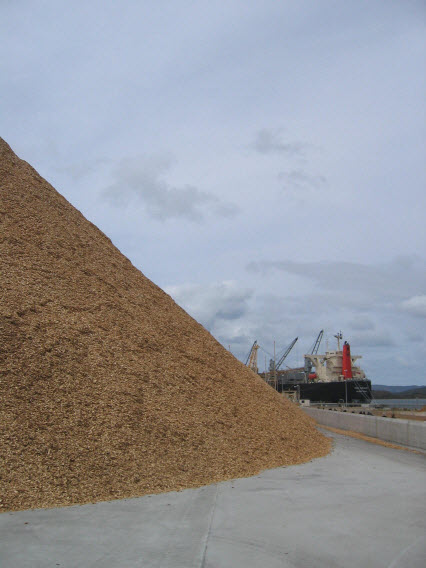
Prt of the 100,000 tonne wood chip stockpile

Part of the 100,000 tonne wood chip stockpile


Hey Wiii-lll-mmm-aaa!

12 10 2008

I had an interesting weekend – some good, some very sad. Will write on that later, perhaps in a day or so.

Meantime, we were coming back from where we’d been this weekend and I saw a dead kangaroo on the side of the road and said something like “dead boomer” or “big boomer”. My husband thought I’d said “Wilma”! So all afternoon on the drive back home we called every dead roo “Wilma”.

Guess you had to be there. But I think that “Wilma” will become part of our shorthand to each other from now on.


Watch out for branches!

2 10 2008

Resource companies are really strict about safety—as they should be. And because most are located in very remote areas of our big state and country, accessing exploration and mine sites requires a four wheel drive vehicle and driving on some very rough tracks… where they exist.

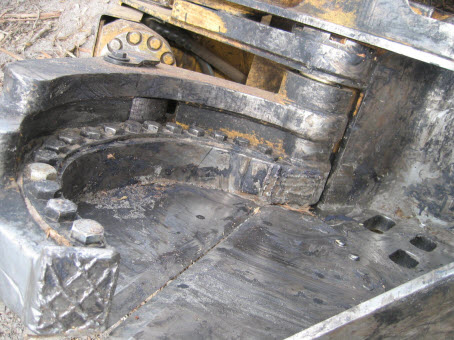
So it was no surprise that a resource company’s incident notification email is doing the rounds of staff at other resource companies. Here’s the essence—I think the picture tells the story!

Here's what happened

Here’s what happened
Too bad if there was a passenger in the vehicle

Too bad if there was a passenger in the vehicle


Knights in shining armour

2 10 2008

It’s been a hectic week workwise, so I’m only now getting around to blogging about the long weekend just gone. I did the Japanese Meshwork workshop on the Saturday, then I had the craft group afternoon up at the estate on Sunday afternoon where Bobbie taught two of us some patchwork piecing basics. This was good—it’s been 20+ years since I did any patchwork/quilting classes, so while I do this hobby for my own enjoyment, I really don’t know the best practices I should be following. We started work on a ‘Blankets of Love‘ quilt each.

On Monday, we took a drive on a big loop along Channybearup Rd (south of Manjimup), around the back of Pemberton, and back through to the Southwest Highway. Channybearup Rd was interesting—I’d heard that Manjimup grew a lot of the state’s avocados but had never seen an avocado tree on any of our trips down that way. That’s ‘cos they were hiding out along Channybearup Rd! Thousands of avocado trees, from brand new ones to well-established ones. And some vineyards thrown in too.

We stopped in at Knights Distillery. I’d heard good things about the liqueurs they were producing there, and I’m pleased to say that my information source was absolutely correct! We tasted some FABULOUS liqueurs, and even bought some of our favourites. It would have been easy to buy one of each, though the bank manager might not have been happy with that!

The ones we purchased were Arabian Knights (cream liqueur with chocolate and Turkish Delight flavours), Frosty Knight (chocolate mint cream liqueur), Mid Knight (coffee liqueur), and Regal Knight (the house specialty). We also bought some home-made chocolates, filled with various liqueurs, and scoffed off all eight of them after dinner that night!

So, how do you do a liqueur tasting when you’re driving out and about? They had these tiniest little shot glasses that probably held not much more than a thimble full. And the guy behind the counter pours a tiny amount, enough to come maybe 5 mm up the side of these little glasses. So you get the taste without too much alcohol. He did say, however, not to drive after eating six of the chocolates as that equivalent to one standard drink! The minimum alcohol content of the liqueurs is 20%, with the Regal Knight and the schnapps varieties at 37%.


Japanese Meshwork

27 09 2008

I spent part of today at a quilting workshop in town learning how to do Japanese Meshwork. Earlier in the week I spent a few hours making the bias strips I used in my ‘tumbling blocks’ piece. A word about these bias strips—they aren’t made from the bias of the fabric. They’re cut on the straight grain, then put through some type of bias tape maker to create the double-fold strips.

Japanese Meshwork has no sewing in it, until you need to add borders etc. It’s all about weaving the fabric. And it takes some time to get the technique right. However, within a few hours all five of us at the workshop had a handle on it, though whether I could repeat the technique at a later date remains to be seen!

Here are some of our efforts:

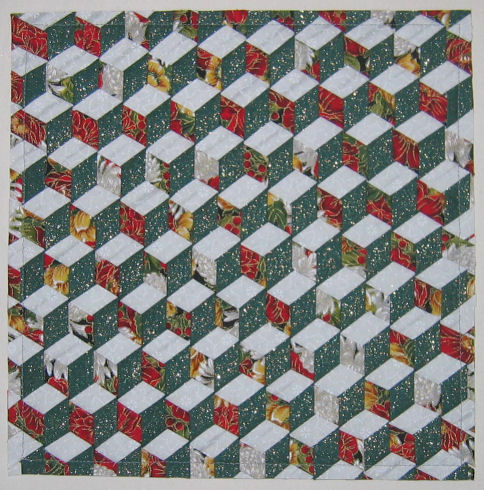
My Christmas Japanese Meshwork piece - 9 in square

My Christmas Tumbling Blocks - Japanese Meshwork piece (9 in square)

Bobbie's Cafe Blocks

Bobbie's Cafe Blocks (9 in square)

Jane's stars and diamonds

Jane's stars and diamonds (6 x 12 in)

Flora's lattice

Flora's lattice - in progress (6 x 12 in)

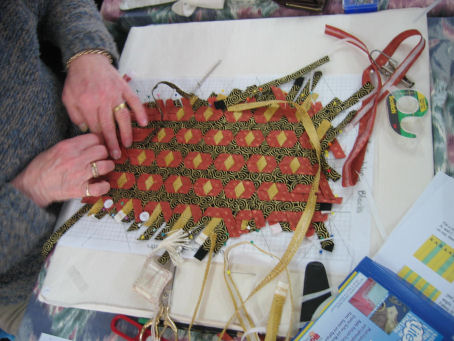
Using the bodkin to weave the strips

Using the bodkin to weave the strips

See also: Japanese Meshwork: Finished


Free issues of Down Under Quilts magazine

24 09 2008

You can get a free 6-month subscription to the electronic version of Down Under Quilts, the Australian quilting magazine.

Just go to The Quilt Mouse (http://www.thequiltmouse.com.au) then scroll to the bottom of home page and click the link. You only have to enter an email address and you’ll get access to past issues and a free sub for the next 6 months.

BTW, this is my friend Bobbie’s website. It’s been revamped recently—her son set it up for her using Joomla, and her daughter did the graphics. It was their Christmas present to her last year, but was longer in the making than they’d all expected. But it’s up now, and you can even see one of the quilts I’ve made with Bobbie’s blocks in the Photo Gallery.


What did I start?

24 09 2008

I popped into the fabric store yesterday to see if my new machine might be here by the weekend in time for the workshop. It won’t, so I’ll have to borrow one.

While I was there, the owner said there was this guy who’d seen my Dragonfly quilt in the window (she’s displaying it in the store for a while) and wants to commission me to make a single bed quilt! She indicated that the price would be high—over $1000—but it seems he gave her his number for me to contact him anyway.

Arrgghh! I’ve got his phone number, but haven’t called him yet. I don’t have the time to make it—unless he’s prepared to wait 12 months—and I’m really not confident in my ‘art’ quilt skills as the Dragonfly was my first effort of designing and creating something myself. And if it had all gone pear-shaped, it wouldn’t have mattered. It seems he wants a particular butterfly, so I’m guessing that it’s for a daughter, especially as it’s a single bed size.

And the store owner also mentioned that some ladies were wondering if I did a lesson or workshop on how to make a quilt like that.

What have I started?


Sewing machine fairies

22 09 2008

Funny how things happen… As regular readers of this blog know, I’ve been considering purchasing a new sewing machine since we moved here 18 months ago and I started quilting again.

I staved off that purchase by trading my 33 year-old Bernina in on my Mum’s slightly newer 25 year-old Bernina, at her suggestion. But as my skills have developed and my needs have grown, I realised that I needed a machine that was better able to do things such as free motion embroidery and the like.

I’ve done some investigation and had decided on the Husqvarna Sapphire 870. I was all ready to put in my order when my friend Bobbie offered to loan me her Sapphire 830 for a while. It was 12 months old but virtually brand new as she’d hardly used it while they were building their house, but she was thinking of upgrading to the latest Pfaff, which has just been released. However, she had to find out from the Pfaff people whether a particular part she’d bought for the Husqvarna would work on the Pfaff. She offered me a good price on her 830, should I decide to buy it *if* she decided to purchase the Pfaff.

Anyhow, long story short… Last week, Di from the fabric store asks if I’m still interested in the 870, Bobbie finds out that the new Pfaff will work with the part, and my Mum calls to say my old machine has died! So, Mum picks up her old machine, I decide to purchase the Sapphire 870 at Di’s ‘good deal’ price, and Bobbie decides not to get the new Pfaff, so I return hers to her. Phew!

I think the sewing machine fairies were at work last week making sure that this all happened the way it was meant to happen! Mum keeps her machine, Bobbie keeps hers, and my old now-dead machine gets replaced with a Husqvarna Sapphire 870! Meantime, my old machine is going to an ex-electrician at my folks’ retirement village who will see if he can fix it and then Mum will donate it to charity or one of the people in the retirement village.

BTW, my Mum has taken up basic sewing again. My niece (her granddaughter) visited an orphanage in Africa a couple of months ago and one way that she can help is to get people to make cloth nappies (diapers) and bibs for the babies out of old towels. So Mum’s doing a lot of that.


Quilting: Easy double-fold bias tape

22 09 2008

I’m off to a Japanese Meshwork workshop this coming weekend and had to cut the fabrics and make double-fold bias strips from it. Bobbie lent me her 1/2″ bias tape maker, but I wasn’t happy with the results on my first few tries. I just couldn’t get the folds even, and on the lighter fabric, I got puckering in the centre, even when using spray starch to ‘crisp’ up the fabric.

So off to the internet to see if there was an easier way! I couldn’t find anything on YouTube but I did find an easy method here:
http://creativelittledaisy.typepad.com/creative_little_daisy/2007/11/diy-version-of.html

In case that blog post ever goes missing, here’s my variation on it (apologies for the blurriness of some of these photos).

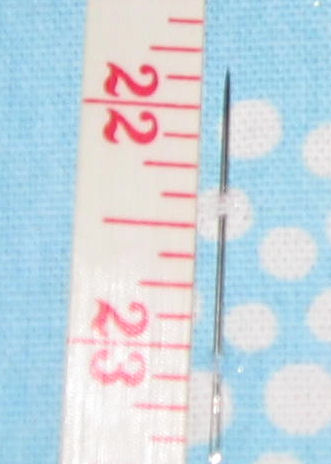
Position a needle on the ironing board so that the gap between the ‘grabs’ of ironing board fabric is 1/2″.

Needle on ironing board with 1/2" gap

Needle on ironing board with 1/2″ gap

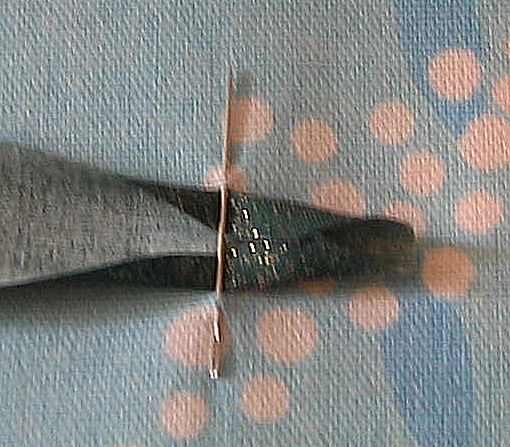
Clip one end of a 1 inch fabric strip to a point so that it can slip under the needle easily.

Snip the end and pull through gap

Snip the end and pull through gap

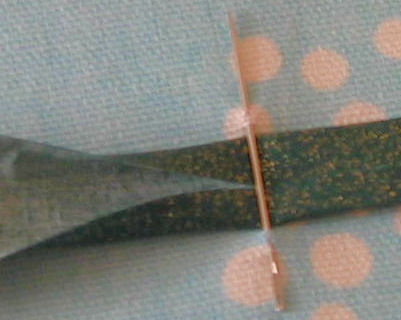
When you gently pull the fabric through, you may need to wiggle it a bit to get the folds even.

Wiggle the folds to make even, if necessary

Gently pull the fabric through, about an inch or two at a time. Watch that the folds remain even, and help guide the fabric through if necessary. I found that with some fabrics I had to use my left hand on the lower fold to keep it even—the upper fold sorted itself out when I did this.

Pull through gently

Pull through gently

Iron as you go. Press each inch or two as you pull it through the needle. Be careful you don’t burn you fingers—the fabric gets pretty hot with all that pressing.

Iron as you go

Iron as you go

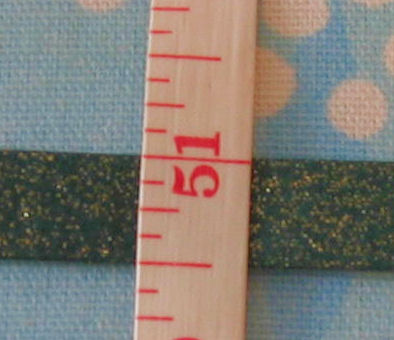
End result—perfect 1/2 inch double-fold bias tape strips! Give the strips a squirt of spray starch and a final press, then, if you’re not using them straight away, roll them around a cardboard tube and pin until you need them. The folds will separate if you’re not using them immediately.

Perfect 1/2 inch double-fold bias tape

Perfect 1/2 inch double-fold bias tape