Empty Spools at Asilomar: Wednesday 26 February 2014

27 02 2014

Another great work day today. Almost finished my second piece and should start my third tomorrow. Photos below…

No planned activities tonight so many of us went back to our classrooms to continue working, me included.

Meals today: breakfast: scrambled eggs and sausage links, though opted for cereal instead; lunch: vegetable tortilla soup, pork with chilli and soft tortillas; dinner: choice of fish, chicken and vegetarian pasta — I opted for the pasta. Still way too much food.

My second piece

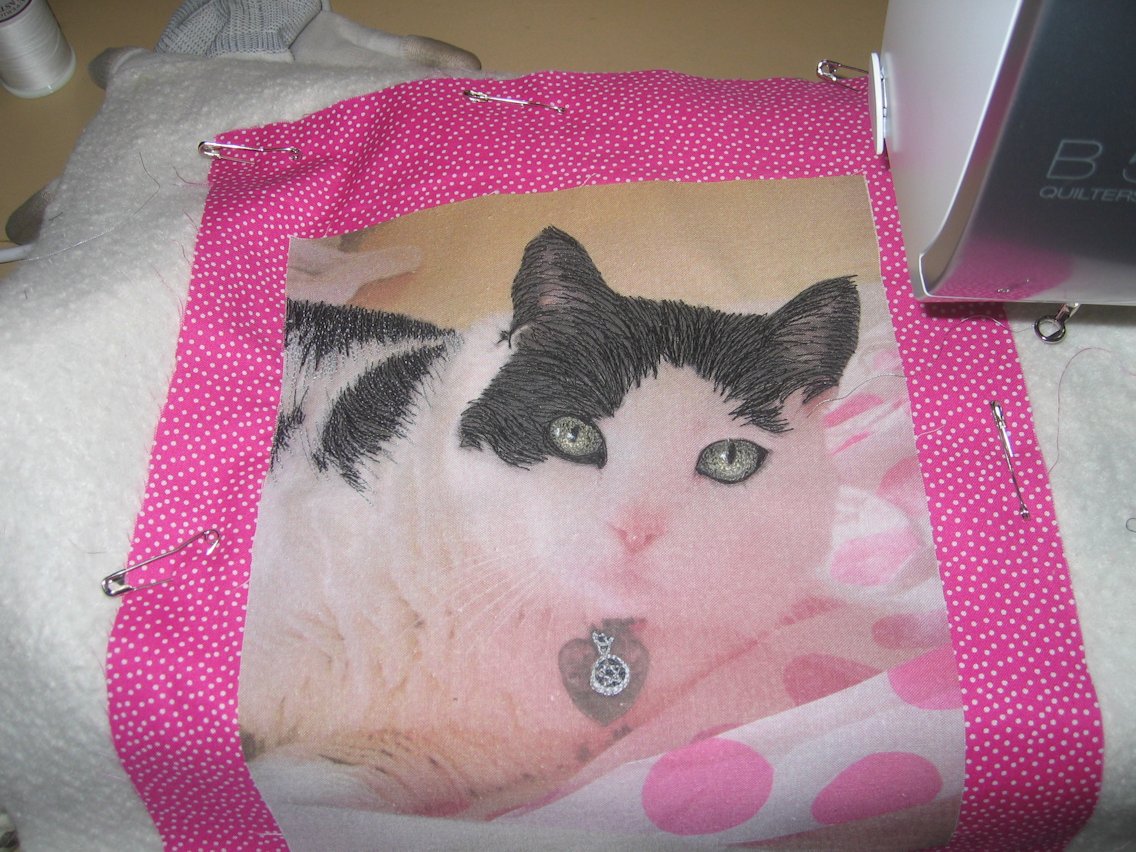
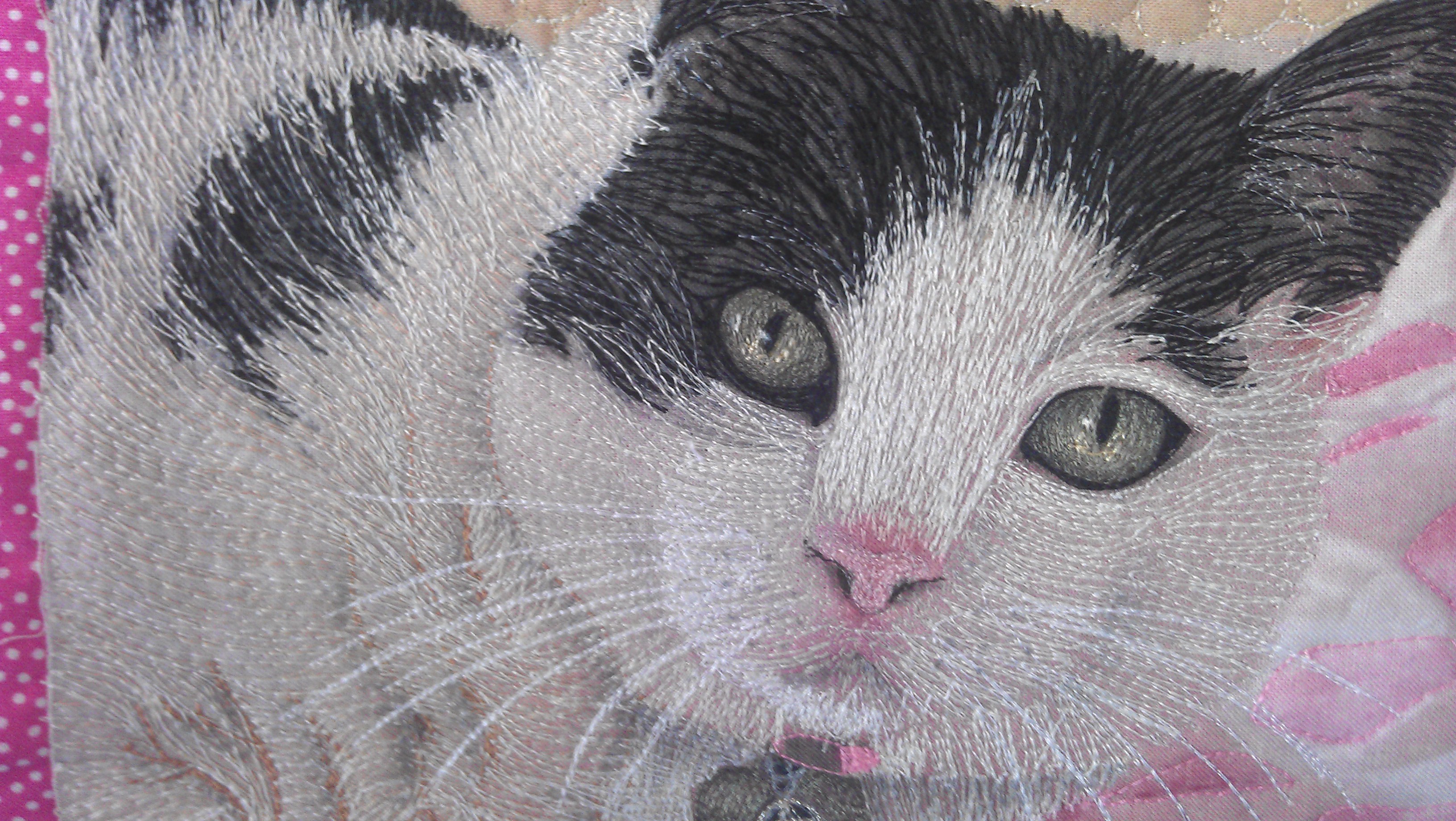
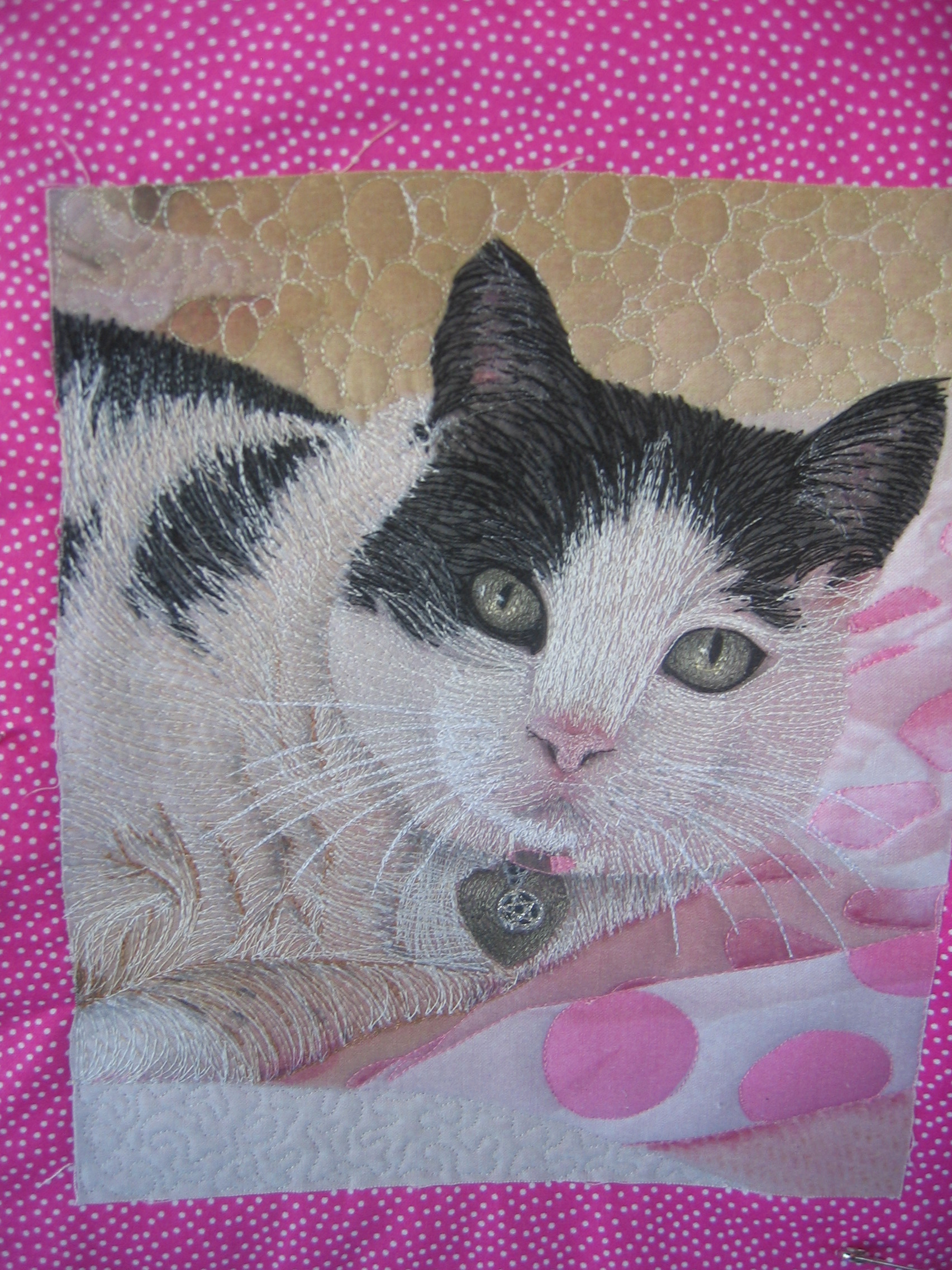
For my second piece, I decided to do my friend Sue’s cat, Kassie. Sue had sent me the photo some time back, and it was such a pretty photo it was impossible not to consider it for thread painting. And Sue’s a ‘pink’ girl, so the pink spots on the tissue paper Kassie is lying on were perfect. To set it off, I purchased a pink and white spot fat quarter from the store set up here as Asilomar for the quilting weeks.

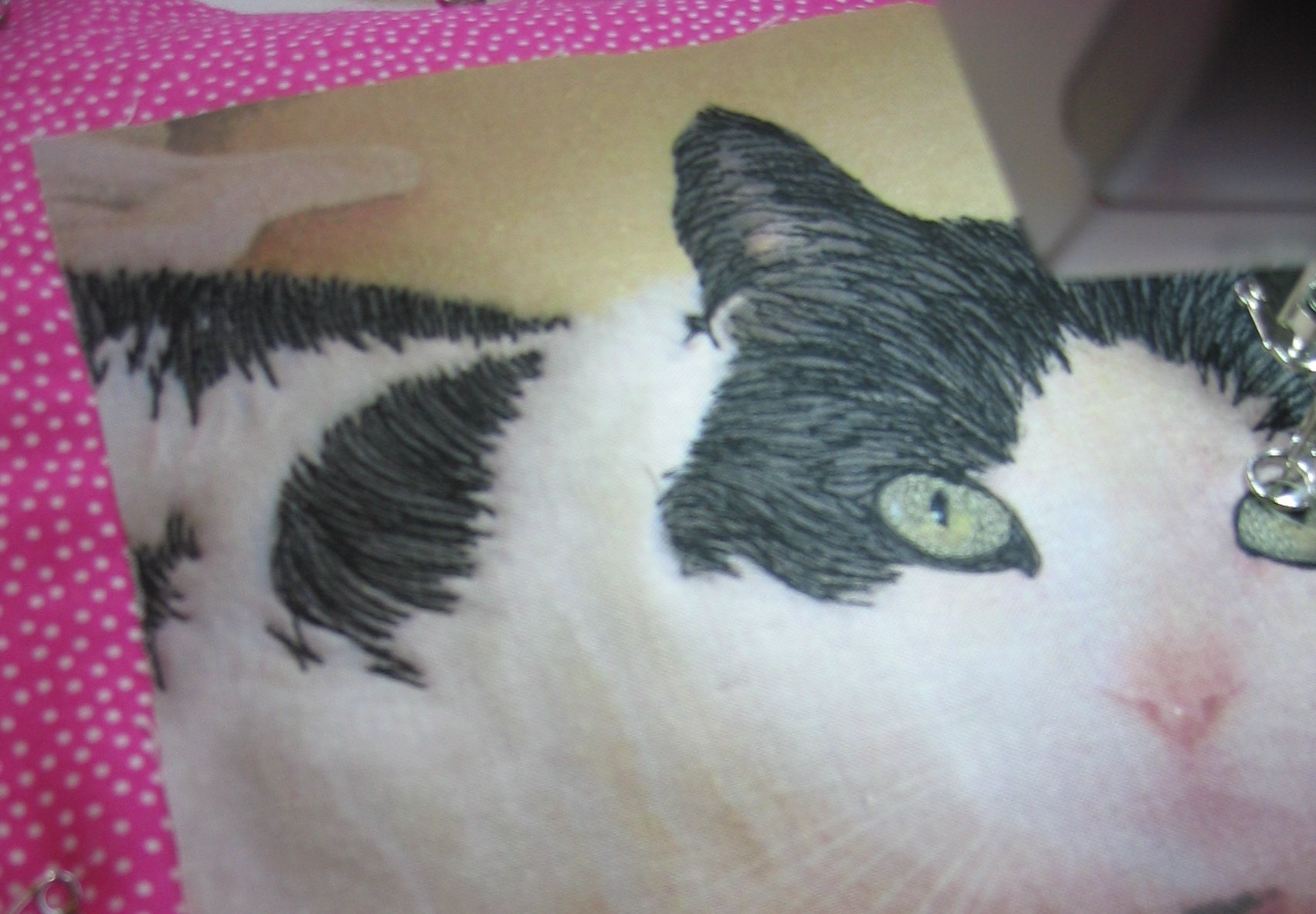
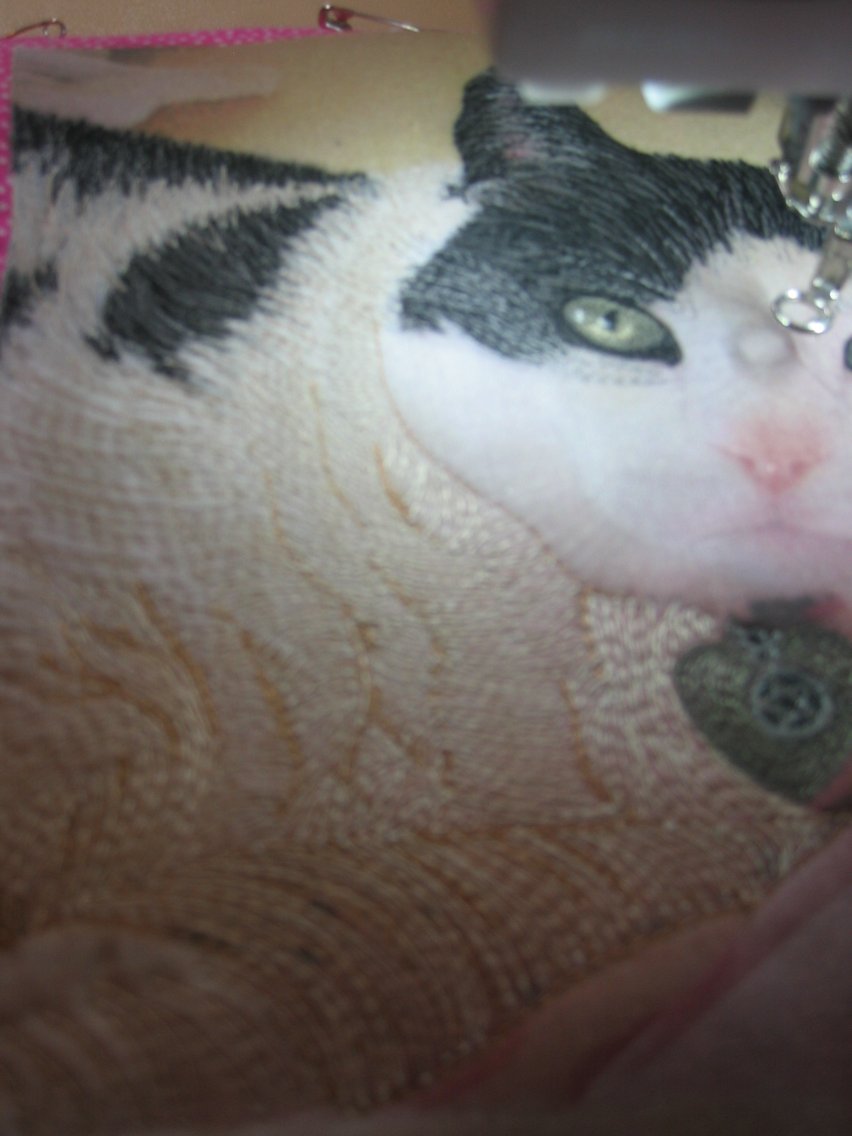
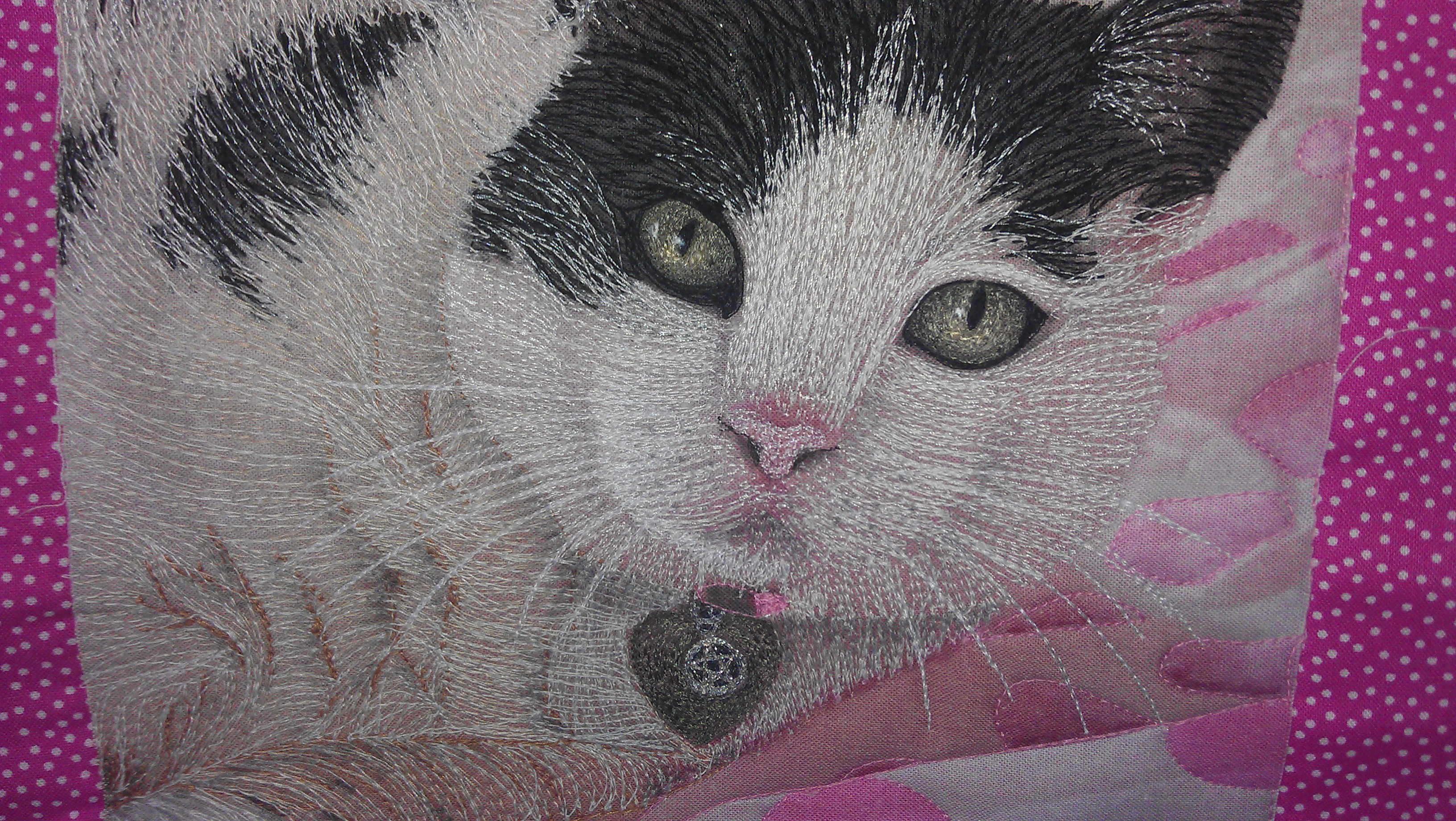
The biggest problem with doing a cat like this was how to stitch the folds of white fur. The black was easy, and the places where the fur laid down in one direction was also fairly easy, but those folds were hard to do. I started off with a soft tan thread, then some grey, then cream and an off white, and after I had finished stitching, I used a soft grey Copic marker to shade the folds a little.

Getting the eyes right was also problematic. I got all the black, grey, and various green colours stitched down, but the eyes were flat/dead. So I added a touch of yellow thread under each iris slit, then a touch of white painted into the centre, and shaded the edges of the eye with the grey Fabrico marker. The eyes then came to life!

I guess I used about 15 or more different shades of thread in this piece, including a metallic silver thread in the neck bauble.

The first photo below is the original, followed by the photos as I progressed. As with the cowboy, once I got into the groove of the stitching, I forgot to stop and take progress photos for each step!

Kassie

Kassi01_IMG_4287

Starting with the black first; black fur is done so now adding more black around the eyes

Kassi02_IMG_4288

Kassi03_IMG_4289

Kassi04_IMG_4290

Nailed those eyes!

Kassi05_IMG_4291

You can see the light tan I used in the folds of fur

Kassi06_IMAG1781

Kassi07_IMAG1782

Kassi08_IMAG1783

Kassi09_IMAG1784

Kassi10_IMAG1785

Kassi11_IMG_4306

Kassi12_IMG_4307

Kassi13_IMG_4308

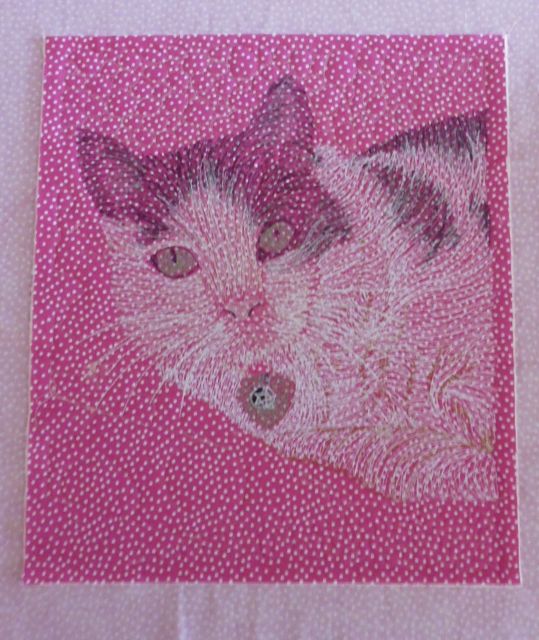
The back:

kassie_back04

See also:


Empty Spools at Asilomar: Tuesday 25 February 2014

26 02 2014

Great work day today. Finished my first cowboy! Luckily I brought along several photos to choose from as I’ve now completed one. I’ll start the next tomorrow. This time I’ll do an animal instead of another portrait, just so I can get help with stitching the fur. (Photos of the cowboy are in yesterday’s post.)

More show and tell tonight, followed by presentations from four of the teachers.

Meals today: breakfast: scrambled eggs and ham; lunch: pepper steak, rice and veges and cauliflower soup (not the pepper steak I was expecting… It was bell peppers with steak, not black or green peppercorns!); dinner: roast chicken, broccoli, and creamy potatoes and apple pie. I’m trying to avoid desserts as there’s SO much food, like tonight we got HALF a chicken EACH. Such a waste of food. I got through a quarter chicken but it was still way too much. I much prefer the way the Texas people do it with a self-serve buffet-style where you can have as little or as much as you’d like. The way they do it here almost forces you to eat more than you should because you know the leftovers will have to be thrown out. Such a wicked waste of perfectly good food all because they over-served you… For EVERY meal.

See also:


Empty Spools at Asilomar: Monday 24 February 2014

25 02 2014

First full day of class today. Pam explained the thread painting process and then we were into it, working straight away on our prepared photo. No practising!!

The basic process with a photo printed on fabric:

  1. Add fusible to the back of the photo, then fuse it onto the background fabric. Make sure you leave at least 4 inches of background fabric around all edges of the photo so you have something to hold onto.
  2. Add batting and backing and pin baste all layers together.
  3. Start with the eyes and the black edges around the eyes. Mark with black pen first,  if necessary, then stitch with black thread.
  4. Finish the eyes with other coloured thread. Get the eyes right first; everything else is easy after that.
  5. Now mark and stitch all other black areas.
  6. Work from dark to light when stitching.
  7. Use short tight stitches and check the fine details  against the original photo.
  8. When stitching, don’t drop the feed dogs, and use both straight free motion stitches as well as zigzag  stitches for the filler areas.

My progress

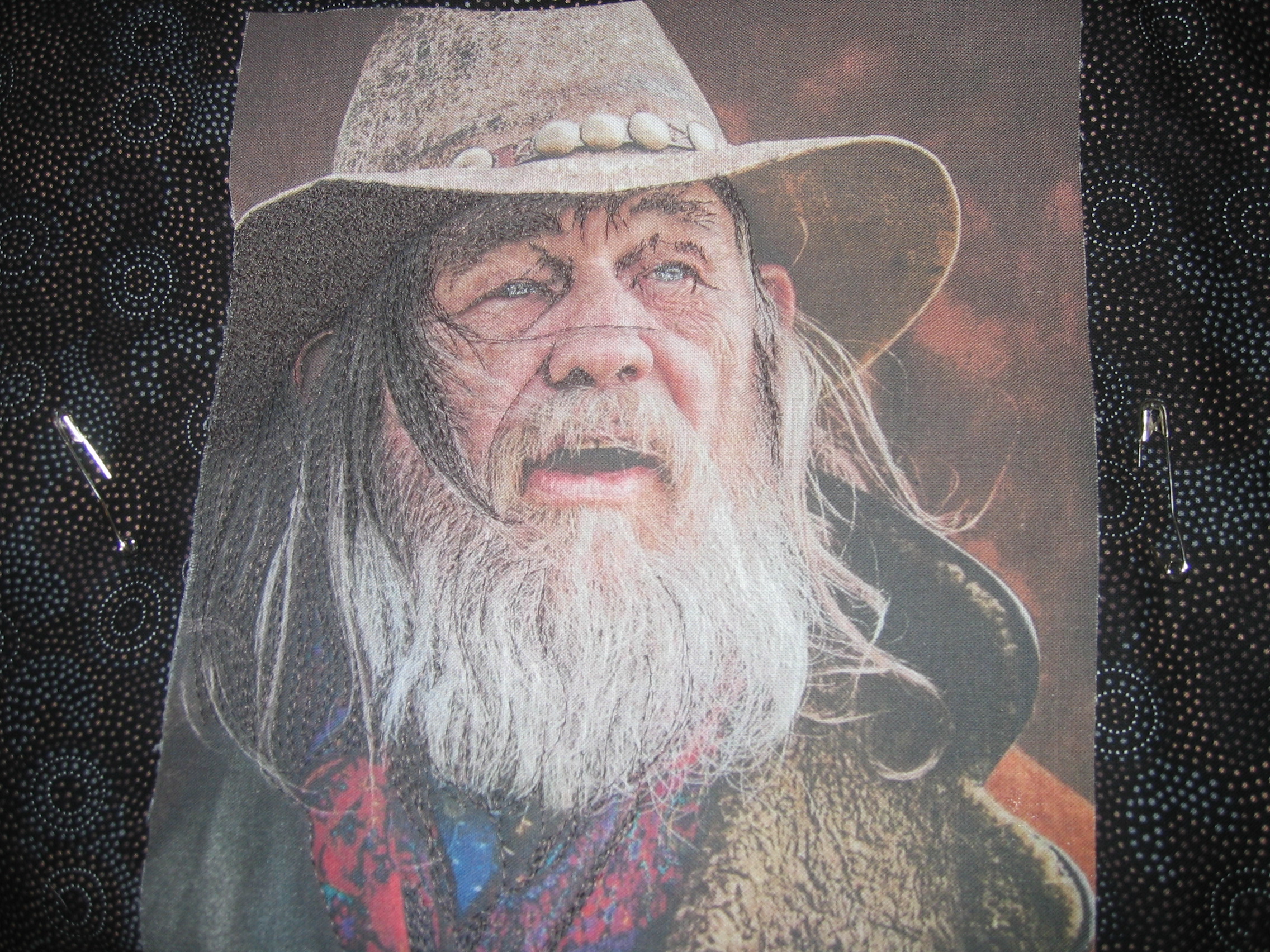
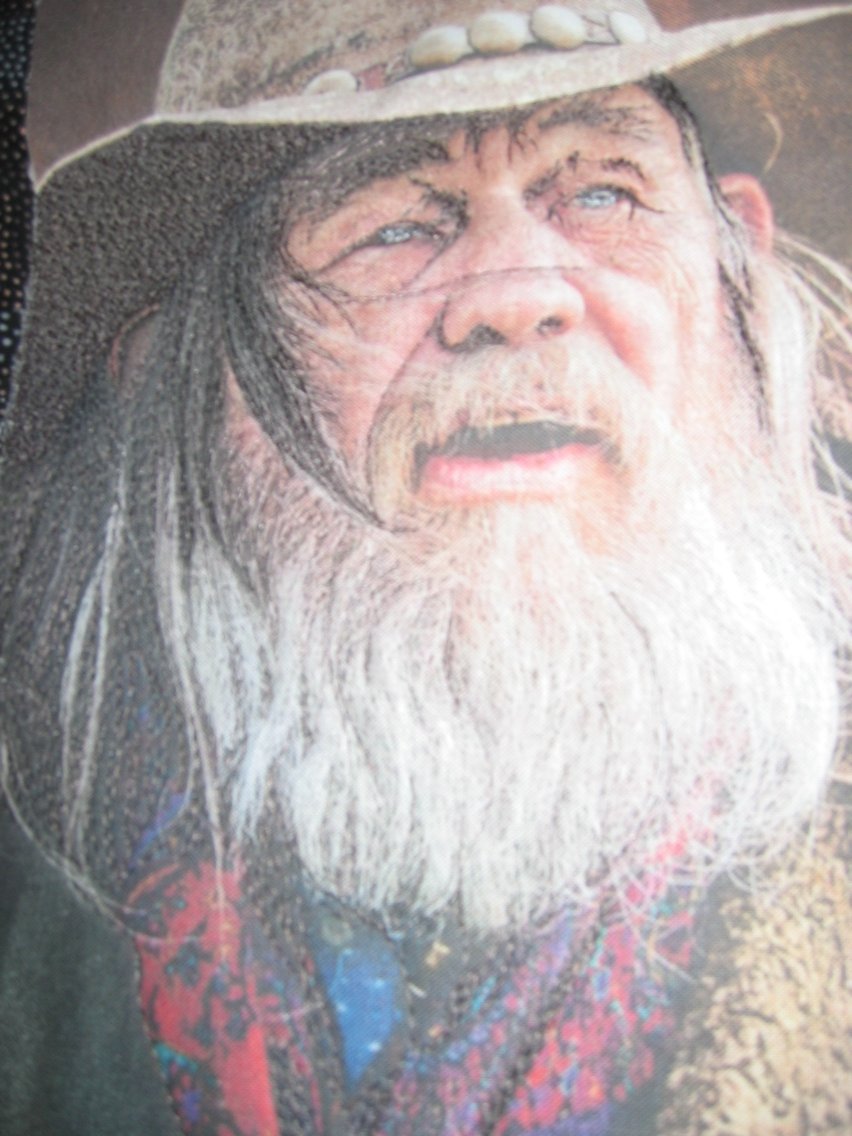
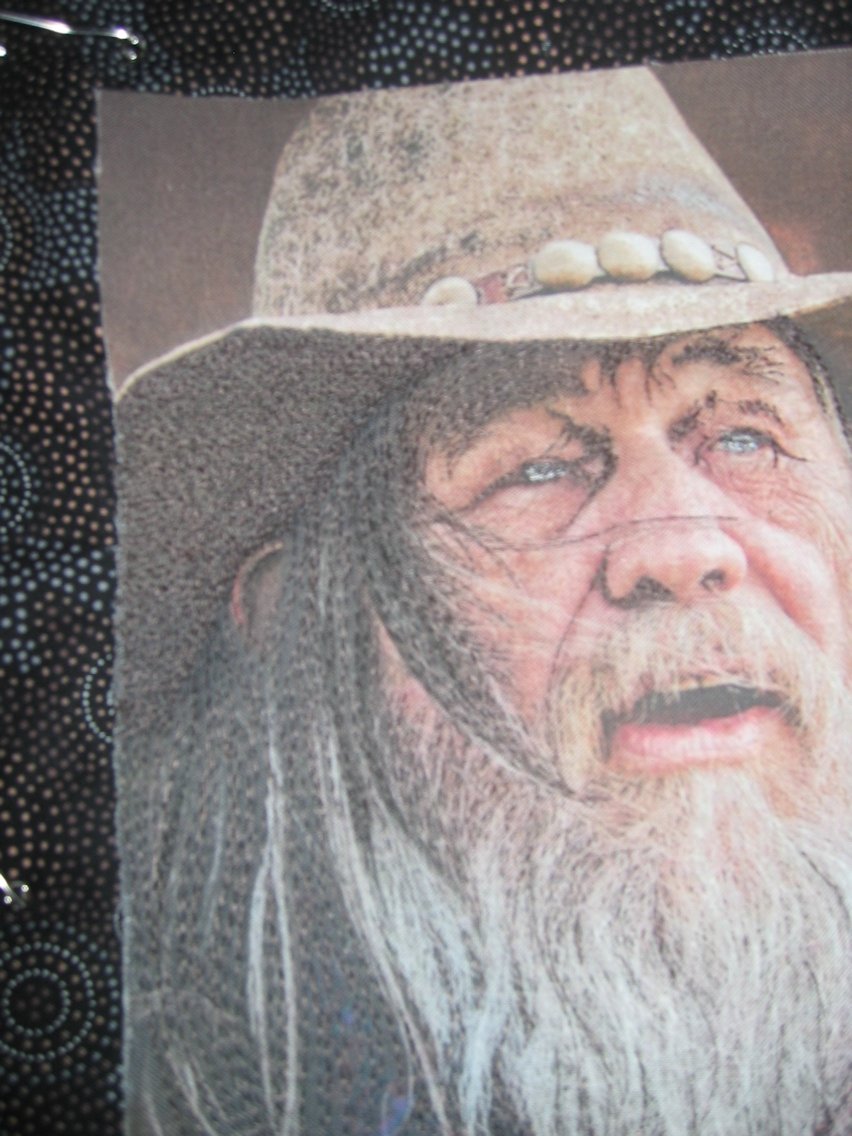
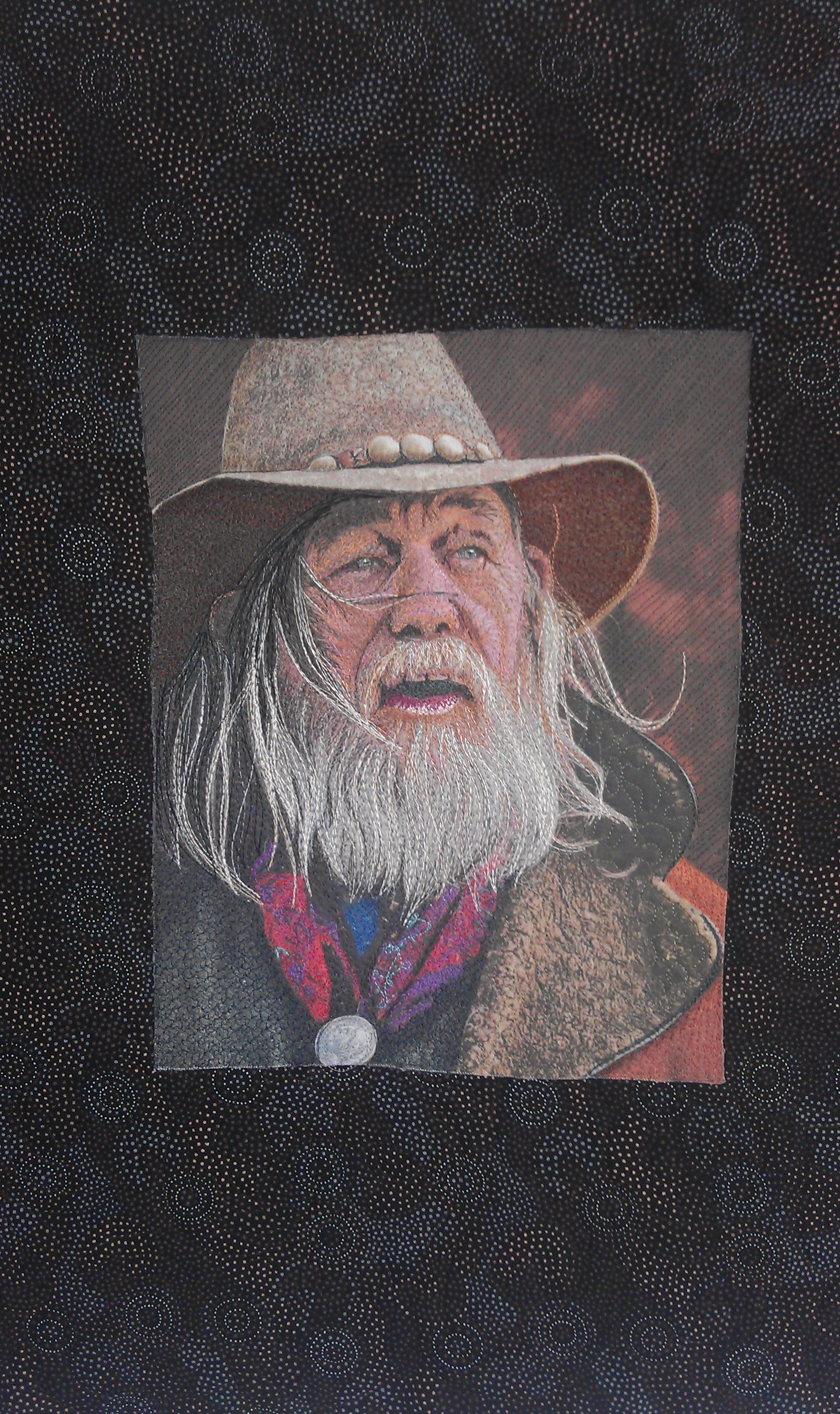
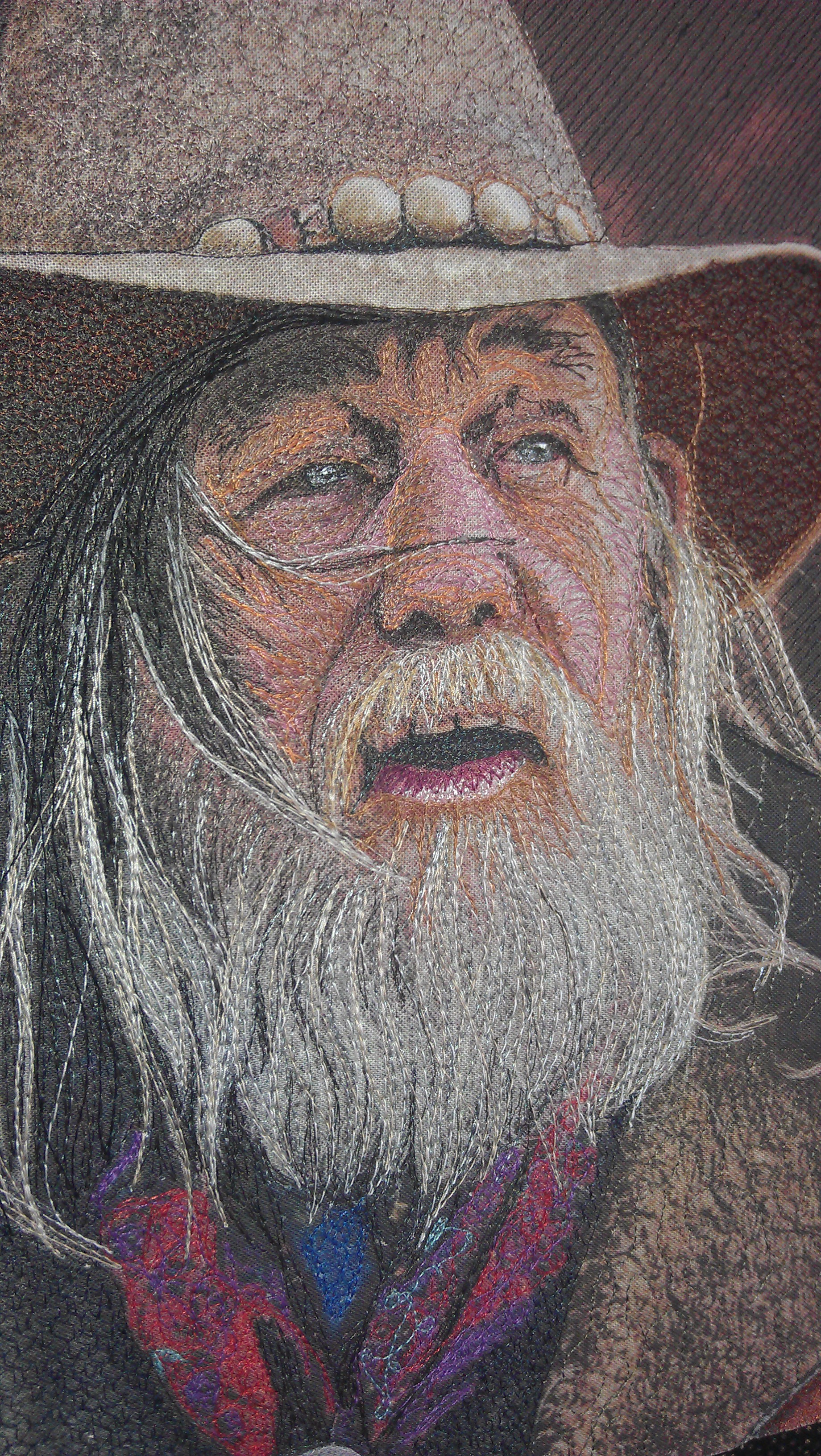
I decided to start with a photo of an old, rugged cowboy (some people thought he looked like Jeff Bridges!). The photos below show the original photo I worked from, and then my progress, from stitching the black of his eyes, hair, hat etc. to adding the pink and tan on his face, the white and shiny grey for his hair, etc.

Cowboy_original

Original photo of the cowboy, who was my inspiration

I used multiple free motion zigzag passes (in different directions) on the underside of his hat and on his vest; meandering stipple on the wool collar of his coat; scribble stitching on the top side of his hat; and straight-ish diagonal lines in black for the background. I also added red, blue and purple scribble stitching to his bandana, and various greys for the silver dollar clasping his bandana. I got up a real rhythm doing his hair and beard, and I guess I used about 15 different colours for those elements. I used about 5 different colours in his face. And I dotted a shine in his eyes with some white paint, using the very pointed end of a bamboo skewer (satay stick).

I finished him early on the second day, but I’ve put all the photos in this post to keep them together and to show the development of his face.

cowboy02_IMG_4259

Stitching the black areas around the eyes first

cowboy03_IMG_4262

Adding more black — eyebrows, hair

cowboy04_IMG_4263

Adding dark brown (especially the underside of the hat), and the grey of the eyes

cowboy05_IMG_4264

cowboy06_IMG_4265

Adding tan to the face and the beard

cowboy09_IMAG1777

Pink added to the face, and all other elements now stitched, including the beard and rest of the hair, and the background fabric (I was so into the process I forgot to take photos of each stage!)

cowboy11_IMAG1779

cowboy12_IMAG1780

cowboy13_IMG_4284

cowboy14_IMG_4285

I finished him when I got home by adding a thin black border around his portrait and a binding in the same fabric as the background.

cowboy01

I then decided to get him valued by my state’s quilt guild. They valued him at $2000! Yes, that’s TWO THOUSAND! And they added a personal note about how much they ‘all loved this little quilt’.

Update May 2014: I’ve had this quilt valued, and the certificate of valuation is below. However the valuation only takes account the materials and techniques used and the quality of both — it takes no account of the time to learn the techniques nor the time taken to make the piece, which can be hundreds of hours.

_Valuation 2014_American_Cowboy

Meals

Breakfast: scrambled eggs with sausage links; lunch: chicken Caesar salad, carrot and ginger soup; dinner: pork loin steak with veges, carrot and walnut cake.

See also:


Empty Spools at Asilomar: Sunday 23 February 2014

25 02 2014

Registration and start of classes today. Fortunately I was able to find Asilomar and check in just after 11am, and orient myself as to where the main halls etc. were in relation to my room, and unpack. I wouldn’t have liked to have left it until 4pm (as suggested in the brochure) as classes started then. As it was,  I left my friend’s house in Monterey at 3:30pm and was pushing to get to registration and to class on time.

I’m in Pam Holland’s group (yes, Pam is a fellow Australian, but I chose her class because of what she was teaching that I wanted to learn, not who she was) and we spent that first session on thread and needles and why she uses what she does. Interesting stuff and I took notes which I’ll add to this blog later when I can type on a proper keyboard and not a tablet.

Dinner was at 6 pm as it will be every night, and was pot roast with rice and veges and a nice dessert cake thing. After dinner we had a general group session in the main hall (Merrill Hall) welcoming us, then it was to bed.

My room is at the top of a bit of a hill and some distance from the meeting hall, dining room, and our workshop room, so there’s a lot walking and lots of steps and stairs. Add to that the bracing fresh air and this could be quite an energetic week!

The only issue I have at the moment is that the place is full of log fires for heating, all of which seem to be going, and the smoke is getting to me.

I won’t post any pictures until I get home as I can’t resize them on the tablet (as far as I know), so you’ll have to live without them for  a while.

Notes from Pam’s initial session:

Thread:

  • Cotton thread has a centre core, and the fibres wind around it with either an S or Z shape twist. With an S-shape twist, when you pull the thread it will bounce back up on release; with a Z-shape twist, it doesn’t bounce back when pulled and released, which is ideal for thread painting. Z-twist threads include Superior Masterpiece, Aurifil, YLI, Madeira, Robison-Anton; S-twist threads include those by Gutermann and Sulky. Silk-finished (mercerised) cottons are fine (e.g. Mettler) as they are coated.
  • All thread weights listed as the same are NOT equal; e.g. Superior vs Aurifil 50 wt — one is thicker than the other and so may need a different size needle.
  • YLI monofilament: Only ever use the first half of the spool then throw the rest away! Superior Masterpiece 50 wt goes well in the bobbin with the YLI monofilament; don’t use mono in the top and bobbin.
  • When using the sewing machine as a drawing tool (i.e thread painting/sketching), use a thread stand — it gives the thread another two feet (~60 cm) to ‘relax’.
  • For thread sketching, have many gradations of one colour in your thread.

Needles:

  • Universal needles are semi-ballpoint needles, which separate the weft and warp of the fabric, resulting in some fraying as it separates.
  • Sharps include embroidery needles, leather needles, quilting needles and don’t separate the fabric as they pierce it. Sharps are good for raw edge applique.
  • Pam uses size 60 needles, which have TINY holes, though she got us to use 70 needles for our work.

Using the markers:

  • User the coloured markers to ‘dye’ the thread AFTER the stitching is done. Dyeing works best on cotton threads, not polyesters, rayons, etc.
  • Use a fine (0.05 mm?) black UniPin marker for the outlines of the eyes and other very dark areas, BEFORE you stitch.
  • The markers she recommends are Fabrico markers (from Tsukineko) — using brush end, mostly. There are many colours, but she said about nine colours are sufficient, and recommends getting the ‘mud’ colours, not the brights for faces, drapes in clothing etc. For the week, we used sand, grey, and an orange marker.

fabrico_marker

Recommendations for thread sketching/painting a child’s face:

  • Print the image out lightly on paper, then shade with coloured pencils to see how to achieve softness.
  • Use less stitching.

Batting:

  • There’s a right and wrong side to batting. Look for the needle punch holes – where they went in is the right side; where they came out is the wrong side.
  • Put the right side facing up when layering top, batting (i.e. right side up), backing.

See also:


Quilt for a 60th

15 02 2014

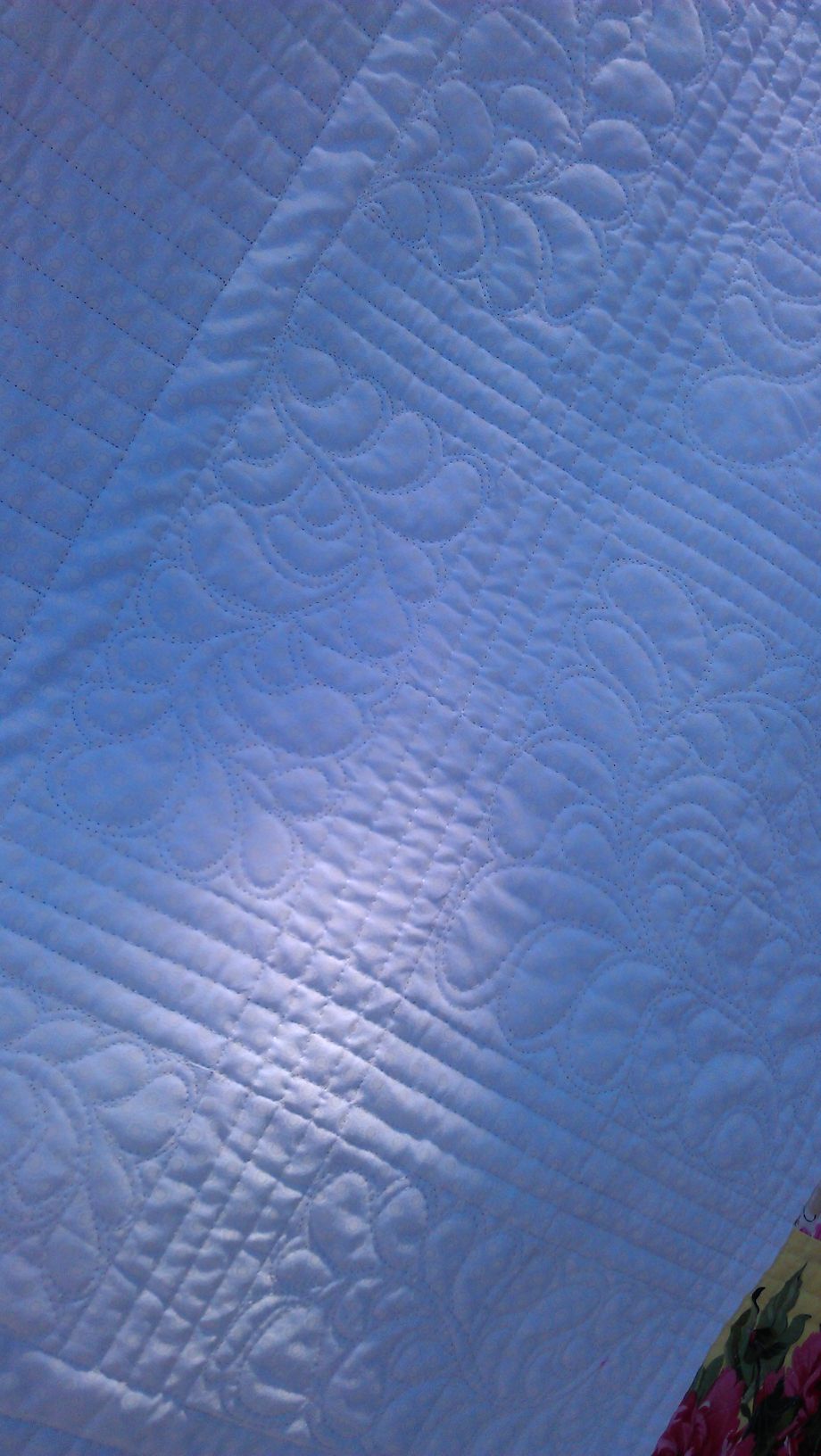
I was asked to quilt a special quilt for someone turning 60 soon. I don’t know the person so didn’t know whether she would be more inclined toward traditional quilting (such as feathers) or more modern quilting (e.g. straight lines). The quilt design leant itself to either — the floral fabrics were quite traditional, but they were set off by white, which is more in line with ‘modern’ quilts. I asked the person who’d given me the task, and she wasn’t a lot of help 😉 — she said the recipient was both traditional and modern, and that if I could combine both styles, that would be good. Hmmm… a challenge…

I started by stitching in the ditch around all blocks and in between the 1″ sashing strips, and did straight ‘piano key’ stitching every half inch on the border fabrics. I did all this stitching in a plain white cotton thread. But what to do in the large floral and white squares? I thought of doing different motifs in each (in different colours), then thought that might be too ‘busy’ — I suspect this is a quilt to be used, not for show. So I decided to go with free form (no marking) feathers, in a soft pink variegated thread.

(Click on a photo to view it larger)

gwen02

gwen05

gwen04

gwen03

Back:

gwen01

Threads used:

  • Top: Gutermann white cotton; Fil-Tec ‘Affinity’ (40 wt trilobal polyester, ‘Mauve’ colour 60149)
  • Bobbin: Fil-Tec Glide pre-wound bobbin (cream)


Orchid art quilt: Finished

13 02 2014

I finally finished my orchid art quilt! Actually I’d mostly finished it a few weeks ago, but had to finalise it by adding a label and prepping it for going into the 2014 Boyup Brook Art Awards. Anyhow, it’s all done now and I can reveal photos of the finished piece.

I started this piece and finished more than 75% of it at the 5-day Quilting Adventures workshop with Velda Newman in Texas, March 2013. That last 25% took me nearly a year!

My friend Wade in California took the photo on which this piece was based. Just a few short months after I started it, Wade’s beloved daughter 19-year-old Evelyn was tragically killed in a car being driven by a drunk/drugged driver. So I’ve named this art quilt in her memory.

Below the photos are my artist’s statement for this work, the original photo on which is was based, and links to the workshop I did with Velda Newman.

The finished piece is 38×39″.

IMAG1674

IMAG1677

IMAG1678

IMAG1676

IMAG1679

IMAG1675

Artist’s Statement

***************

In Memory of Evelyn

The inspiration for this art quilt came from a photograph of an orchid taken by my friend Wade Courtney (California). Shortly after I started this piece, Wade’s beloved only daughter Evelyn (age 19) was tragically killed in a car driven by a drunk/drugged driver. I named this piece in Evelyn’s honour.

I used several techniques in this piece, many of which were taught by renowned quilt artist, Velda Newman, in a 5-day Quilting Adventures workshop with her that I attended in Texas in March 2013. The main flower was a single piece of white cloth that I cut into several pieces and then treated with various paint techniques and paint products, such as artist acrylics, Derwent Inktense watercolour pencils and sticks, and Copic markers.

Surface stitching was done on my Handi Quilter Sweet 16, using threads of various weights, colours, and types—monofilaments, rayons, trilobal polyesters, etc. Much of the surface stitching was completed prior to adding the batting and background fabric, with more done afterwards to add the impression of stems, leaves, and other flowers in the background. I sketched three smaller flowers on white fabric then coloured them with Copic markers, before fusing and machine appliqueing them to the quilt. To finish this quilt, I used a ‘pocket’ technique, where I stitched a backing fabric all round, leaving a small section open to pull the quilt through, before topstitching close to the edge. Some minor quilting was done at this stage to keep the three or more layers together.

Designed and created March 2013 to January 2014

**************

Photo on which this quilt was based

qa_day2_veldaclass00_wade_pink_orchid

See these posts for my progress on this art quilt:


Clutch for an iPad

6 02 2014

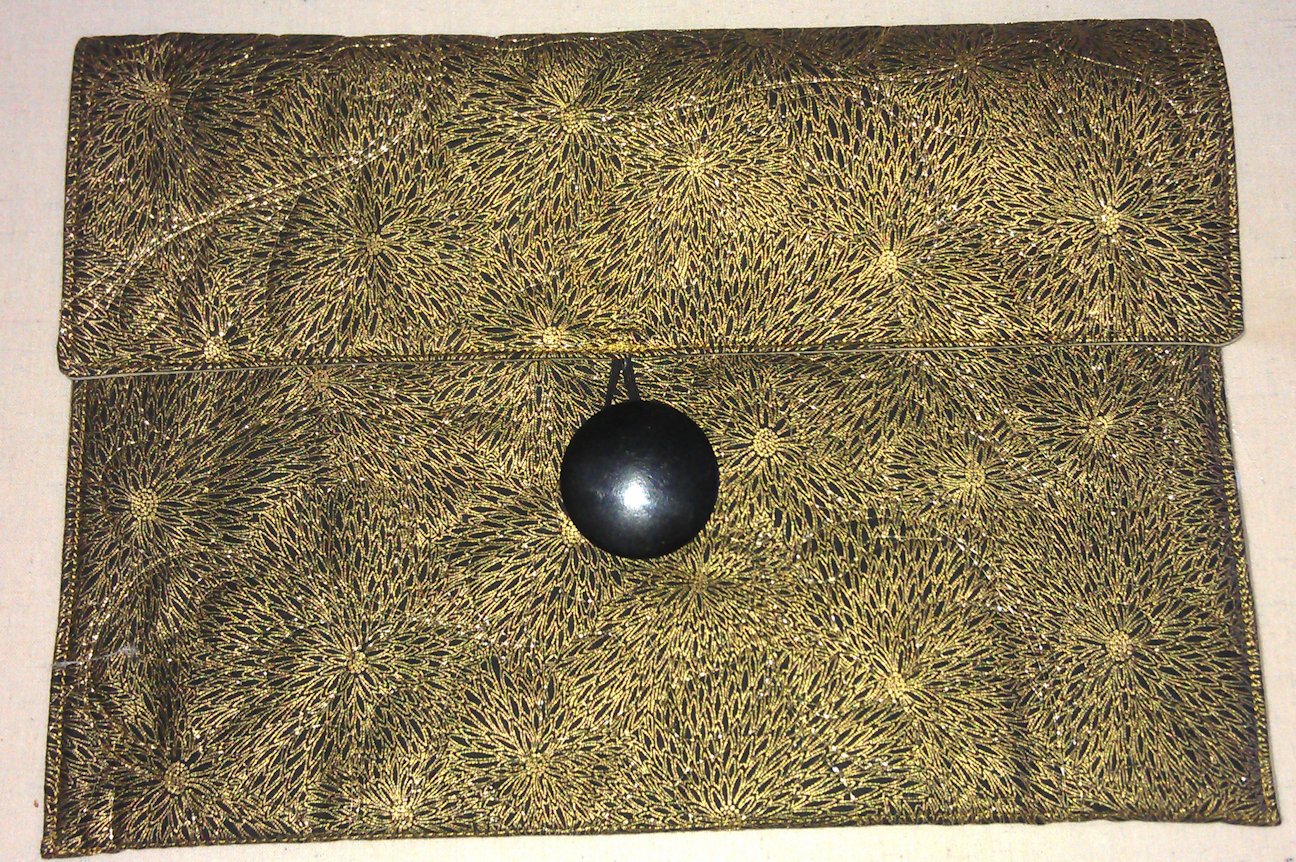
Last month my friend Clare asked me to make an evening clutch for her sister’s birthday present. One like this one in my Etsy store: https://www.etsy.com/au/listing/100227098/clutch-peacock-blue-satin-quilted-with, but it had to be big enough for her sister’s iPad.

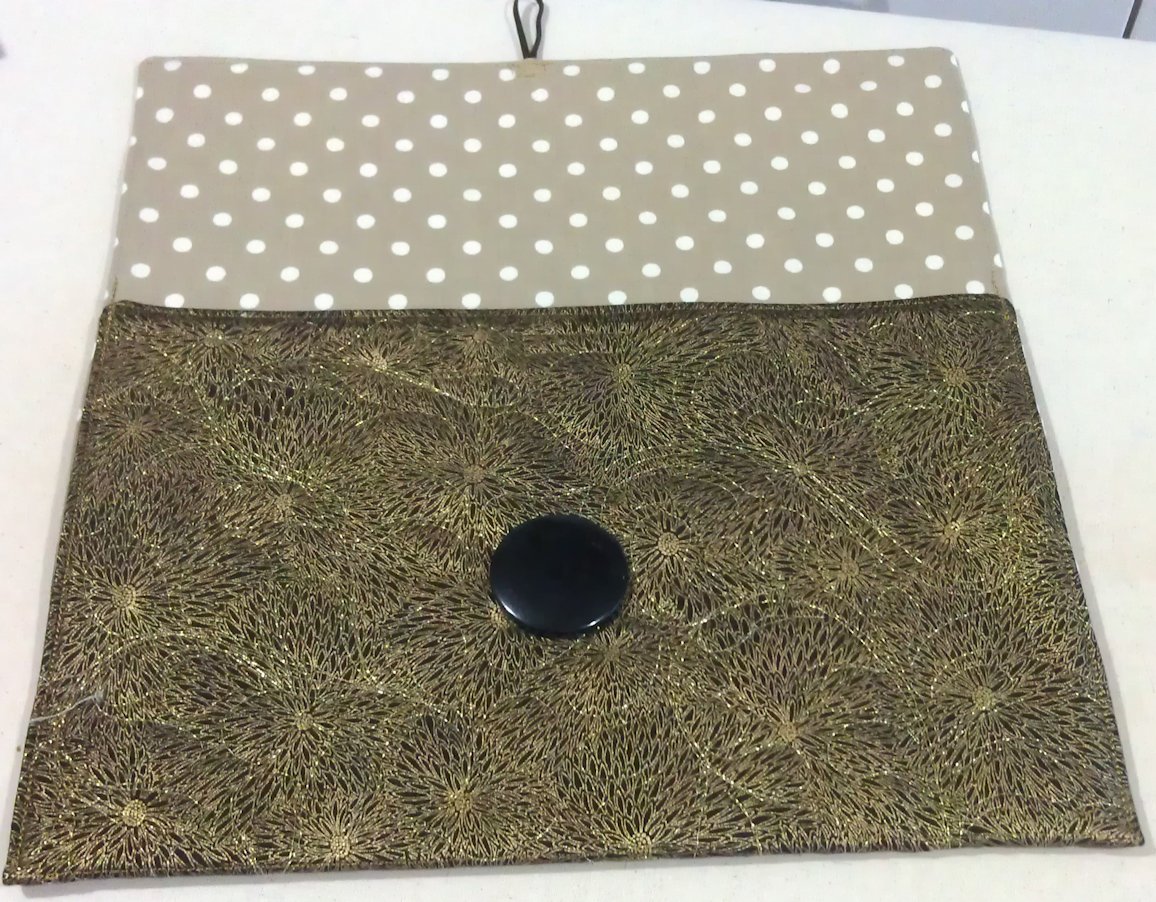
Clare chose one of my fabrics (a black fat quarter with a gorgeous gold flower burst) and I made it in an afternoon. I used a gold metallic thread for the quilting (all-over feathers), and a vintage black button that I *think* was from my grandmother’s stash from years ago.

I chose a lighter fabric for the inside only because there’s nothing worse than being out to dinner, for example, and hunting (in dim light) for something inside a purse that has a black lining!

IMAG1671

IMAG1667

I hope Clare and her sister like it!


Scrappy Quilt: Finished

28 01 2014

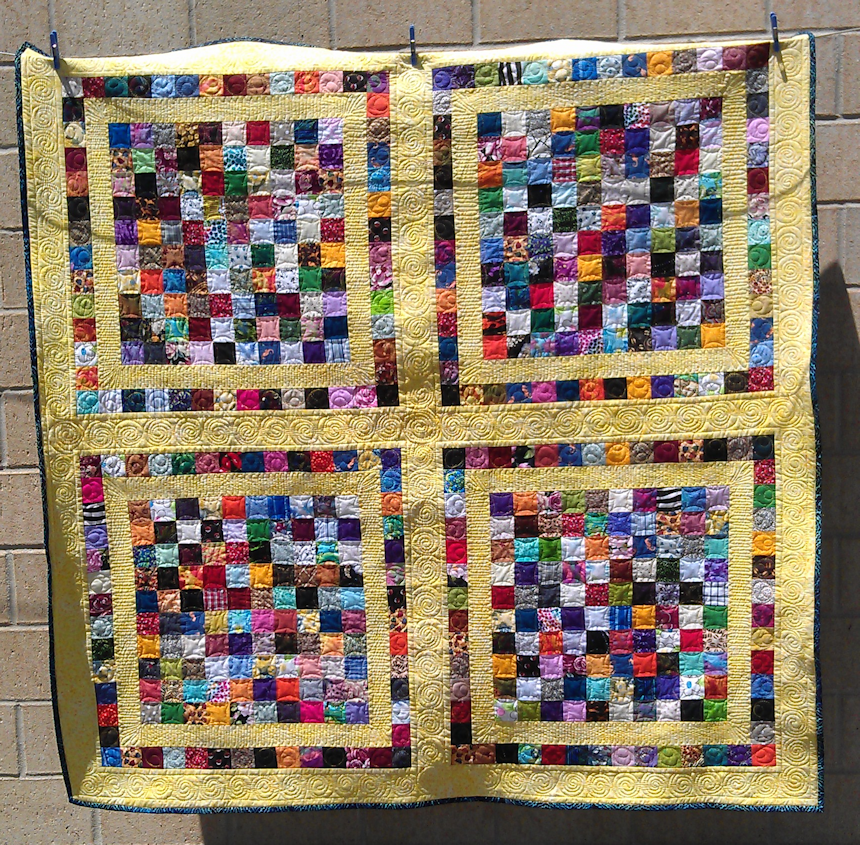
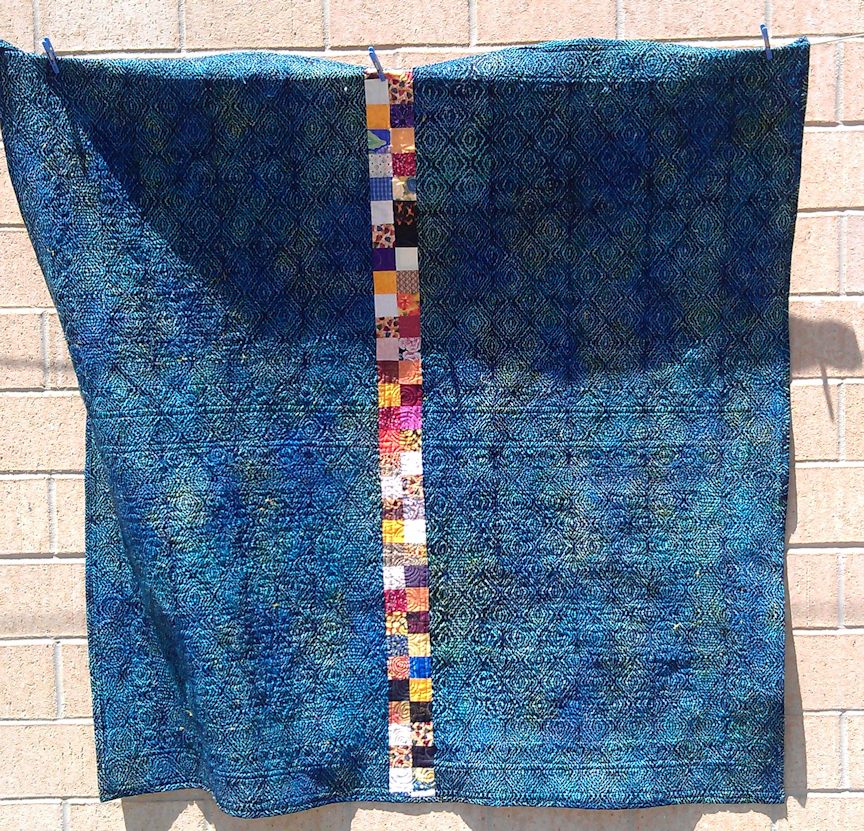
I finished up my scrappy quilt over the Australia Day long weekend. This quilt is for me, and used up lots of 2.5″ squares of scrap fabric. The only ‘new’ fabrics in this quilt were the yellow border fabric and the blue/green backing fabric, both of which I bought in Bali about 18 months ago. I still don’t think I made much of a dent in my scrap stash… 😉

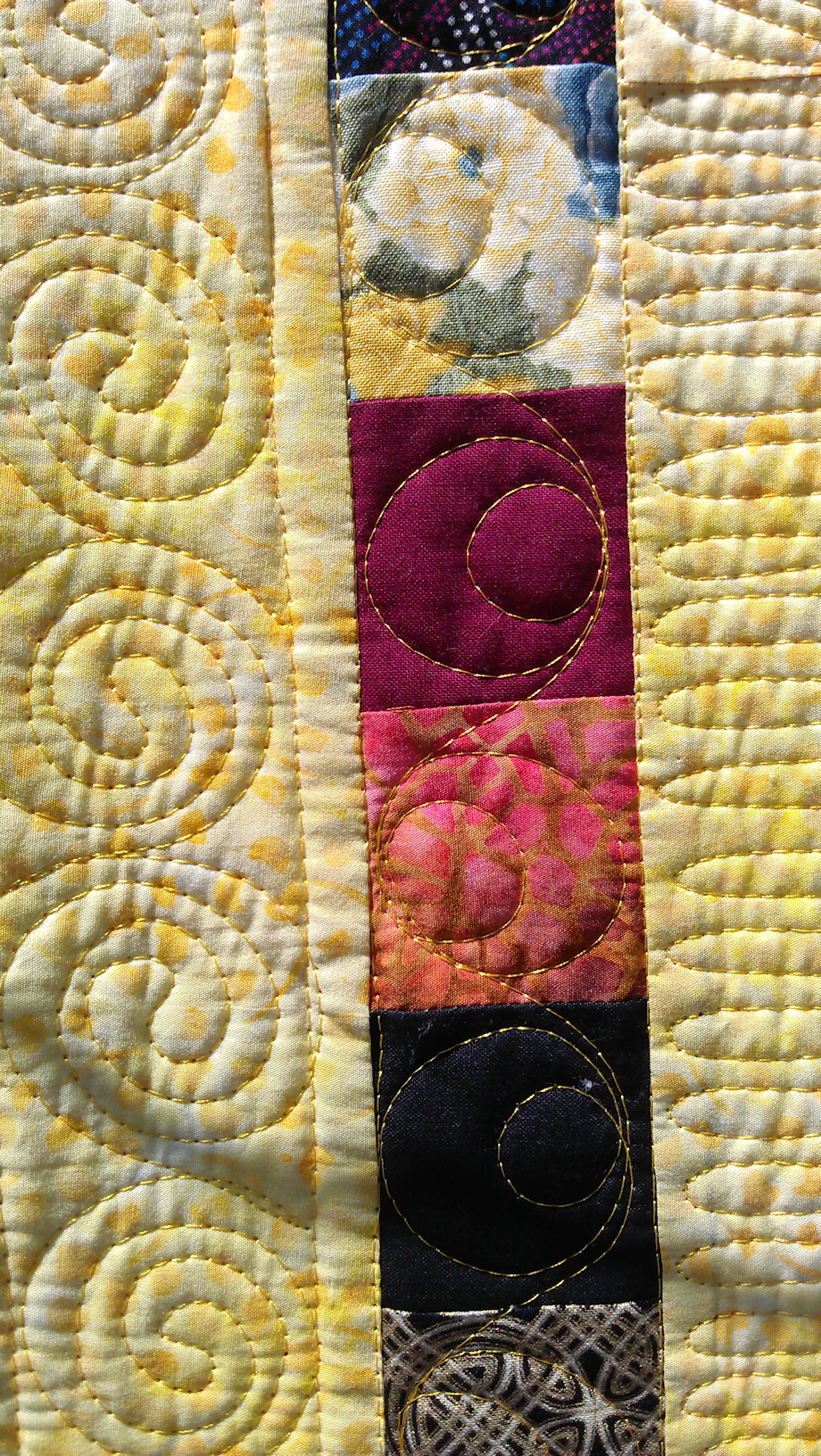
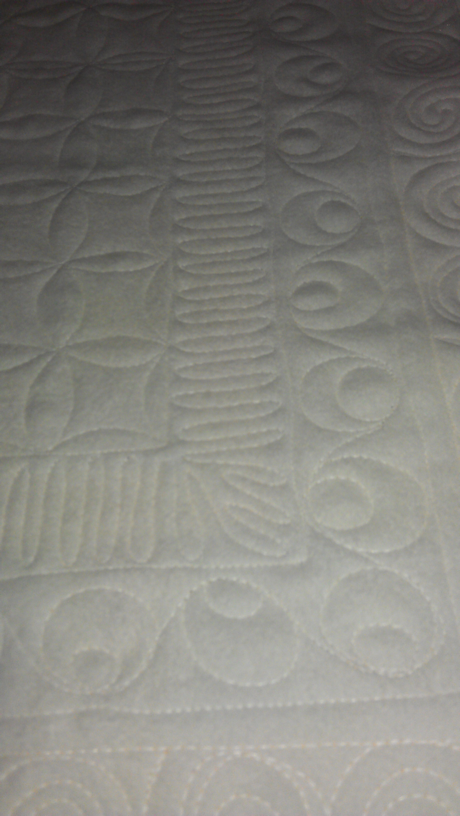
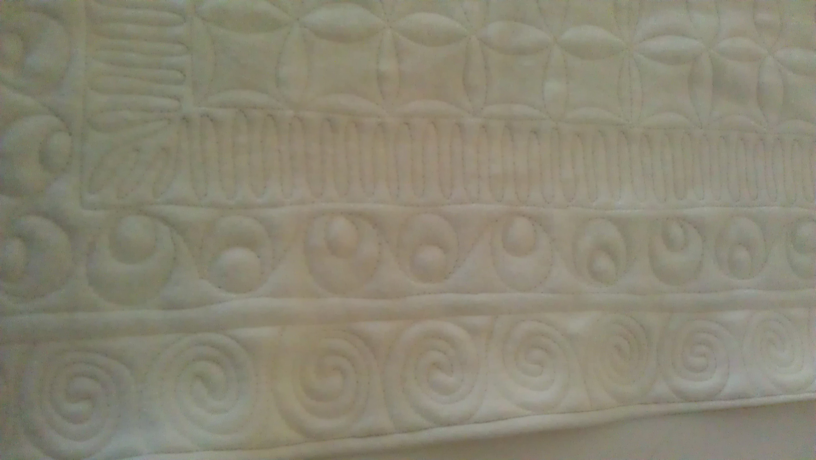
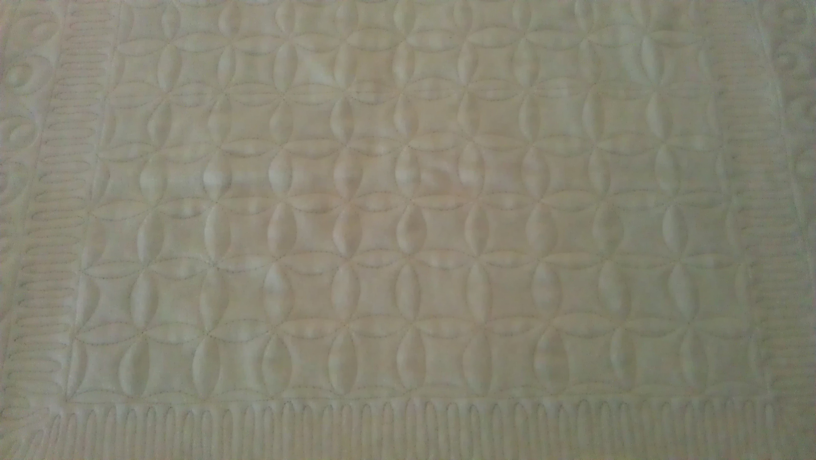
For the quilting, I did cathedral windows in the 100-square blocks, a long U shape in the first yellow borders, a double circle in the border of scrap fabrics, then some spirals in the outer yellow border. I used the same thread throughout. All the quilting, except the stitch in the ditch and the straight lines in the outer border where I used the Line Tamer ruler, was done free motion. No rulers, markers, templates.

On the back, I joined the backing fabric with more strips of the scrap squares, and as I’d made five 100-square blocks, I used the fifth block as my foot warmer pocket — I backed it in a fleecy fabric and quilted it the same as the main quilt. For the binding, I used the same fabric as the backing fabric and I like how that contrasts nicely with the yellow in the borders.

The pattern I used was a free one from here: http://weddingdressblue.wordpress.com/2011/07/06/100-patch-quilt-tutorial/
Click on a photo to view it larger.

scrappy_front03

scrappy_front01

scrappy_front02

scrappy_front04

Back: First photos without the foot pocket attached

back02

back01 back03

The back (inside) of the foot pocket on the back:

foot_back01

foot_back02

foot_back03

foot_back04

Threads used:

  • Top: Fil-Tec Glide ‘Mango’ (40 wt trilobal polyester, color 80116)
  • Bottom: Fil-Tec Glide pre-wound bobbin (white)


Spoonflower order has arrived!

25 01 2014

I’m attending an Empty Spools workshop at Asilomar, Pacific Grove, California next month, and one of the supplies I needed to have was a photo of a person’s face printed onto fabric. I don’t have an inkjet printer or the required ‘fabric paper’ so I asked the tutor if I could use Spoonflower and get my photos printed that way. She said that was a good idea.

So I gathered together about eight different photos of people (and one dog and one cat!), put them into a single image file, then ordered a yard of Kona cotton fabric from Spoonflower, which contained all the portraits as about 8×10 printed photos. I placed my order on January 6, Spoonflower told me they’d printed it by January 9, and were shipping it on January 10. It arrived at my PO box sometime between 21 and 24 January, so I’ve received it well before I need it late next month.

It has a lovely ‘hand’, so hopefully will stitch really well.

I won’t post a photo of the yard of fabric until after I’ve started the workshop 😉


Easy cathedral windows quilting motif

19 01 2014

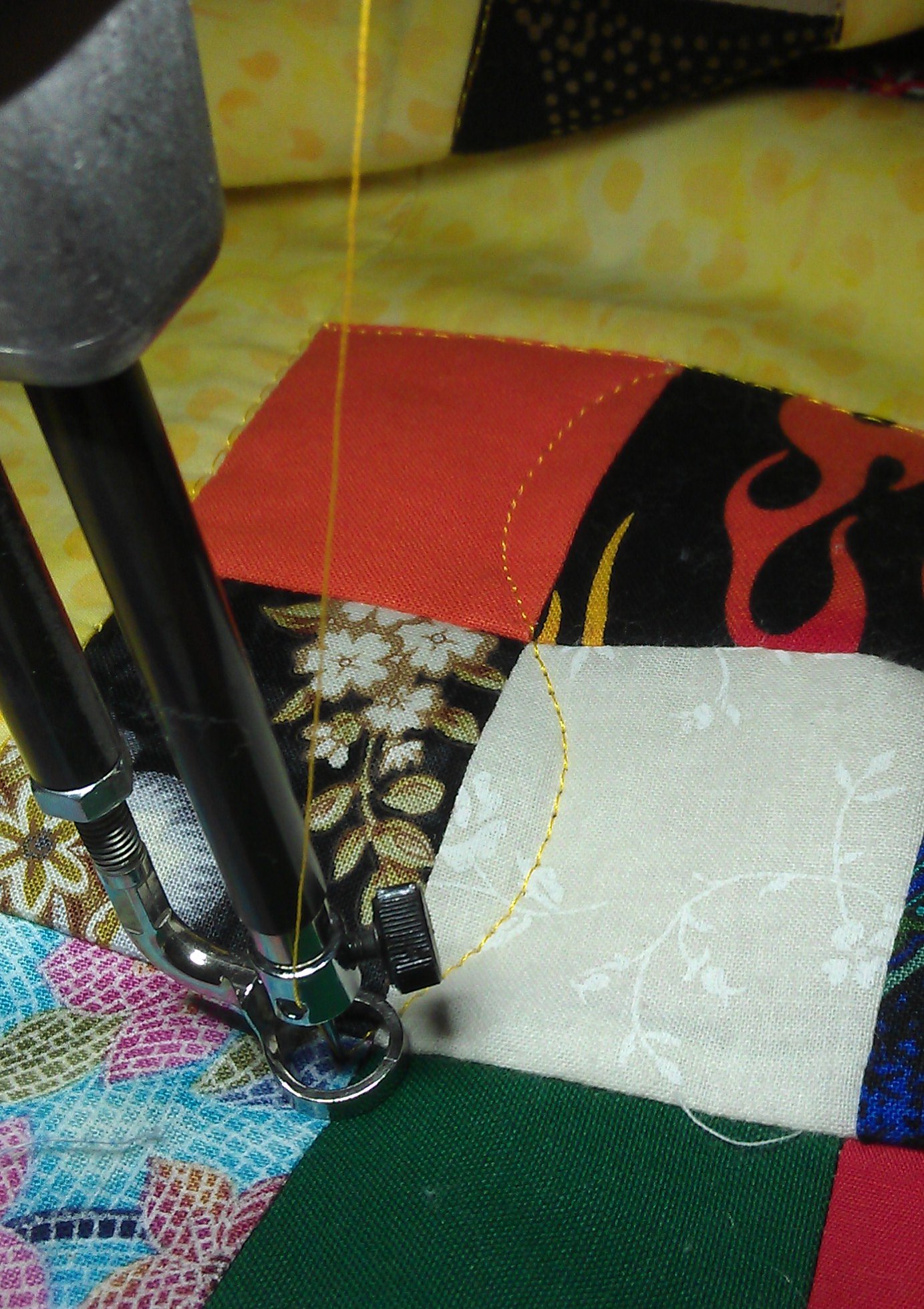
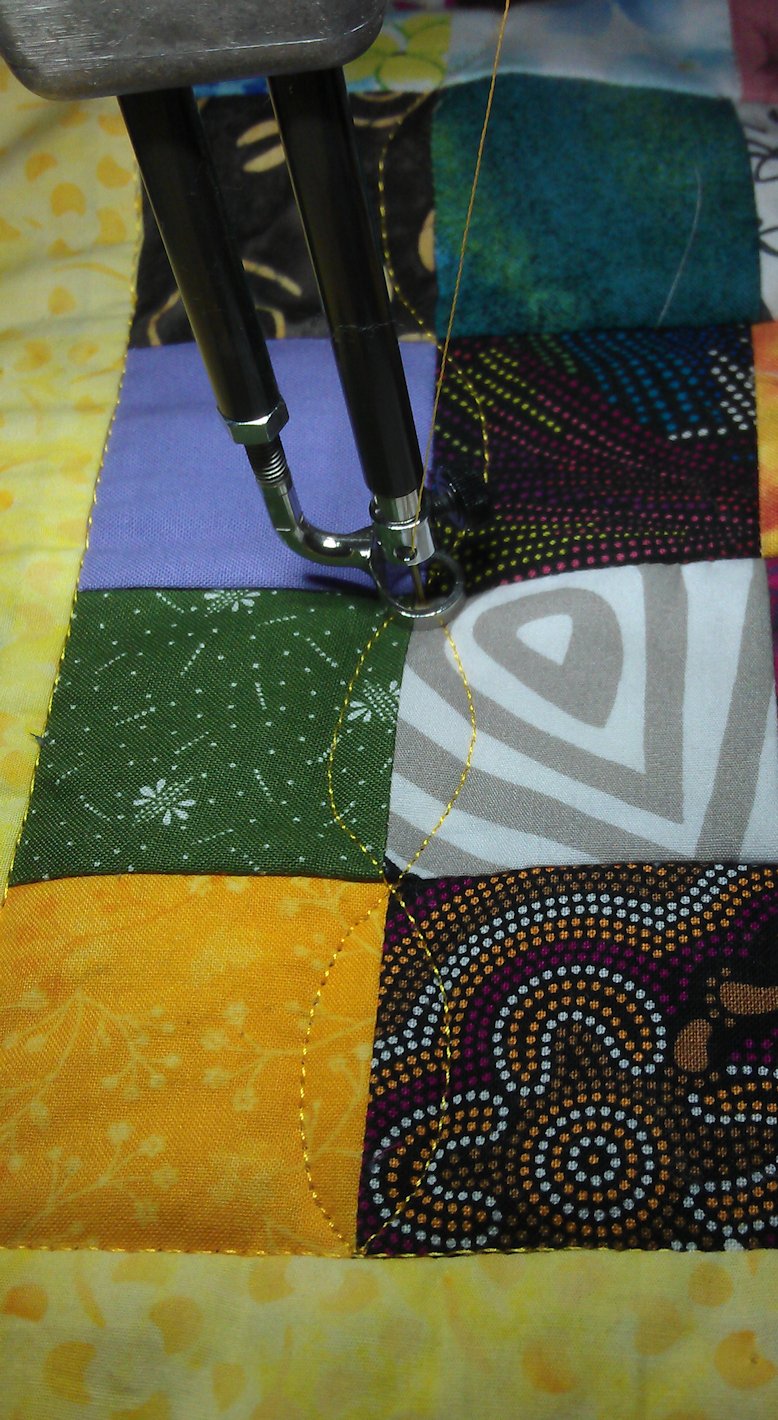
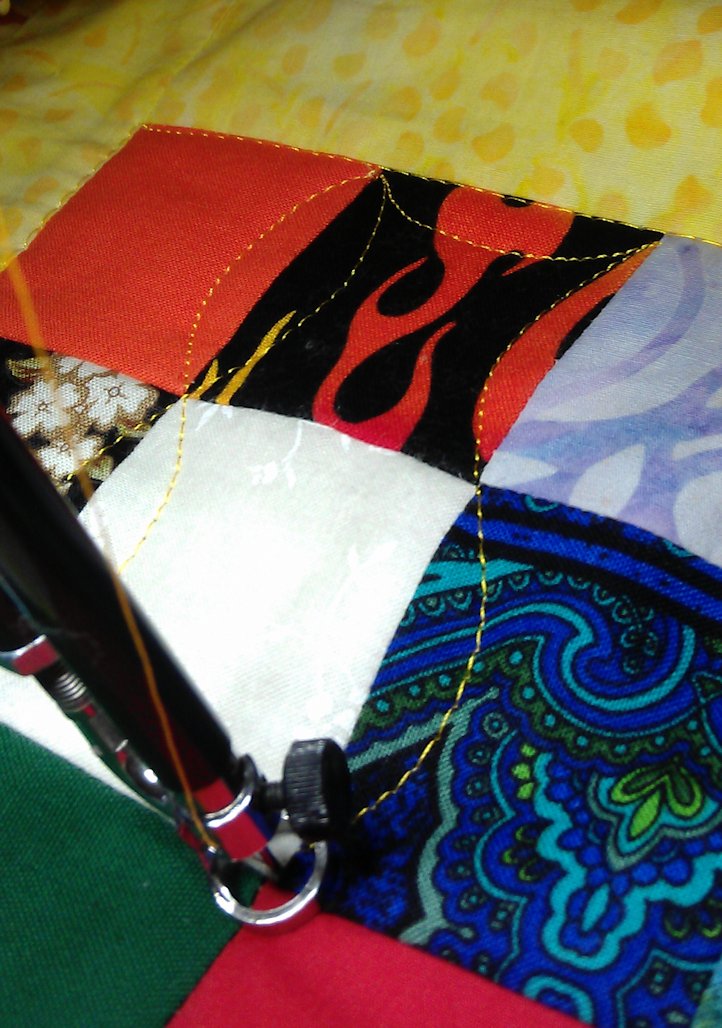
I have LOTS of 2″ squares in my scrappy quilt — probably about 500. As all the fabrics are a mixed bag (batiks, cottons, fabric from old clothes, cheap fabrics, expensive fabrics, stiff fabrics, fraying fabrics, etc.), I wanted to stitch a quilting design that held them all down as much as possible and that secured the seams and joins as far as possible, while also creating a rounded effect against the stark geometry of the squares. I decided on the cathedral window quilting motif (shown finished below), and took photos as I went to explain how to do it super simply.

IMAG1685

What I like about this motif is that you get all sorts of sub patterns within it — you get circles, semi circles, flower shapes, and curved diamonds all in the one pattern!

While I could have used rulers to create the arcs, I would’ve spent many hours quilting each block and likely getting frustrated if the rulers moved a little. This quilt is for me to use — it is NOT a show quilt — so my arcs didn’t have to be perfect. The method I describe and illustrate below took me about 15 minutes to stitch in one continuous line — that’s 15 minutes per 1100-square block. And to be honest, the effect is just as dramatic as ruler work if you don’t look too closely 😉

The essence of this motif is the ‘S’ curve — if you can free motion stitch an ‘S’ curve you can do this!

How to create your own cathedral windows:

  1. Start at the top of a block of squares — I started one square in from the edge of the block.
  2. Stitch an ‘S’ curve with the centre of the ‘S’ going through the seam join. I tried to make my curves between 1/4 and 1/2 inch at the fattest point, and arcing relatively evenly throughout the curve. But don’t beat yourself up over this — it doesn’t have to be perfect as the end result still looks good. Just go with the flow of the ‘S’ curve.
    IMAG1681
  3. Repeat the ‘S’ curve motif all the way down to the bottom of the column of squares.
  4. When you reach the bottom, come back up the column stitching ‘S’ curves in the opposite direction.
    IMAG1682
  5. You’ll end up with small ovals with pointed ends (like little footballs).
    IMAG1683
  6. You end up where you started so stitch an arc across to the top of the next column and repeat the ‘S’ curves going down and then back up.
    IMAG1684
  7. When you’ve finished all the ‘columns’, arc down to the rows and stitch ‘S’ curves across all the rows. Turn the quilt if you find it easier to stitch up/down than left/right.
  8. Stitch an arc at the end of the row down to the next row and repeat….
  9. Repeat until you get to the bottom of the block, then stitch arcs across the bottom and up the left side until you get back to the beginning.

And you’re done! Cathedral window quilting the easy way.

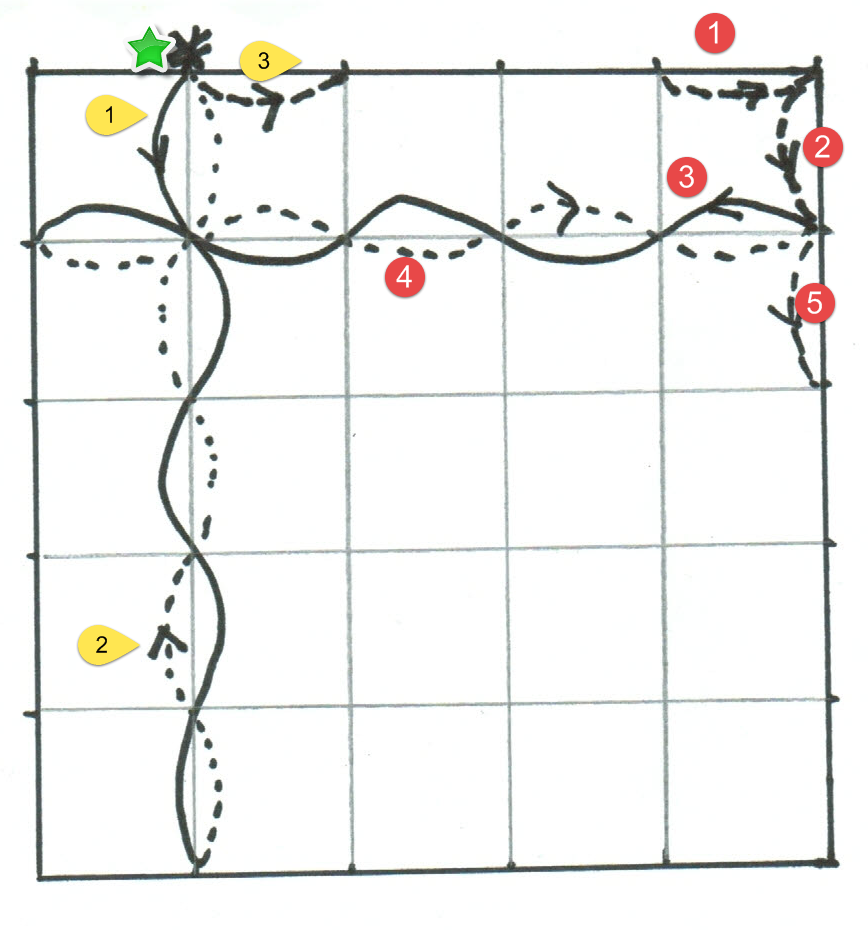
Here’s a diagram in case you learn better this way or want to practice with pen and paper first (explanation below the diagram; the arrows show direction):

grid02

  1. Start at the green star position.
  2. ‘S’ curve down the column (solid line with yellow ‘1’ in the diagram).
  3. Come back up the column in the opposite ‘S’ curve direction (dashed yellow ‘2’ in the diagram).
  4. Stitch an arc to the next column (yellow ‘3’).
  5. Repeat steps 2 to 4 for all columns (NOT shown on diagram).
  6. When you’ve finished the columns, stitch an arc to the edge of the block (red ‘1’ in the diagram).
  7. Stitch another arc down to the first row (red ‘2’).
  8. Stitch an ‘S’ curve along the first row (red ‘3’; solid line).
  9. When you get to the end of the row, stitch back in the opposite direction (red ‘4’; dashed line).
  10. At the end of the first row, stitch an arc down to the next row (red ‘5’).
  11. Repeat for the rest of the rows (NOT shown on the diagram).
  12. At the bottom, stitch arcs all the way along the bottom, then up the left side (NOT shown on diagram), back to the start position (green star).