Laundry observations in an Australian summer

24 12 2022

There are a LOT of things I hate about an Australian summer, not least of which are the relentless heat, the hot easterly winds coming from the inner part of the continent, the flies, and the always-present threat of bushfires. But one of summer’s joys is hanging the washing on the line and it being dry by the time the second load is ready to go out. Then bringing in the washing and smothering your face into the smell of the sun and fresh air that lingers for hours in the towels etc. Burning your hand on the metal spring in the pegs isn’t so wonderful, however! (guess who left the peg bucket outside in the sun for 30+ minutes this morning?)

For those living in other climes, nearly every Australian who lives in a house with a backyard has a clothesline, even if they also have a dryer. And when the weather’s fine and if we have the time to do so, we peg out our laundry to dry in the sun. I realise this may seem like an old-fashioned novelty to many of my friends and family in other parts of the world, and it certainly isn’t recommended if you live in a cold climate (when I lived in Canada, I recall naively pegging out my clothes on the outside line when it was -5C — they didn’t dry, instead they froze 🙂 )

I also remember living up north (particularly the Pilbara region of Western Australia) and there we had two big issues with laundry. One was that the cold water was often hotter than the hot water! (In those days, the cold water was piped to the town across about 20+ miles in aboveground pipes.) And the other was that in the hottest time of the year we had to hang our laundry out at night to avoid bleaching and rotting from the harsh sun.

BTW, we’ve never owned a dryer in the house where we’ve lived for the past 13 years—we hang out our washing all year round. There’s rarely a run of more than a few days a week of wet weather in the middle of winter. The clothes take longer to dry in winter, but invariably they do, or we help them along by hanging them over a portable clothes rack in the house.




Firefighting aircraft call signs (southwest Western Australia)

13 12 2022

It’s bushfire season and already the firefighting aircraft have had their work cut out for them.

This post is for me to save me having to click on all the call signs on FlightRadar24:

  • BDOG125, BDOG642, BDOG646 – spotter planes?
  • BMBR132, BMBR139 – Hercules C130 (the big ones!)
  • BMBR605, BMBR608, BMBR611 – yellow air tractors
  • DUJ – yellow air tractor
  • EGU – helicopter, possibly a spotter
  • FBIR661, FBIR662 – helicopters
  • FCO, FCU – yellow air tractors
  • FNE – yellow air tractor
  • N260UH – Sikorsky Blackhawk helicopter
  • NID – yellow air tractor
  • PEK – yellow air tractor
  • PKAR644 – spotter plane?
  • SPTRxxx – state government (spotter?) planes, likely used by the DBCA and/or DFES

Other aircraft:

  • FDxxx – Royal Flying Doctor (planes and helicopters)
  • RSCxxx – RAC rescue helicopter


Directory of Western Australian teachers, 1900-1980

9 12 2022

As part of researching my family history, I use quite a number of online resources (this post on my professional blog lists the main ones: https://cybertext.wordpress.com/2022/07/24/family-history-resources-i-use/).

One I’ve used a lot is a digital database of Western Australian teachers from 1900-1980 (https://www.carnamah.com.au/teachers). Why? Because quite a number of my extended Western Australian family were teachers, including me and my mum. Back in the day, this directory was published each year, with several copies delivered to each public school in the state. We called it ‘the stud book’! And we used it back then to see where our colleagues had been posted, check their qualifications and years of service (if we were competing for seniority-based promotion), even their middle names and the married names of the women (many married locally and didn’t leave the town, so they’d appear in the stud book the following year under their married name). It was a valuable resource then, and it still is. Either in the 1980s or by the early 1990s the Education Department of the day either decided to no longer publish it as a printed book, or not distribute it so freely to schools, or went digital with this information (if it was digital, it wasn’t available to teachers in schools). Whatever the reason, the stud book seemed to disappear from schools. I taught until early 1992, and as I was a teacher-librarian, I was the custodian of many years of stud books in my school (available to the staff only, not to students), but I know in the last few years I was there we didn’t get the annual stud book.

So I was delighted to discover a fully searchable database of all the stud books from 1900 to 1980 on, of all places, the Carnamah Historical Society and Museum’s website. Why was this surprising? Well, for those who don’t live in Western Australia, Carnamah is a dot on the map in the central wheatbelt (the town’s Wikipedia entry is correspondingly tiny, but the link from there to the Wikipedia entry for the historical society uncovers a wealth of information: https://en.wikipedia.org/wiki/Carnamah_Historical_Society). Carnamah is about 200 km north of Perth and has a population of around 400 people. So why did Carnamah do this and who was the driver for it? It would’ve taken many many thousands of hours of scanning and typing and editing the data—there is no easy way to get those hundreds of pages (all in a tiny font size and with deep gutters in the books) each year into a digital form, and I’m sure the state Education Department wasn’t willing to share any digital information, assuming they had it.

I still don’t know who the driver is for this most useful website (they aren’t resting on their laurels either—they recently added 80,000+ records of Western Australian car registrations from 1915 to 1928: https://www.carnamah.com.au/car-registrations), but I had occasion to contact them recently. Back in the late 1940s my mum was a ‘monitor’ at Carnamah Primary School and she had some photos from that time that I shared with the person who looks after their Facebook page and website. In my email to him I congratulated him and the historical society on making the old stud books available as a searchable database. He shared back this information:

The school teacher index was a slow burn but we got there. We were assisted by Work for the Dole participants at a number of locations across metro Perth.

What a fantastic use of resources! And what a fantastic resource freely available to anyone in the world. Well done, Carnamah Historical Society.


Goodbye, ancient one

28 10 2022

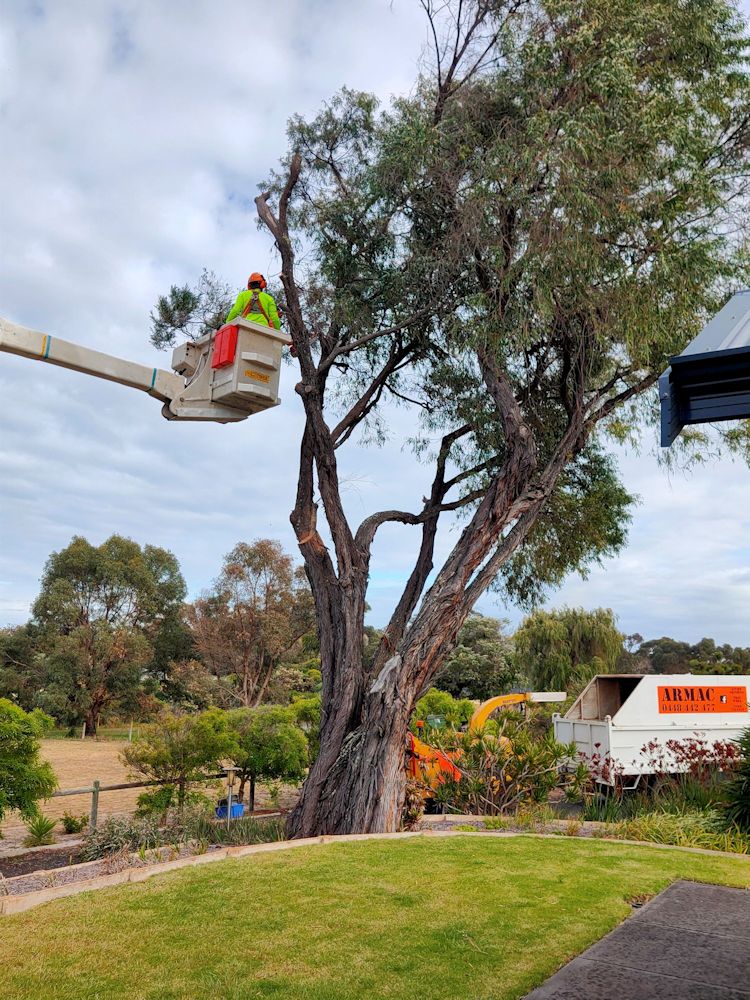
We’ve had an old peppermint tree (Agonis flexuosa) growing on our property, likely for many generations. But it’s had, and has caused, some problems—the most recent was a tree limb snapping off without warning and landing on the driveway, and previous to that, termites, and branches overhanging the house. We’ve had the overhanging branches lopped several times and had treated the termites. This is the only tree close to our house and it’s many tens of thousands of dollars cheaper to lop a few limbs every few years than to replace an entire smashed corner of a double-brick house!
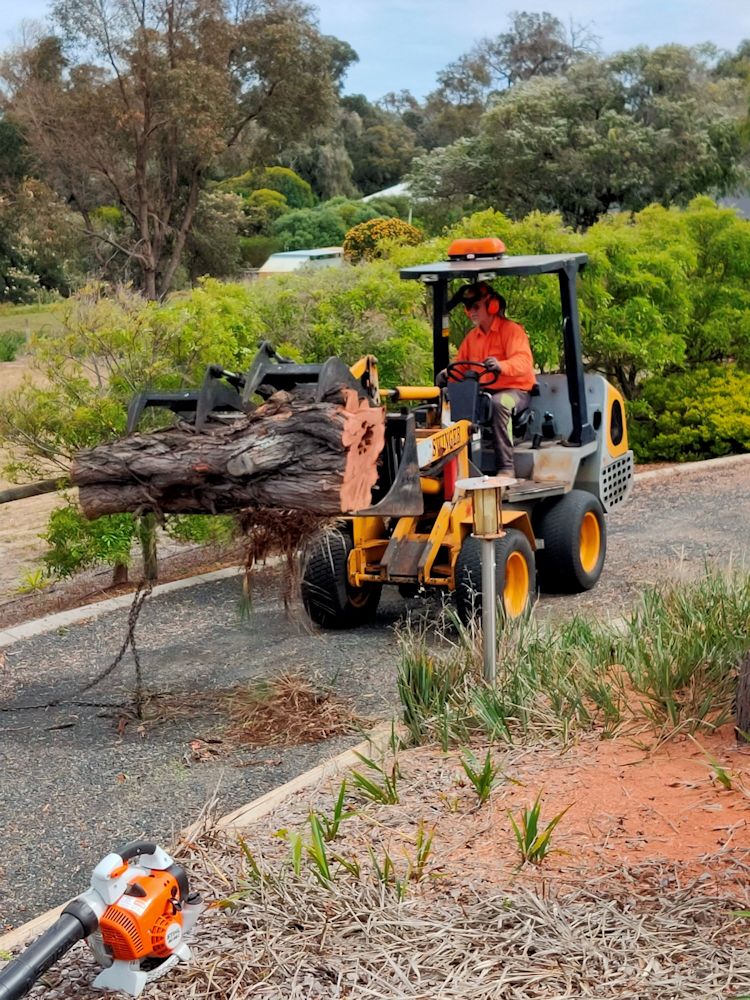
But with the latest unexpected branch drop, we realised it was time for the tree to go. Who knows what would happen in a big storm with gale-force winds coming from the north-west as they do? Or in a bushfire (the oil in the leaves is highly volatile)?

I contacted the people who’d previously done our lopping, but 2 months after accepting their quote, they still couldn’t give me a date when they’d come. I found another company and the owner came out the next day, gave me a quote on the spot ($400 cheaper than the first quote) and told me it would likely be done within 3-4 weeks. Two weeks later I get a text to see if 7:15am in a couple of days time was OK—sure was!

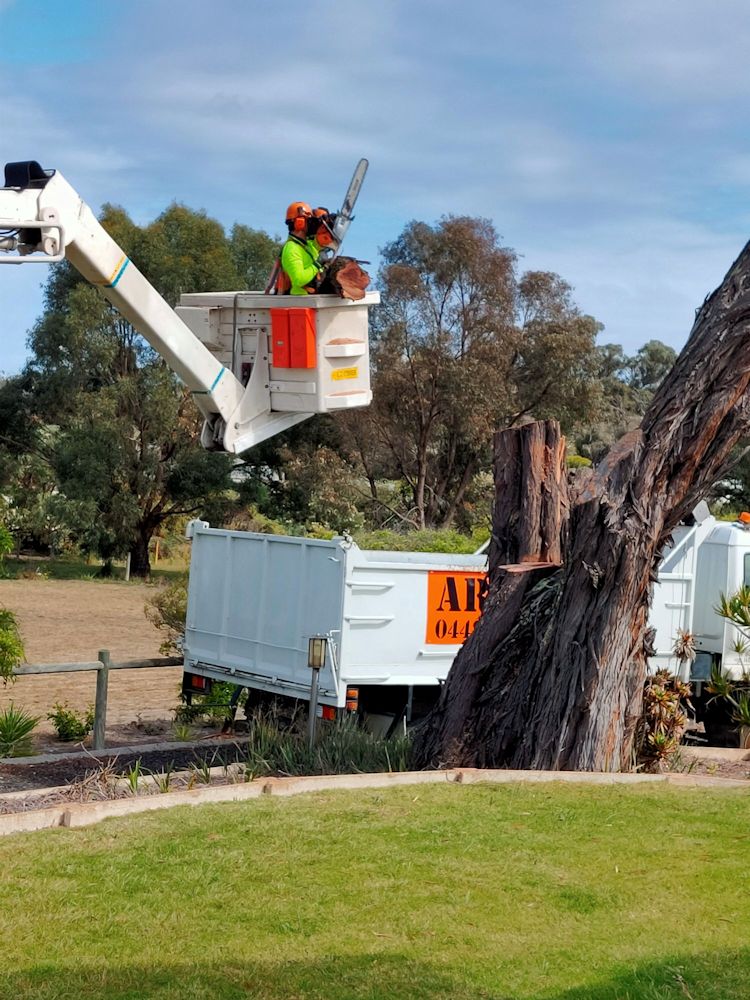
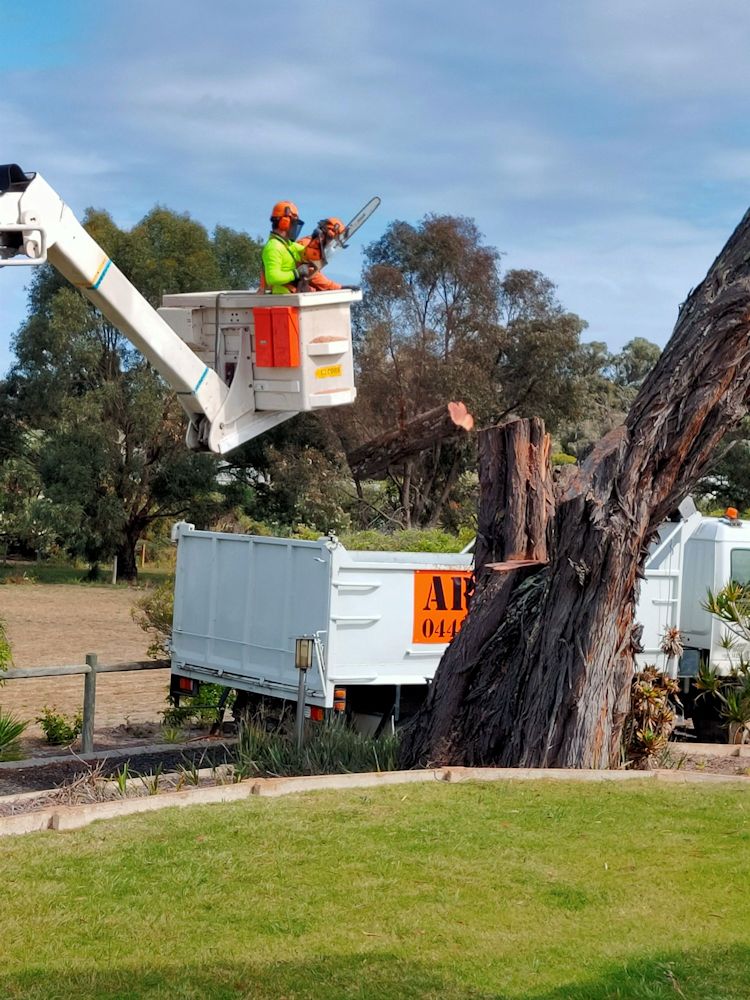
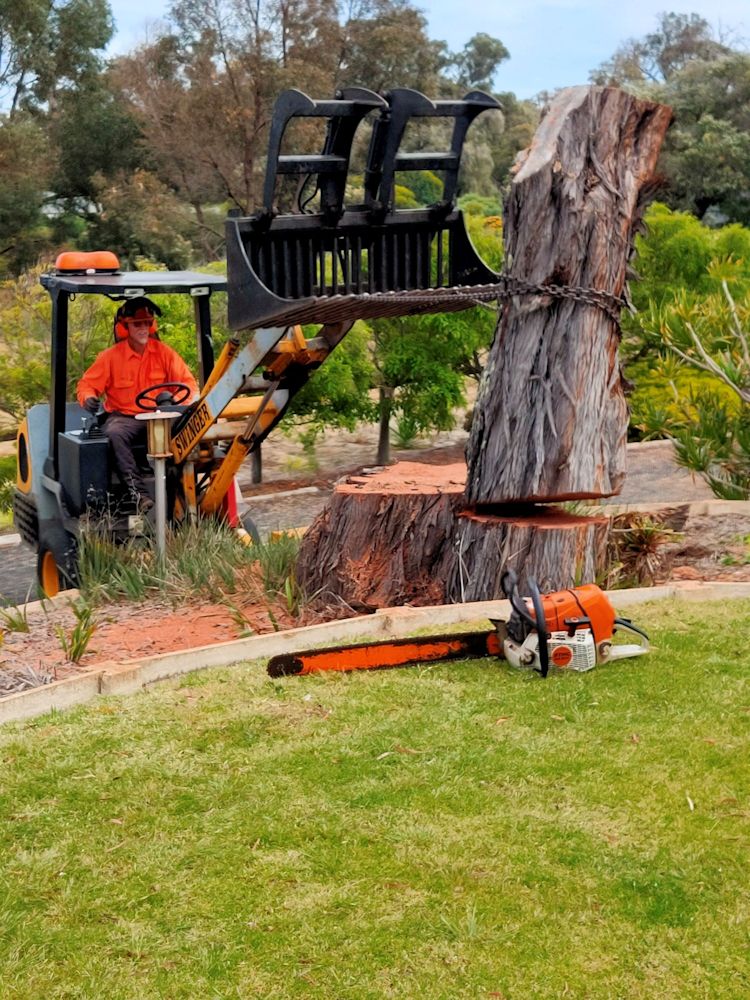
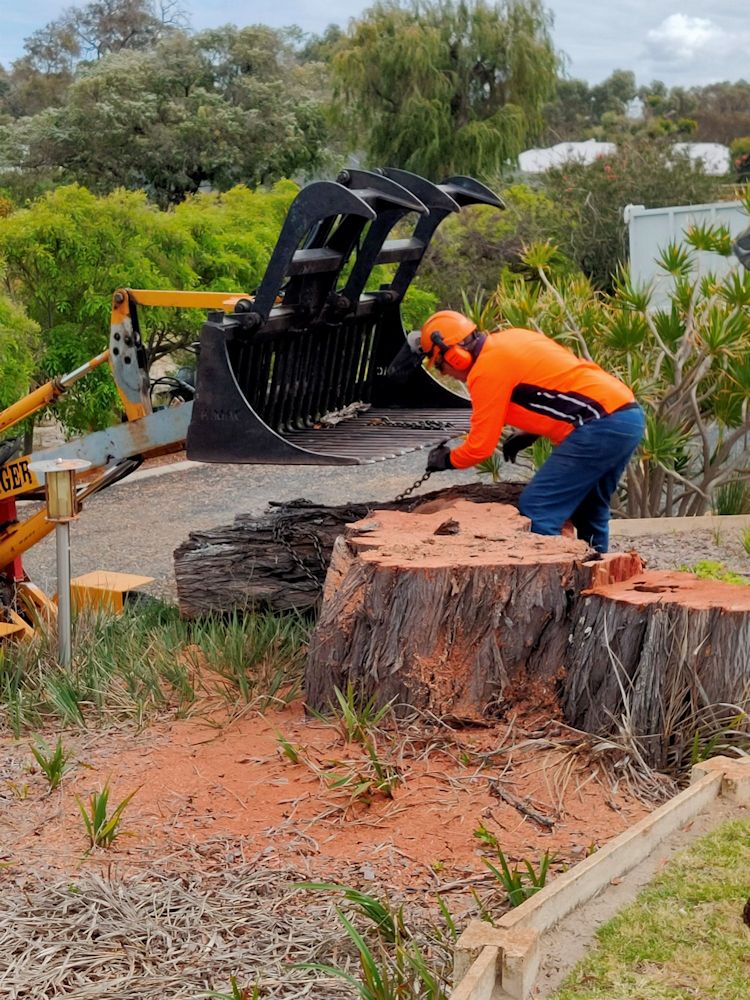
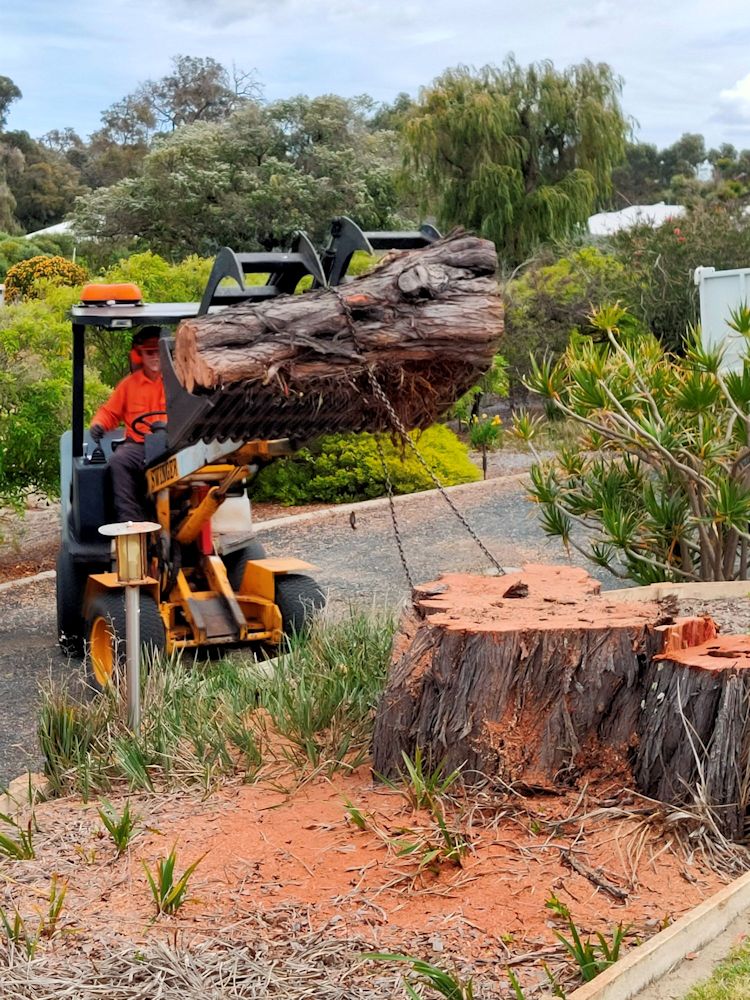
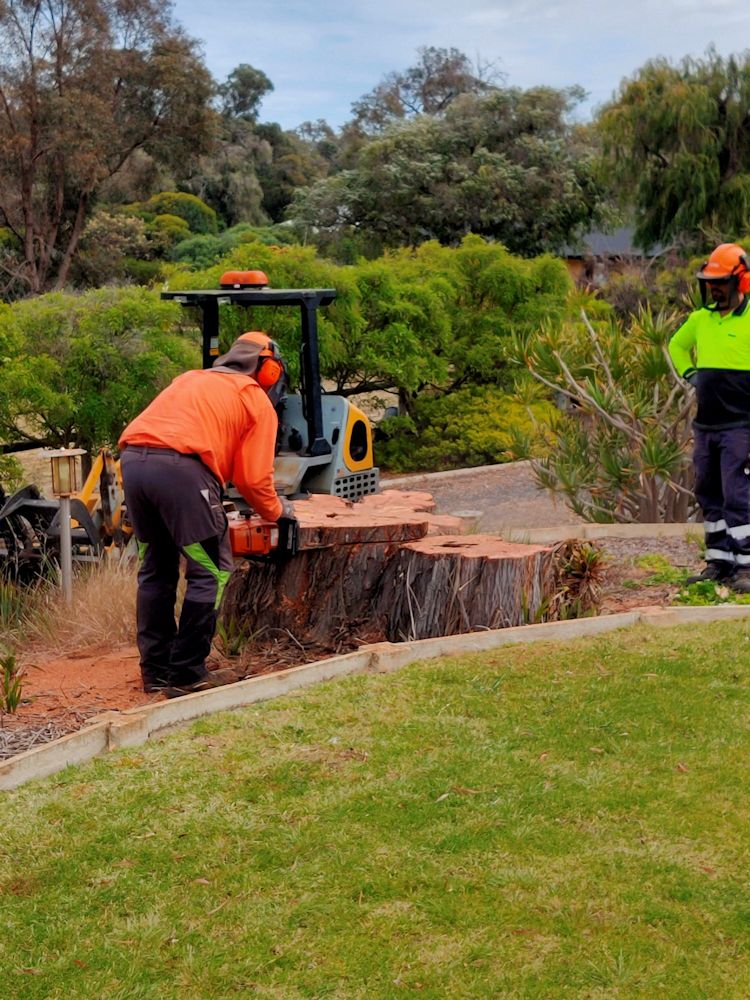
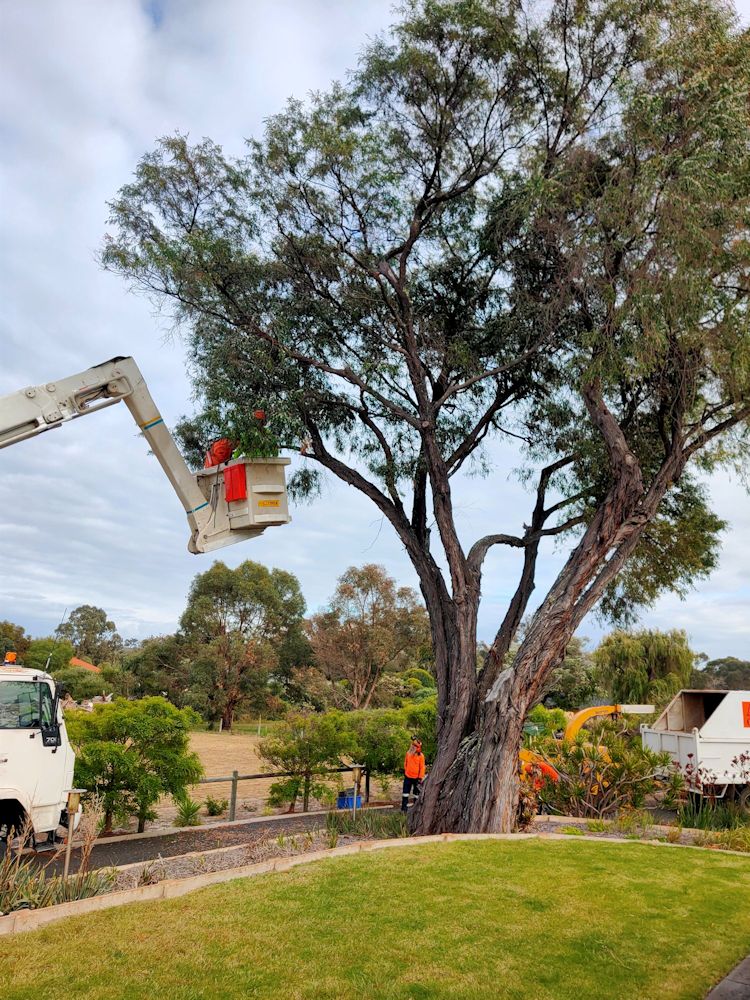
They turned up at 7am with ALL the regalia—about 4 trucks, a big cherry-picker crane, the wood chipper, a small piece of equipment that could pick up big logs and put them into the back of a truck, etc. By 7:15 they were into it, and within 2 hours they were all done, had cleaned up the site, and taken all bits of the tree away. They also poisoned the stump to hopefully prevent new shoots from forming. They couldn’t grind the stump because of its location on a narrow retaining wall at least a metre off the ground, and they couldn’t cut it down too close to the ground as the base of it was way too big for their various size chainsaws.

I was particularly impressed with their professionalism—using a cherry-picker crane to get to the high branches instead of shimmying up the tree with ropes and leaving chainsaws hanging in the air, using chains and a small loader thing to lift the large trunk piece, and cleaning up. The boss was also training a younger chap, and he spent time showing the young bloke the right way to do things. And they all wore the appropriate safety gear.

From beginning to end…


Testing acrylic paints

13 05 2022

I purchased a set of 24 metallic acrylic paints from Amazon (Ohuhu brand; link to the Amazon Australia site: https://www.amazon.com.au/gp/product/B08PPCCM2D/r) and decided to test them out on some sample popsticks.

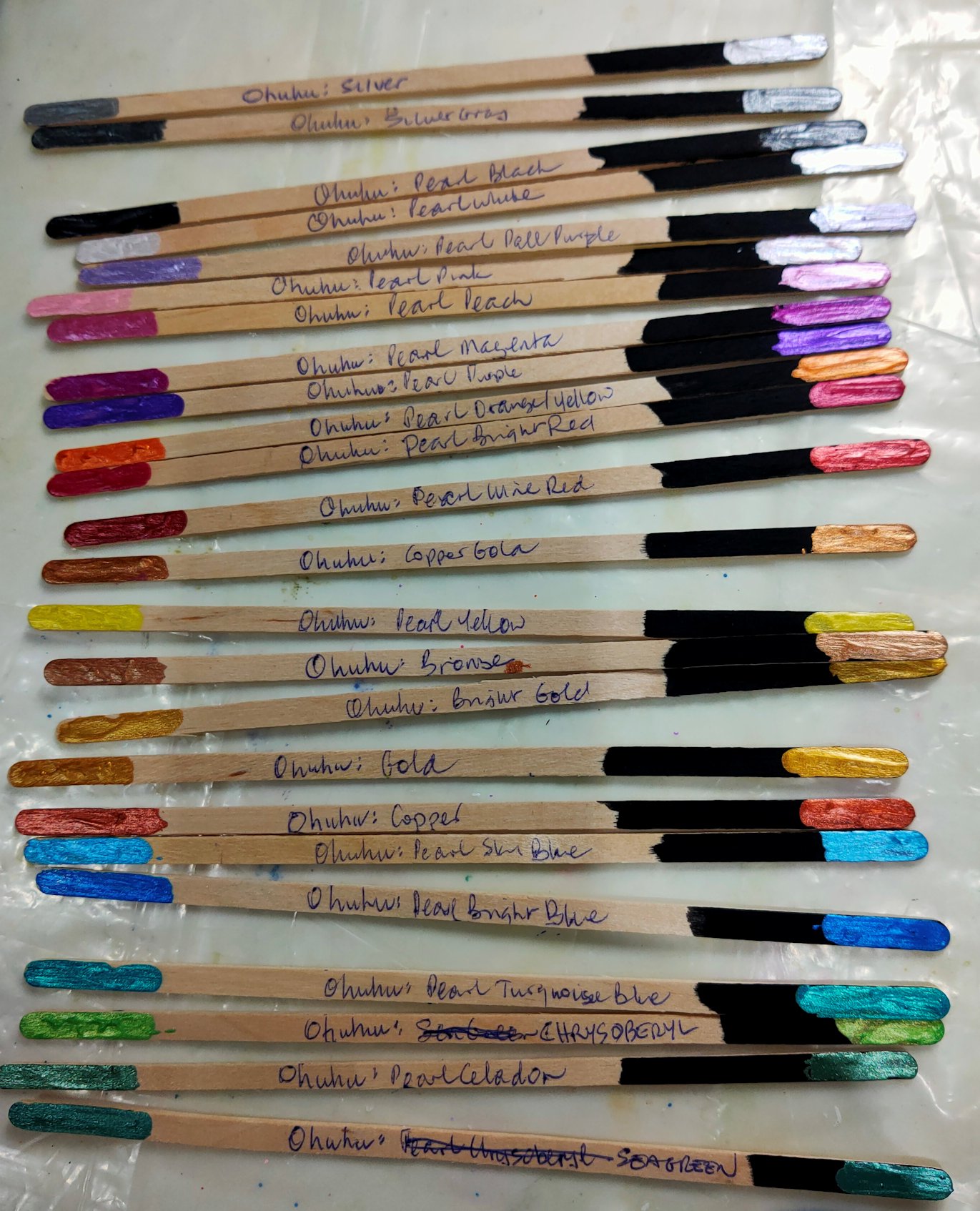
The idea of using popsticks is that you have a ready reference for your colours without having to lift every paint pot out of the boxes you have them stored in (I saw this trick on YouTube!). I wrote the brand and colour name on each stick, kept one end ‘naked’, and painted the other end of each stick with black gesso because I wanted to see how the colours worked on a black background. Would the black bleed through or would the colours remain strong and opaque? Was there any difference in the colours? (in some of my early dotting, I’ve found that yellow can react badly on black and almost disappear, even when other paint colours from the same brand work well). After prepping my sticks, I ‘painted’ each end (using a dotting tool) with the same colour. Simplistically, this is what I did—the reality is that it took several days to create these samples while I waited for paint to dry 🙂

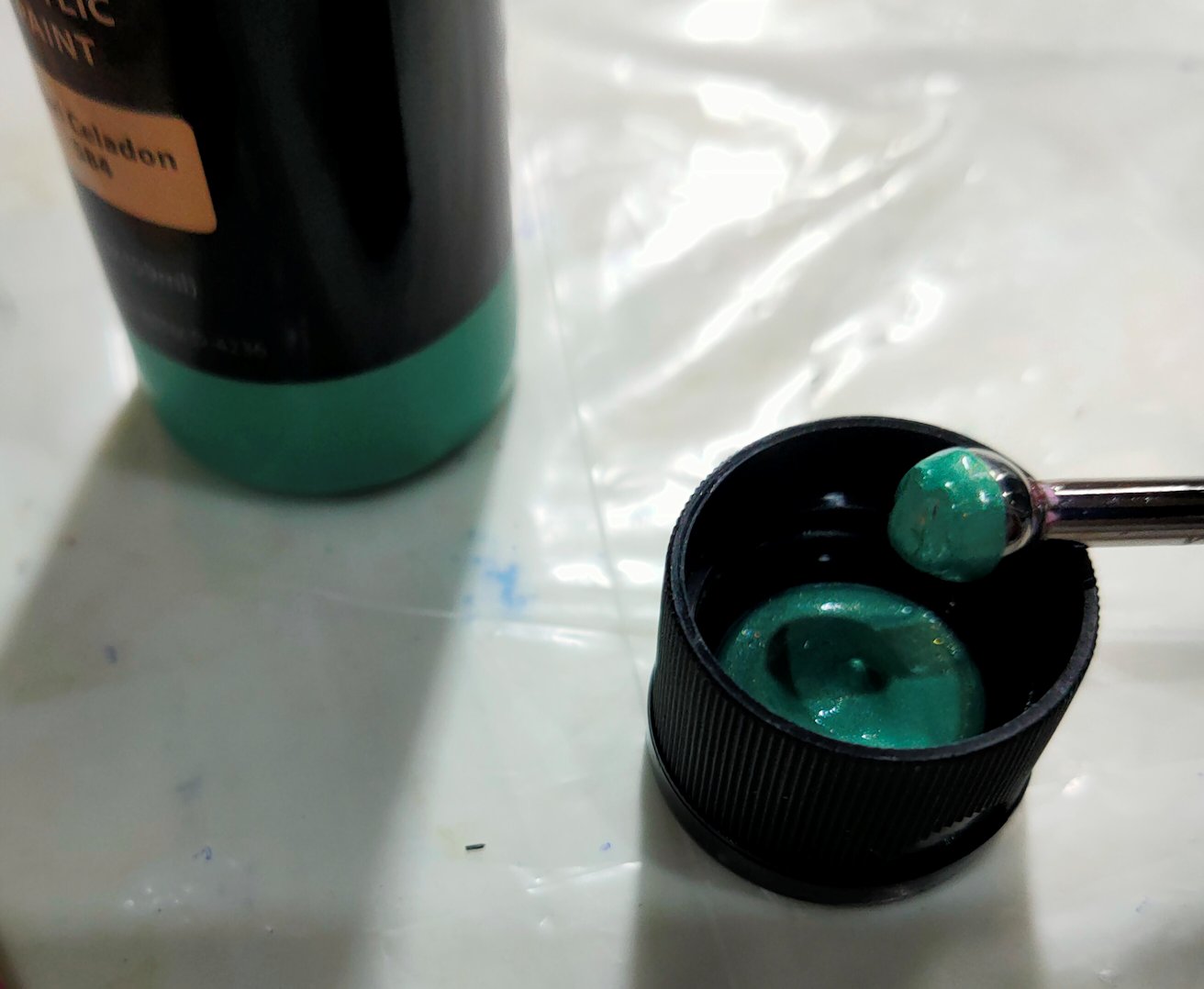
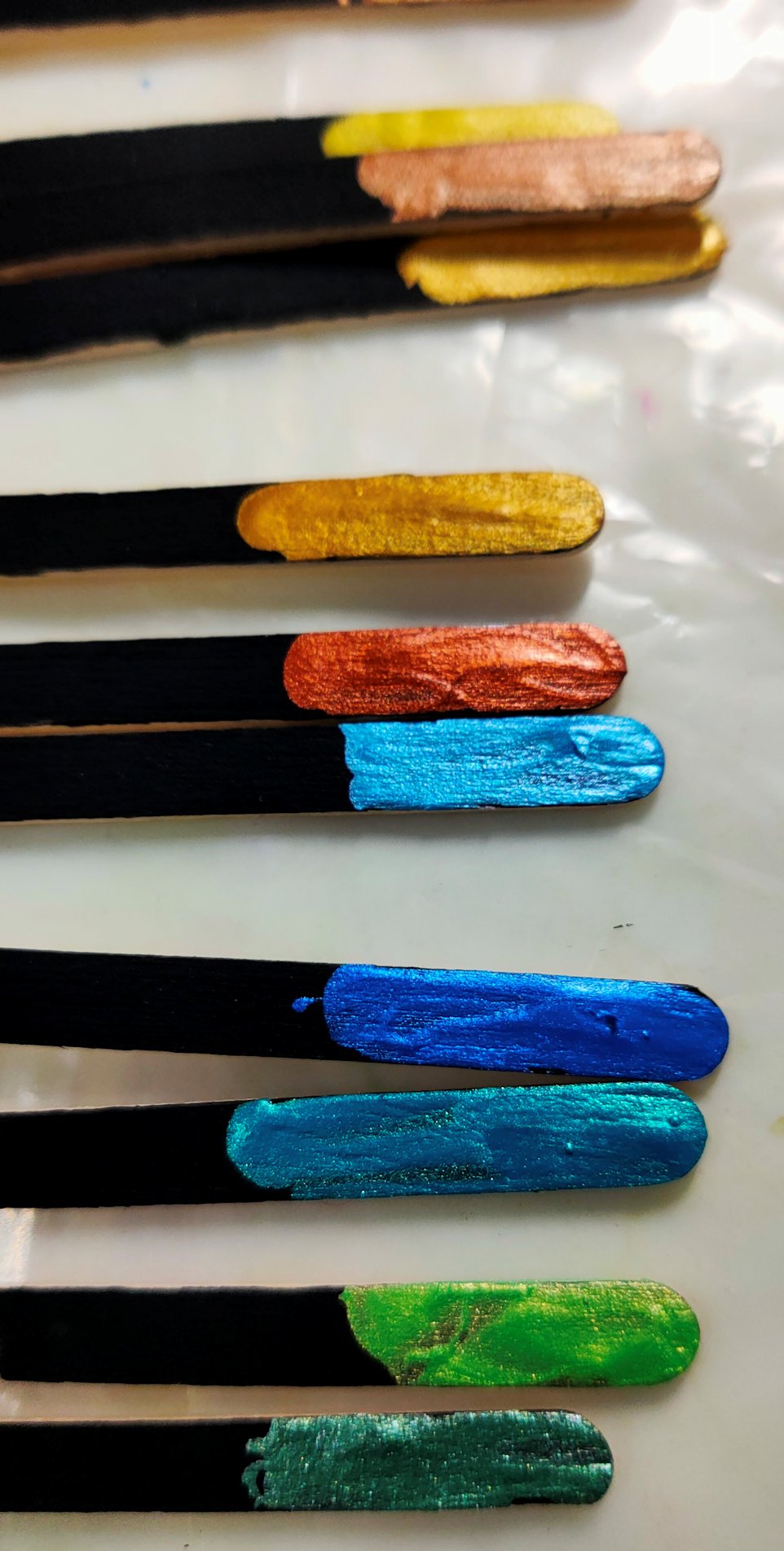
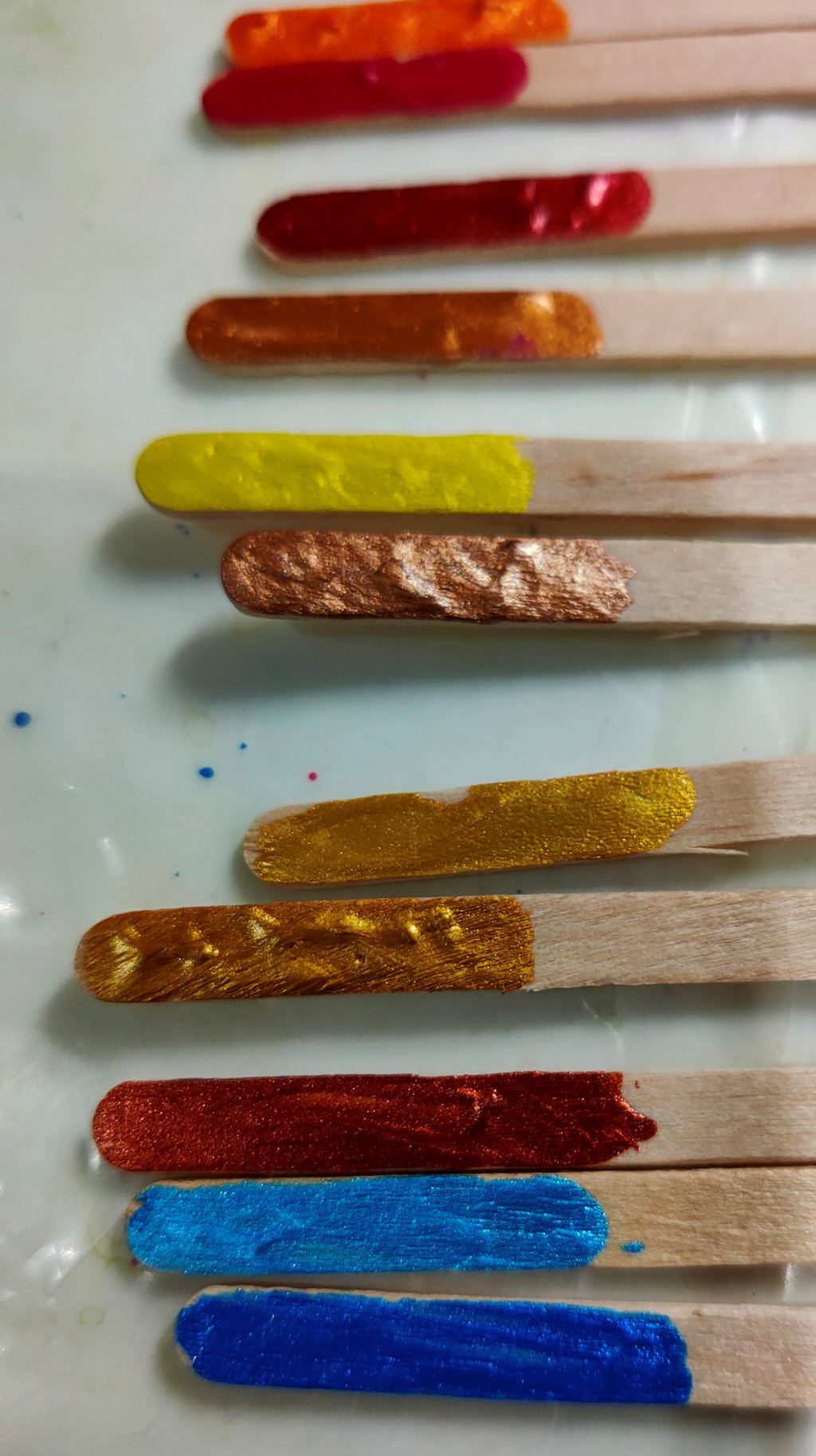
Well, the metallic colours of this set of paints are great. And the colour seems to give good coverage with no bleeding through. But, and there’s a big ‘but’ here… these paints are very thick and ‘goopy’. They aren’t suitable at all for dotting straight from the bottle. Some practitioners (via their YouTube videos) suggest the paint for dotting should be the consistency of runny honey. These paints are nowhere near that. You can see from the photos below that when you take the top off the bottle, the paint peak remains (green paint bottle). And it stays like this for ages. You can also see the goopiness of the (green) paint on the practice dotting tool, and later I dabbed the tool into the yellow and held it suspended for more than 30 seconds. The drop didn’t move—it stayed peaked like that. For dotting, it should form a drop within a few seconds, even if the drop doesn’t actually drop off.

But now that I know these paints are thick, I won’t use them straight from the bottle. Instead I’ll add them to a paint palette and add pouring medium to them to give me the consistency I need.


The peak remained on the paint for as long as I had the bottle open.


The dotting tool is very ‘goopy’ with this thick paint.


The dotting tool with a peak of paint—it didn’t move.


The full range of 24 metallic colours, on plain and black-painted ends.


The colours on black gesso. The coverage is good, but the paint’s thickness means that the coverage wasn’t even.

Some of the colours on the ‘naked’ ends of the popsticks. Again, the colours are good, but the thickness means there are a lot of bumps of paint.


Dotted coasters and magnets

8 05 2022

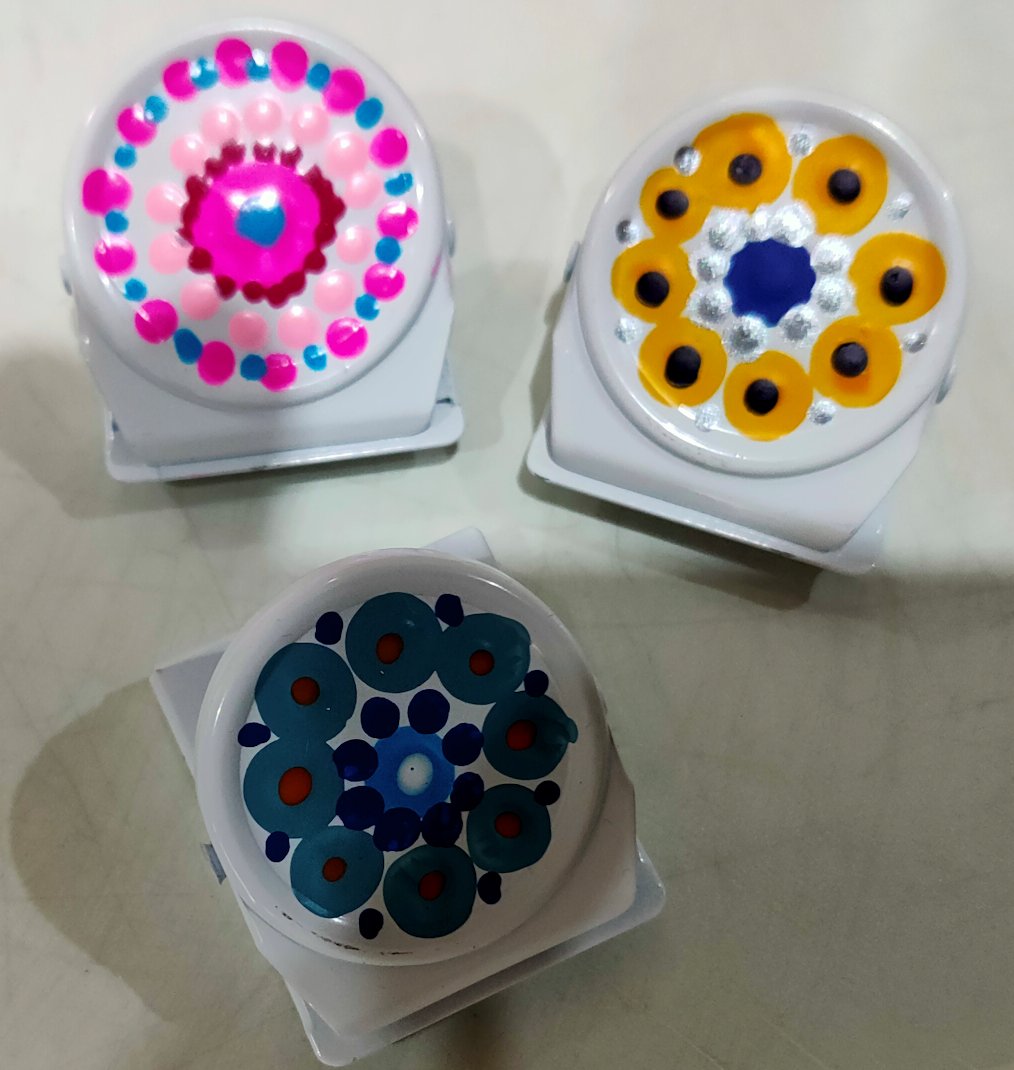
My latest foray into the dotting world had me dotting some plain fridge magnets (super quick!), and applying black paint to 10 cm (4 inch) wooden coasters then dotting them too. I started with one coaster a couple of weeks ago, then have slowly been doing the others in the same colourway. I finished the final two today. I’d guess I’ve spent 6 hours on the coasters, perhaps a bit more. The designs were all out of my head.

I still have to apply the glazing medium to the coasters but I likely won’t do that until I’ve put some sort of protective backing on them as they are raw MDF at the moment.


Dotted animals

3 05 2022

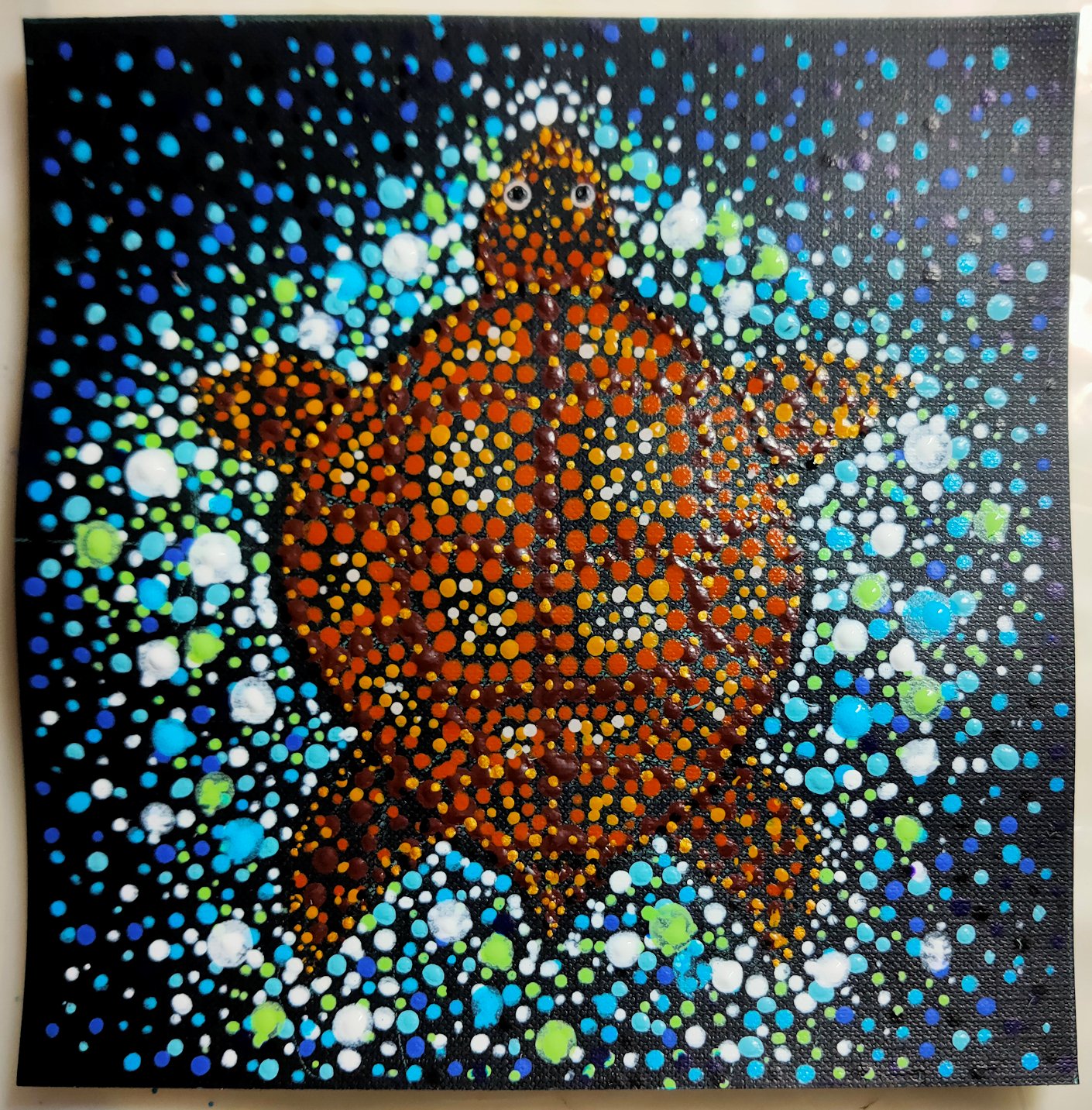
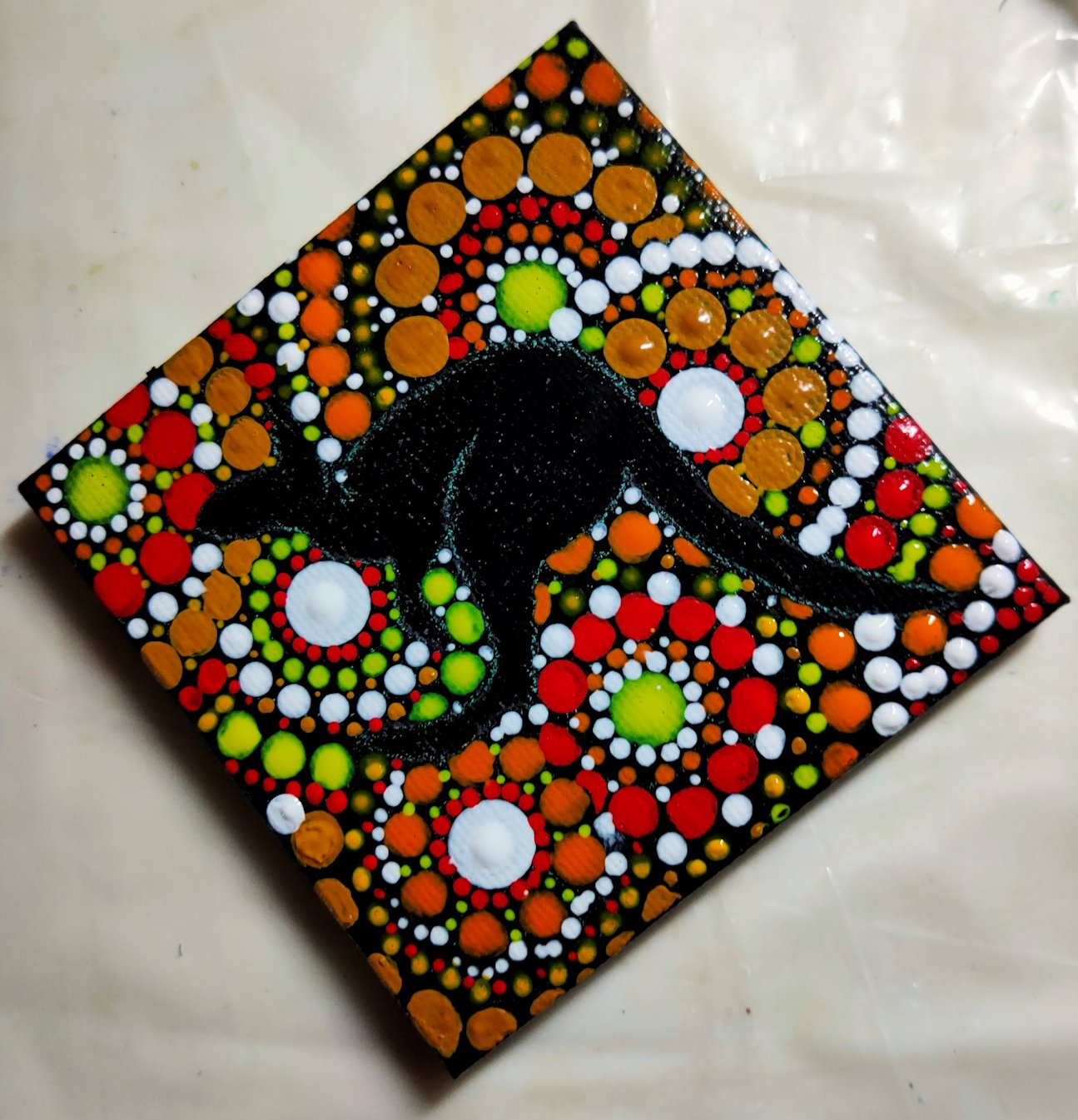
After doing several mandalas and other dotted art pieces, I decided to try some animals. The turtle is on a piece of 15 x 15 cm (6 x 6 inch) black paper, and the kangaroo is on a black painted canvas, which is actually a large fridge magnet (about 10 x 10 cm; 4 x 4 inch). I added a glazing medium to the kangaroo after I finished doing the dots. Note: The magnet is meant to be placed on the fridge (or hung) on the diagonal so that the kangaroo is correct in the horizontal plane.


Marine turtle swimming in the ocean


Paints used for creating the turtle


Partly finished kangaroo—final dots to be added, and the glazing medium


Finished kangaroo fridge magnet, with glazing added


Paints used for the kangaroo


Going dotty

24 04 2022

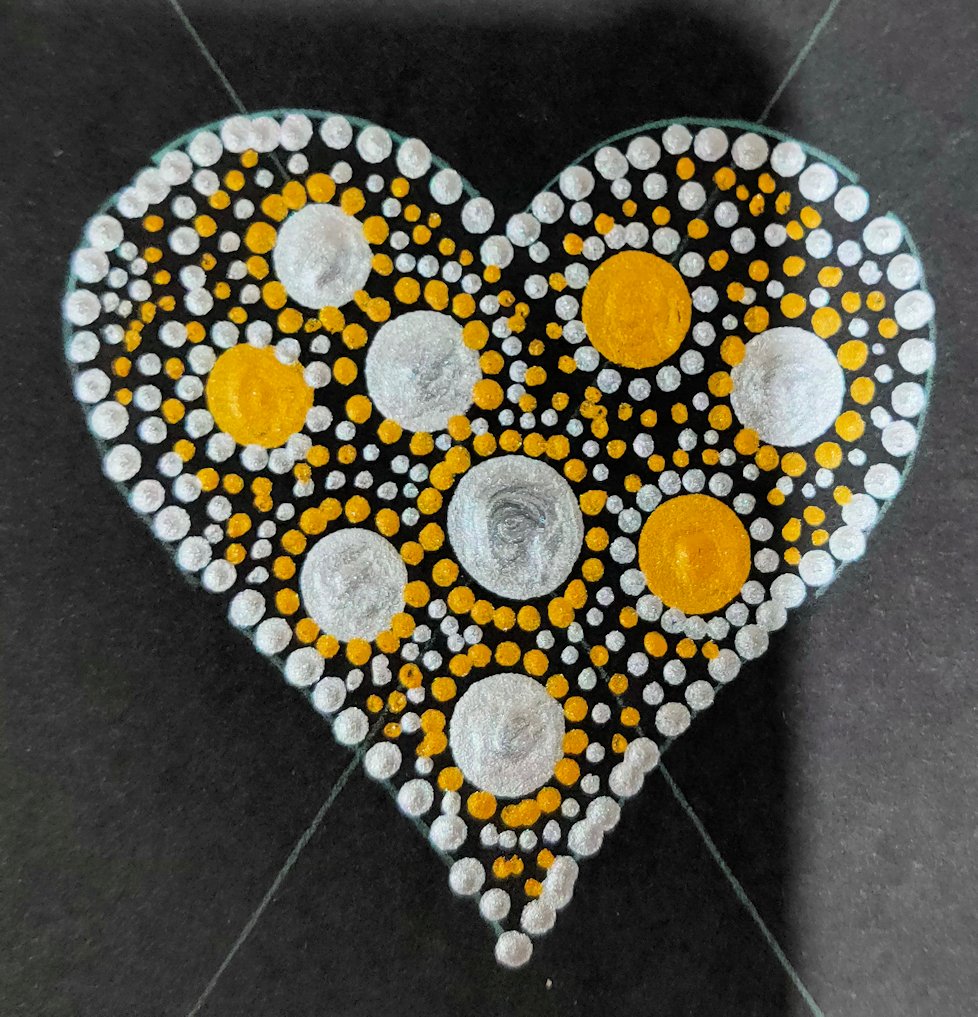
I’m still practising dotting art on black art paper. Yellows don’t come out well—they tend to turn green and I have to redot them after they are dry. I’ve yet to try a surface I’ve painted black—I would really like to use yellow without having to go over it every time. But I won’t try on those black painted surfaces until the set of dotting tools I’ve ordered arrive (I ordered them on 31 March, and it’s now 24 April and they still haven’t arrived… they first went to Tampa then to Miami [2 days], then it was another 5 days to New York, another 2 before they checked back in, in New York. After their holiday in New York, it took them another 4 days to fly to Japan [why Japan??? Australia’s borders are now open] where they had a mini holiday for 2 days before arriving in Brisbane. They left Brisbane on 20 April, but haven’t been checked in anywhere else yet. We have a long weekend this weekend, so I’m not expecting to see further tracking information until Tuesday. And this is despite paying $22USD for postage for a small parcel! Between them, USPS and AusPost are pretty bloody inefficient!)

The top two are a small gift card size; the bottom two are suitable for framing and are not made as cards. The bottom right one is on a 6 x 6 inch square piece; the left is slightly bigger and rectangular.


Trying dotting

15 04 2022

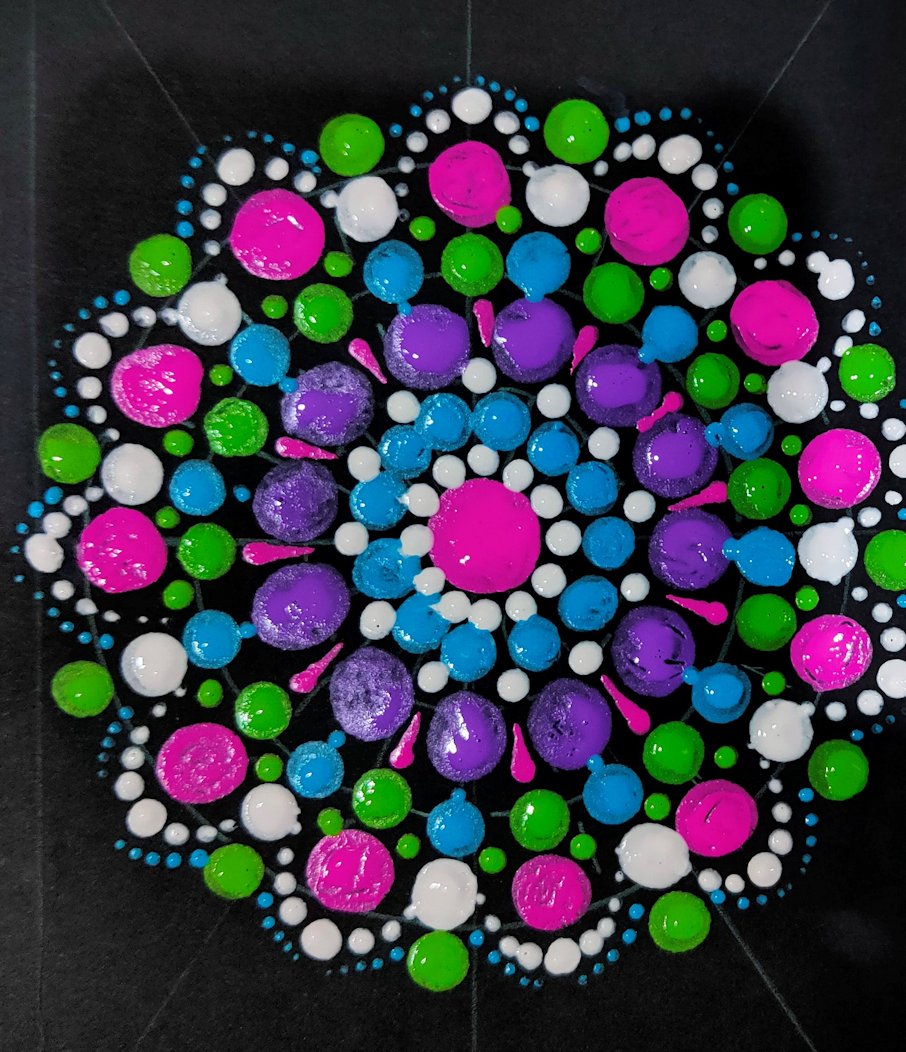
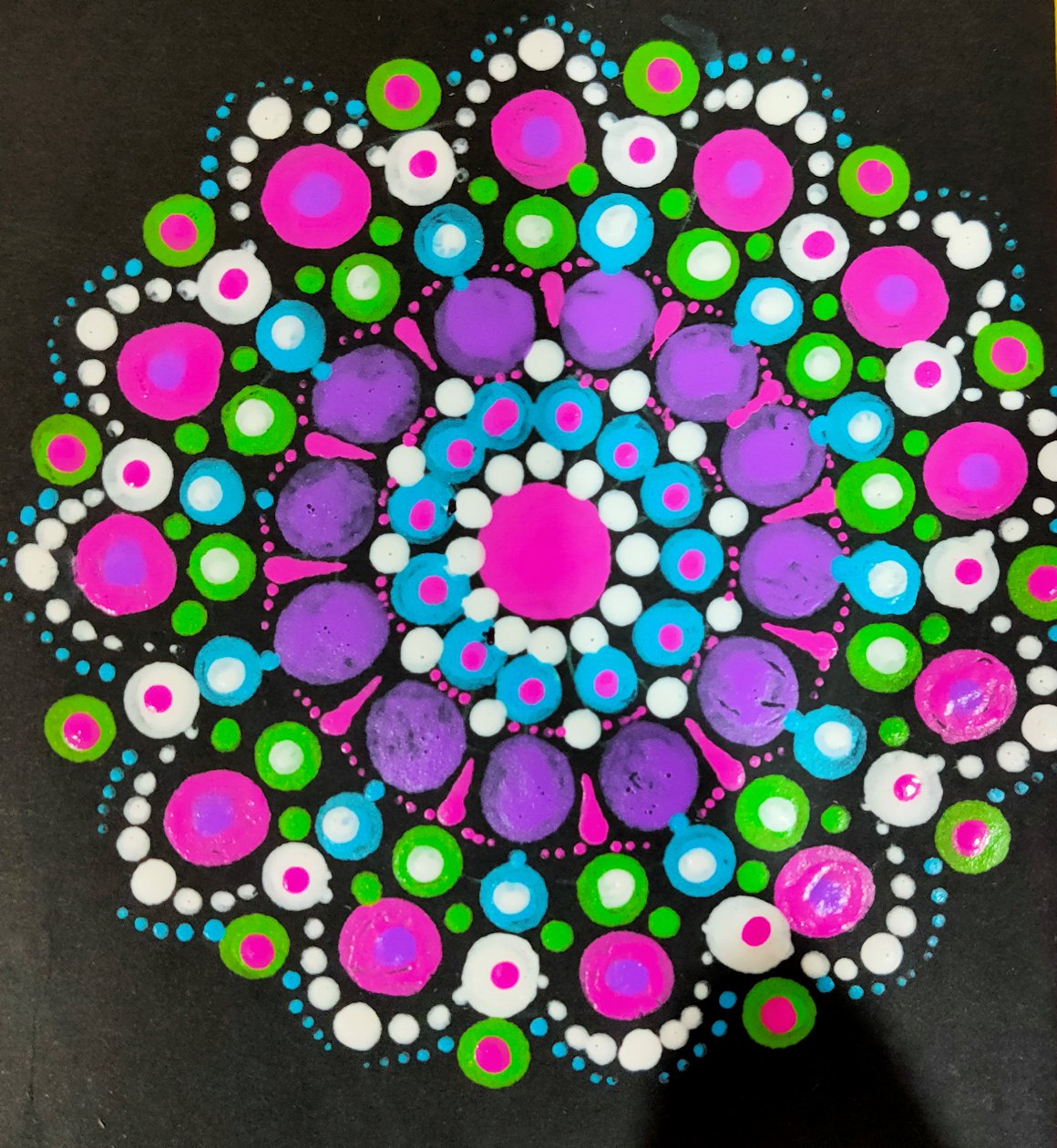
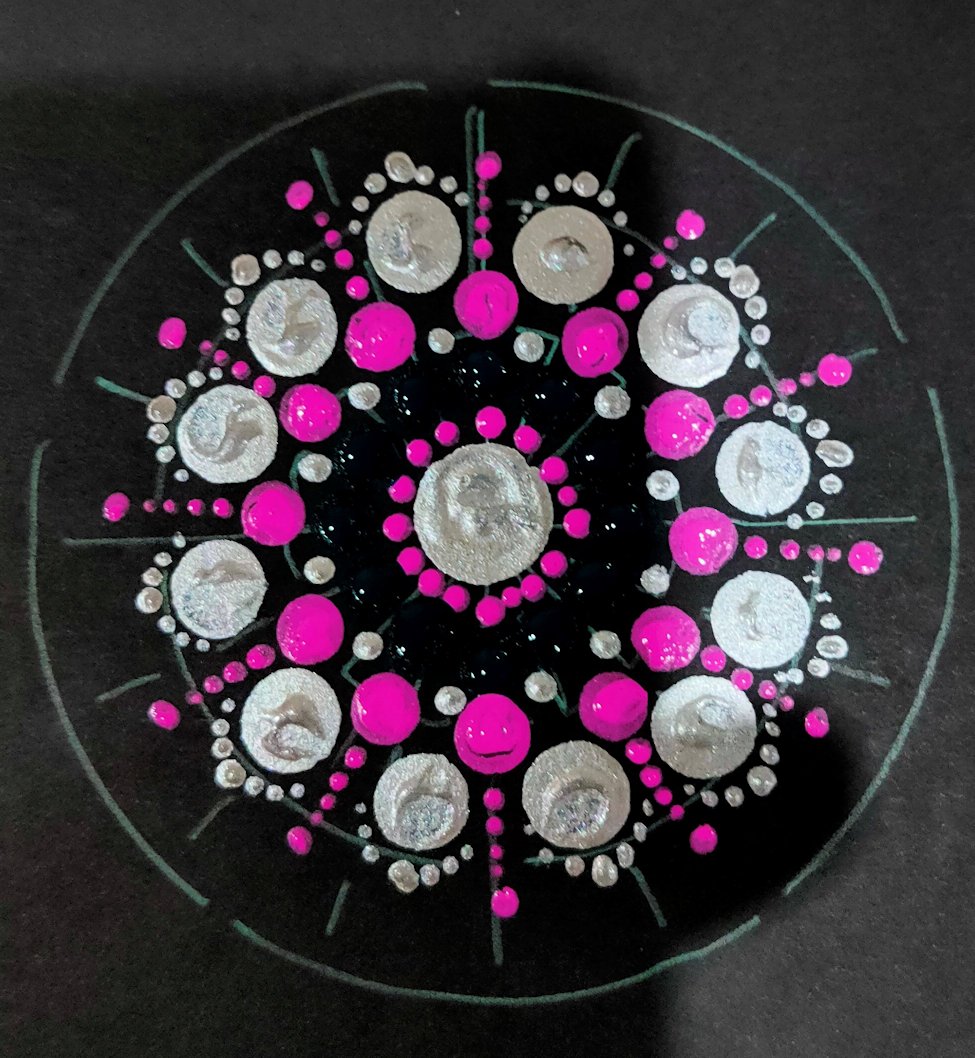
I’m trying dot art for the first time. My initial attempt was a few weeks ago, but I’ve learnt a bit more now (thanks YouTube!) and have practised some techniques. Doing these mandalas is very focusing, so it’s good for mental health. I still have to get the paint consistency right, but these were some I did yesterday and today. All are on one half of black card suitable for a greeting card. Some were still wet when I took the photos so the chalk registration marks are still visible—I’ll erase those when the paint dries, and likely add more dots on top of the existing dots. The one with the page fully covered is from earlier in the week, and I added more dots over the other dots, pretty much filling the black card. The hardest thing at the moment is getting that centre dot perfectly lined up. More practice needed there, as the position of the centre dot dictates how accurate the placement of the others dots is. At the moment I’m using mainly the ends of things I already have — various paint brushes, pencil eraser ends, satay sticks, and a set of dotting tools for nail art, which create VERY small dots. I’m waiting on delivery of a range of tools developed just for dotting, in a range of sizes, and I think I’ll mark registration marks on the bigger tools so I can centre more precisely. I’ve also been using some quilting stencils I have to get the shapes 🙂 And I haven’t yet put anything on canvas so it will be interesting to see how prepped canvas takes the acrylic paint compared to the mixed media black card

Update a day later: I’ve added photos of the updated mandalas after adding further dots and erasing the chalk marks, plus another non-mandala—a free-form one that I think of as a cell (it was still very wet when I took the photo, so I may have to go over some of the yellows as they fade into the paper).


My first house

10 04 2022

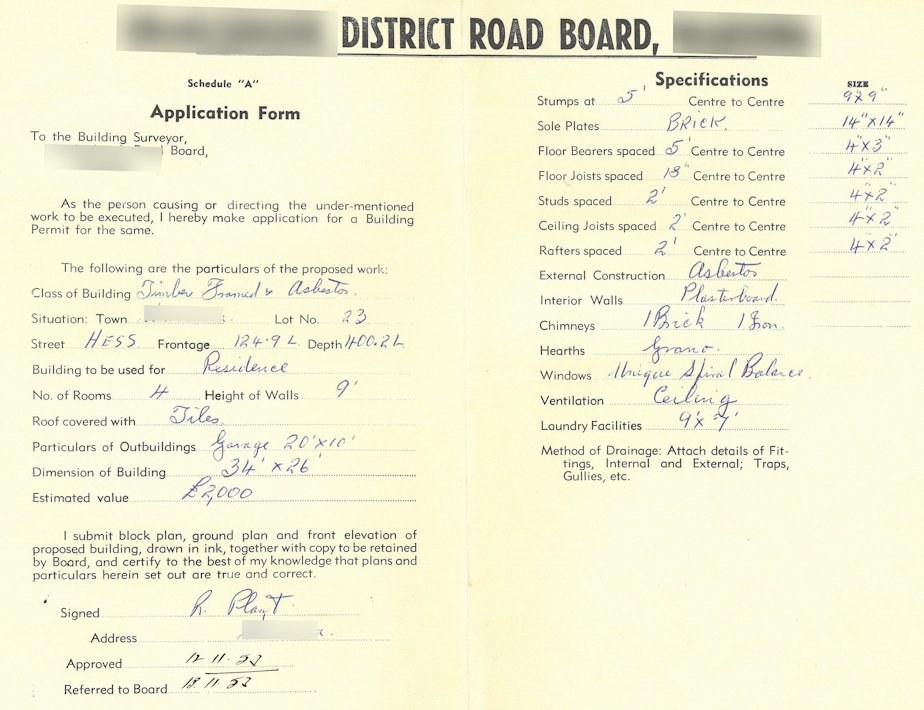
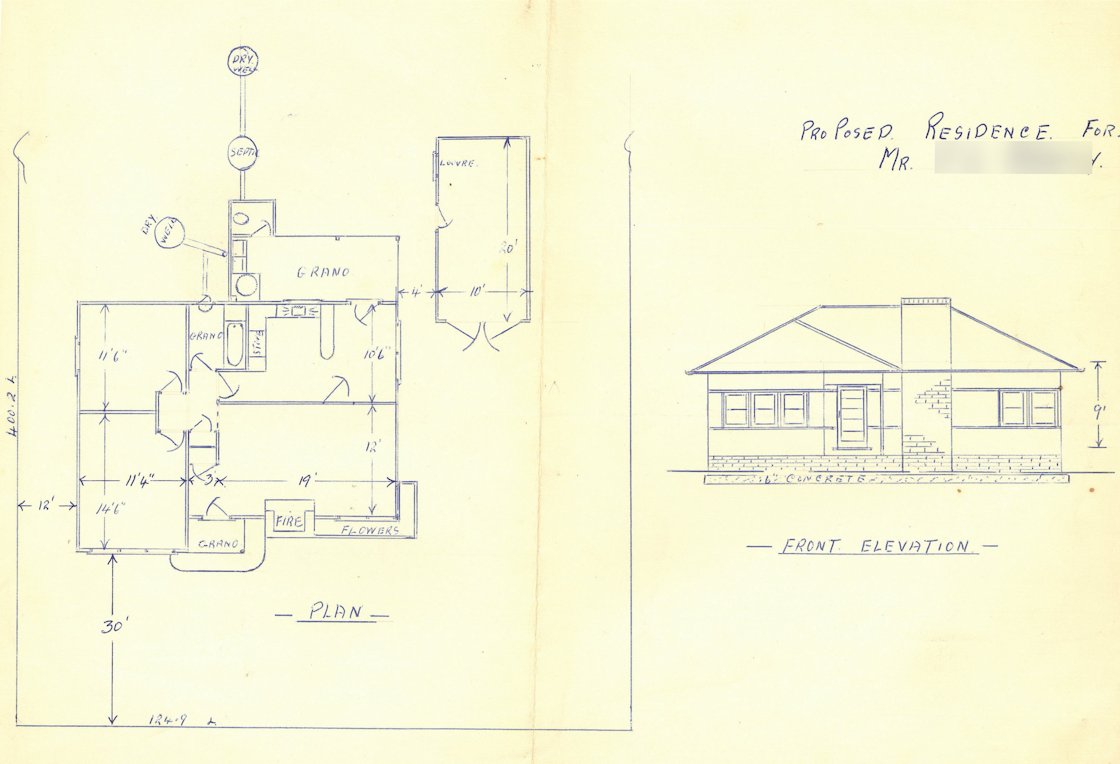
This was not the first house I purchased, but the first I ever lived in! I’ve recently been in touch with someone from the historical society for the Western Australian country town where I spent my life from birth to the day I turned 13, and she just happens to work for the local Shire and has access to old building plans. And she found these plans of the first house I lived in (until I was about 7 years old), which was commissioned by my grandfather to be built for my parents just before they got married.

These were certainly simpler times, as evidenced by the degree of ‘detail’ in the plans (just the 2 pages to get approval to build!) and the design of the house—a simple 4-room house. The price of 2000 pounds (equivalent to $4000) seems ridiculously low, but for the time it was a lot. However, using an online inflation calculator (https://www.inflationtool.com/australian-dollar/), that $4000 is equivalent to around $80,000 today, a vast difference to the cost of building a house in Western Australia today. That said, today’s houses have a LOT of bells and whistles—and rooms—and this one certainly didn’t.

Take a look at the materials used in the building—compressed asbestos board was used for the inner and outer walls of the timber-framed house! And according to Mum, lino was the floor covering of choice for the kitchen and later the living room. Lino in those days was full of asbestos too. Mum remembers the other floor coverings in the house too:

    • Kitchen – lino on the floor (more asbestos!)
    • Lounge room – wooden floors until my sister and I started crawling, then cheap lino; no furniture in this room bar a radiogram and my other nana’s treadle sewing machine, which mum would put the playpen over when she’d finished using it to stop us from crawling into the mechanism!; the fire surround was brick (likely red brick)
    • Main bedroom (front of the house) – Feltex carpet (very cheap)
    • Our bedroom – they think it was a wooden floor (and by wooden, probably not polished boards, but plain wood, perhaps oiled)
    • Bathroom – they couldn’t remember, but likely concrete
    • Laundry – red concrete; copper in the corner (the round thing in the laundry); back steps – no handrails
    • Front verandah – red concrete.
 

The same house after it was built and after I was born—I believe that’s me in the pram on the front verandah, so I was likely less than 12 months’ old, just a tad younger than the house.