Community Quilt 136

13 04 2014

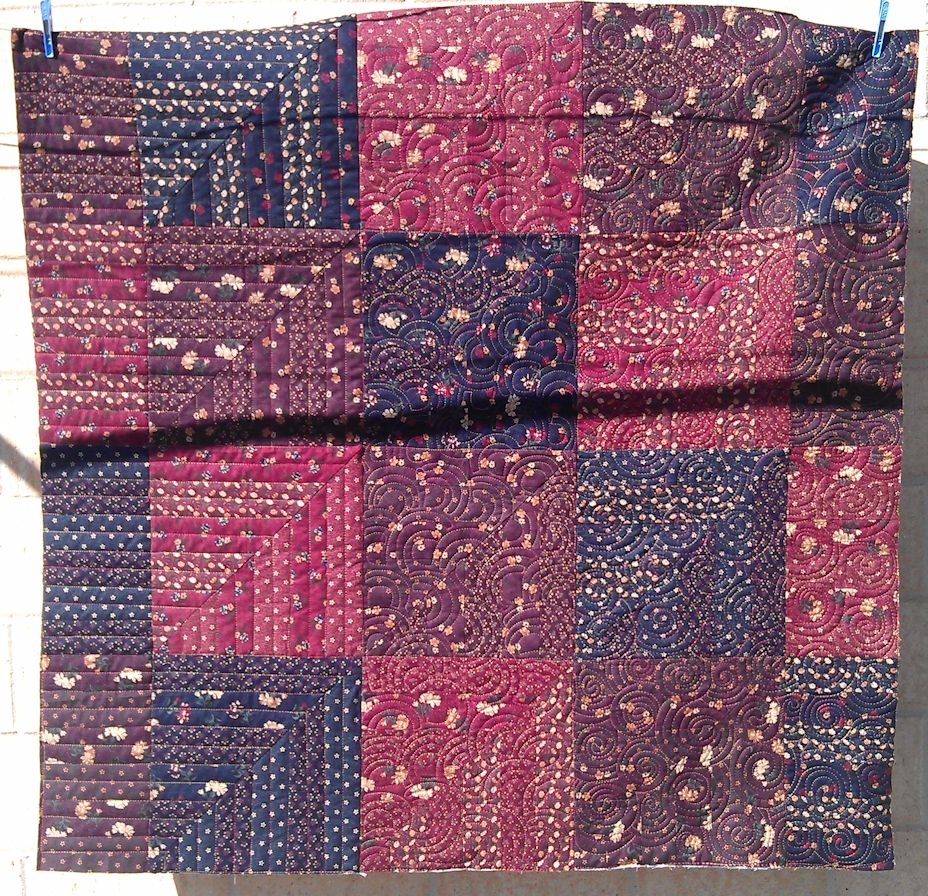
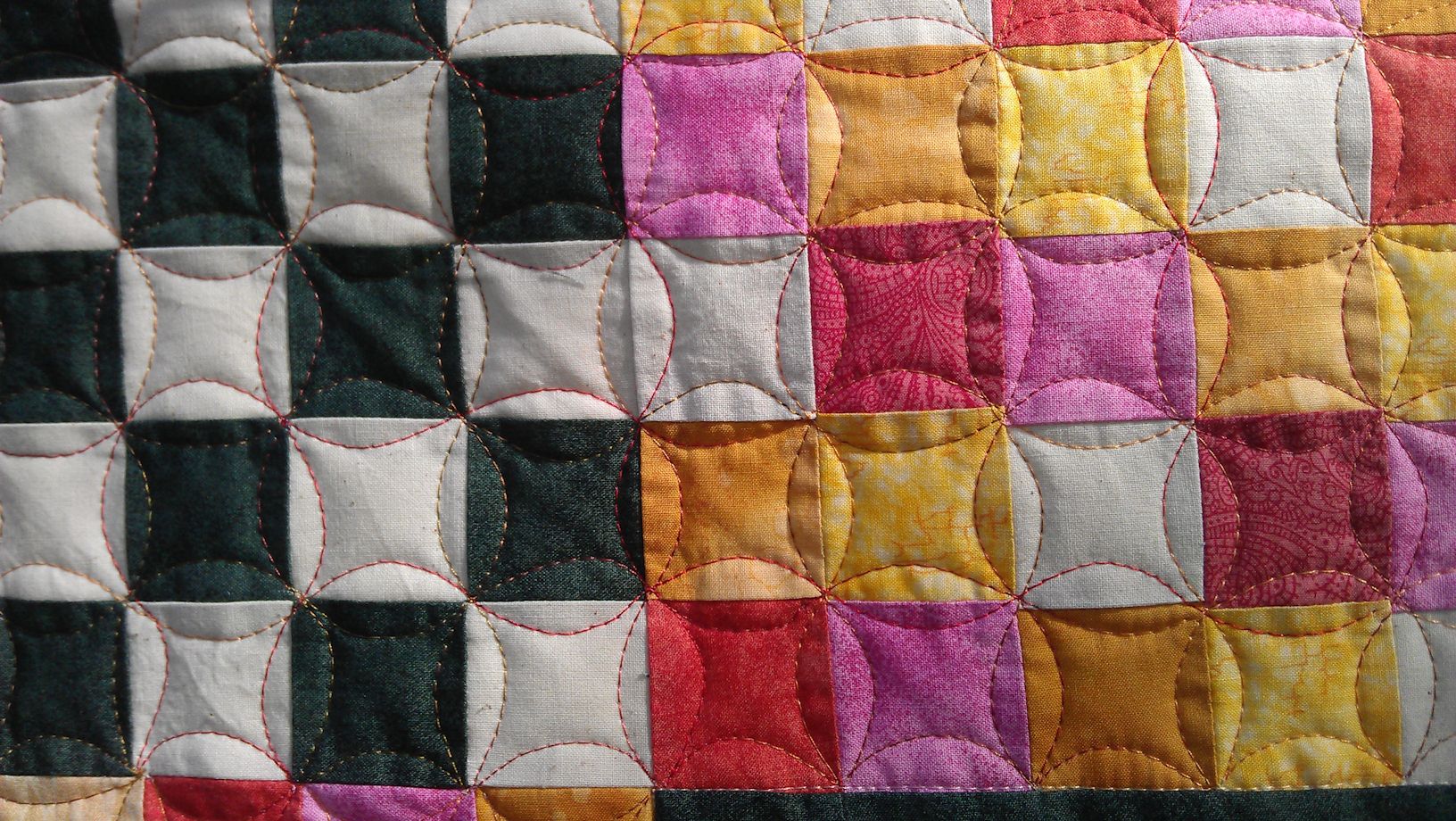
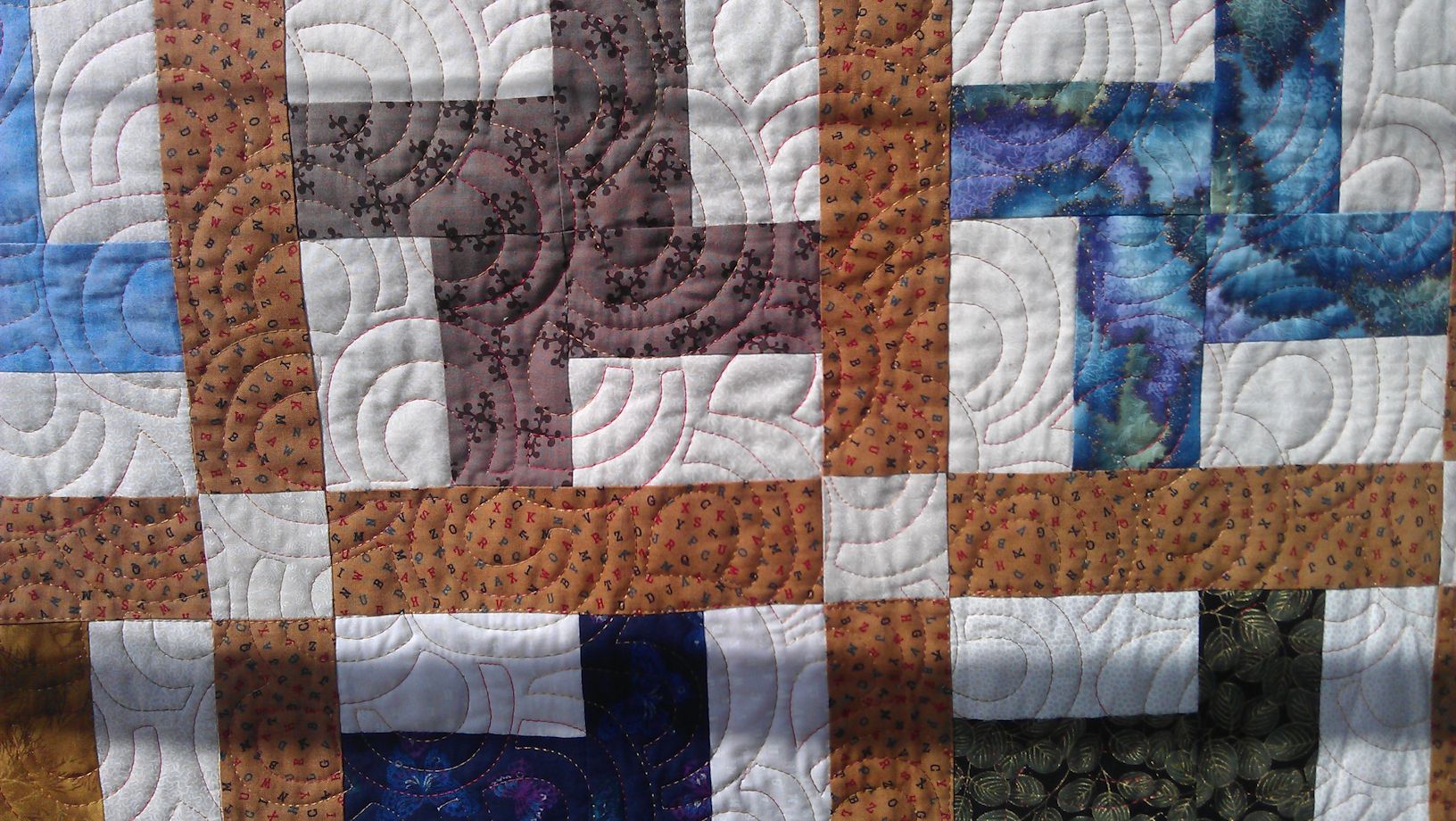
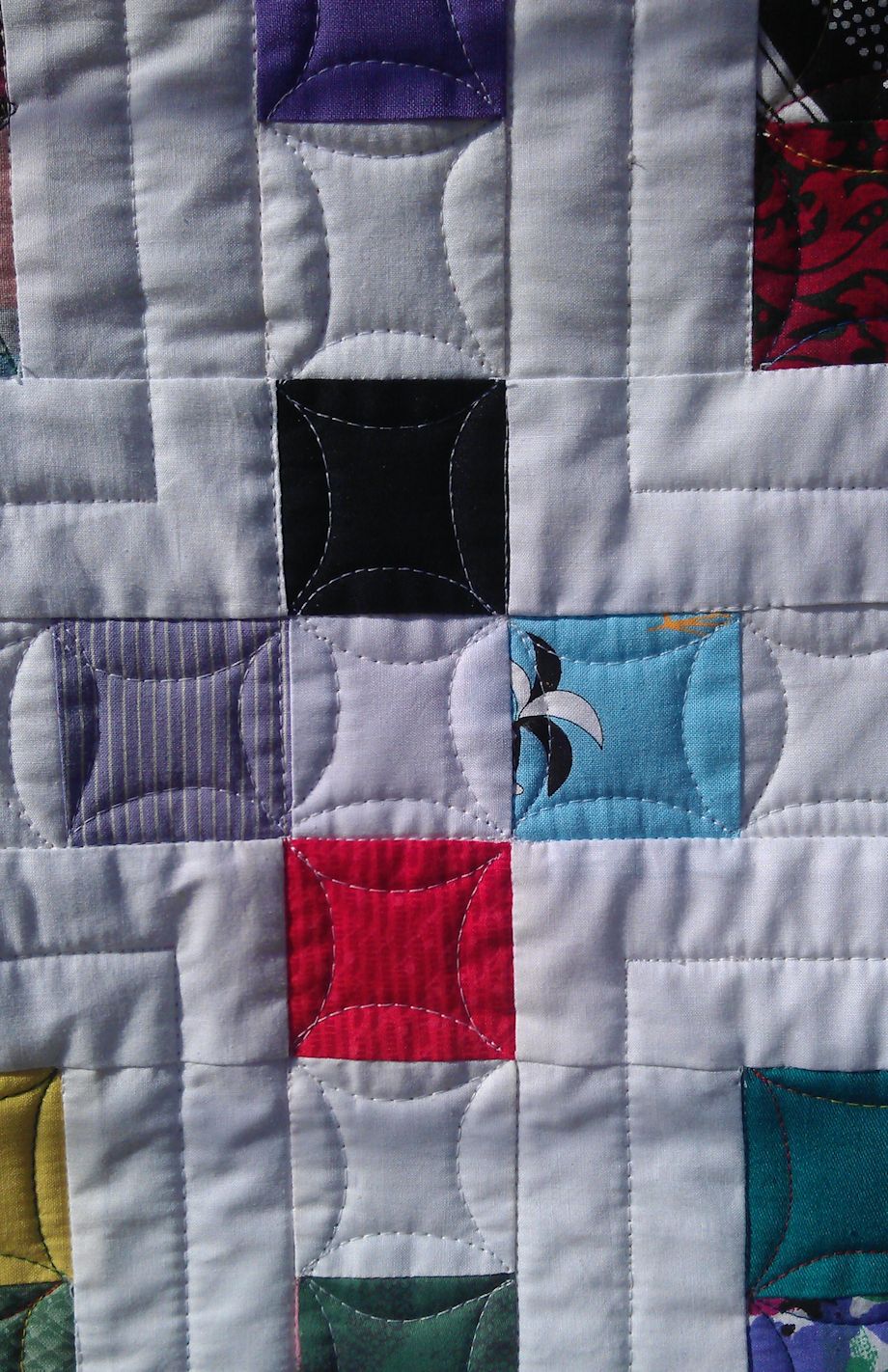
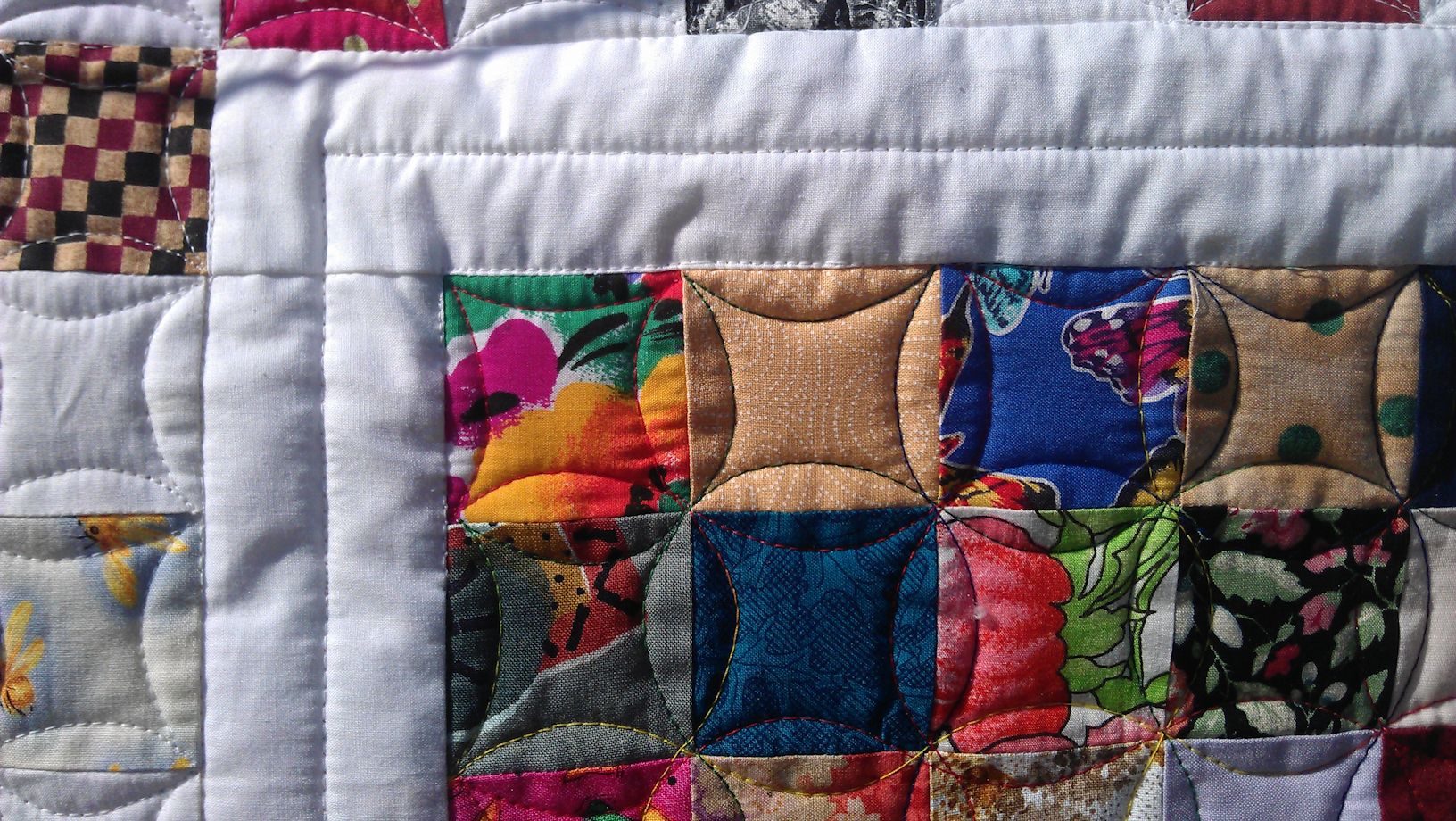
This small dark quilt was a challenge. How to quilt it to enhance the depth of the colours, while not overpowering the quilt with the quilting?

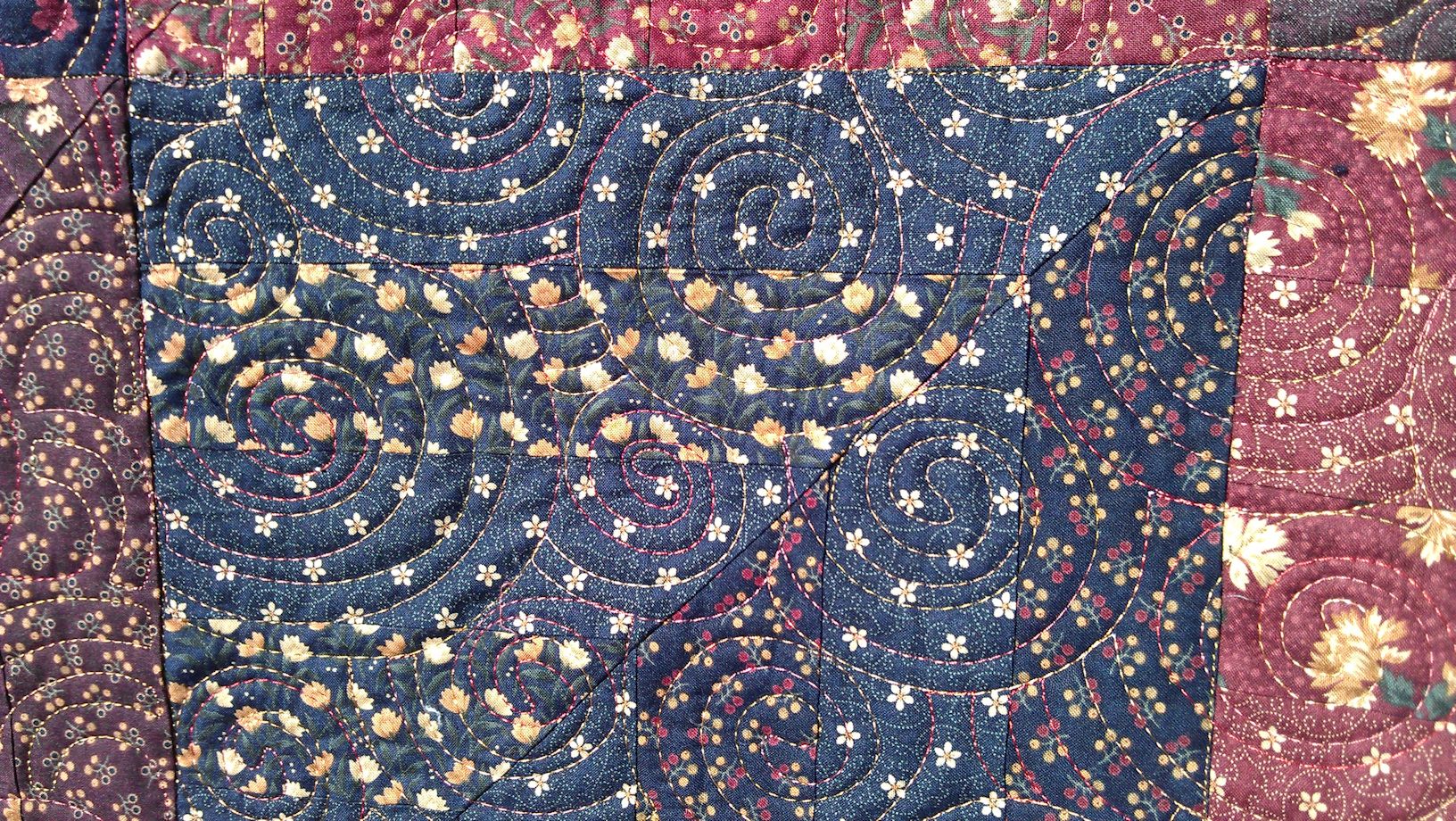
The first decision was what thread to use. I didn’t want a very dark thread as that would’ve hidden the quilting, so I opted for a variegated thread in rich orange, copper, ginger, red, and peach tones.

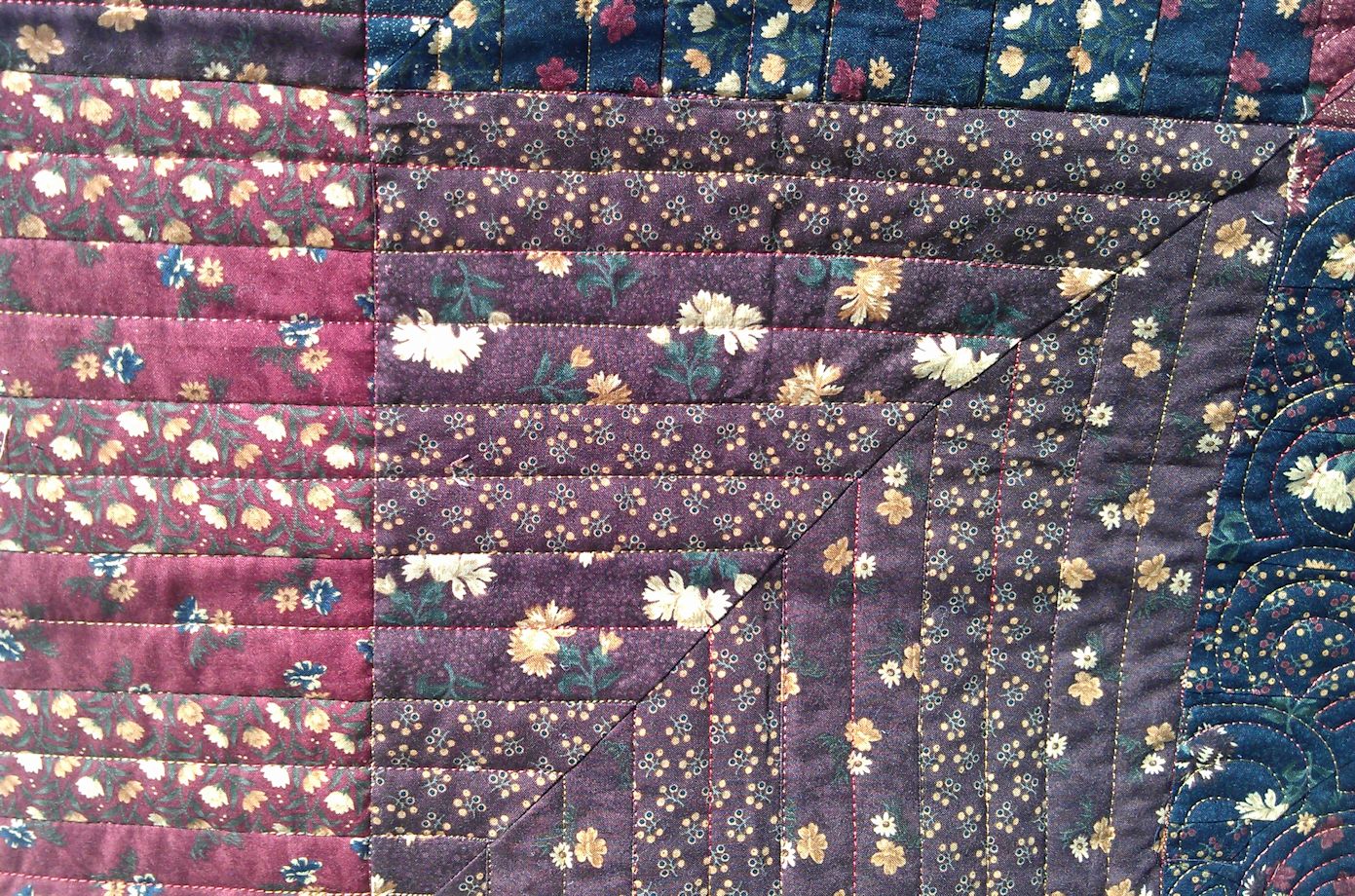
I started by doing straight line quilting from the piano key border into the adjoining row of blocks, following the existing seam lines of those blocks. But when I looked at the other side’s piano key border, it didn’t marry up with the seam lines of those blocks, so I had to abandon that idea for the other side. What to do?

I’d seen quilts that blended one motif into another but hadn’t tried it myself, so I sort of did that. The motif I used for the blocks next to the straight line blocks was a curved open headband motif with squared off edges, and then the one for the blocks and piano key border adjacent to that was a full circular spiral design, thus varying the quilting from one edge to the other from straight lines to circular lines.

(Click on a photo to view it larger)

quilt136_04 quilt136_03

quilt136_02

quilt136_01


Community Quilt 135

13 04 2014

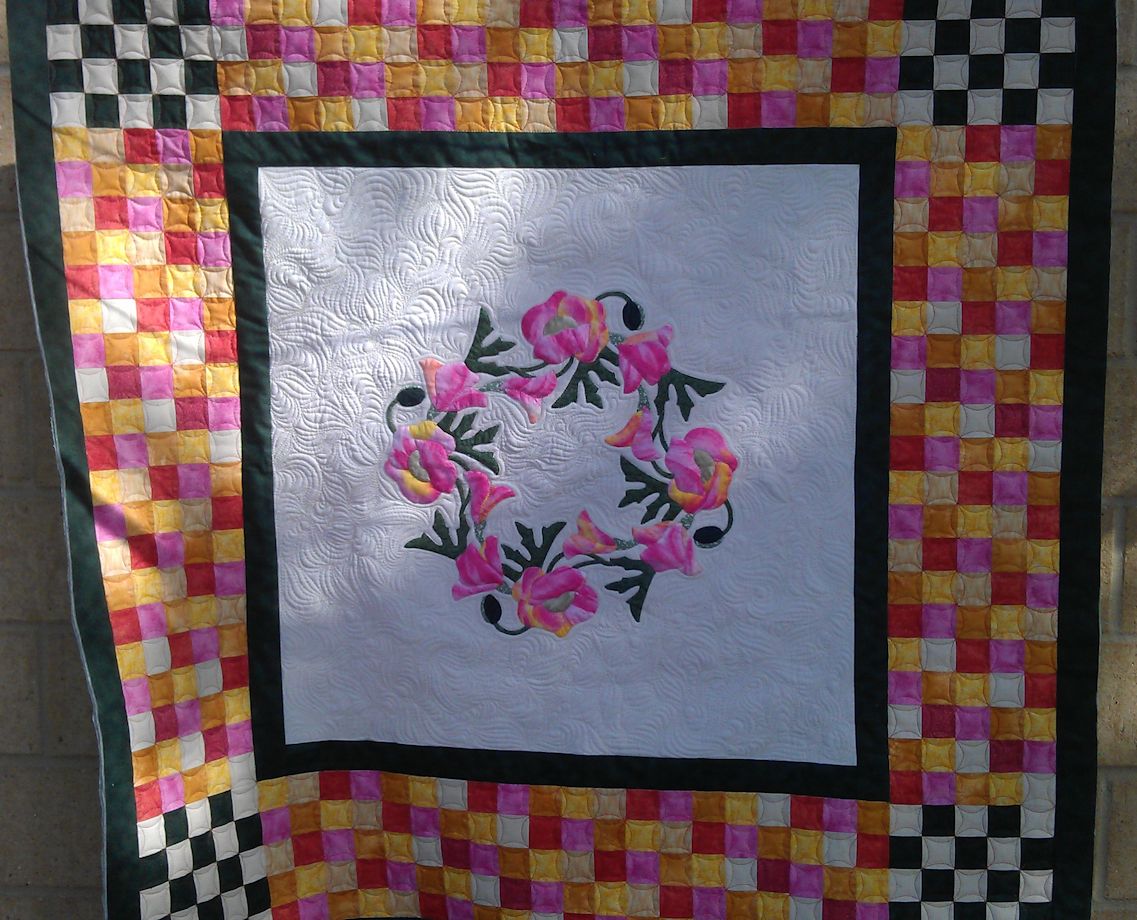
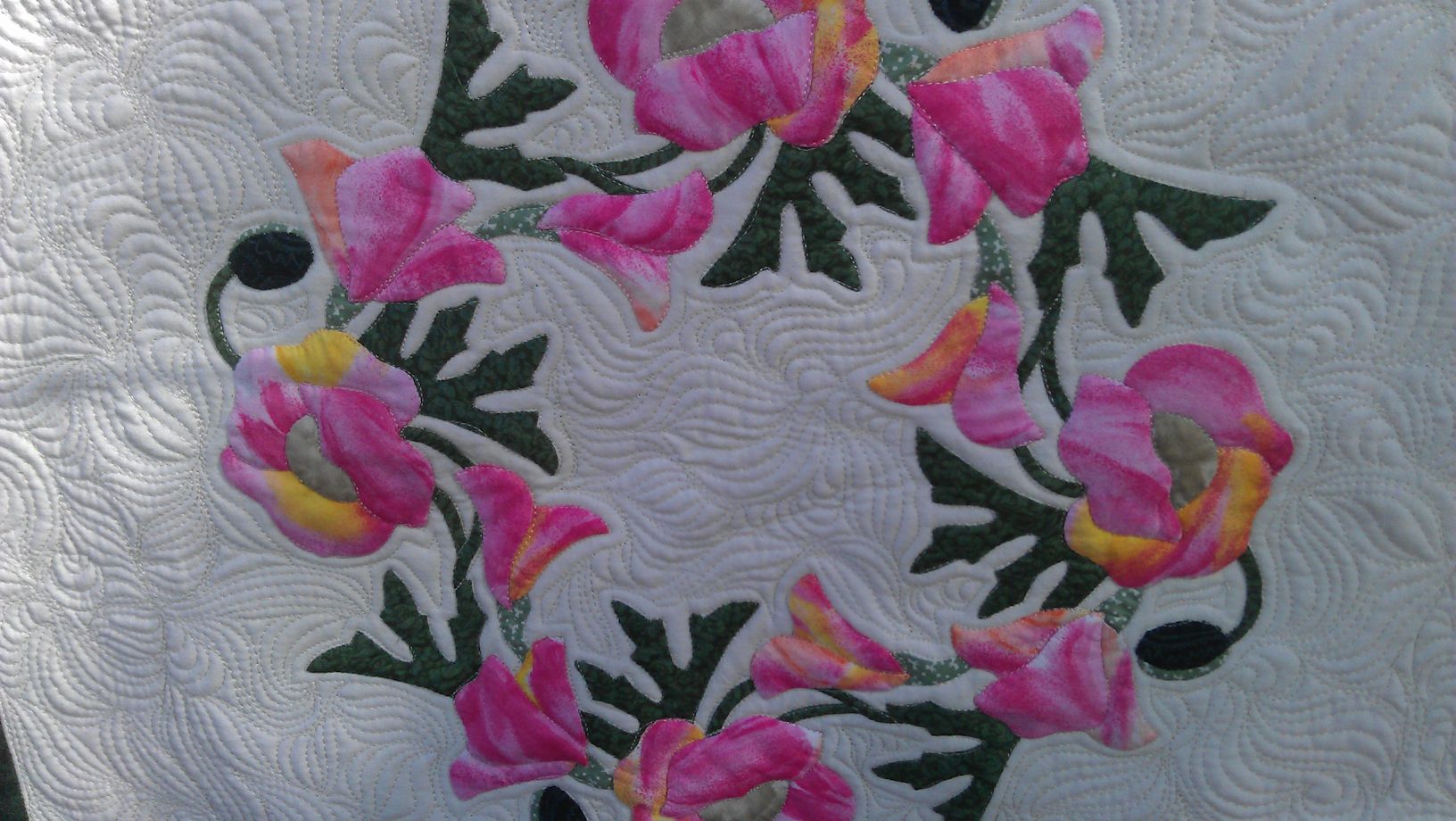
I loved the colours in this quilt! And as soon as I pulled it out of the bag, the cream centre just screamed ‘McTavishing!’ to me, so that’s what I did. I also stitched around the main parts of the appliqued flowers in the centre to make them ‘pop’ even more.

I left the dark green borders unquilted, and did my quick and easy cathedral windows motif in the checkerboard borders using a variegated orange/copper/pink/ginger/peach rayon thread.

I was really pleased with how this quilt looked after I’d quilted it.

(Click on a photo to view it larger)

quilt135_01

quilt135_03

quilt135_02  quilt135_05

quilt135_04

Threads used:

  • Top: Fil-Tec Glide ‘Cream’ (40 wt, trilobal polyester, colour 20001) and Wonderfil Mirage (30 wt, rayon, colour SD31)
  • Bottom: Fil-Tec Glide pre-wound bobbin (white)


Community Quilt 134

13 04 2014

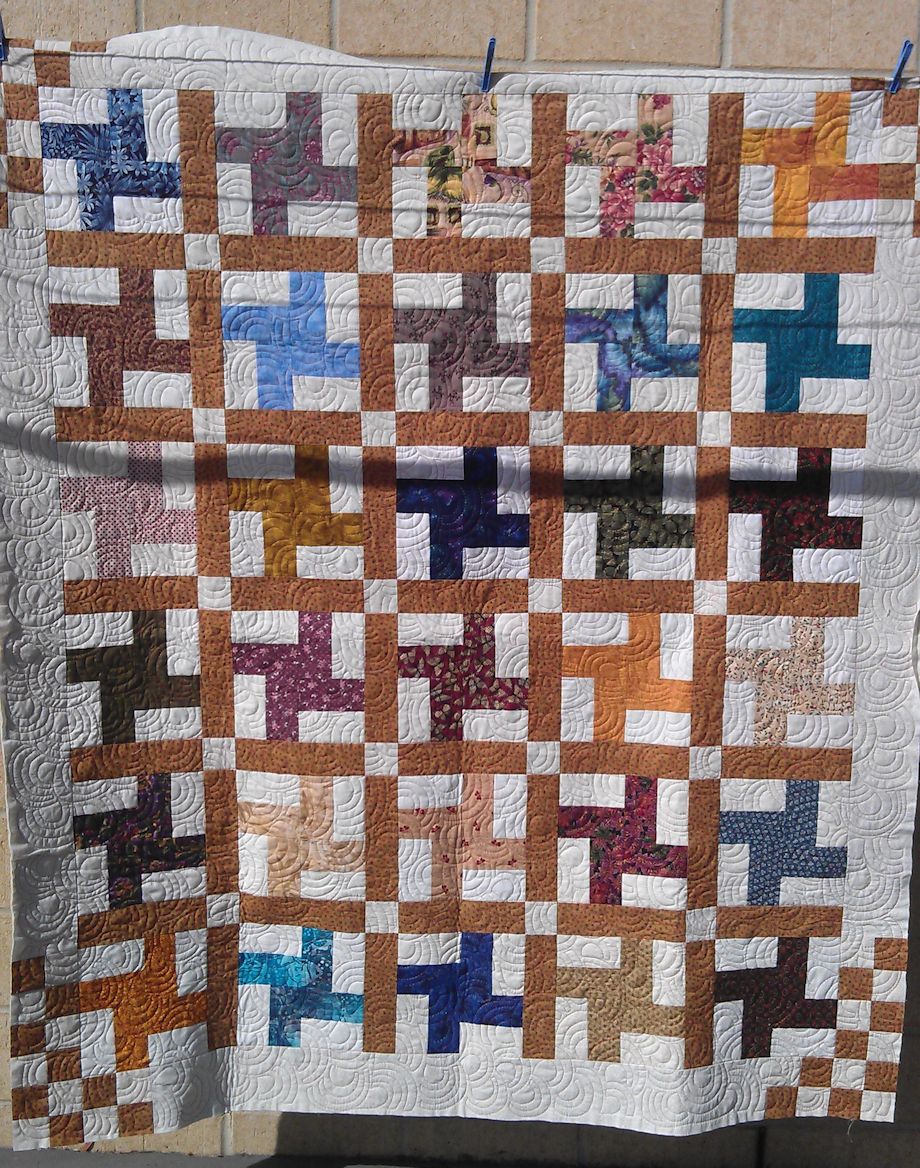
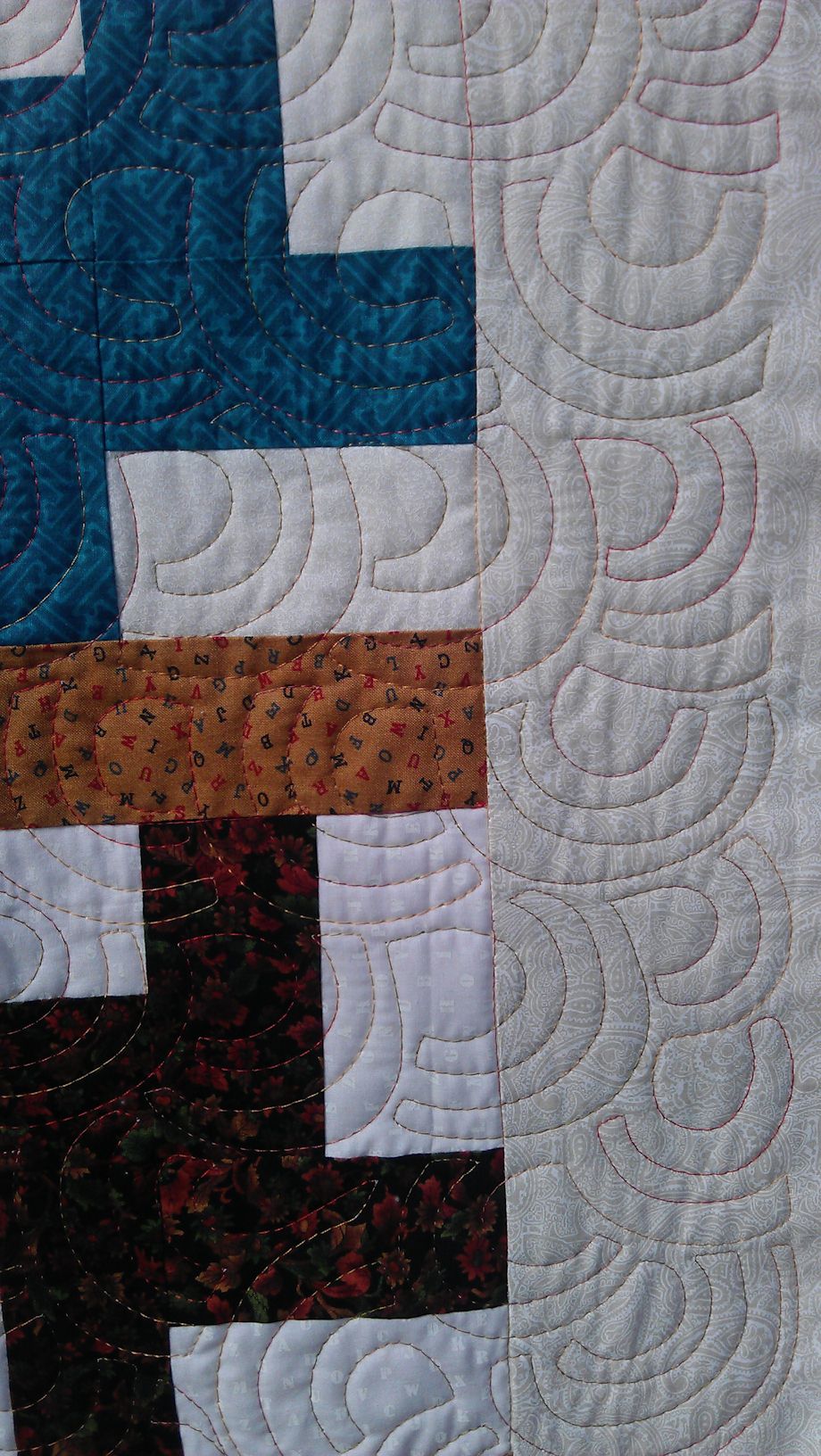
I thought this very geometric quilt top needed something to soften the edges a bit, so I quilted it in a squared-off variation of the ‘open headband‘ motif I’ve used many times before. I stitched this design all over the quilt, using a cream thread.

(Click on a photo to view it larger)

quilt134_01

quilt134_03

quilt134_02

Threads used:

  • Top: Fil-Tec Glide ‘Cream’ (40 wt trilobal polyester, colour 20001)
  • Bottom: Fil-Tec Glide pre-wound bobbin (white)


Jim’s ride

7 04 2014

Background

Our friend (let’s call him Jim) has just cycled – yes, on a bike – from Adelaide to Perth. That’s a HUGE undertaking and an amazing journey to do on a bike. I cannot imagine the mental and physical strength required. Jim is from Edmonton in Canada, and his wife (let’s call her Sue) is on teacher exchange in Adelaide. We know Jim and Sue as Jim was on teacher exchange from Edmonton to Perth in 1989 and taught at the school where my husband taught. Some 25 years later, they’re back, and this time Jim is the ‘house spouse’ and Sue is the breadwinner. They didn’t have kids in 1989, and now both their children are grown and have left home. Their son is currently studying at the University of Western Australia in Perth.

Prior to this amazing trip, Jim went on regular 85 km rides in the hills around Adelaide. And when in Edmonton, he cycled very regularly, participating in a 1000 km kids cancer charity ride.

Jim had a three-day break with us almost at the end of his journey, and I took the opportunity to interview him about his amazing ride.


jims_ride02

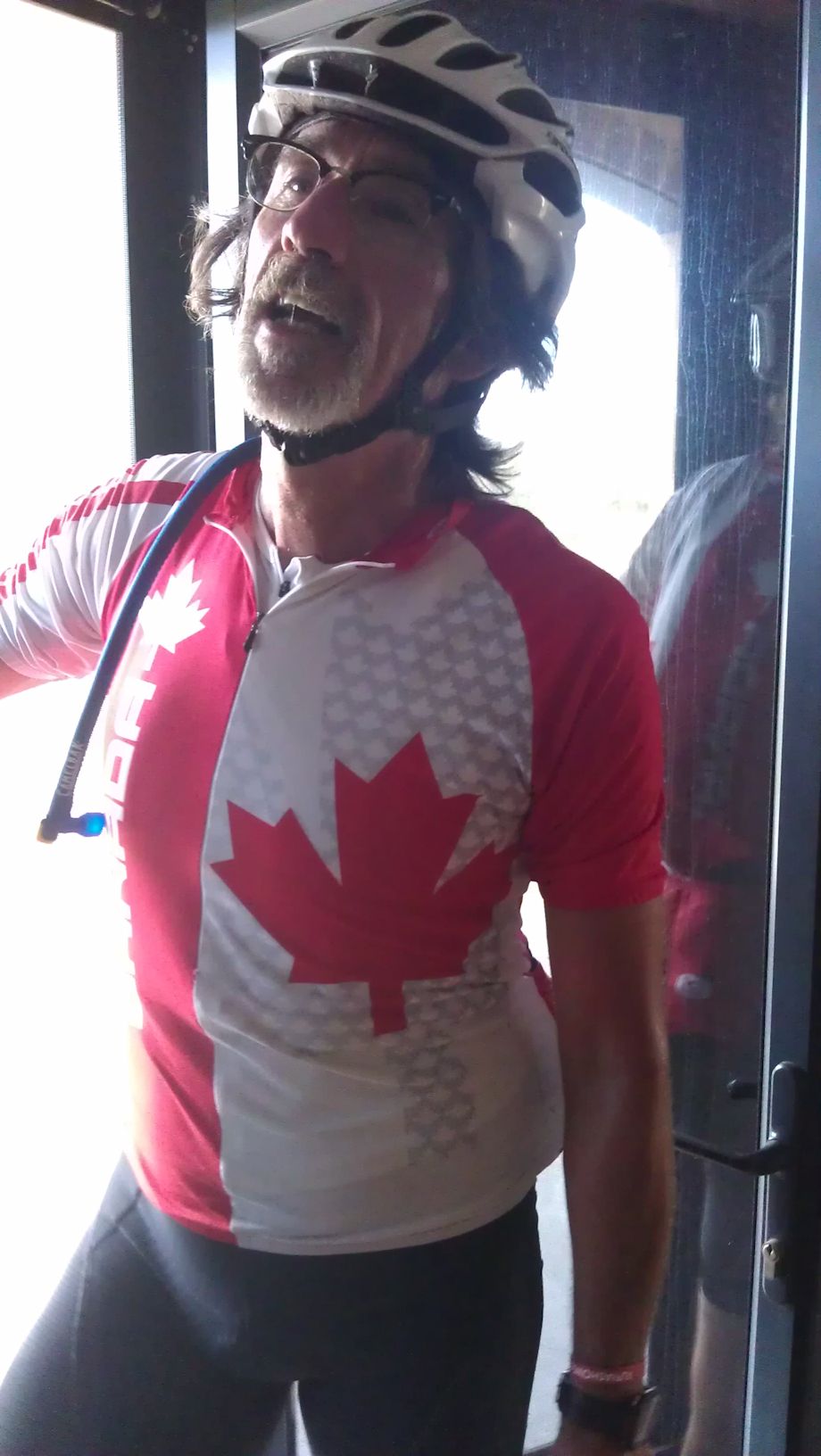
Walking in the front door of our house


jims_ride03

The bike before Jim unpacked it

The numbers

  • It’s ~2900 km from Adelaide to Perth going the route Jim took from Adelaide to Perth (i.e. via Esperance). For those in the US, that’s just a bit under 2000 miles… About the distance from New Orleans to San Diego.
  • He rode between 150 and 200 km per day, on average, for about 17 days straight; the longest distance he covered in one day was about 220 km. (Again, for those in the US, 160 km = 100 miles.)
  • He was in the saddle for at least 6.5 hours a day for most days; his longest day was more than 10 hours riding. He would start riding at least one hour before sunrise, and stop around 2pm on most days, in time to organise accommodation and to rest.

The route

jims_ride01


Jim left Adelaide (A on the map) on March 19. His route and timing comprised:

  • 2 days from Adelaide (A) to Port Augusta (B) (1 day off sick in Port Augusta)
  • 3 days from Port Augusta (B) to Ceduna (C) (220 km to Kimber, 90 km to Wirilla)
  • 1 day from Ceduna to Nundroo (D) (roadhouse only, not a town)
  • 1 day from Nundroo to Nullarbor (approx. E) (roadhouse, not a town; with a 26 km round trip detour to the head of the Great Australian Bight)
  • 1 day from Nullarbor to Eucla (F)
  • 1 day from Eucla to Madura (G) (up really early, descended to ocean plain; 65 km to Mundrabilla roadhouse for breakfast, then 115 km to Madura)
  • 1 day from Madura to Caiguna (H) (Cocklebiddy was a nice break point at 90 km, with another 65 km to Caiguna)
  • 1 day from Caiguna to Balladonia (I) (got up early as it was the 90-mile straight stretch of the Eyre Highway across the Nullarbor Plain; 190 km that day)
  • 1 day from Balladonia to Norseman (J) (broke a spoke, spent 30 mins doing running repairs and rebalancing load to account for imbalance from broken spoke, computer logging device stopped working [low battery?]; NOTHING from Balladonia to Norseman – no roadhouses, no nothing)
  • 1 day from Norseman to Esperance (K) (stopped at Salmon Gums for breakfast, then the wind hit; rode 200 km against the wind)
  • 1 day from Esperance to Wagin (L), but on the bus! Wind was expected to be bad, so spent $66 on a one-way ticket to Wagin (included $10 for the carriage of the bike)
  • 1 day from Wagin to Bunbury (M) (Coalfields Highway down from Collie to the Southwest Highway was terrifying – traffic, culverts cut into road to divert water are a real hazard for cyclists as they cut through the shoulder area)
  • 1 hour from Bunbury to our place
  • To come: 2 short days to Perth (N)


Physical challenges

  • Heat stroke on Day 1, when it was 38C (100F) coming out of Adelaide, resulting in headaches, stomach cramps, etc. He had a rest day the next day to deal with that.
  • Hills. Although as he said, ‘there’s always a top, and sometimes there’s a down too’, so hills aren’t really a big deal to Jim (he does cycle in the Rockies at home…)
  • Wind. Constant, relentless, sometimes behind you, sometimes in front, often buffeting you at the sides. Unlike hills, there’s no ‘top’, and you don’t know when it will get worse or calm down.
  • Traffic. Big trucks on the highway. If one was coming from behind and one from in front at the same time, he pulled off the road and stopped to let them pass. Likewise, if going up a hill and a truck was coming from behind, he stopped to let it go past so that it wouldn’t have to swerve out on the crest of a hill. So he did the right thing by the traffic.
  • Broken spoke somewhere between Balladonia and Norseman. Created imbalance, so had to rebalance his load, and do some running repairs enough to get to Esperance where he got it fixed at the local bike shop.
  • Crap on the road shoulders. Lots of debris that can make cycling dangerous – bolts and screws, broken glass, sticks, small rocks, etc.
  • Variable road shoulders. Shoulder widths vary from up to a metre wide to absolutely nothing, when you have to mix it with the traffic. And the state of the shoulders varies greatly too, with lots of breakaways at the edges, unrepaired potholes, sharp drop-offs etc.


Mental challenges

  • ‘Why am I doing this?’ – he still doesn’t know why!
  • Handling the frustration and anxiety as a result of the broken spoke
  • Loneliness and being by yourself. Strips away everything and all the normal barriers you put up to thinking; you become more pure in your thinking, more emotional, and more emotionally vulnerable.


Logistics

Although he carried a small tent and blow up mattress, he only camped out for one night, when the South Australian town he was in was closed up (it was a Sunday…). Other nights were spent in roadhouse motel rooms, on-site caravans, small hotels, etc. It was basic accommodation (though often expensive because it was the only accommodation for a couple of hundred km), but a bed, a shower, fridge, and toilet facilities were all he needed.

Everything was packed onto the bike, except for the stuff he mailed ahead to himself. His main water supply was his ‘Camelback’ strapped to his body and with a mouth tube. He carried ~4.25 L water – 2 L in the Camelback, and 3x 750 mL bottles, each of which also contained powdered electrolyte. He would only drink from the bottles when he stopped, and would sip from the Camelback about 4x per hour. He never ran out of water. He also started cycling very early in the day, and as it was cool in the mornings, he wasn’t drinking too much water.


Miscellaneous

  • As he was travelling from east to west, he didn’t wear sunscreen or lip balm, and often not sunglasses either because the sun was at his back for much of the time. However, some mornings he wore sleeve things to cover his arms from the sun (and the cold in some places!).
  • The relentless nature of the wind coming from Norseman to Esperance and especially after Salmon Gums, plus a spoke that had broken causing the balance to be off, resulted in him catching the bus from Esperance to Wagin (some 500 km).
  • He lost perhaps 2 kg the whole trip from Adelaide to Bunbury! One reason perhaps is that he didn’t get his heart rate up into the burn zone – instead of riding hard and fast for the 180 km in a day, he took it at a pace that allowed him to manage the distance without burning too much.
  • Regular stops. He got into a routine of stopping every 50 km for about 10-15 minutes break.
  • Most cycling was done from 6 to 11 am, with a bit more from 11 am to 2 pm, which is when he tried to finish most days.
  • Food. He ate roadhouse food, as greasy and fatty as he could get, for the calorific value. And had a couple of beers each night where he could get them. The worst food he had was a tough-as-old-boots beef schnitzel he had at Nundroo. He supplemented his food with gel energy packs.
  • Roadkill. Kangaroos, emus, a feral cat, a camel! Stench…. Didn’t see many live animals – just a couple of foxes, a couple of dingoes, some emus, and one rabbit.
  • No flat tires at all! However, he wasn’t using standard tires with inner tubes. From how Jim described it, he had these special tires and the ‘tube’ contained some sort of sealant that expanded and closed the hole if a puncture was detected.
  • Signage sucks, especially close to towns as assumes local knowledge which tourists don’t have.
  • Phones. He carried two phones – his iPhone (WiFi only), and a Telstra ‘burn’ phone – and a camera (though he said he really didn’t need the camera as he should’ve used just his iPhone camera). Telstra had coverage for almost everywhere he stayed (exception: Nundroo, where there was a pay phone).
  • Supplies. Prior to leaving Adelaide he had mailed packages of electrolyte powder, Hammer gel energy packs, etc. to Ceduna and Balladonia and had contacted them by phone to book accommodation and let them know about the packages on their way. However, as he was running a day late because of illness on the first day, he had to call to change his accommodation dates. He said the packages were waiting for him when he arrived at both places. He also mailed clothing to our place so he had something decent and clean to wear when he got here.
  • Routine at the end of each day’s riding – would finish around 2-3 pm to avoid the worst heat of the day and would try to get accommodation straight away before there were no vacancies for the night. Accommodation varied from roadhouse motel units (of varying degrees from fleapits to OK, varying costs — $90 to $130 per night, and varying facilities, though most had air conditioning, fridge, and a TV), to old-style hotels (Wagin, Bunbury), to on-site caravans ($50-$100/night; Port Augusta, Ceduna, Norseman, Esperance; some with own bathroom, but most with shared ablution block; fridge, TV), and only one night did he have to sleep in his tent/sleeping bag. He would keep his bike in his room, even in the upstairs rooms at some of the older hotels. He would partially unpack the bike, and his first priority after checking in and unpacking the bike would be to get some food as he rarely had breakfast or lunch. The first food would be junk food, potato chips (crisps), choc milk or iced coffee or lemon squash (loads of sugar), but no Coke or Pepsi. Then he’d shower and relax a bit, sometimes sleep for an hour, then get up and have his main meal of the day – often a counter meal at a pub, a couple of beers (rarely more than two) if there was a bar, then stock up on snacks (e.g. more hot chips [fries] with lots of salt and vinegar) and drinks for the evening. During the evening he’d watch a bit of TV, and charge up his devices – camera, phones (he carried two), battery backup for his devices, head and tail lights for the bike (all charged via USB into a power outlet adaptor). And sleep.
jims_ride13

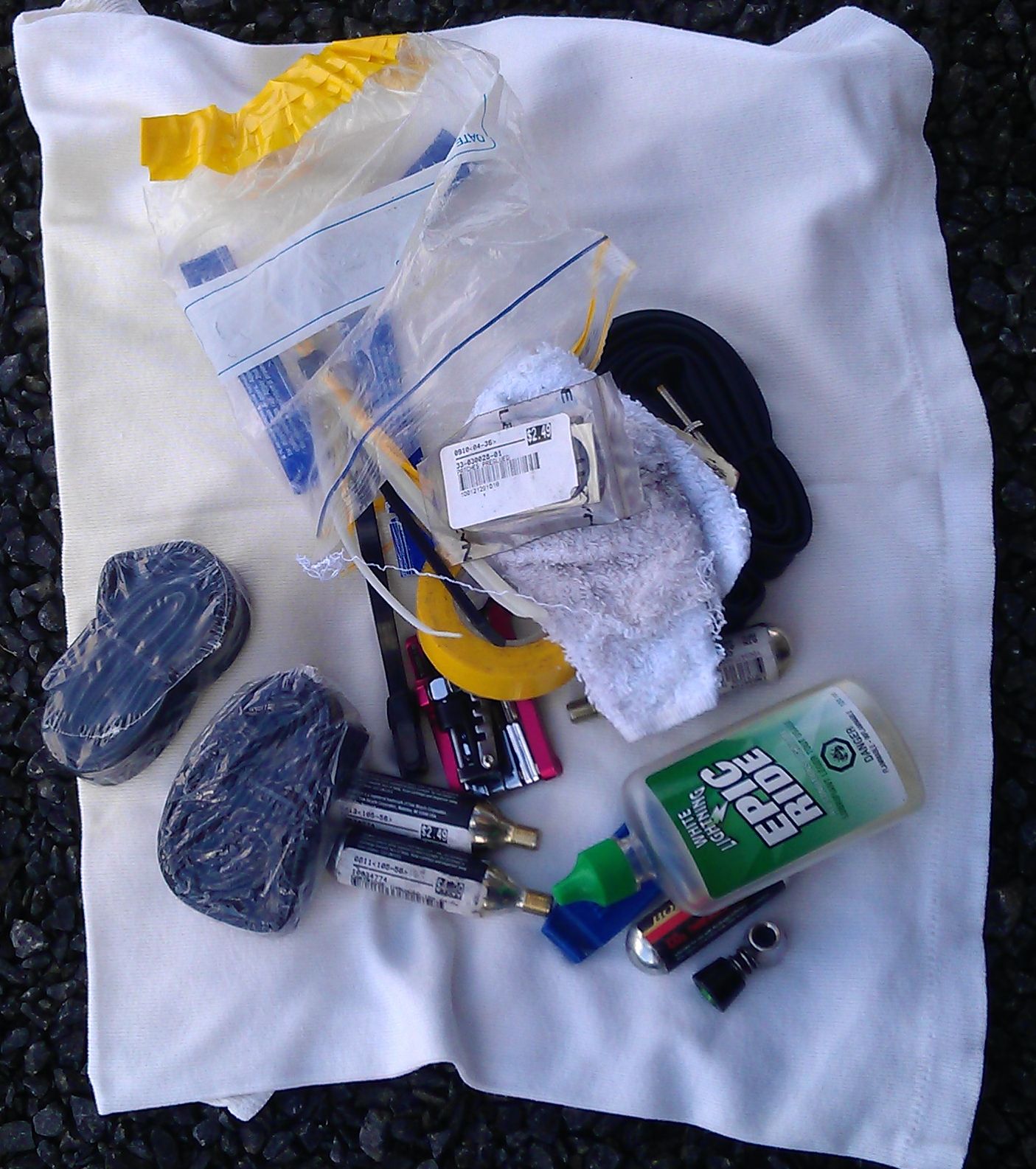
Most of contents of toolkit

jims_ride12

Basic repair tools and compressed air for tires

jims_ride11

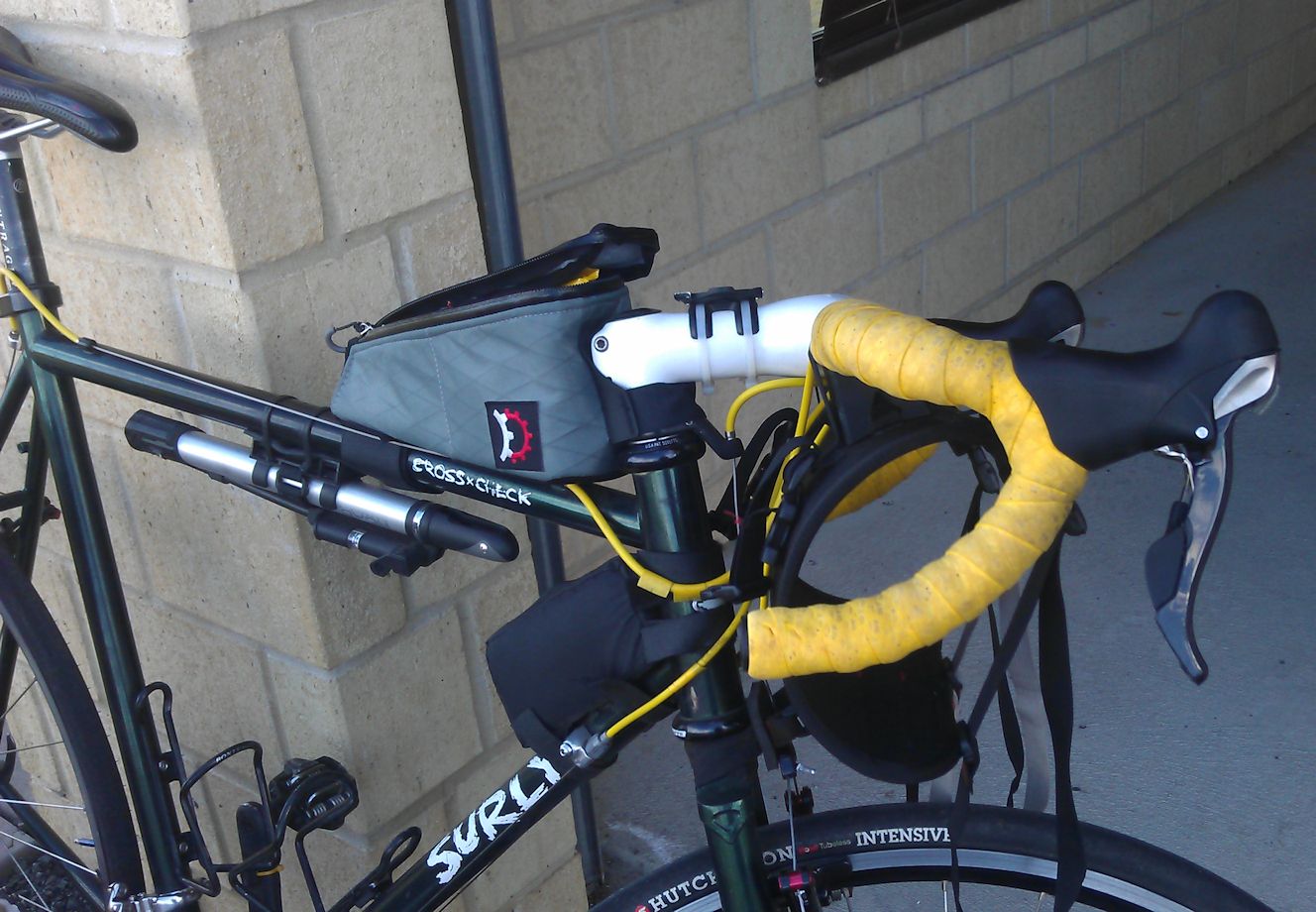
‘To hand’ pack, toolkit below, foot for Polar computer device on handlebar


jims_ride10

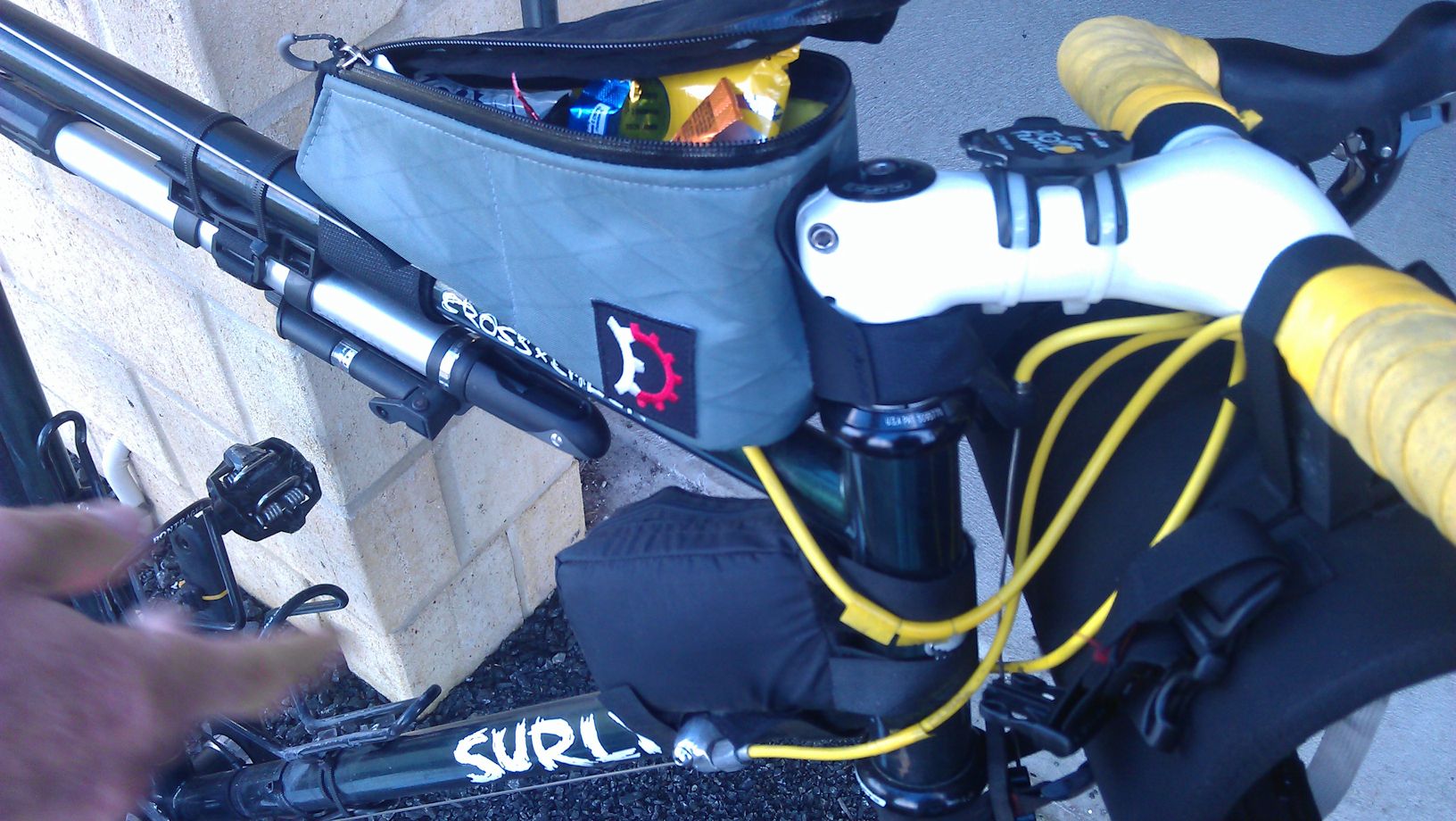
‘To hand’ pack on top of bar, pump, toolkit below bar

jims_ride08

Emergency ‘food’ pack contents in case of no food options for purchase (e.g. places closed for the night)

jims_ride07

Gel energy supplements

jims_ride06

The 3 water bottles to supplement the Camelback

jims_ride09

After 3 days rest, prepping the bike the day before the final ride into Perth

jims_ride14

Final prep for the final push; bike all loaded up with gear

jims_ride15

I’m outta here!


Community Quilt 133

29 03 2014

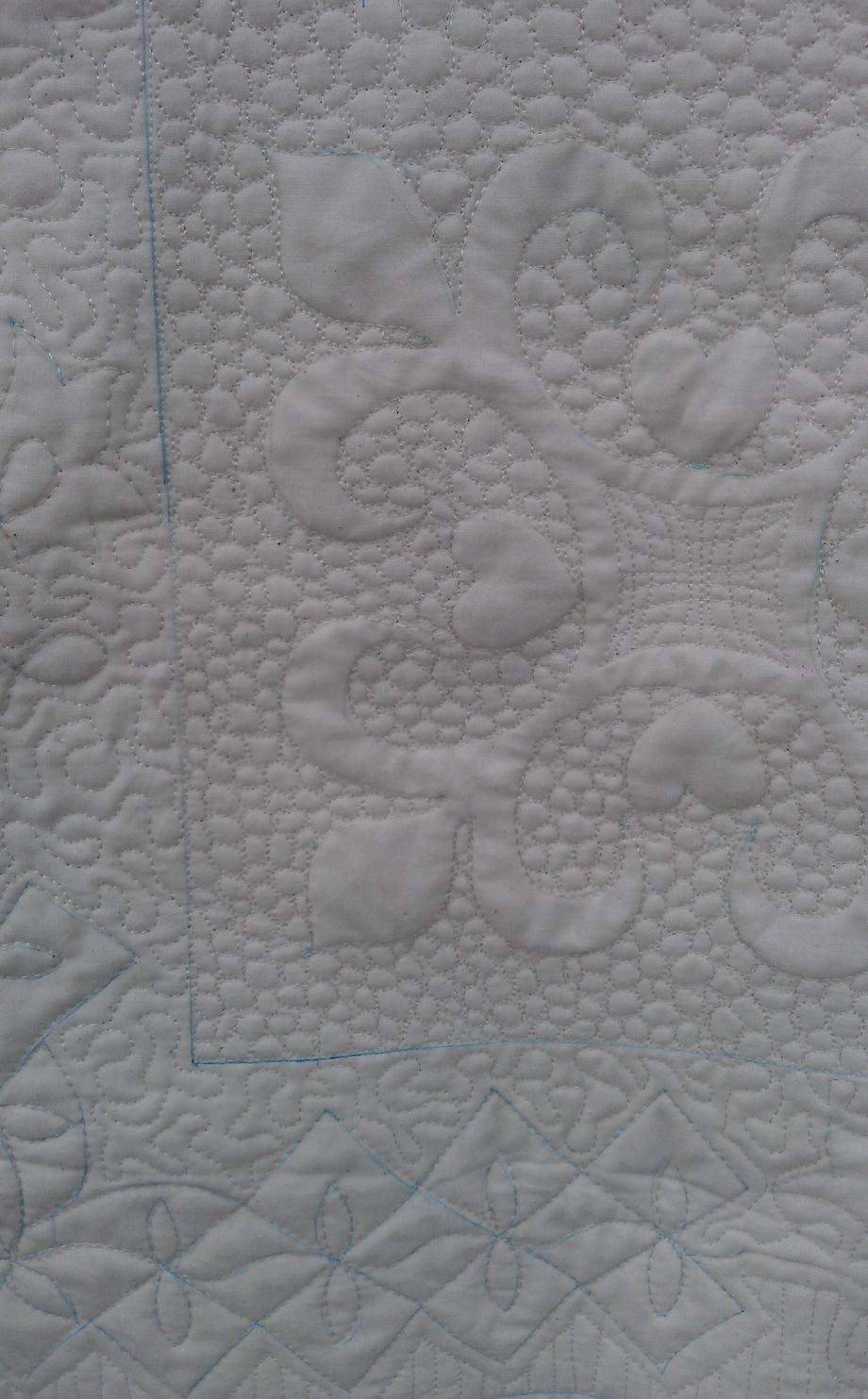
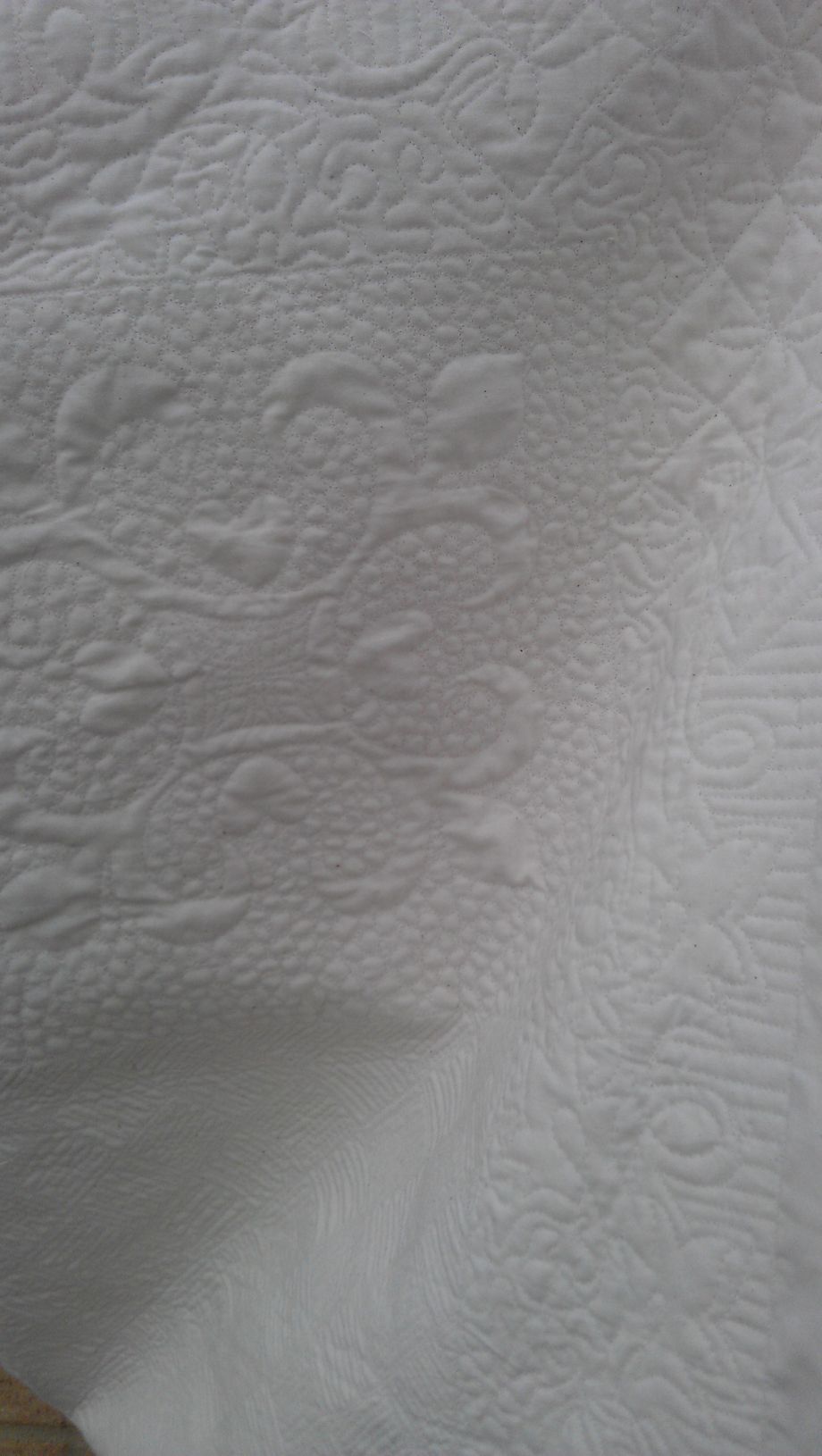
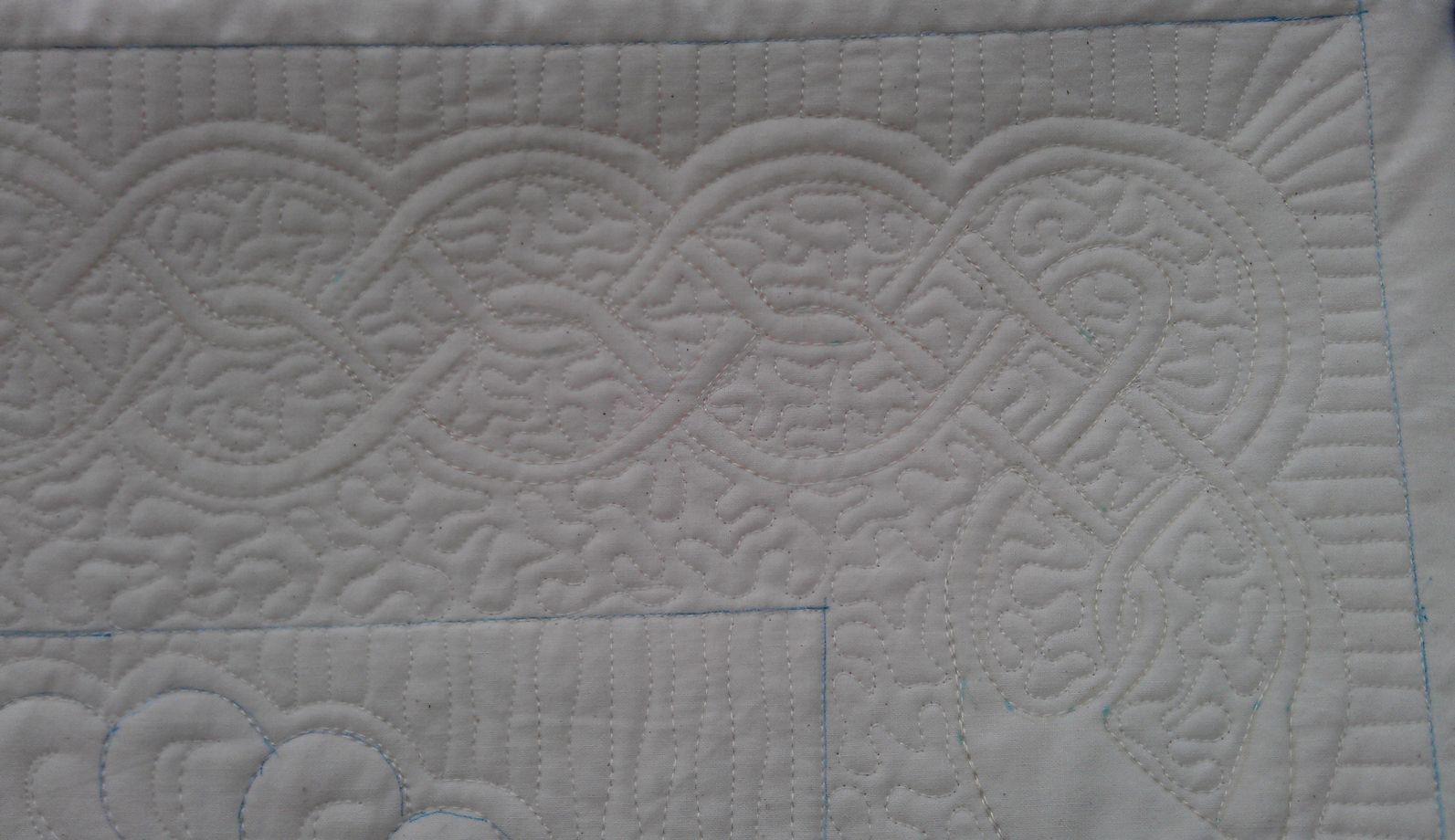
I’ve never done a ‘whole cloth’ quilt before, though I’ve admired those I’ve seen. For those not familiar with the term, a whole cloth quilt is created from one piece of fabric for the top — no piecing, no blocks sewn together, no applique. Typically, the single piece of fabric is one colour with no pattern in it, often a light colour like cream or white, though I have seen some stunning whole cloth quilts done in black. The decoration comes from the quilting.

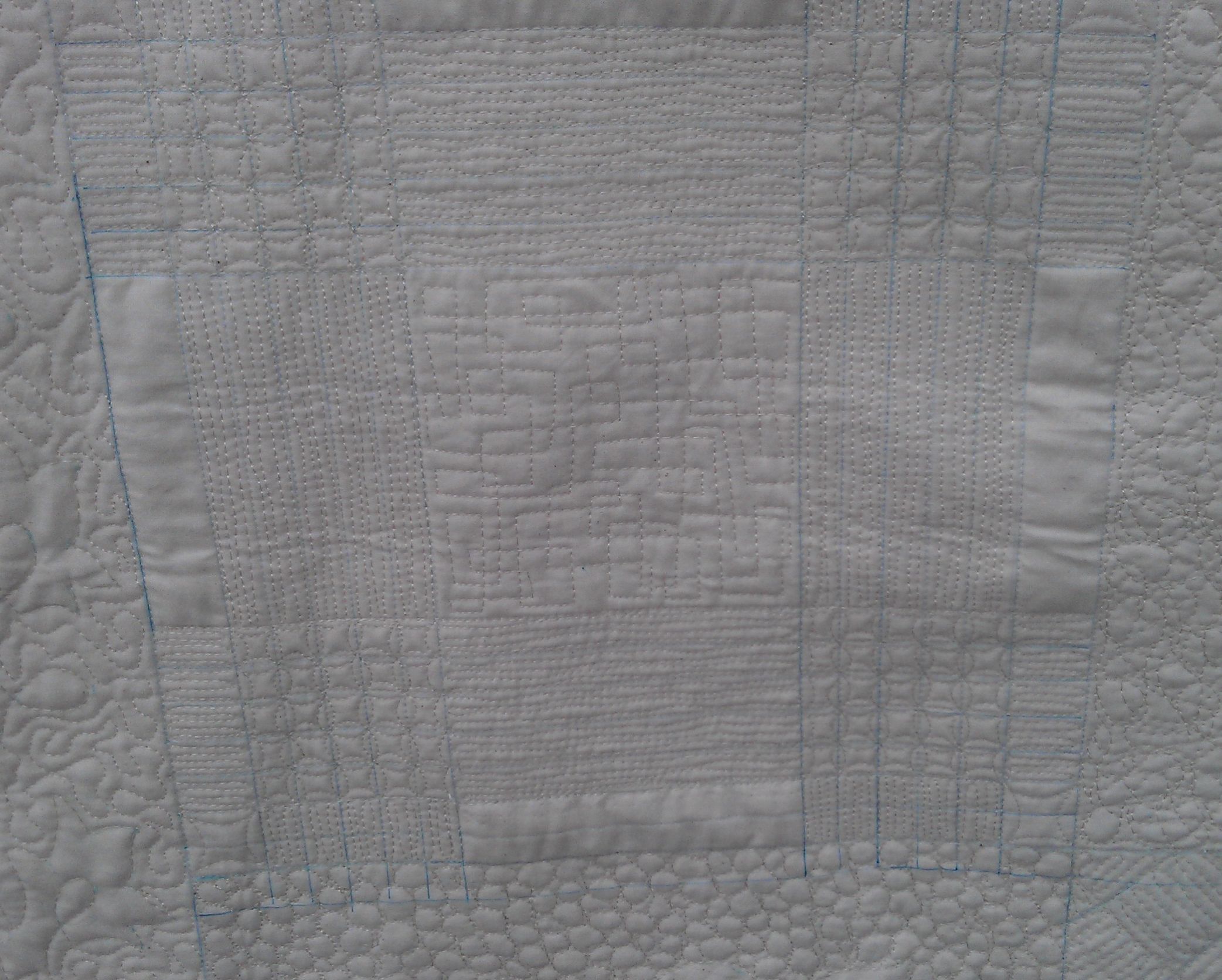
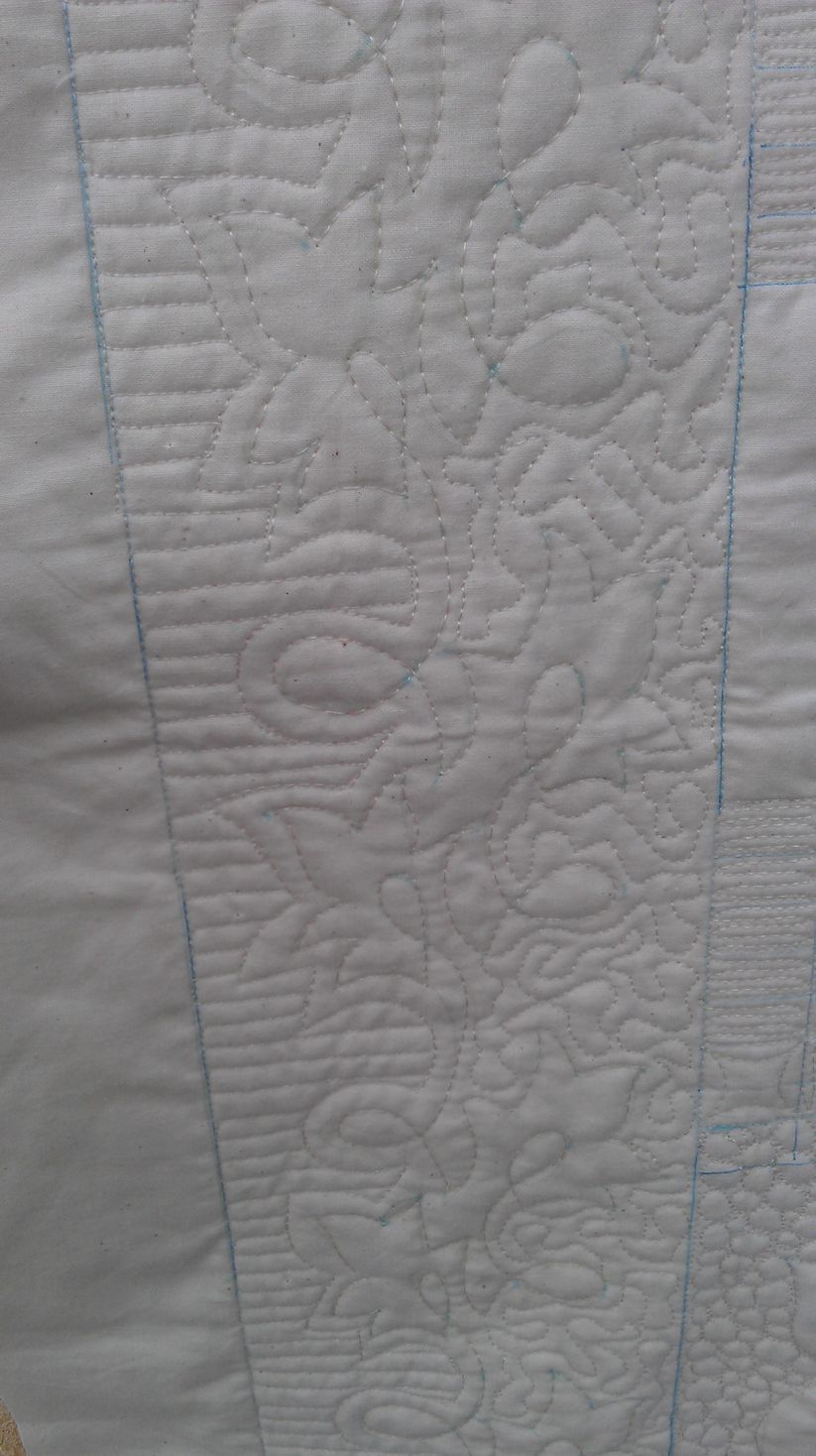
My challenge with this quilt was to take someone’s whole cloth top that they had carefully marked (the blue lines) in 12″ squares and a 4″ (?) border, and make something of it. Instead of trying to reinvent the wheel, I followed the markings the creator had made, then added fills where I thought they were necessary. I didn’t do ANY ruler work in this piece — all the ‘straight’ lines are either deliberately wonky, or are done by ‘eyeballing’ an imaginary straight line.

The centre square was the only one that didn’t have any markings, so I found a picture of a square Celtic knot and printed it out then marked it up with orange chalk.

The person who marked up this quilt did an awesome job in the ‘borders’ as she segued from one design to another in a seamless manner.

I REALLY REALLY hope that when this quilt gets washed before it gets given away that the marks come out! That said, the back looks pretty stunning too! 😉

(Some of the photos weren’t as good as I’d like — it was pretty windy outside and rain was threatening)

(Click on a photo to view it larger)

quilt133_06

Some of the designs after I had only stitched the marked lines:

quilt133_04

quilt133_05

And then I quilted each square….

I started with this one, as I figured that 1/8″ straight lines creating a checkerboard effect of about 1″ diamonds would suit the markings:

quilt133_19

quilt133_15

quilt133_16

quilt133_18

quilt133_09

quilt133_22

quilt133_07

quilt133_02

With the central Celtic knot design, I did some very tight scribble stitching inside the background areas, then less and less tight stitching heading out to the edge to the 12″ square. I was really pleased with how it came out, as my original intention was to do tight scribble stitching for the entire square. However, I thought it might pull the quilt out of shape if I did that, so I changed tack and made the outer areas far less tight, though it’s still scribble stitching.

quilt133_17

Detail of some of the border designs:

quilt133_10

quilt133_11

quilt133_12

quilt133_13

quilt133_14

And this is the back:

quilt133_21

Time taken: About 6 hours or so (maybe 10??? — I wasn’t keeping track…)

Threads used:

  • Top: Fil-Tec ‘Glide’ (40 wt trilobal polyester, Cream, colour 20001)
  • Bottom: Fil-Tec Glide pre-wound bobbin (white)


Community Quilt 132

23 03 2014

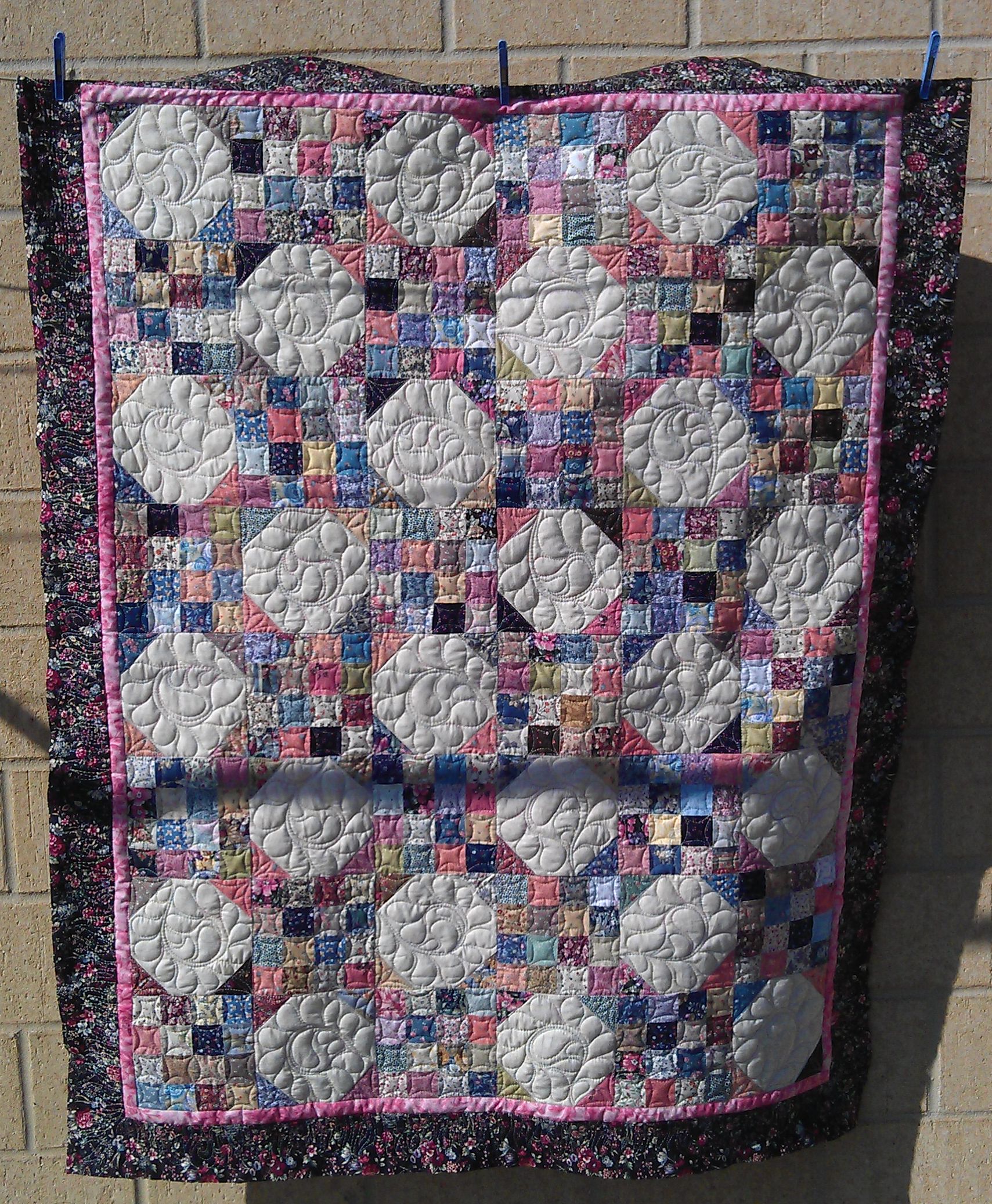
This was quite a traditional snowball block quilt, with lots of small floral fabrics used in all the scrappy squares.

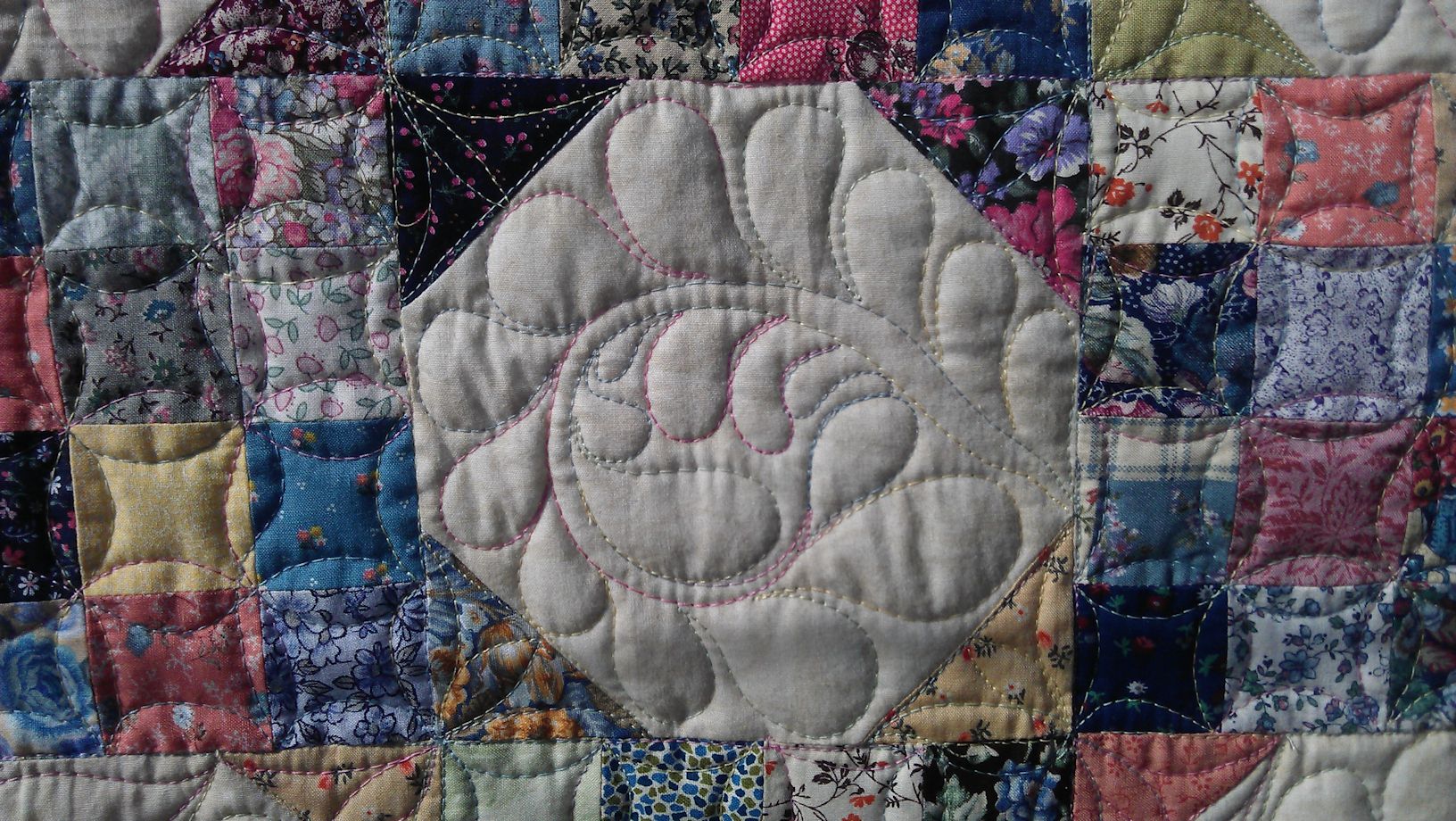
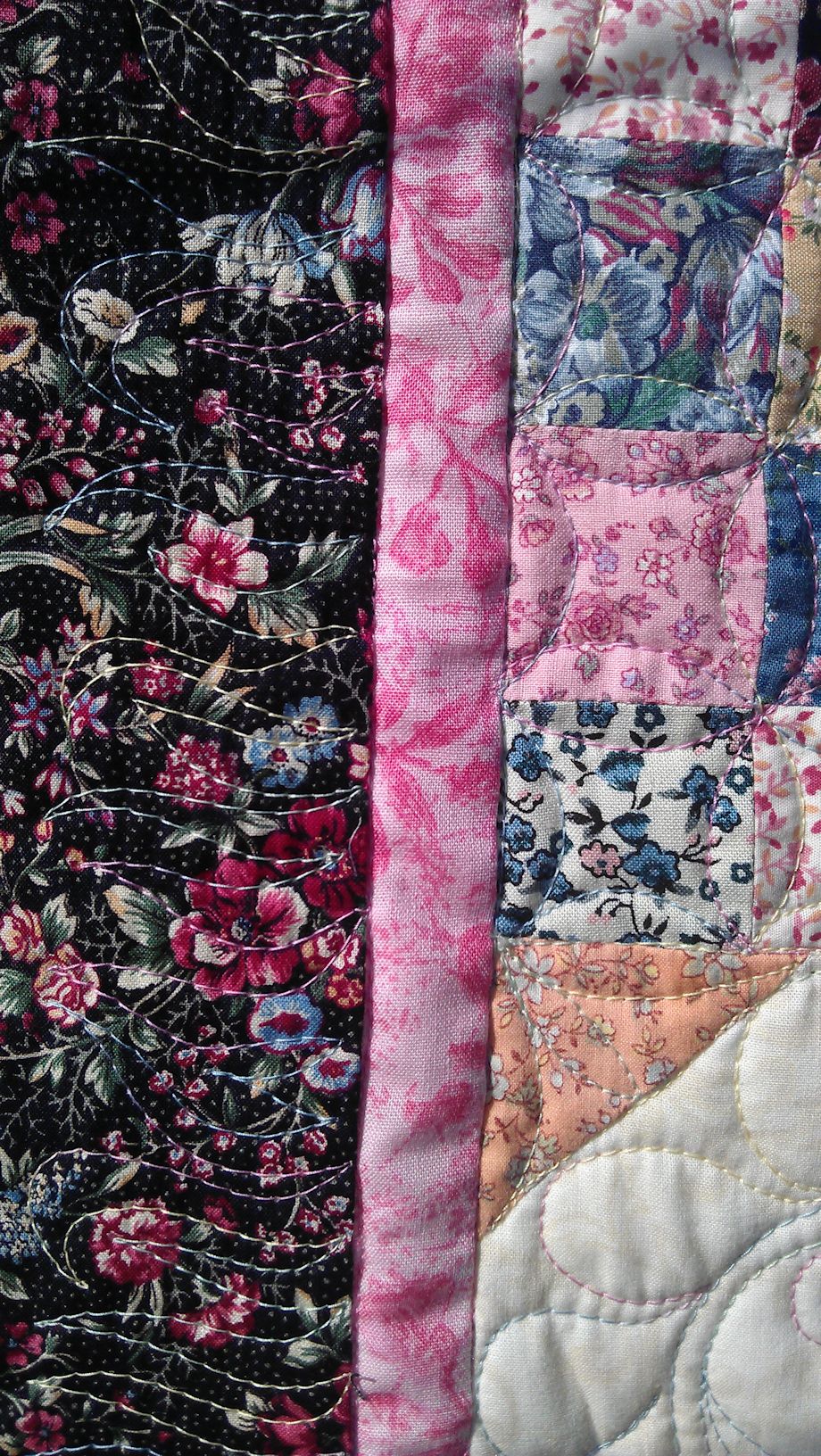
I stitched in the ditch around all the blocks first, then did the cathedral windows/orange peel motif in all the blocks of little squares (each scrap square was about 1.5 inches square),with a half flower in the half square triangles setting off the snowballs. In each snowball, I did a single loopy spine and bulbous feathers. All stitching was done in the same variegated pastels (pink, yellow, green, blue, and cream) thread. In the black floral border, I did flames all the way along. I didn’t stitch the pink border.

(Click on a photo to view it larger)

quilt132_01

quilt132_02  quilt132_04

quilt132_03

Threads used:

  • Top: Fil-Tec ‘Harmony’ (‘Spring’, colour 14062; 40 wt cotton)
  • Bottom: Fil-Tec ‘Glide’ pre-wound bobbin in white


Community Quilt 131

23 03 2014

I liked this bright scrappy quilt! The crisp white set it off perfectly. I think this pattern was used (http://weddingdressblue.wordpress.com/2012/09/24/tutorial-film-at-five-quilt/) or a variation of it.

How to quilt it? First I stitched in the ditch around all the blocks to stabilise the quilt. My next thought was ‘modern’ with lots of straight lines, but then I decided to just do the straight lines in the centres of the sashing and border strips, using white thread. Once that was all stitched, I tackled the small squares. This time I decided to do the cathedral windows/orange peel motif as it’s quick, easy, and gives a great effect of circles and/or flowers. I used a variegated red, yellow, blue, and green thread for these sections. And I finished off the sashing/borders with the scrappy squares using the cathedral windows motif, but in white thread.

(Click on a photo to view it larger)

quilt131_01

quilt131_03

quilt131_02

Threads used:

  • Top: Confession: ANCIENT cotton overlocker thread in both white and a variegated red, yellow, blue and green! Using up my thread stash…
  • Bottom: Fil-Tec Glide pre-wound bobbin in white


Designs, signs, and other oddities

14 03 2014

This post is full of miscellaneous signs, oddities, patterns/designs, I came across in the US.

Patterns/designs

I’m starting to see patterns/designs everywhere — maybe it’s my quilting eye? Here are a few:

Acrylic_wall_hanging_Renaissance_PalmSprings01

Layered acrylic pieces in black, white, grey. I can see this as a quilt…

Acrylic_wall_hanging_Renaissance_PalmSprings02

More quilty goodness — licorice allsorts, anyone?

Carpet_HiltonGardeInn_Monterey

This is DEFINITELY a free motion quilting pattern in the making!

Carpet_Renaissance_PalmSprings01

More potential quilty goodness…

Carpet_Renaissance_PalmSprings02

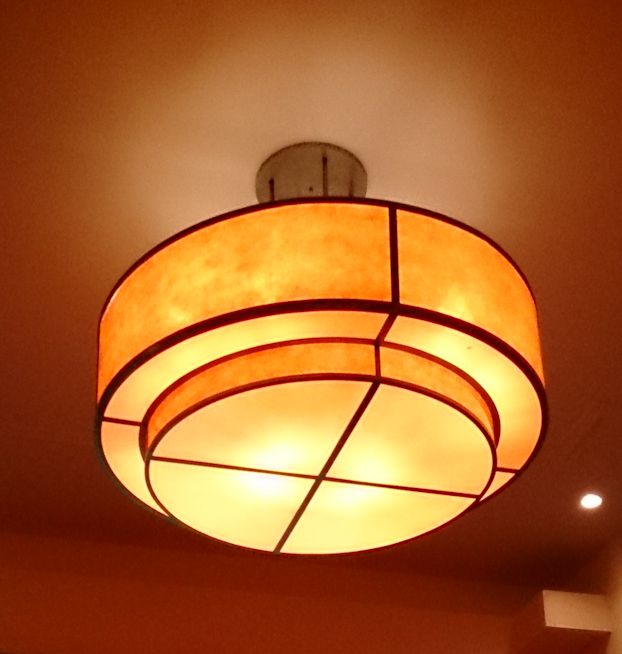
These circles look like alien spacecraft when looking at them at an angle up the hotel corridor. The centre section looks like another quilt… I like the ‘borders’ too.

light_Renaissance_PalmSprings

IMG_4251

Weird signs

IMG_4281._Asilomar

I guess no-one told the crow about the restricted parking.

IMG_4282_Asilomar

I don’t know how you can report a mountain lion that doesn’t retreat to the Park Headquarters when it is threatening you!

IMAG1853_Renaissance_PalmSprings

Other than the need to reword this sign (I’m always editing!), I have to wonder WHAT made them put it up… Not something I want to think about for too long…

IMAG1854Renaissance_PalmSprings

Two things — 3199 people is a very specific number. Why not 3200? Will an extra person cause the courtyard to collapse? Secondly, ‘adult in attendance’ is not going to help children under 14. There could be 3198 adults in attendance, but it doesn’t mean that any one of them is watching out for a child under 14. I think they meant an adult with a supervisory/parenting/guardianship role over their children under 14.

IMAG1862

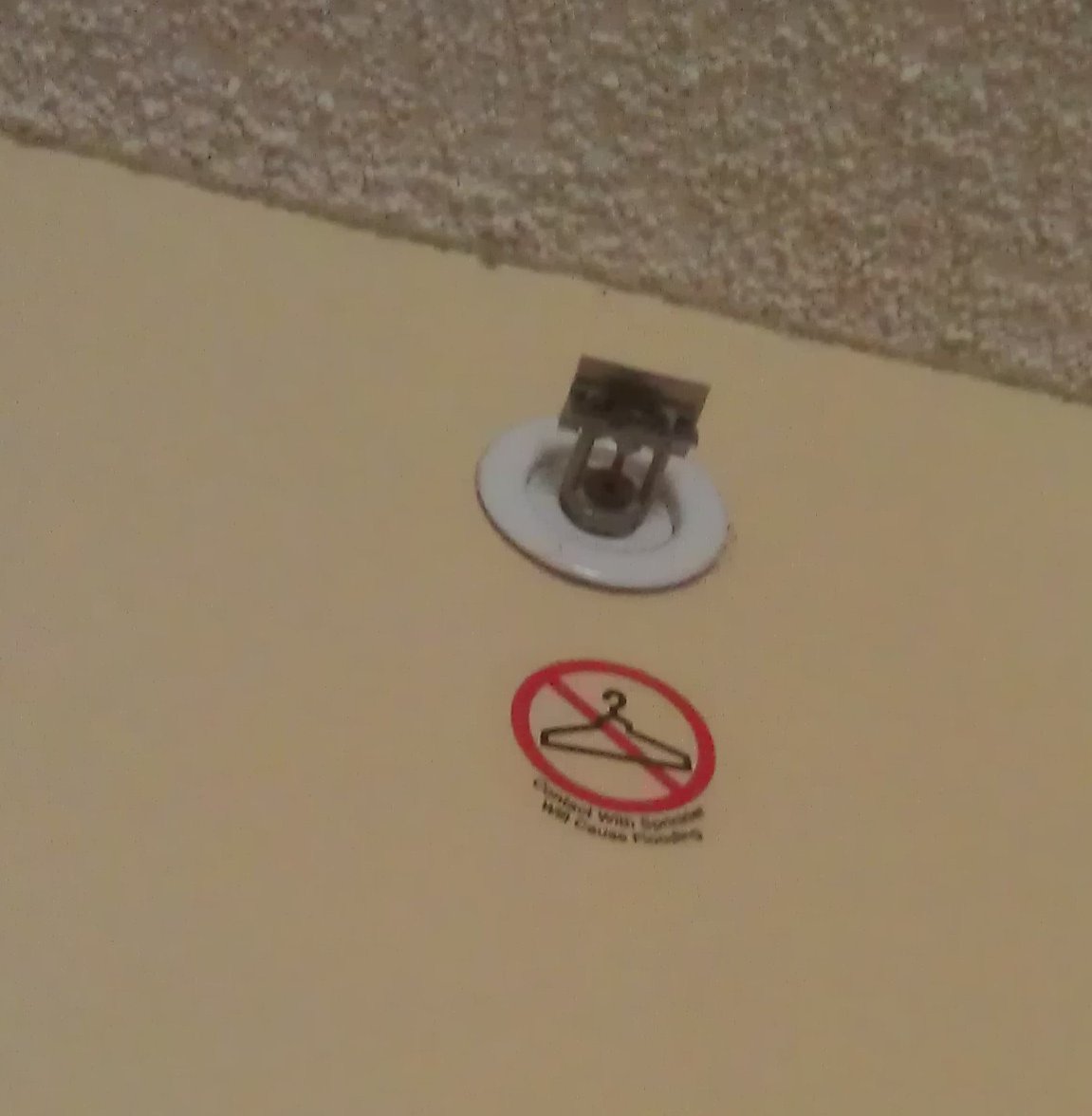
Again, what prompted the hotel to put up this sign a few inches from the ceiling? Did someone once hang their clothes on the room’s fire sprinkler? The sign says ‘Contact with sprinkler will cause flooding’.

Oddities and bits and pieces

IMG_20140304_172555

Yes, seriously! Two people were parading their dogs advertising their doggie sunglasses business. This one had these chic red sunglasses on, and was wearing a little dress (with a frilled skirt!) in a pink and cherry pattern. Only in Palm Springs… or Venice Beach!

IMAG1835

‘How humiliating!’

IMAG1856

I know it doesn’t rain very often in Palm Springs, but from the size of this downpipe outlet, I suspect when it does, it rains VERY heavily and for a short duration. That outlet could sure push out a large volume of water very quickly.

IMG_4242

Love the rustiness and flaky paint on this fire hydrant and the one below, but I wonder if they are still active?

IMG_4241


Feeling mortal

14 03 2014

You coast through life, not thinking too much about death and the fact that your time on earth will come to an end at some point. Then a few things start to get a little too close for comfort and you’re staring down the face of your own mortality.

So it was for me this trip to the US.

Later this year I have a ‘zero’ birthday, so that’s always a time for reflection. And a time to realise that I have fewer years left on this earth than I’ve lived. At 25, 30, and even 40 you don’t really feel that, but there comes a point where it’s bleeding obvious. And so I’ve made the decision that if I really want to do something I will — life really is too short.

But back to my latest US trip. During my two weeks there (and in the months beforehand), these things happened to people close to me:

  • A friend in Vancouver, Canada was diagnosed with breast cancer and is currently undergoing chemo. Like the friend below, she is asking for and getting help from friends, acquaintances, etc. and not trying to tough it out herself, strong though she is. (Update: Six days after writing this post, my friend passed away [21 March 2014, aged 58]. She took a turn for the worse during the week, was admitted to hospital overnight with a cough she couldn’t get rid of, then to the ICU as her immune system had broken down with the chemo, then, after catastrophic organ failure, her family made the decision to turn off her life support — as per her wishes. She slipped away within a few minutes. Fly free, Emma! You had guts, determination, balls, a HUGE heart, said what you thought, and you lived life to the fullest, grabbing each day by the hands and wringing out every drop. You will be missed by a legion of friends and family around the world. And by your beloved kittehs.)
  • A friend in California is losing her husband to a tumour on the spine. The prognosis is that even with chemo drugs etc. he maybe has another two years, but the reality is that they might have another six months or five years together — no-one knows. No matter what, whatever happens from here on in will only get harder — both the caregiving and the reality of his death. She is being very realistic and is asking for help, but I wonder how much of her realistic attitude is just her brave front to the world? She now can’t work much outside the home, and travelling to other states to work is out of the question (she’s a freelancer/contractor, so that curtails her earning potential right at a time of her life when she needs it most; however, she is the ‘poster child’ for ‘Obamacare’ as she says that without it for his treatment and pain meds she was staring down the barrel of losing their house and declaring bankruptcy just a few months ago). (Update: Her husband passed away peacefully at home, 30 April 2016.)
  • Another friend and his family in California lost their beautiful 19-year-old daughter and sister in a car crash; she was a passenger in a car being driven by a drunk/drugged driver. The driver has been sentenced to 10 years’ jail, but that doesn’t bring back their beloved daughter. I can’t imagine their pain.
  • In the past 18 months or so, a dear friend in California has lost her father, has had to put her mother into care and is now sorting out her parents’ accumulated possessions gathered over a lifetime together, is losing her husband to the ravages of Alzheimer’s, and has lost her 40-year-old son to suicide. She’s also getting a shadow on her lung investigated… How she copes is beyond me. Her strength is amazing, though it doesn’t take much to break through that fragile crust.
  • Another dear friend is getting old and it’s showing. He’s in his mid-70s now and is still working, but is finally talking of retirement, though I’ll believe it when I see it. I had the pleasure of catching up with one of his sons at my friend’s house… and worked out that the son is now older than the father was when I met him. That was scary.
  • My 82-year-old uncle in Michigan has cancer and has undergone treatment. (Update: He passed away peacefully at home, 30 April 2016)
  • But the worst is my 90-year-old uncle, whom I haven’t seen in a few years. He has gone from being a strong, vibrant, energetic man, to a shadow of his former self. He still lives at home, but in my opinion, he needs full-time, not part-time care. He can’t do much for himself anymore, and what he does do is dangerous — like leaving on the stove after cooking his eggs in the morning, and driving! He’s having difficulty breathing, is incontinent, bruises and tears his skin for any tiny little touch. As he said to me a few times while I was there: “Getting old is no fun.” Based on the current state of his health, I doubt I’ll ever see him again. [UpdateBill passed away 7 June 2014, a couple of months after I wrote this.]

So, I’m feeling mortal.

On a more positive note, my parents (both in their 80s now) are both still hale and hearty and fit and healthy. They celebrated their 60th Wedding Anniversary last year, and are still travelling (they’re on another trip somewhere at the moment — I can’t keep up!). And I was privileged to have the company of all four of my grandparents until I was well into my 20s, when the first one passed. My final grandparent passed when I was 40 and he was 97. I was so lucky to have that experience as so many people don’t get blessed with even knowing one grandparent, let alone all four. I just wish I’d appreciated them a bit more, and had asked them a lot more questions about their lives growing up, but when you’re young, you don’t think about such things and they aren’t very important in the context of your ‘exciting’ and busy life.


Social duty

14 03 2014

I’m sure we’ve all been there. Social function. Lots of people. And you know no-one.

So you sit/stand off to the side by yourself, holding onto your drink, checking your phone for ANYTHING, and wondering at what point you can slip away. After all, no-one will notice, will they? They haven’t noticed you yet…

Everyone seems to know everyone else, and there’s lots of laughter and fun being had. But you’ve come to this event knowing none of these happy people. You thought there’d be some connection because you all work in the same industry, and this is a conference of like-minded people, and it IS an official conference event you’re attending. But the groups all seem well-established. How do you break in? DO you break in?

Do you just sip on your free drink and assess the situation, then quietly disappear? Or do you try to break into a group that seems to be impenetrable? What if you have nothing to say? What if they don’t like you? Or worse, what if they ignore you?

I’ve been there. And it’s not pretty. It’s not a nice situation, and can be really damaging to your mental health and feelings of self-worth.

So when I saw a chap sitting off to the side of our conference group, but part of our party, I watched him for a couple of minutes to make sure he wasn’t with anyone. He wasn’t. He was just observing people, and sipping on his martini. And he was obviously alone and knew no-one. The group I was with have all known each other for ages, and we were having a nice time. But I kept getting drawn to ‘lone martini man’.

Then I did something I’ve seen others do, but have never done myself. I excused myself from my jolly group, grabbed my drink and went and sat down beside him. I introduced myself (his name was Eric), said how I’d noticed he was by himself and asked he wanted some company. I then initiated a conversation with him, and he was very grateful as he was going to leave after that one and only drink. He’d come down from the San Francisco area and this was his first time at one of these conferences, and no, he didn’t know anyone. He’d been people-watching, which was the excuse I used to use when I was in such a situation.

After a few minutes’ conversation, I found out that Eric has rescue greyhounds! How serendipitous!!! A friend of mine (Hamish, one of the other Australians at this conference) is also involved in greyhound rescue. So when I spotted Hamish, I called him over and introduced him to Eric. Within seconds they were sharing their pictures of their respective greyhounds and exchanging business cards and details on their dogs.

My work here was done! 😉

(Actually, it wasn’t quite done… I spotted Eric at the conference a couple more times over the next two days, and he had a great big smile and hello for me, and he seemed to be actively participating in the conference social activities. I hope in some way I helped break the ice for him. If nothing else, he now has a friend on the other side of the world who he can talk to about his greyhound pets. It’s all about listening, asking the right questions, then putting people with common interests together. And doing your social duty to another human being.)