Baby elephants

22 06 2014

I have twin nieces in the US, both of whom are pregnant. No, they didn’t plan it that way! One is due in October; the other in December.

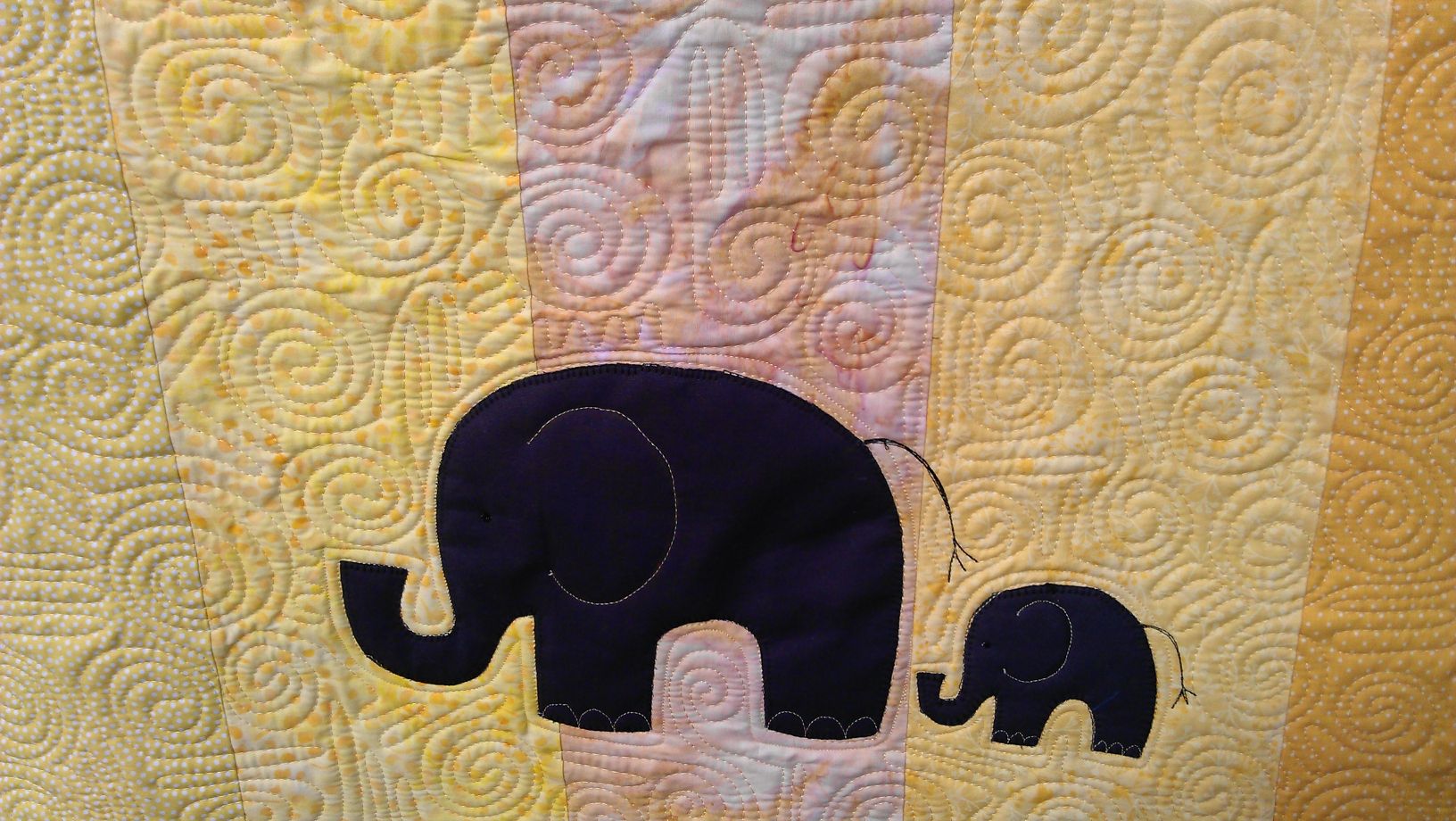
The one who is due in October has a thing for elephants for her nursery, so I decided to make a gender-neutral baby quilt for her in yellow, featuring elephants. And as I had enough fabric, I thought I’d make two at the same time, just in case the other twin got pregnant… And sure enough, she did! So now I’ll be taking two baby elephant quilts with me to the US in October.

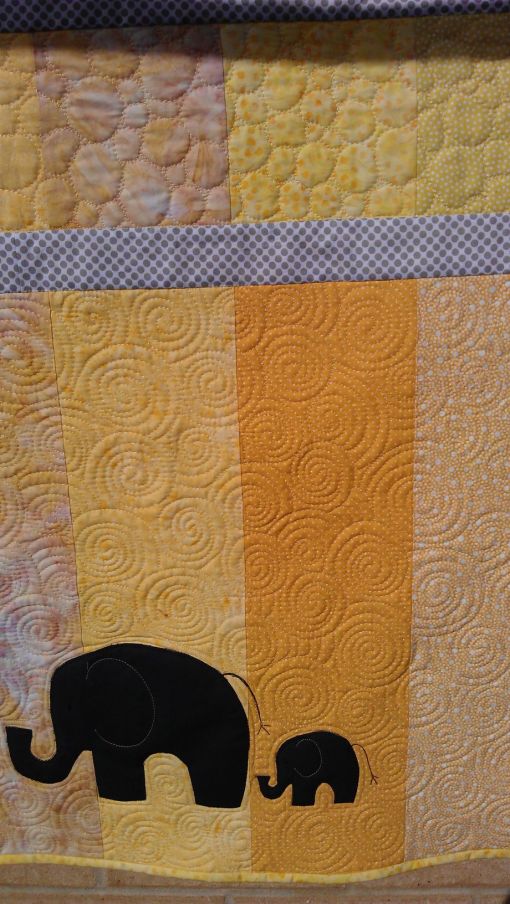
I really enjoyed making these quilts — the pattern was super easy to put together (‘Little black quilt’ pattern available free from: http://www.meandmysisterdesigns.com/patterns/?id=9). Just 6.5 inch strips, with a reverse strip part way up, separated by two bands of sashing. I didn’t have quite enough of all the fabrics to use exactly the same in each quilt, so the fabric choices are slightly different in each. But that’s OK.

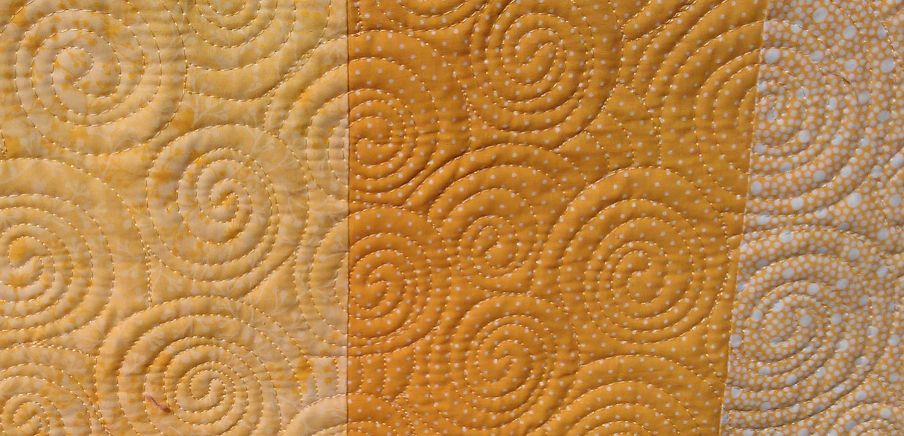
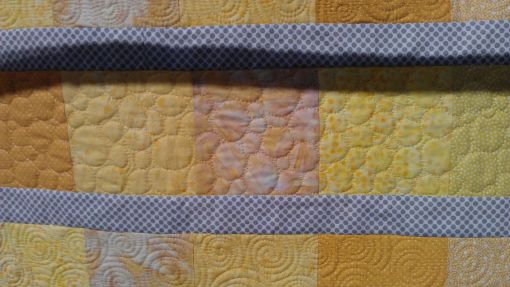
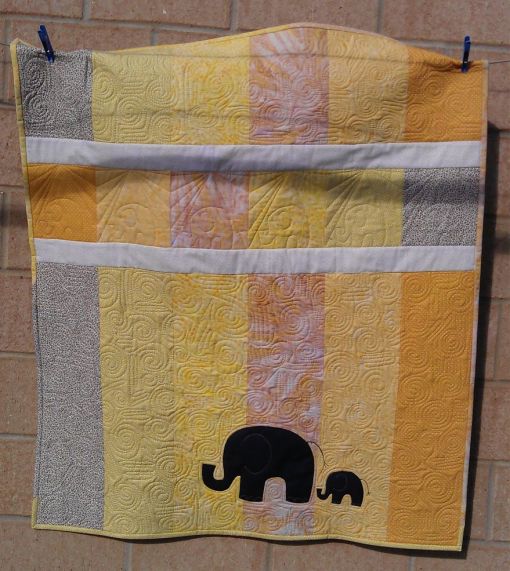
I also quilted them differently. For the first one, I made up a spiral motif with long U shapes, and outlined more elephants in the reversed panel; for the second I did all-over spirals, with bubbles/pebbles inside the reverse strip.

The charcoal grey elephants were fused on and then I blanket stitched around them in black. I stitched their ear shapes and toenails in yellow thread, and their eyes and tails in black thread.

Finally, I added a binding made up of multiple pieces of leftover yellow fabrics.

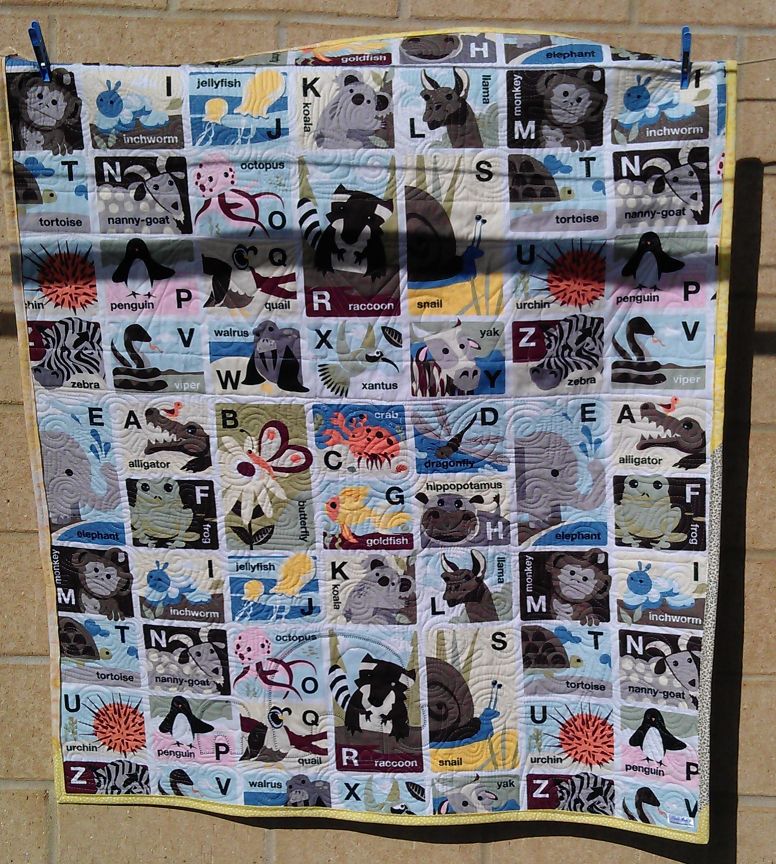
Oh, and the backing fabric was an alphabet print from the dressmaking poplins in Spotlight — it even has E for Elephant!

(Click on a photo to view it larger)

Auditioning fabrics

Interestingly, almost every yellow fabric I had had dots, spots, or circles of some sort!

baby_quilt_fabrics

Quilt 1

elephant_1_07

elephant_1_06

elephant_1_08


elephant_1_05

elephant_quilt1_01


elephant_quilt1_02

Quilt 2


elephant_2_03

elephant_2_04


elephant_2_01

elephant_2_02

The back on both

elephants_back

Threads used:

  • Top: Isacord (trilobal polyester, 40 wt, colour 0640 [a soft buttery yellow]); Robison-Anton (rayon, 40 wt, black)
  • Bobbin: Fil-Tec Magna Glide pre-wound bobbin (white)


Community Quilt 149

22 06 2014

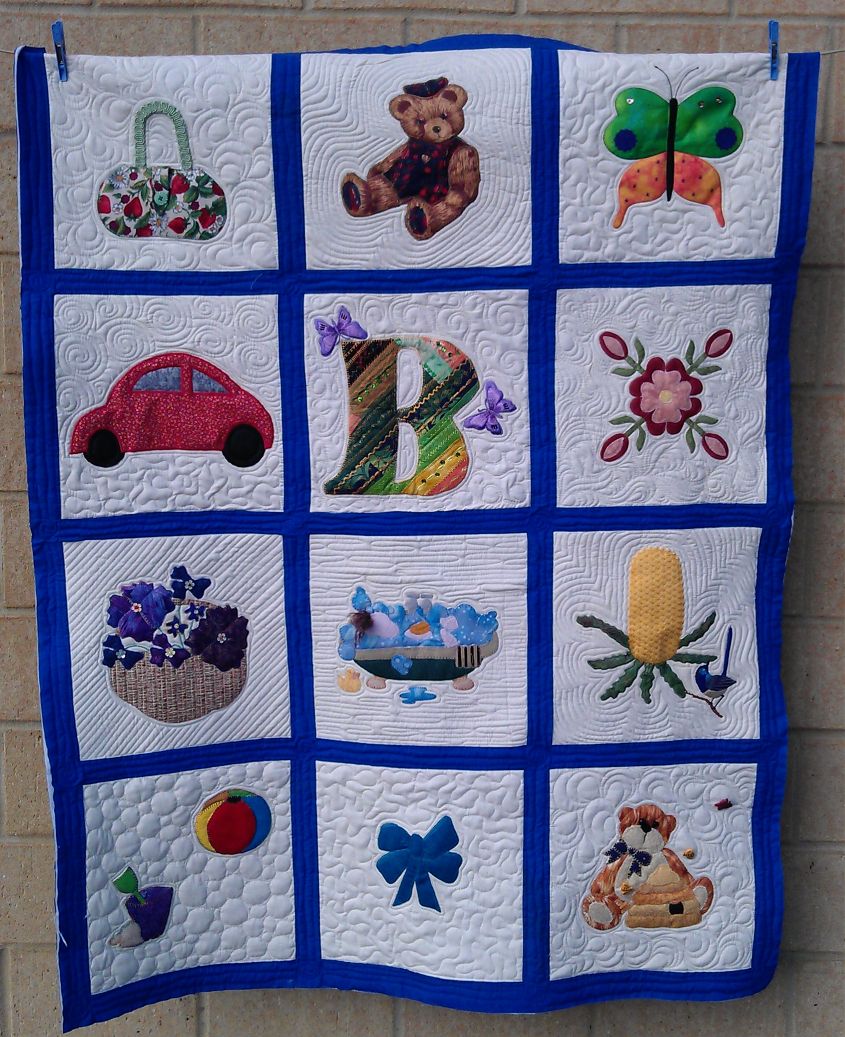
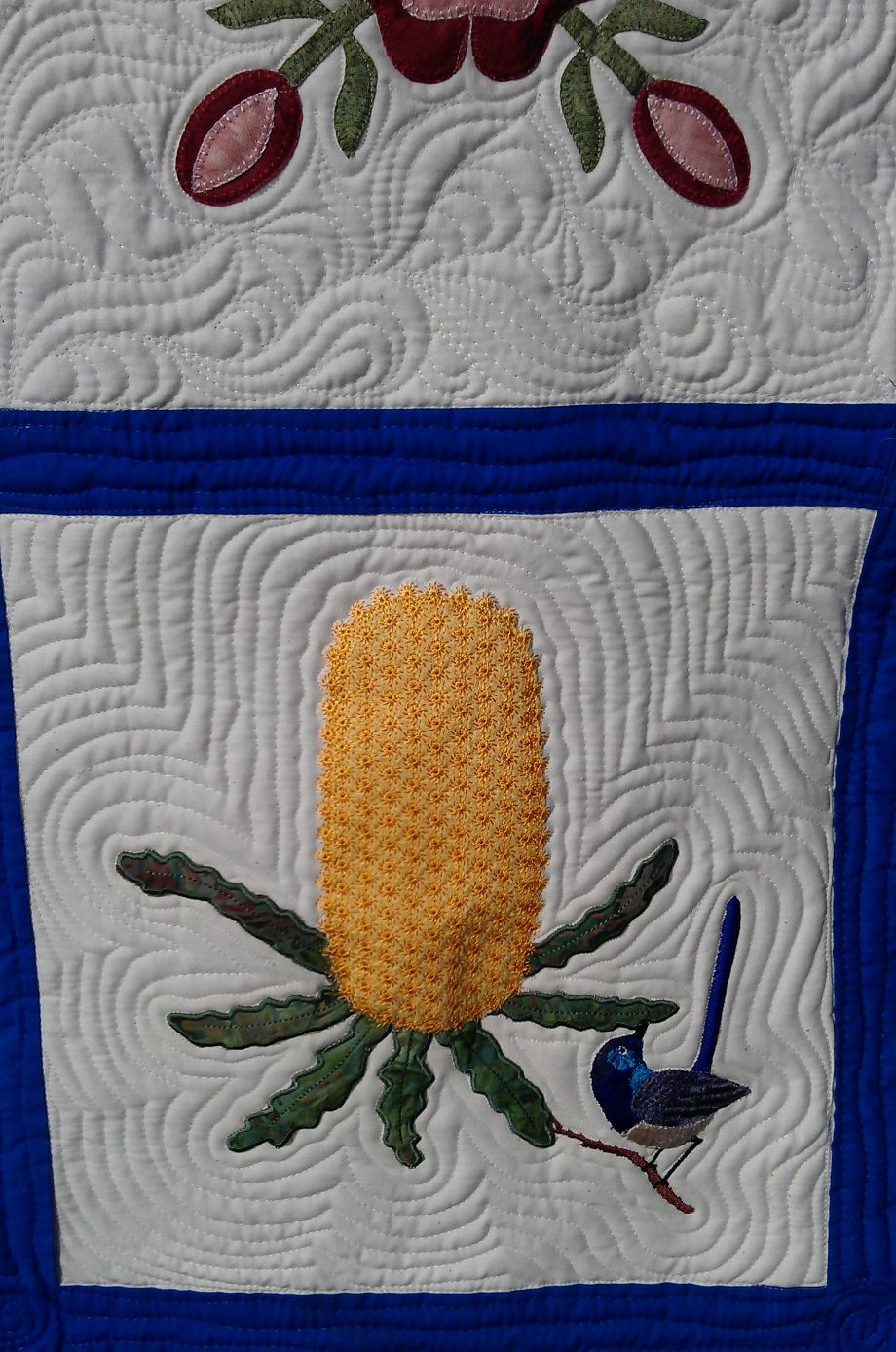
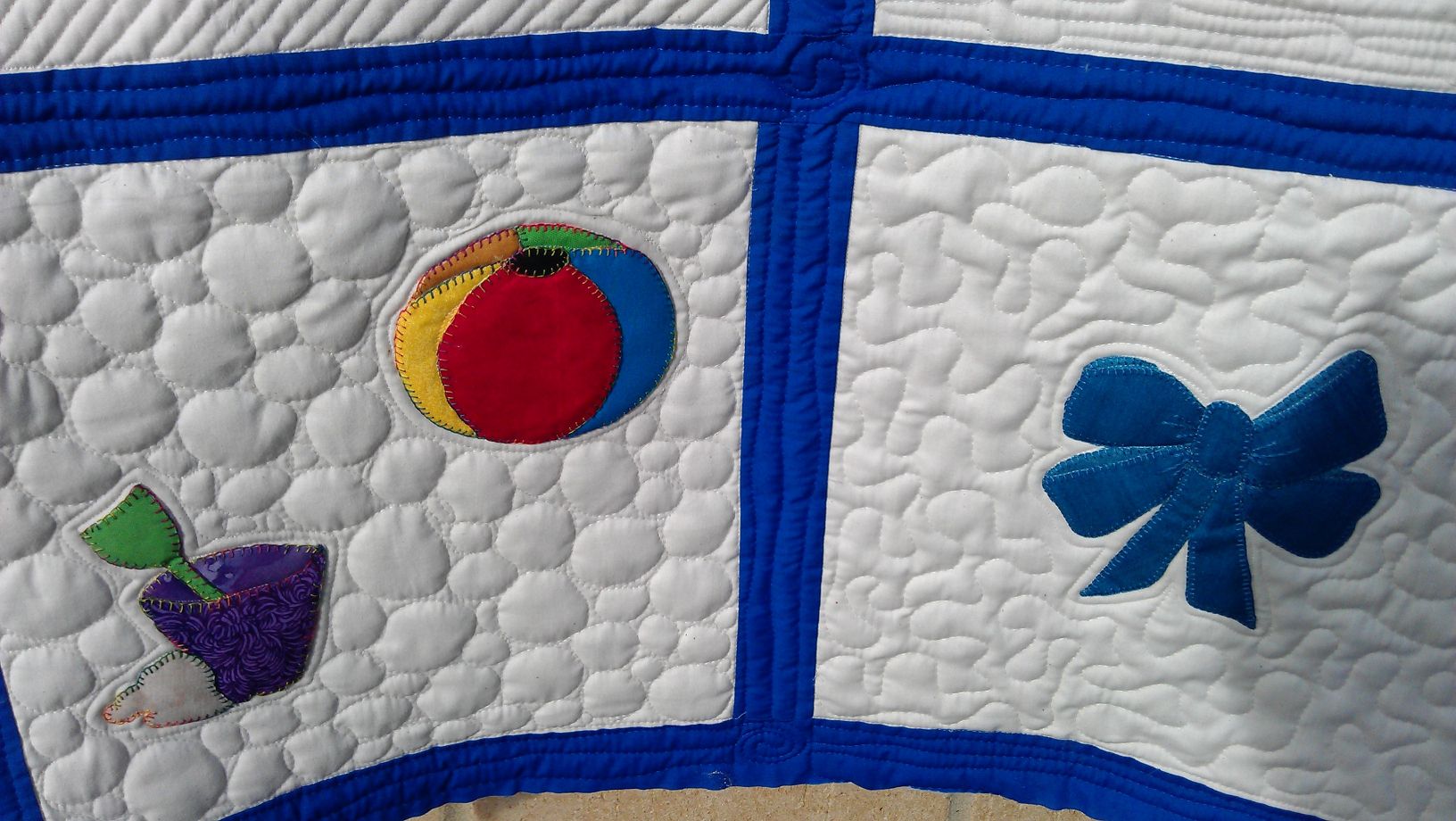
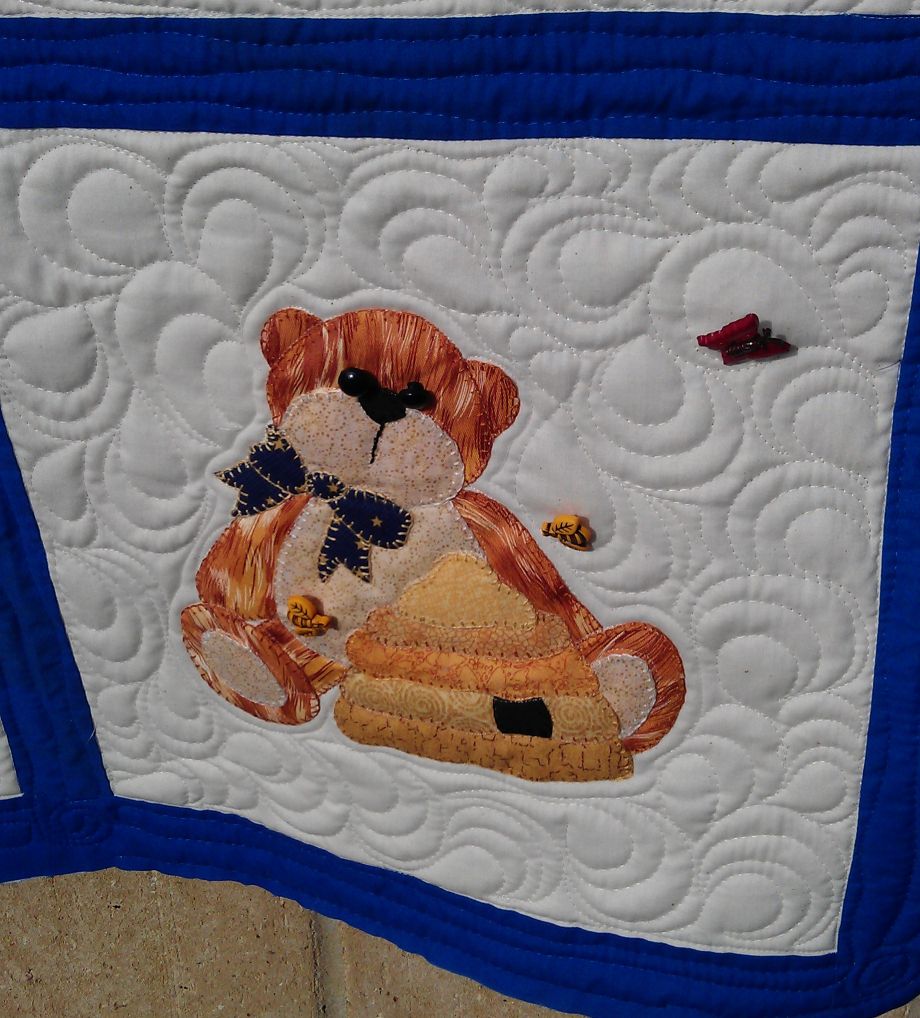
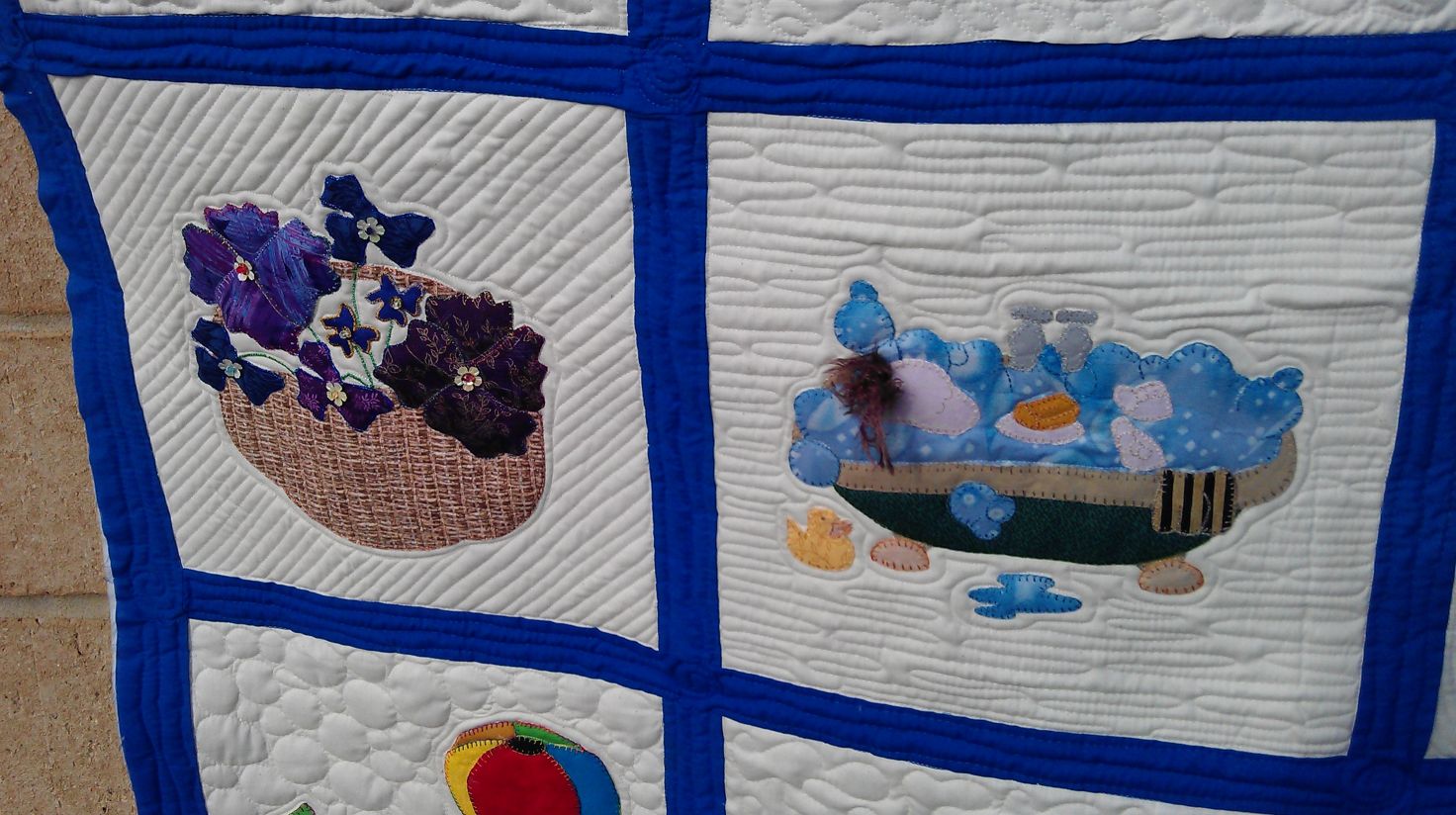
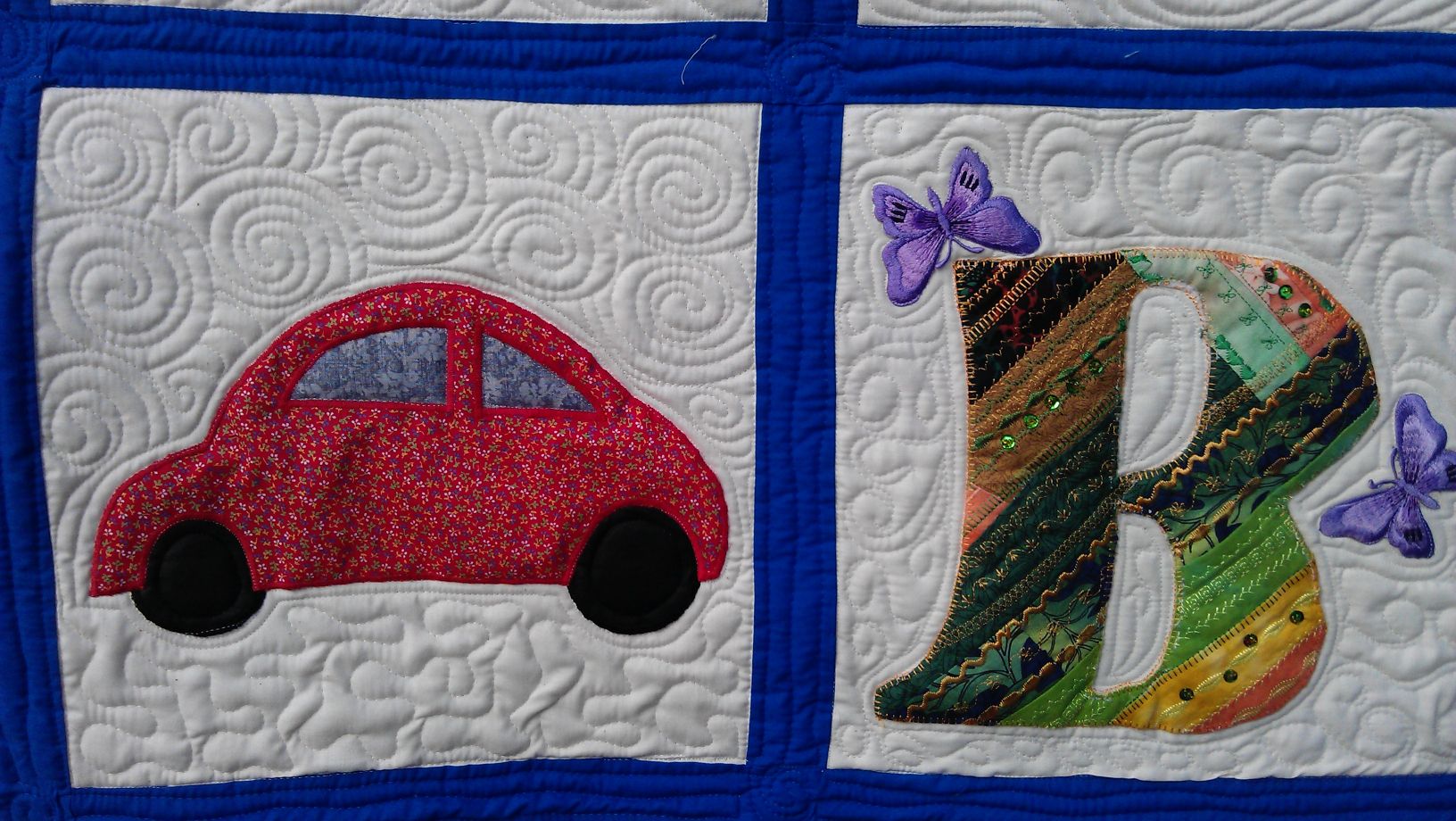
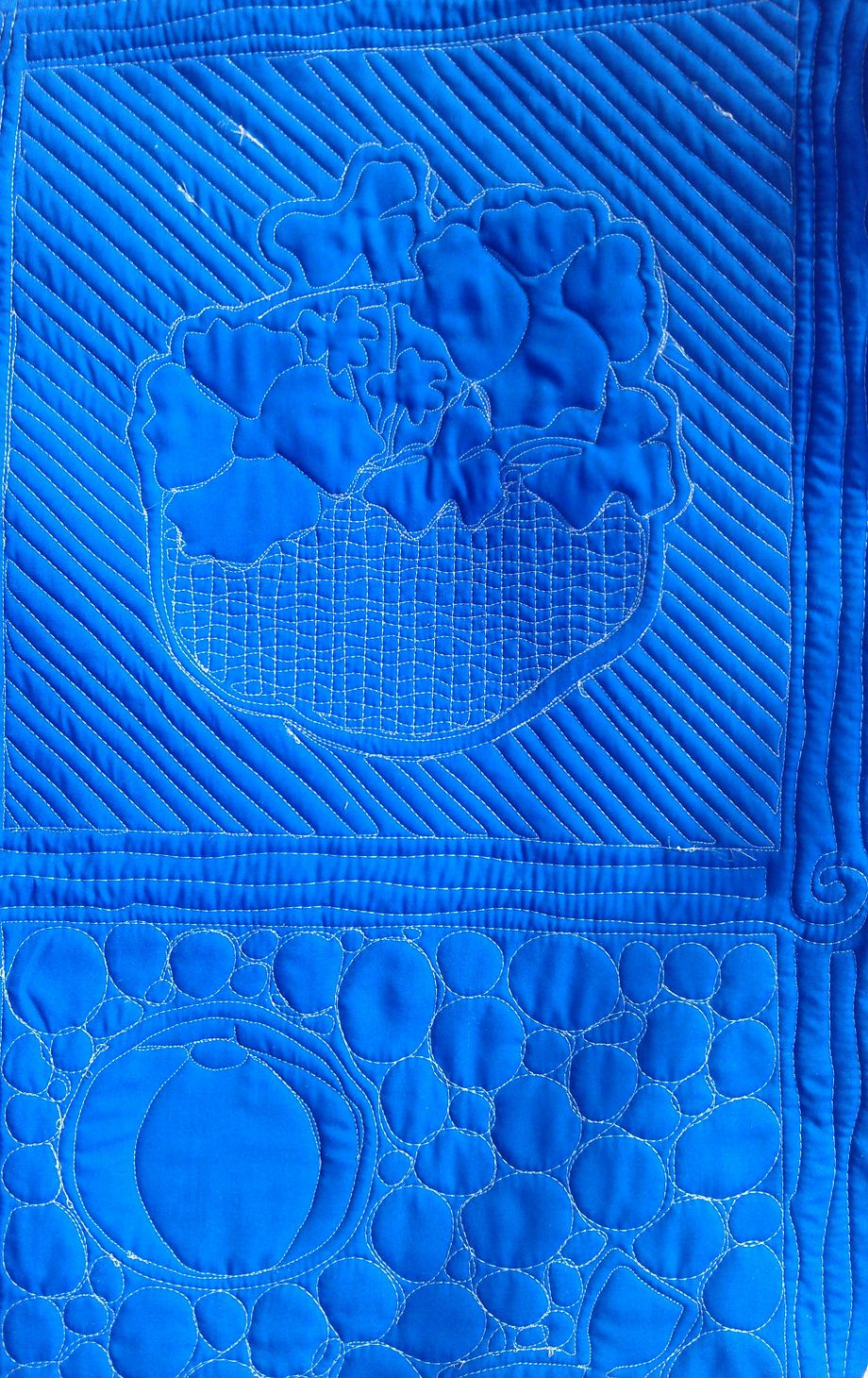
Every appliqued centre of this quilt was a ‘B’ word. My favourite was the banksia; I wasn’t quite sure about the very hairy baby in the bathtub!

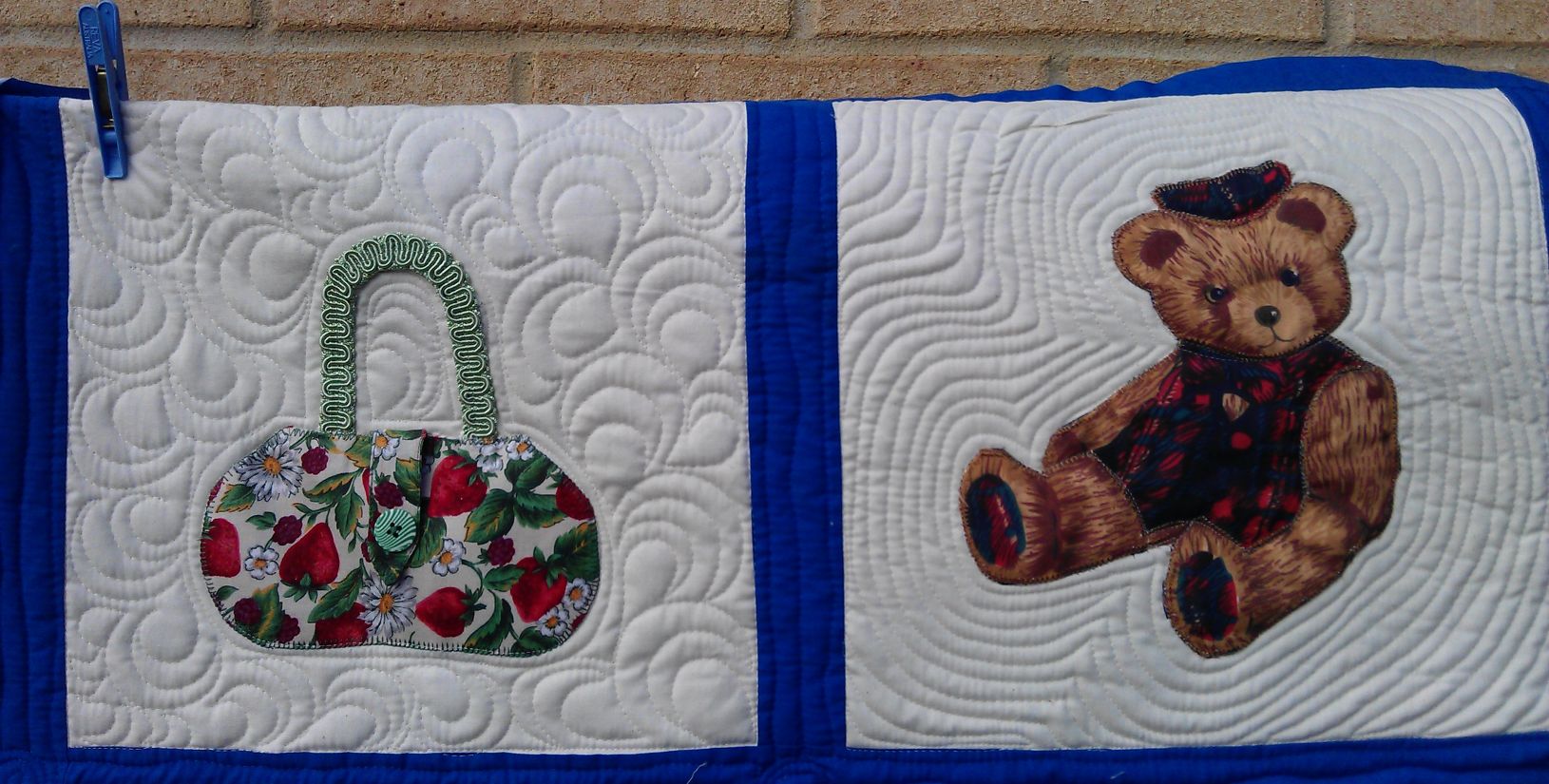
How to quilt it? I started by stitching in the ditch around all the blocks, then around the appliqued pieces, then echo stitched about a quarter inch around each appliqued object/set.

I decided to do largish motifs in each block — I still wanted this quilt to have some puffiness. Finally, I switched to a blue thread and stitched deliberately wobbly lines along the sashing, with spirals in the corners and joins.

For this one I used quite fine thread — an 80 wt and a 100 wt in the top (with a 70 needle), and a 60 wt in the bobbin.

(Click on a photo to view it larger)

quilt149_01

quilt149_02


quilt149_09

quilt149_07

quilt149_06

quilt149_05

quilt149_04

quilt149_03

Back:

quilt149_08

Threads used:

  • Top: Wonderfil Deco Bob (80 wt, colour DB112); Wonderfil Invisifil (100 wt, colour IF311)
  • Bottom: Fil-Tec Magna Glide pre-wound bobbin (white)


Vale: William E Bracey (1923-2014)

9 06 2014

I heard the sad news last night that my ‘uncle’ Bill had passed away (10:20pm 7 June 2014). We met through genealogical research and although he always referred to me as his ‘cousin’, out of respect I referred to him as my ‘uncle’. Our common ancestor (my 5th great grandfather and Bill’s 4th great grandfather) lived from 1749 to 1824. So that’s how Bill and I were connected. But that connection went much deeper than mere names and links on a family tree can state.
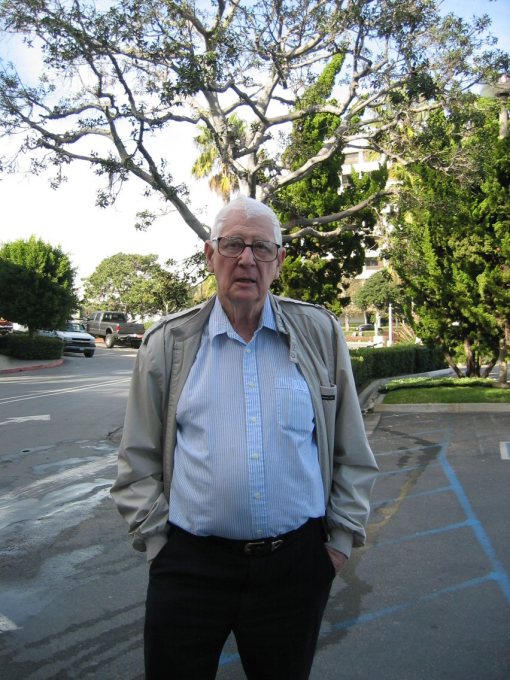
Bill Bracey, 19 Jan 2005

Bill Bracey, 19 Jan 2005


I ‘met’ Bill online in 1994, when I got my first computer and internet connection. I was doing some research into the Bracey name and came across a chap in Albuquerque, New Mexico, who was pretty certain I wasn’t related to his line but was equally certain I was related to Bill’s line. It took a while for Bill (who lived in California) and I to find the common connection. Our respective sides of the family came from the same area in Bristol, England, in some cases from the same street. We were certain we were related but we didn’t have the evidence. However, a particular UK Census record gave us the evidence and so I brought some 50 names into Bill’s family tree; in turn, he added about 5000 names to my tree! We corresponded via email and mail for a couple of years, then at the end of 1997, we met. My husband and I were on our way to Chicago and had a long layover at LAX, so Bill met us in person at the American Airlines lounge there.

I’ll never forget that meeting. My husband and I came into the lounge area strung out from 20+ hours of flying and layovers, and this imposing man with cropped grey/white hair rose up from a seat in the reception area, held out his hand, and said ‘I’m Bill’. I don’t think we’d even seen photos of each other at that stage — he just knew who we were, and equally, I knew who he was. His handshake was firm and he stood militarily erect, all 6 feet 4 (?) of him. He would have been 71 years of age then.

We got on immediately. I don’t know whether it was the family connection — some part of the ancient ancestral brain — or the fact that he was such a nice man, even without that connection. He thought I was wonderful for bringing him so many Western Australians to his tree, and I thought he was wonderful for all the mountains of research he had done long before the days of the internet, when he had travelled extensively in the UK ferretting out records and people, and paying quite a bit of money I expect for copies of legal documents such as birth, death and marriage certificates. So much of this is now available freely or for a small fee online, we forget that only 20 years ago you had to write letters, pay by money order, and wait weeks to get copies of documents (in the hope that you had the right person), or you had to go to the places and hunt out parish records or haunt the Public Records Office in London, looking for those elusive bits of information that tie one person’s family tree to another’s. Bill did much of that legwork research to compile the family tree, and likely spent thousands of dollars in pursuit of documentary evidence to verify connections.

In July 1998 Bill came to Australia and New Zealand to meet his Bracey relatives in the various branches. I organised a big lunch at a riverside cafe in Perth for all my Western Australian relatives and Bill papered two entire walls with his printout scroll of our family tree. For many, this was the first time they saw how they were connected to others who were still living and who had gone before them. I still have that scroll. We all had a lovely time.

From 2001, I started travelling to the US each year to attend conferences. At that time, Qantas only flew from Australia to the US via Los Angeles (we can now fly direct to Dallas), and so I started staying with Bill for a few days on arrival before heading off to wherever the conference was — his house was about a 45-minute drive from LAX. It was an opportunity for me to get over jet lag, but most importantly, it was an opportunity for me to spend time with Bill. We’d talk about the family tree research, I’d help him do stuff on the computer (and often fix issues — he always had a list of things for me to fix/explain!), we’d go out for meals, I met some of his friends, and he’d let me sleep off the jet lag as I needed to. I stayed with Bill for a few days each year for most years from 2001 to 2014, visiting and spending time with him for the last time in February/March this year.

He would often lament how much he missed ‘his Joanie’, his beloved wife of 43 years, who passed away in 1993, before I met Bill. He spoke so well of her that I felt I knew her.

I knew that he’d served in World War Two, but he never spoke about that time with me. I expect he only spoke about it with his fellow Veterans, when they had their annual get together on the east coast.

What about Bill, the person? Well, he had a very sharp mind, even in February 2014 (when I last saw him) when his body was failing. He didn’t suffer fools gladly, he was methodical, meticulous, and precise in everything he did (that engineering and military training, I expect, but did he go into engineering because he was methodical or did he become methodical as part of his training?), and he was ‘ornery’, blunt, and stubborn at times. He hated the frailty that came with his aging body.

He was such a strong, athletic man when we first met, but gradually injuries started to affect his prowess on the tennis court and the ski fields and he had to give those loves away.

I met his son Tom both at Bill’s house and in Texas, where Tom lives, and met his grandson James at least once. I never met his daughter Lisa or his other grandchildren or great grandchildren, though I feel I know them as Bill proudly showed off their photos to me and talked about their lives and how they were all doing.

He was very proud of his family and loved them dearly, although perhaps he didn’t say so often enough.

We will miss you, Bill. We’ll miss your sharp mind, your welcoming arms, your HUGE hugs, and your love. You treated us as your own, and I’m forever grateful that we got to meet you and to know you.



Static!

7 06 2014

For Community Quilt #148, I decided to use white Magna Glide pre-wound bobbin thread for the top AND the bottom thread. Why? because the colour match was perfect. So I slipped the bobbin onto a hacked thread holder and started.
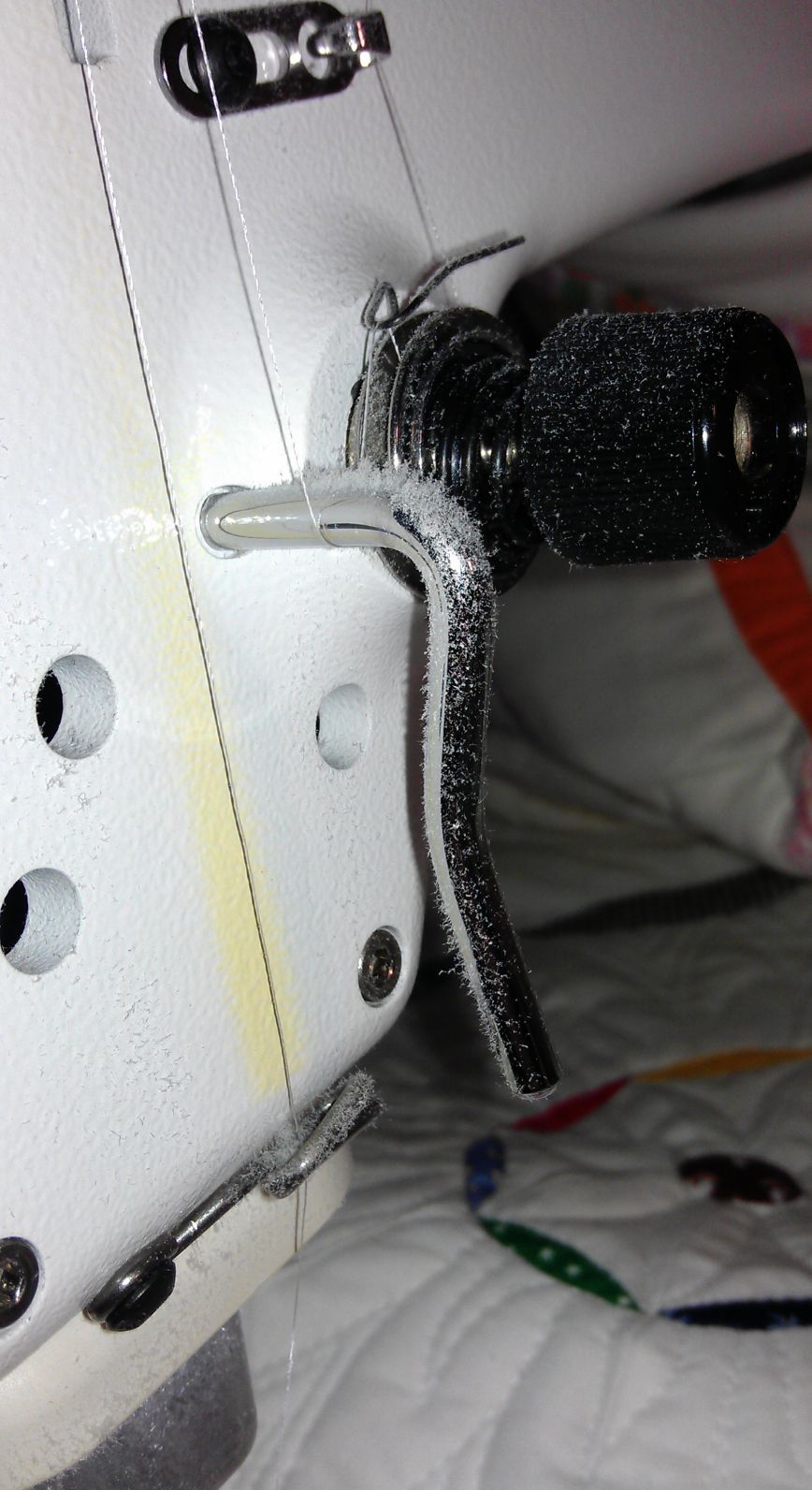
What I didn’t realise was how much static there was on the machine, which picked up the tiniest bits of polyester ‘lint’ from this thread and deposited it on the metal bits of my Handi Quilter Sweet Sixteen! I’ve never noticed any issue with this sort of static buildup in the bobbin housing, but it was very prevalent in the top thread path.

I wonder if it’s due to the continual up and down motion of the thread before it finally gets to the eye of the needle and into the quilt? The bobbin thread, on the other hand, just loops off the bobbin in one continuous motion, as far as I’m aware.

Whatever the reason, I had to clean the tension disks and other parts of the upper thread path several times while quilting this quilt.

Here are some pictures to show that static build up at the tension disk area and near the needle.

static02

static01


Community Quilt 148

7 06 2014

I thought Quilt #146 was my challenge quilt in the latest bunch. Not so. It was this one!!

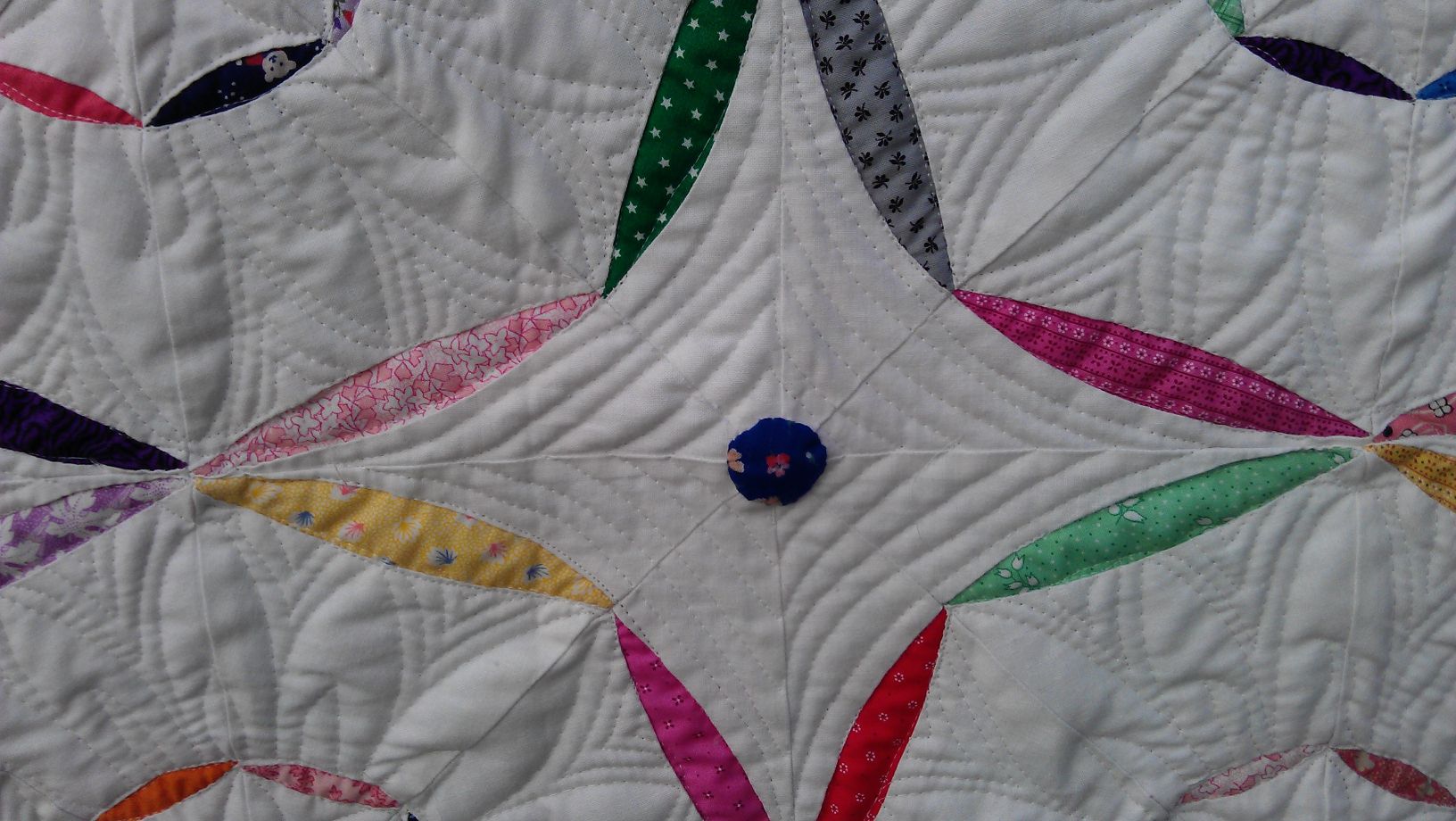
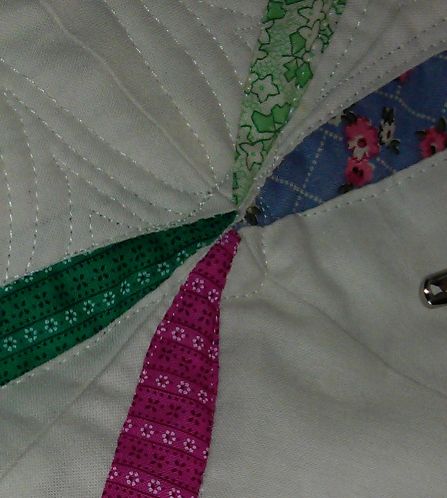
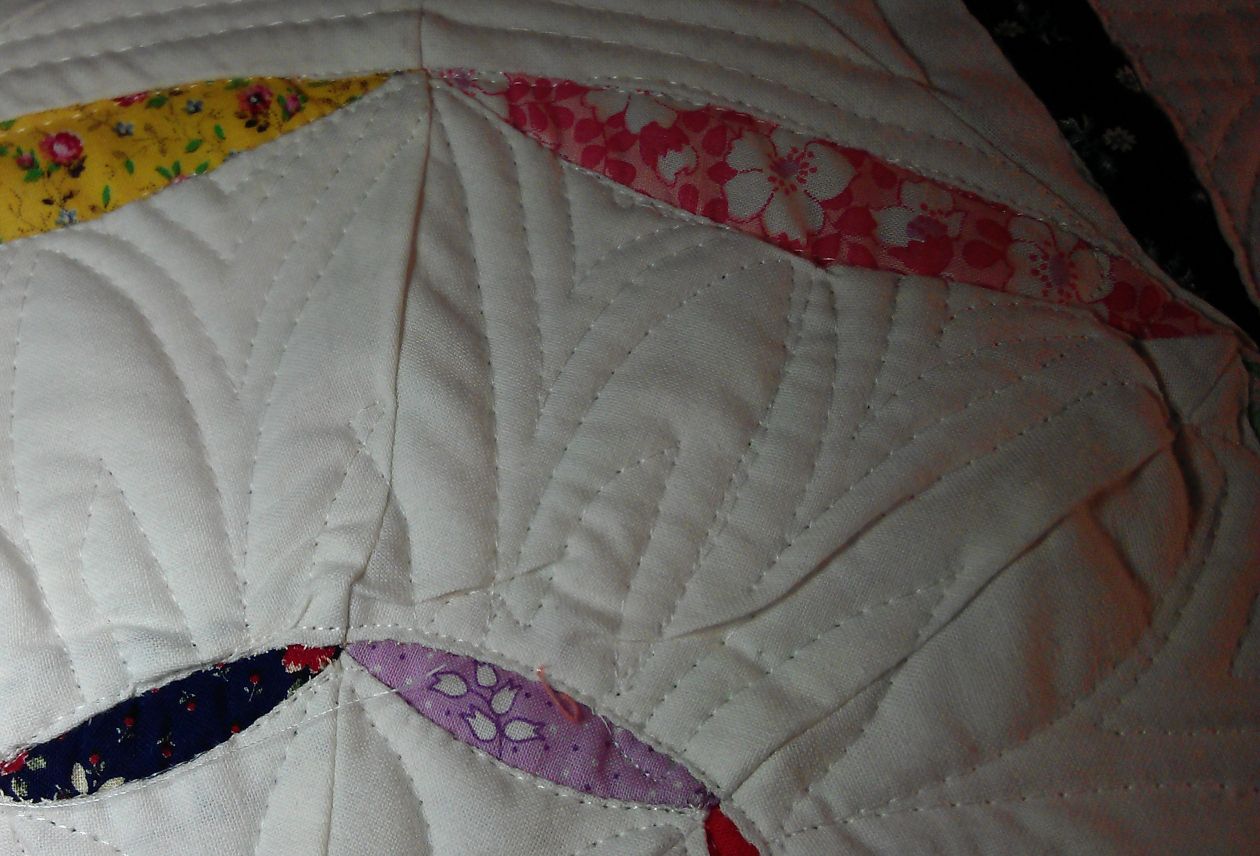
Why was it such a challenge? Well, it was FULL of bias edges, very thick seam joins, and lots of puffiness as a result of those bias edges. I had to do a LOT of quilting on it to try to flatten it, and I think I succeeded, for the most part. However, there are still parts of this quilt that have pleats and folds that I just couldn’t get out. And where the big circular blocks join, there are masses of seams that come together to form a big lump — having already snapped a needle off in the bobbin case before (which cost me $$ to have fixed as well as a trip to the city), I wasn’t going to attempt to sew through those. Someone has carefully appliqued on little circular disks into the centres of the other seam joins, and I’ll be suggesting that they add more where those horrible lumpy seam joins are.

I started by stitching in the ditch are all the circles and the borders to stabilise the quilt as far as possible. Then I tackled the centres of each circle inside a larger circle by curving out to a point and back in, making flower petals. For the larger circles, I did the same, dividing (with my eye) each inner area into thirds, stitching up to an outer point then back down then up to the centre point of the curve, then down and back up to a seam point.

After stitching the big flower petals like this, they were still too puffy, so I stitched some inner ‘flame’ sort of thing inside each one, then did some echo stitching around the big petals. That squashed them for the most part.

For the areas outside the circles, I just did some echo stitching in a continuous-line spiral. I left the pink borders unstitched. For the main white border, I continued the theme of the curved petals (no markings or rulers — just eyeballed them) then echo stitched around each one.

The first set of pictures below show the finished quilt, followed by pictures showing the puffiness I had to deal with in this quilt. Yes, it WAS a challenge and half!

(Click on a photo to view it larger)

quilt148_01


quilt148_03

quilt148_04


Puffiness:

quilt148_puff01

Puffy, puffy, puffy…

quilt148_puff02

Seam join with about 8 seams coming together. Very lumpy.

quilt148_puff03

Stitching some puffiness into submission, but some of these folds were just unavoidable

Threads used:

  • Top: Fil-Tec Magna Glide pre-wound bobbin (white)
  • Bottom: Fil-Tec Magna Glide pre-wound bobbin (white)


Handi Quilt Sweet Sixteen: Using bobbin thread as the top thread: Hack #2

7 06 2014

Some time back I needed to use some thread I only had wound on a bobbin as the top thread in my Handi Quilter Sweet Sixteen. As the spool rods are too fat for the bobbins, I came up with a dodgy system using painters tape and a paintbrush. Since I posted that hack, I’ve read about another person’s method, using what we used to call ‘pipe cleaners’ in Australia but that I understand are called ‘chenille sticks’ in the US.

So I tried it and it works fine for a bobbin spool. However, I didn’t have as much luck with a normal spool of thread as it ended up wrapping itself into the chenille bit and snapping. That’s probably more user error than it is the fault of the ‘design’!

Here’s my setup; the bobbin thread comes off from underneath the bobbin, not over the top — I think that’s where I went wrong with the other spool of thread I tried with this:

bobbin_hack2

And no, the bear doesn’t come with the machine 😉 He was a gift from one of my quilting buddies.


For Pennie only

6 06 2014

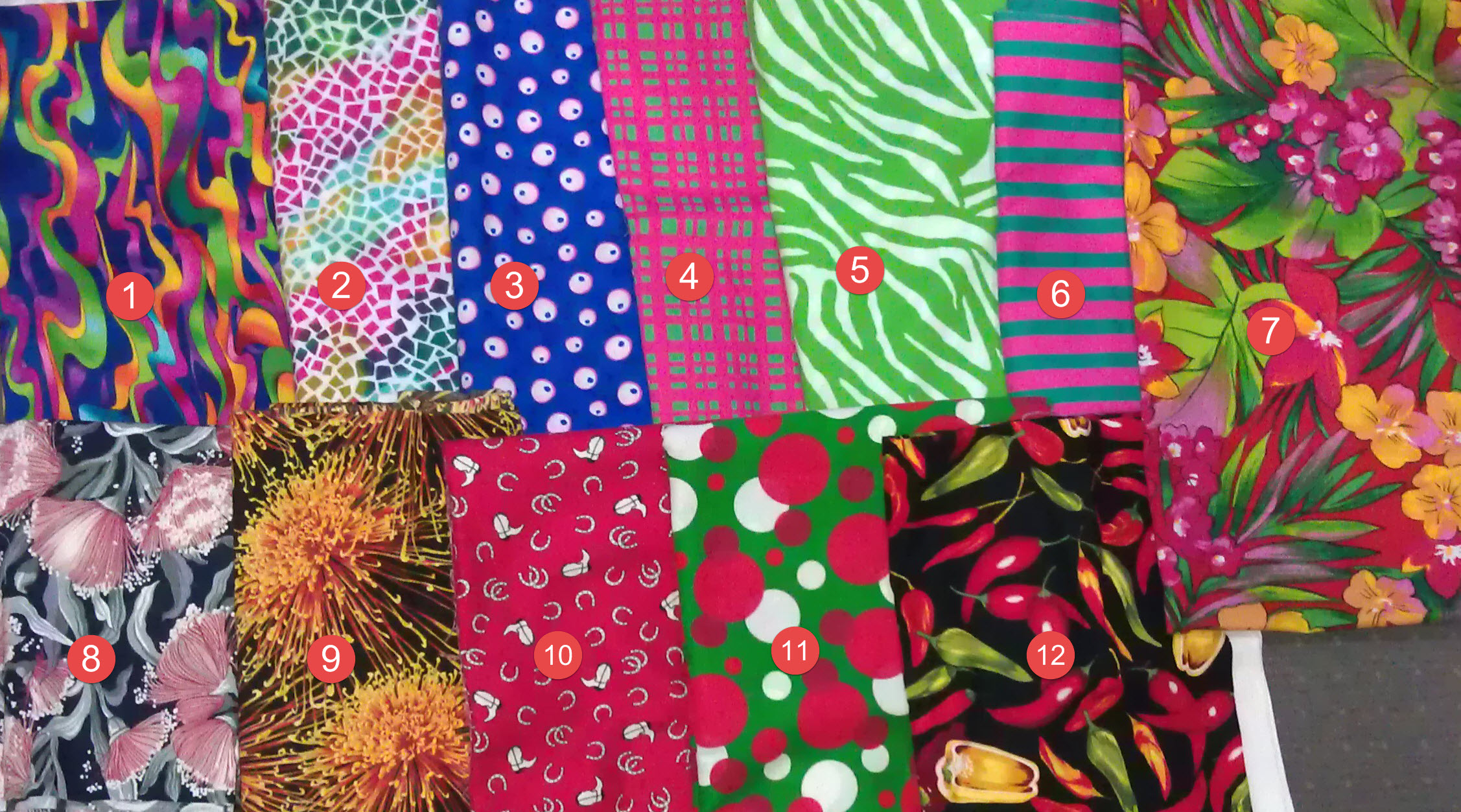
Fabric choices:

etsy


Community Quilt 147

3 06 2014

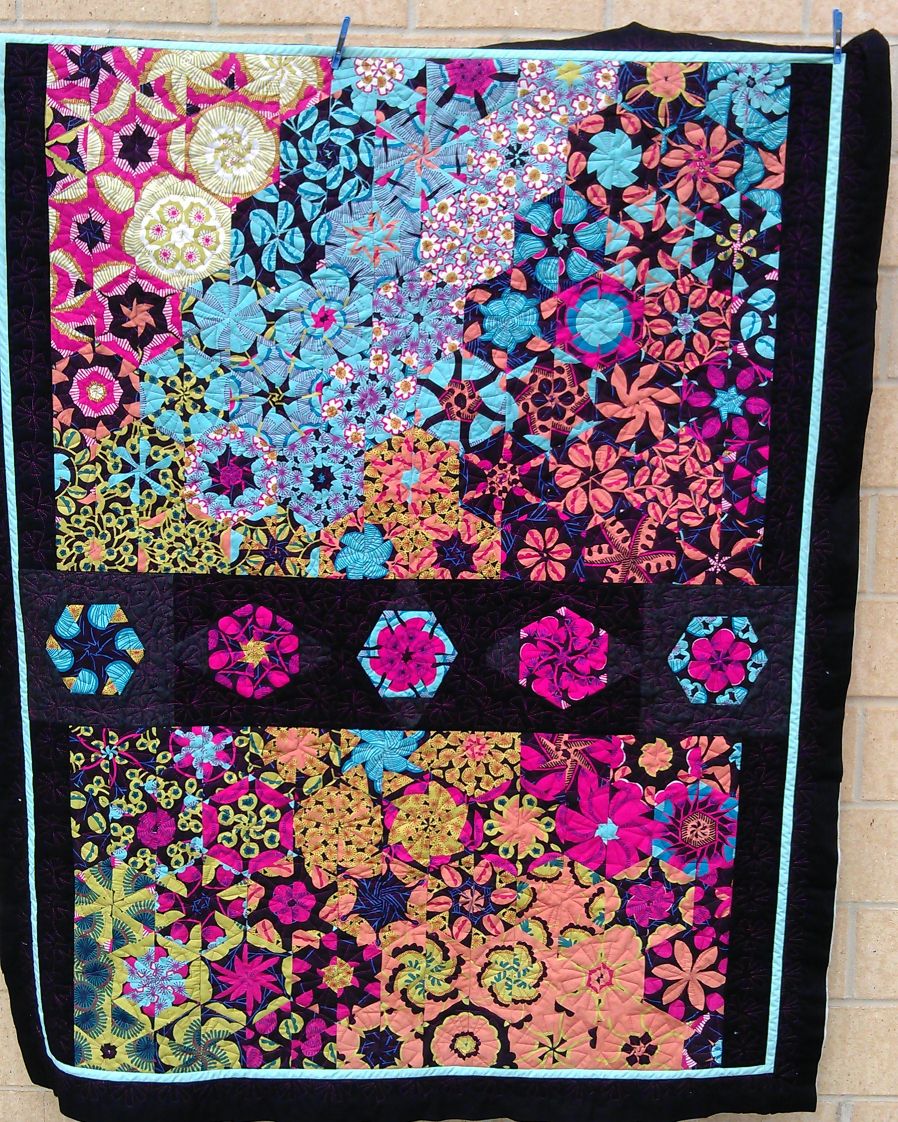
What a bright, vibrant kaleidoscope/stack-and-whack quilt! (and the back is even brighter!) But how to quilt it? All those colours, those designs in the fabrics, those triangular shapes…

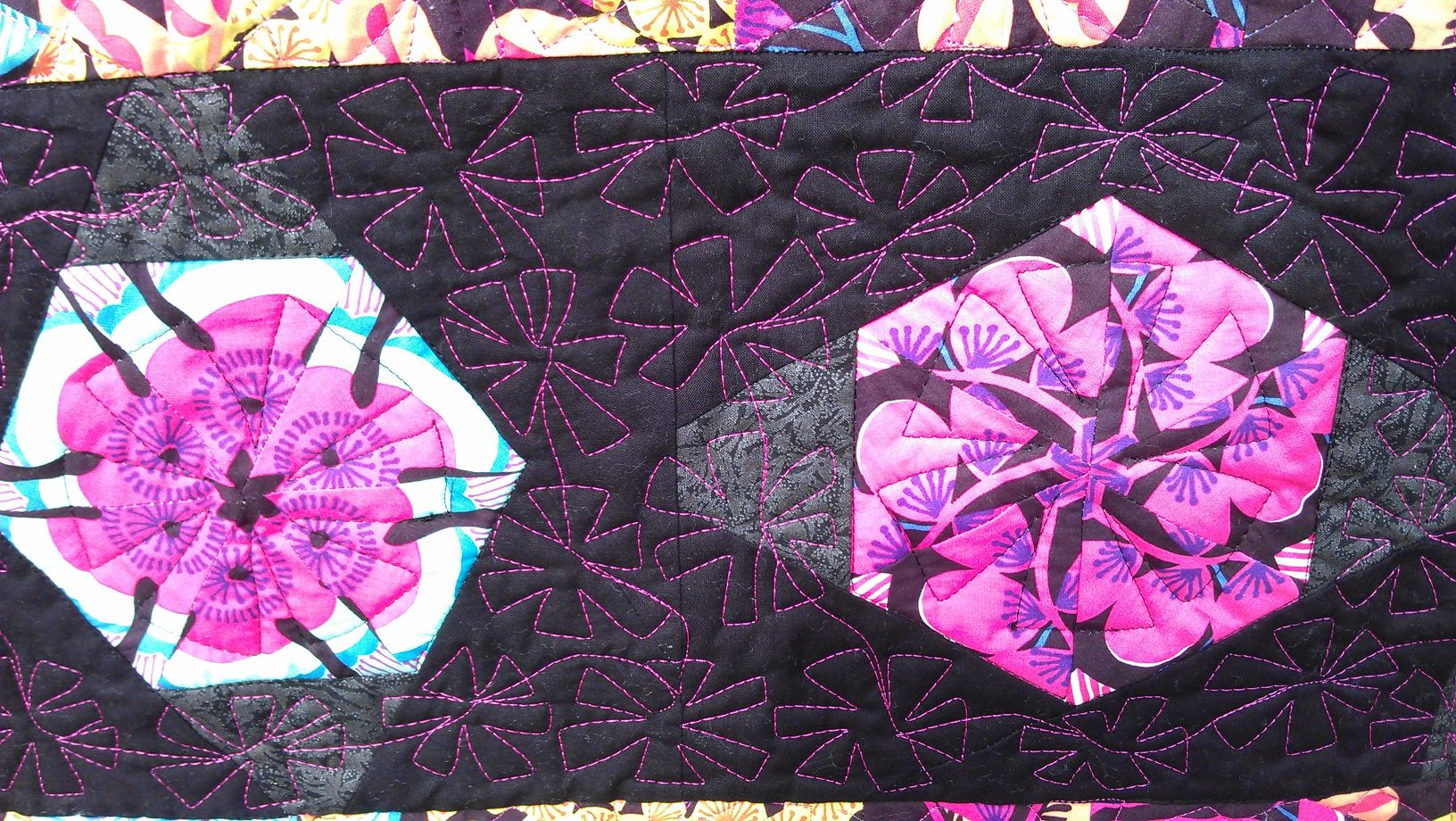
First, I stitched in the ditch around the central black banner and all the borders. Then I laid some clear plastic over one of the motifs in the banner and drew a couple of ideas before committing to stitching them. My initial thought was to do a stylised flower pattern with squared off petals, echoing the stitching lines and the overall shape of each hexagon, but then I moved the plastic a tad and saw that I could do the same but off-centre, thus ‘cutting’ the seam lines with the straight top of each petal (see the second photo for what I mean — it shows it better than I can describe it). As each centre was full of seams, I wanted to avoid stitching there (I’ve had a needle break doing that and it wasn’t pretty… or cheap to fix!), so instead of stitching in to the centre of each ‘flower’ I left a gap to give the illusion of a centre.

I stitched the ‘flowers’ in the central banner first, in black, but I was having trouble with that thread breaking all the time, so I switched to one of the other threads I’d chosen — a deep pink/cerise Isacord thread, which gave me NO trouble at all for the rest of the quilt. I stitched all the flowers in the main quilt top and the black areas and the border with this thread and it went through my machine like a hot knife through butter. Where possible I also stitched in the ditch with this pink thread in the main areas to get from one hexagon to the next without stopping.

All stitching was free motion (except for the straight stitch-in-the-ditch lines when I used my Line Tamer ruler), so some of the flowers in the black areas and the borders have 5 petals, some have 6, others 7 or 8.

For the border, I stitched a half flower of the motif I used in the main quilt, again using free motion (no rulers or markings).

(Click on a photo to view it larger)

quilt147_01


quilt147_03

quilt147_02   quilt147_04


Back:

quilt147_05

Threads used:

  • Top: Isacord (40 wt trilobal polyester, colour 2508); and Robison-Anton (40 wt rayon, colour 2632 ‘Jet Black’)
  • Bottom: Bobbinfil (70 wt cotton, black)


Community Quilt 146

3 06 2014

I was told when I picked up these Community Quilts for quilting that there was a ‘challenge’ quilt amongst them. I have a feeling this might have been it. Why? because someone had started quilting it (the long straight lines extending from the blocks into the borders) and had marked big circles randomly across the quilt, ready for quilting.

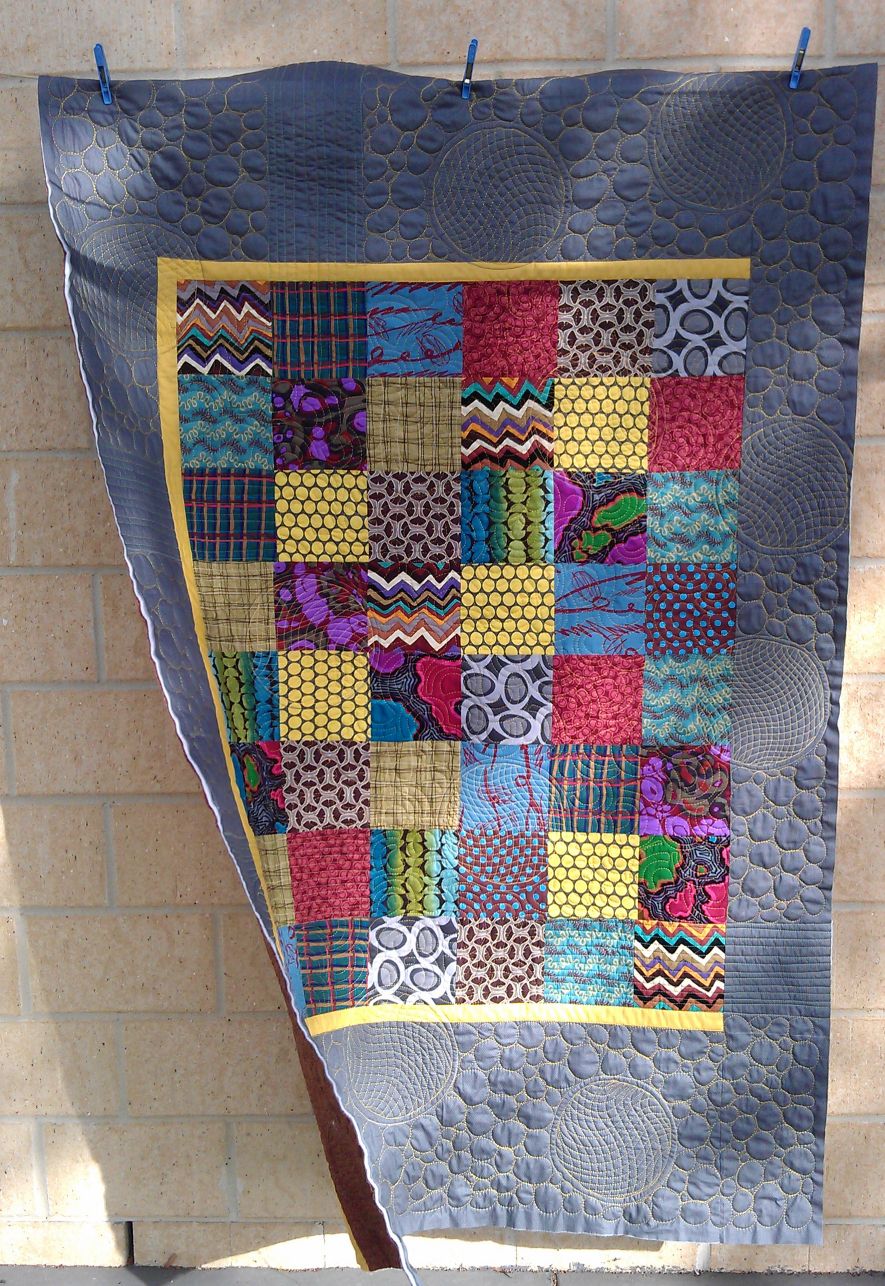
On pulling this one out of the bag, my first thought was to quilt it in yellow to set off the grey in the uneven width borders and to echo the yellow in the sashing strips (only on 3 sides). My second thought was to quilt the ‘white space’ in the borders with more circles (or pebbles or bubbles, or whatever you want to call them). I wasn’t quite sure what to do in the main top where the busy fabrics were.

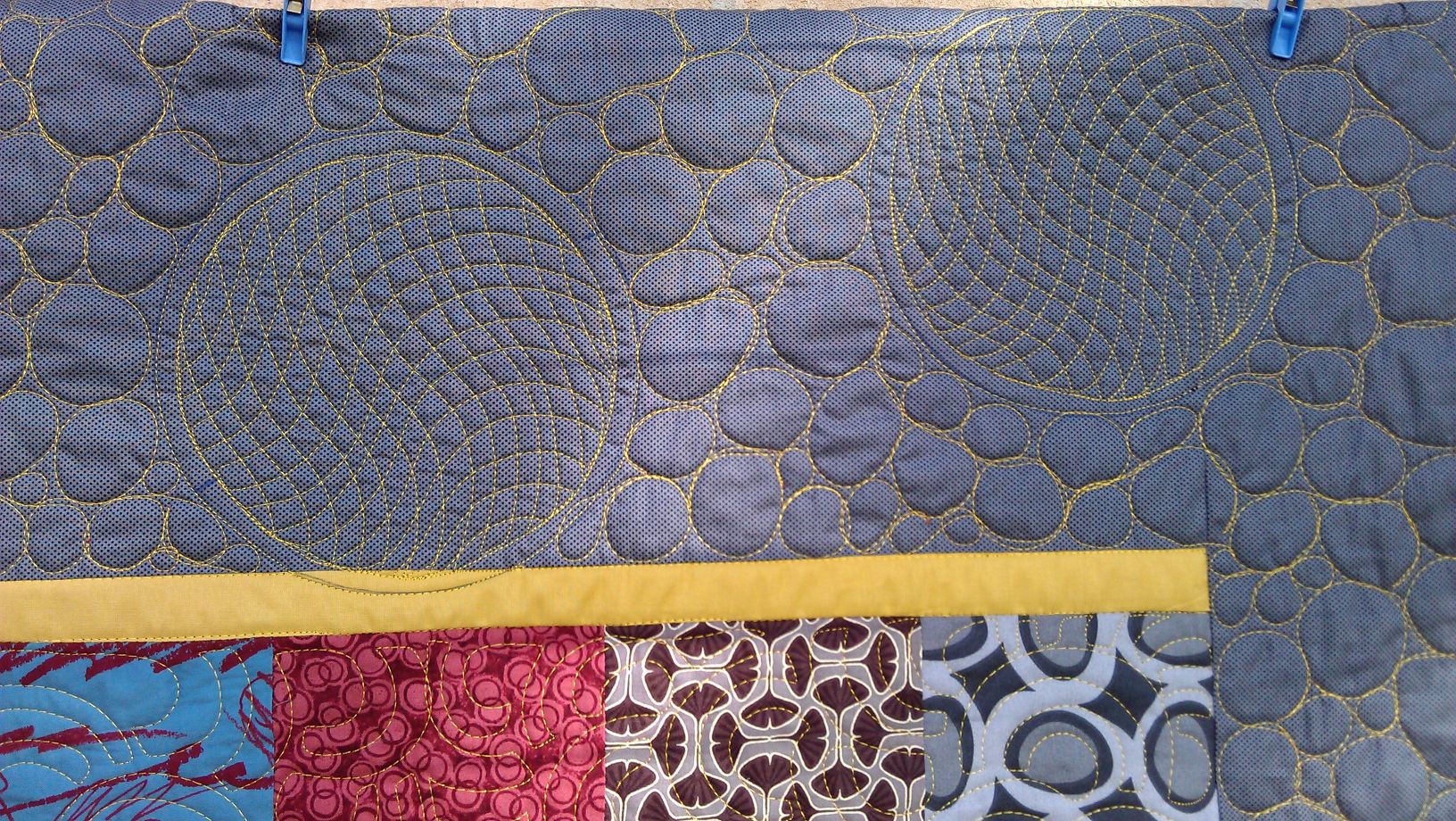
I started by stitching around each of the circles, then free motion stitching an echo circle about one quarter inch in from the marked circle I’d just stitched. Then I continued stitching a wavy matrix inside each circle, leaving the gap between the two lines of circle stitching to act as a slightly puffy border. Even though my inner circle line wasn’t always exact (i didn’t mark it or use a ruler), with the extra stitching I don’t think it matters too much.

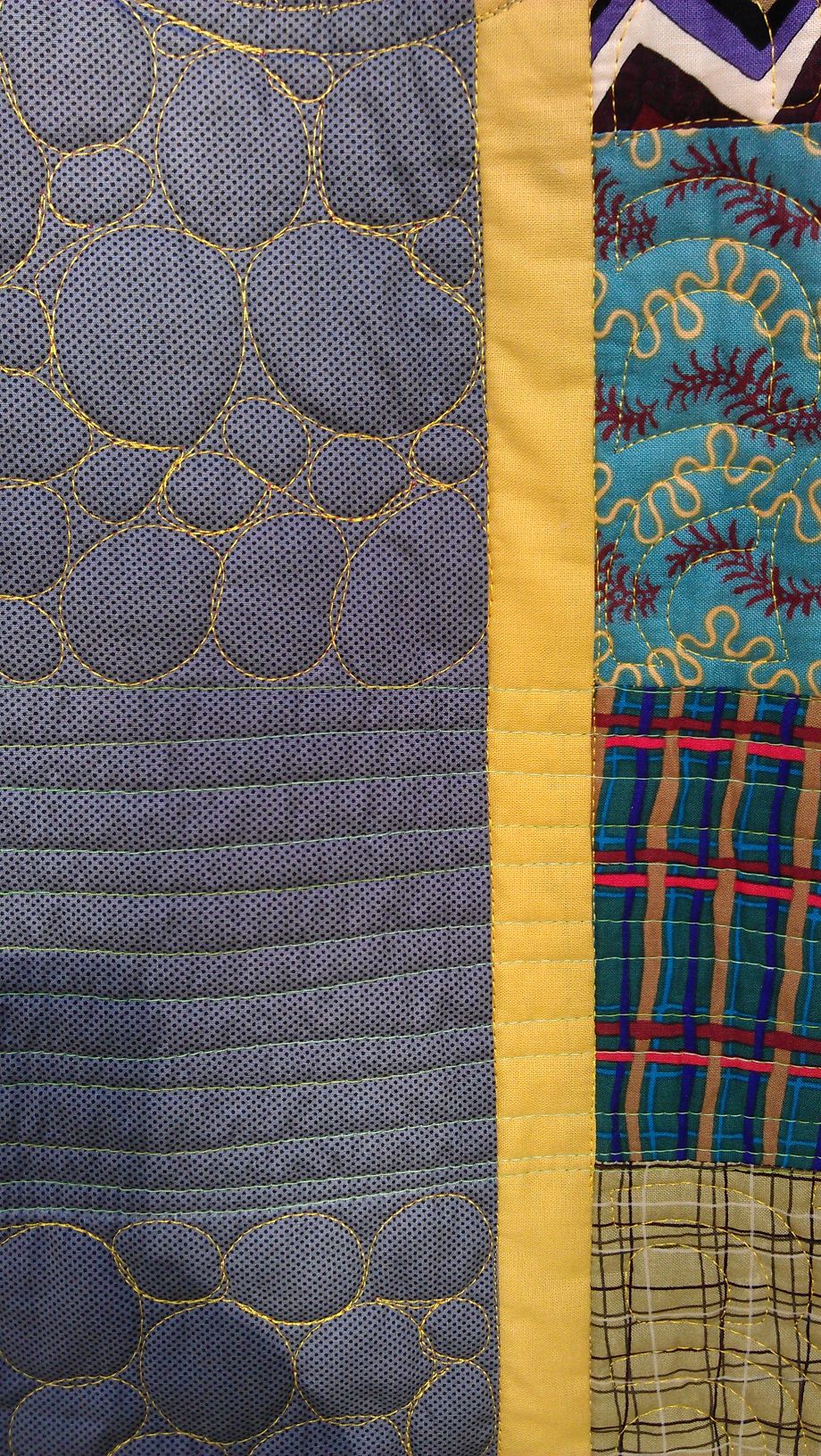
After I finished stitching all the circles and their centres, I had decided to do a simple all-over motif for the gaps between the circles in the very busy fabric of the main part of the quilt top. To echo the circular motif, I stitched a squared-off-end version of my ‘open headband‘ motif across all the open areas. And then I stitched circles/bubbles/pebbles in the open areas of the grey borders.

I liked the overall effect, especially the yellow thread against the grey fabric.

(Click on a photo to view it larger)

quilt146_01

quilt146_03

quilt146_02   quilt146_04

Back:

quilt146_05

Threads used:

  • Top: Mettler Poly Sheen (40 wt polyester, color 0706 [bright yellow]) and when that ran out, Fil-Tec ‘Glide’ (40 wt trilobal polyester, colour 80116 ‘Mango’)
  • Bottom: Can’t remember, but likely a Wonderfil Invisifil (100 wt) in a dark brown thread.


Community Quilt 145

3 06 2014

This was a little quilt, with no batting. Instead, it had a bright red polar fleece for the backing, which served as batting as well. I took a photo of the back, but reds and my phone camera just don’t play nicely together, so I haven’t added it below.

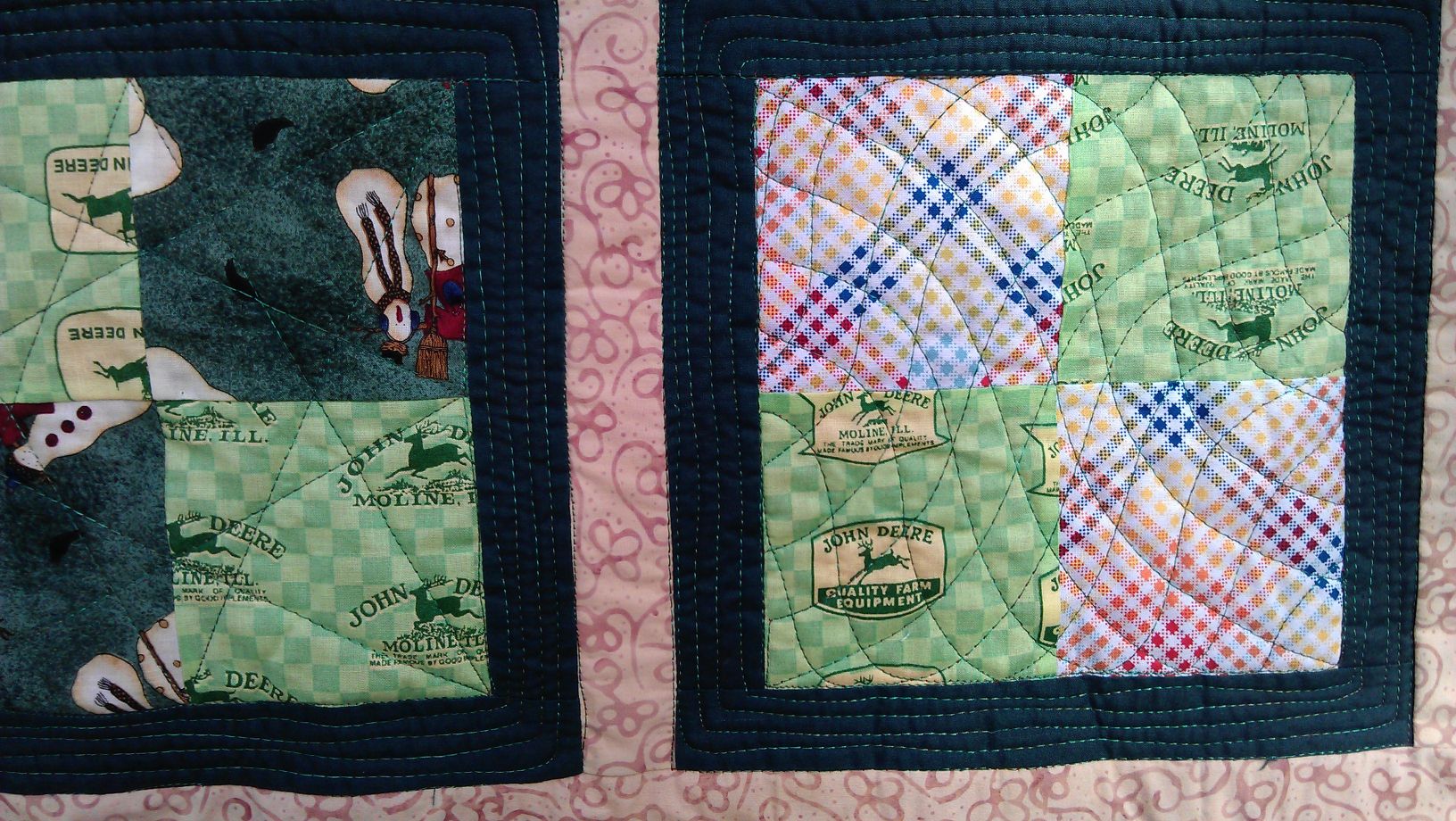
How to quilt it? I started by stitching in the ditch around all the blocks and the border as my previous experience with polar fleece as a backing is that it slips a LOT, so I needed to stabilise the two layers. Then I used the plaid fabric in the alternate blocks as my inspiration and based the stitching in these blocks on a variation of that, using different sorts of cross-hatching motifs in each of those blocks. To counteract the geometric nature of the quilting in those blocks, I used curved motifs in the other blocks, finishing with a star in the centre.

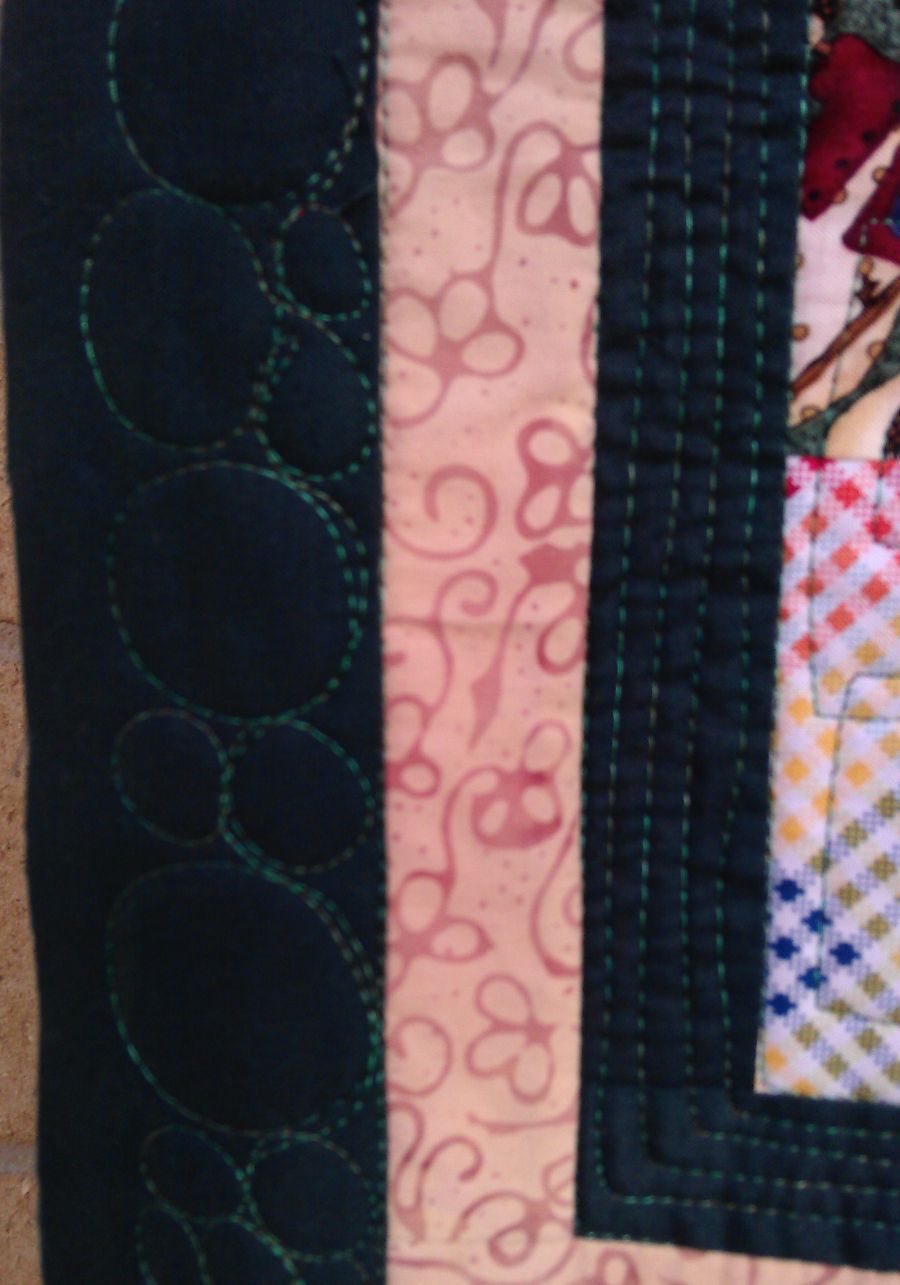
Then I stitched the borders of each block with wobbly lines (yes, they are deliberate!), and stitched big circles/pebbles/bubbles in the outer border. I didn’t stitch the beige inner border at all.

I used the same variegated green thread for all the stitching.

(Click on a photo to view it larger)

quilt145_01

quilt145_02

quilt145_03

Threads used:

  • Top: Fil-Tec ‘Affinity’ (40 wt trilobal polyester, colour 60293 ‘Forest’)
  • Bottom: Wonderfil Invisifil (100 wt, colour IF202 [red])