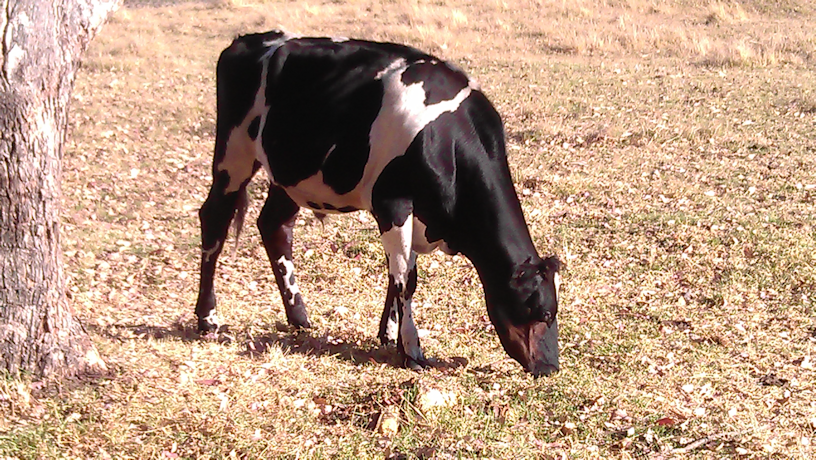
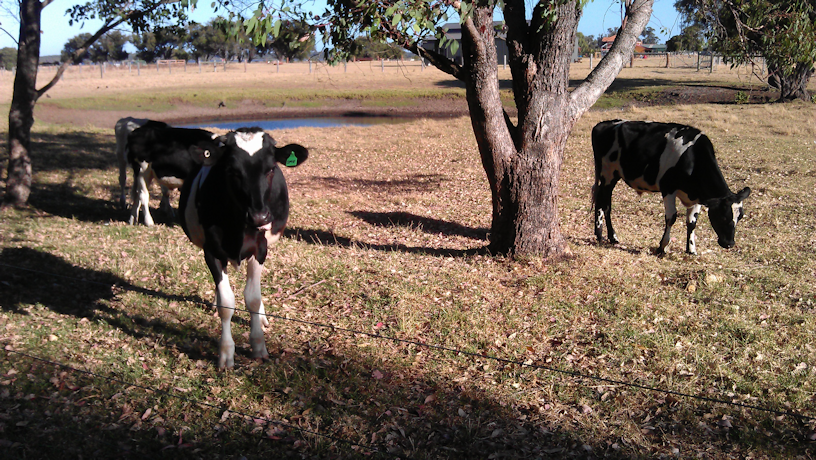
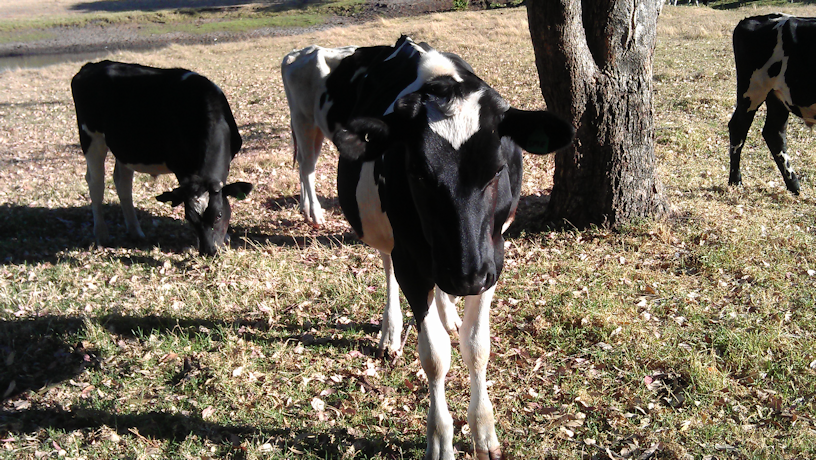
On my morning walk I see lots of livestock (horses and cattle mainly) and birds. The cattle usually hang out in a couple of paddocks and are often quite some distance from the path. But this morning several of them were close to the fence, and while wary, didn’t run away when I approached with my phone to take some pictures of them. Unfortunately, photographing black cow faces is as hard as photographing black cats 😉
New locals
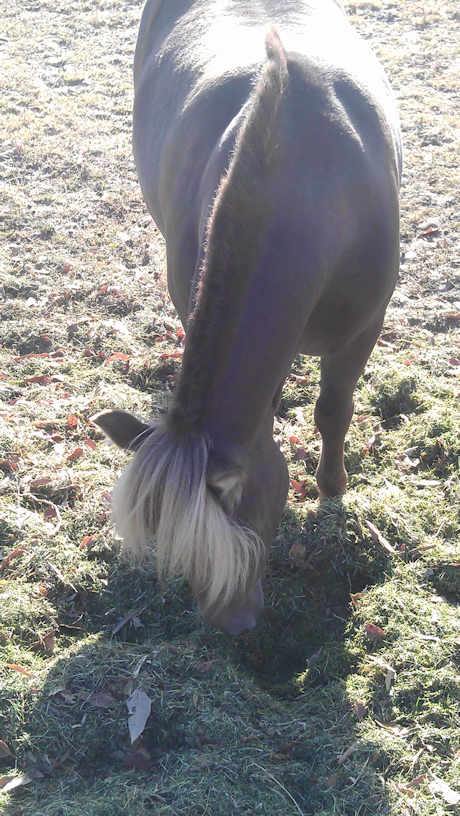
25 01 2015Sometime around Christmas, a neighbourhood property (5 acres) got a few new residents. First were two miniature horses, followed a few days later by about six Dorper sheep (one ram, some ewes, and some juveniles). The horses are very friendly and will come running to the fence when I walk by on my morning walk.
I got to meet the owner this morning, and he said they just love carrots and he would be fine with me bringing some to feed them when I walk past. He also told me the names of the horses — Sandy (the female with the blond hair and tail) is about four years old, and Angus (brown mane) is about a year old. They are just the cutest things!!!
Comments : Leave a Comment »
Categories : Life stuff
Community Quilt 183
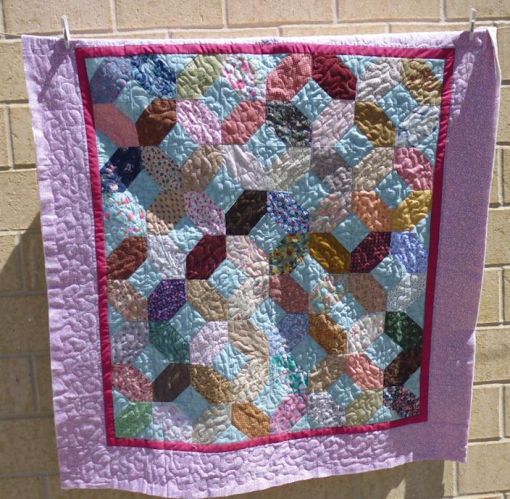
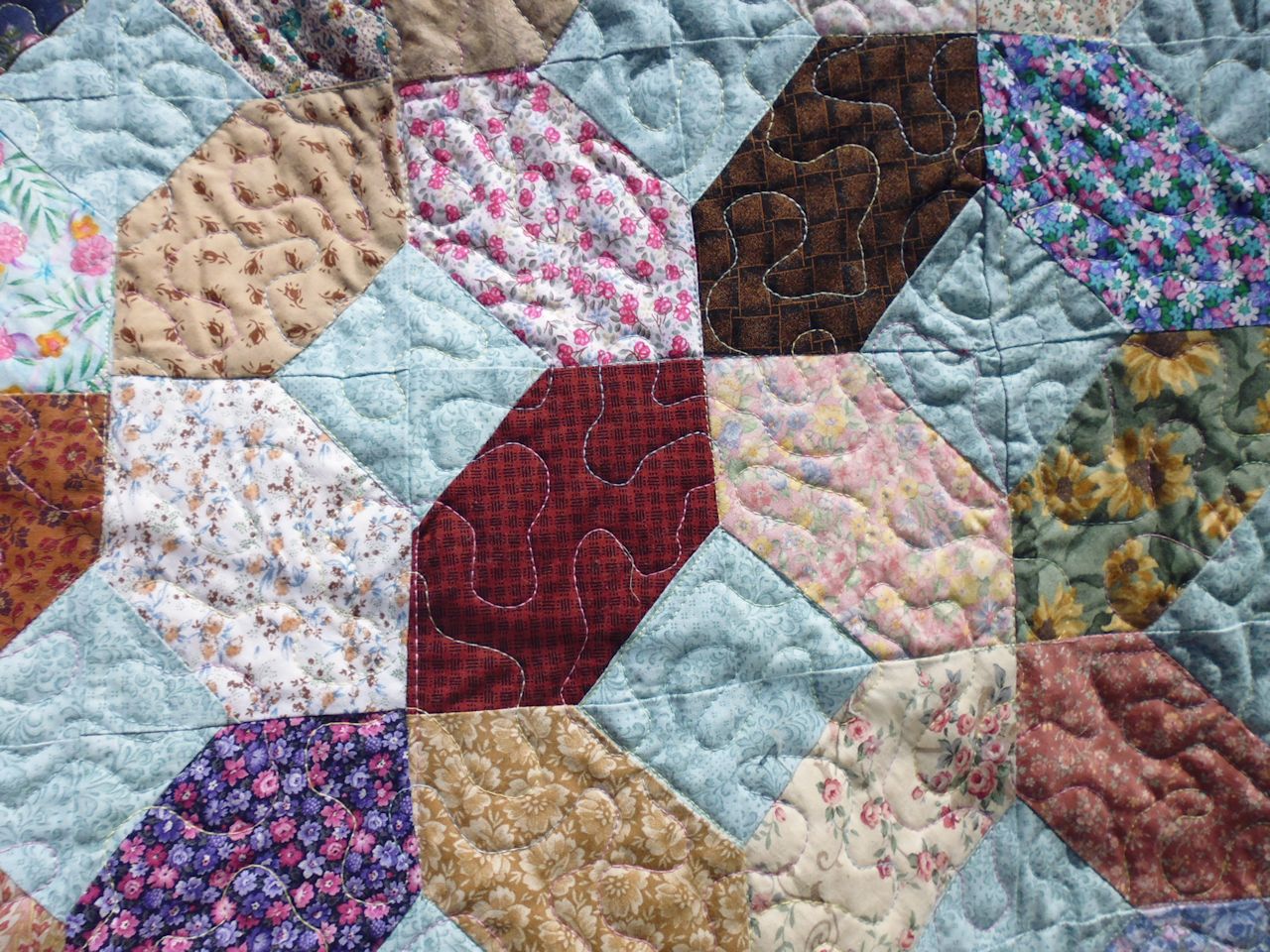
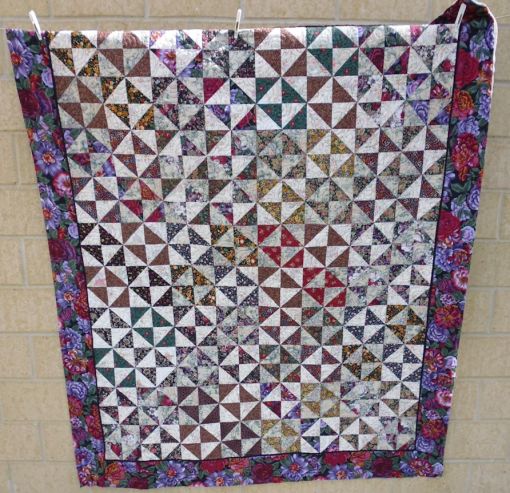
25 01 2015Some quilts (like #182) sing to you; others make you want to get them off your machine table ASAP… #183 was one of those. I didn’t like the fabrics (I suspect some were quite old), the colours, or the HUGE amount of biased edges and wonky blocks. It was one of those quilts that has to be stitched into submission.
Normally for a smallish quilt like this, with this many fabric variations, I’d just stipple it all over nin a neutral thread and not worry about stitching in the ditch. But it was obvious as soon as I put this quilt on the machine’s table that I’d have to stitch in the ditch otherwise I’d end up with massive puckers if I just stippled it, even if I started from the centre (as I usually would).
So, even though I wanted this one off my table ASAP, it had to remain on there long enough for me to stitch in the ditch for almost ESS (‘every stinking seam’), and then for the stippling.
I was glad to be done with it. Fortunately, it was small and didn’t take too long.
(Click on a photo to view it larger)

Threads used:
- Top:Â Fil-Tec Harmony ‘Spring’ (40 wt, cotton, colour 14062)
- Bottom: Fil-Tec Magna Glide Classic pre-wound bobbin (white)
Comments : Leave a Comment »
Tags: community quilts
Categories : Quilts and fabric stuff
Community Quilt 182
25 01 2015Sometimes a quilt just sings to you — this was one of those. I loved its simplicity and how the quiltmaker had used all solids in graduated colour ranges in each rail fence block. And the use of various widths in the white sashing strips.
I decided to quilt it with a yellow thread — enough to show up on the white, but not enough to be overbearing and dominate the simple beauty of the coloured strips.
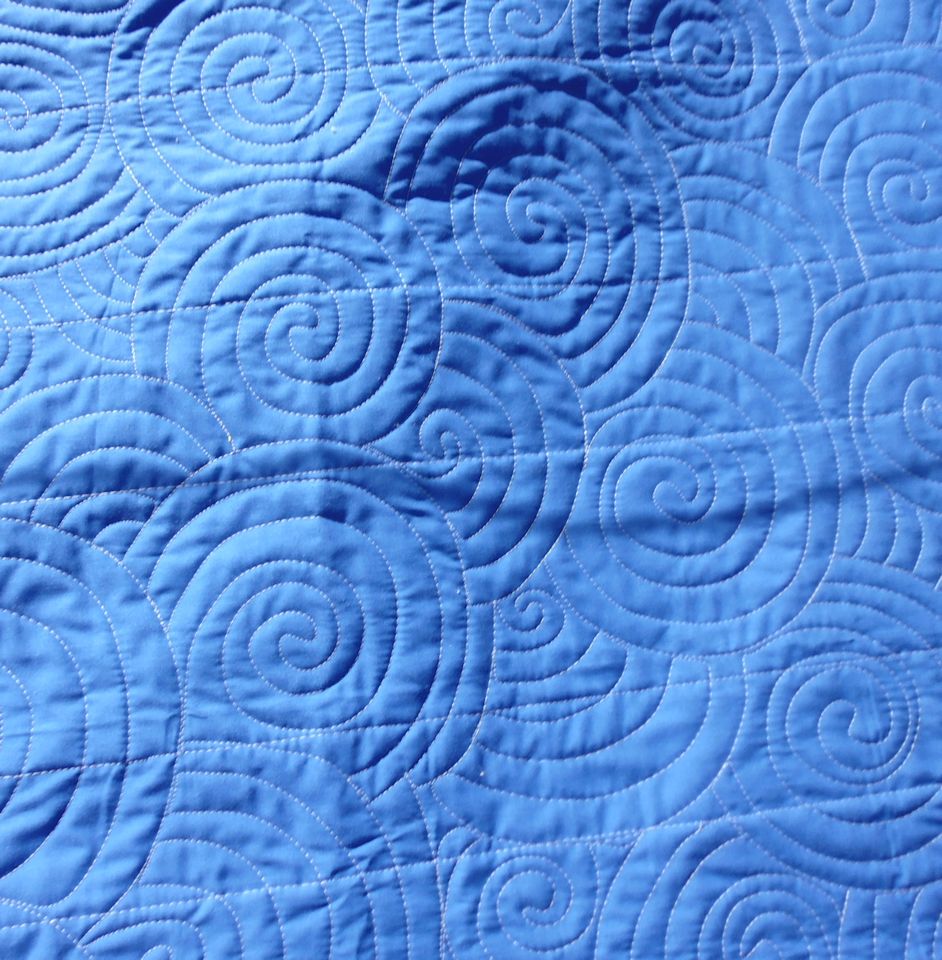
First, I stitched in the ditch around each coloured strip. Then it took me a while of looking at it to figure out how best to quilt it. I went through lots of options in my head and drawing over it with my finger 😉 Eventually, I decided on an all-over squared stipple motif and was about to start, but at the last moment I decided on really big swirly spirals, with about a half inch between the lines in each spiral.
I didn’t mark anything — all these spirals were free-motion.
I really like how it turned out. And I liked how the yellow added just a bit more life to an already vibrant and colourful quilt. The back looks pretty awesome too 😉
(Click on a photo to view it larger)
Back:

Threads used:
- Top:Â Isacord (40 wt, trilobal polyester, colour 0600)
- Bottom: Fil-Tec Magna Glide Classic pre-wound bobbin (light tan)
Comments : 5 Comments »
Tags: community quilts
Categories : Quilts and fabric stuff
Community Quilt 181
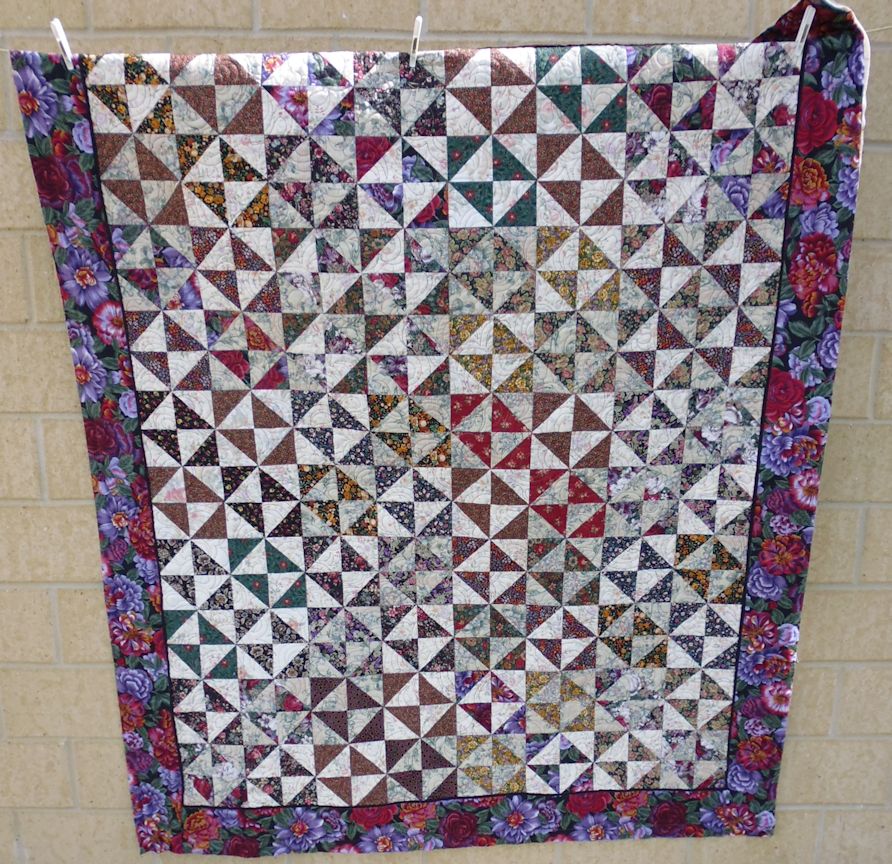
25 01 2015This was a very ‘busy’ quilt, with lots of tiny half-square triangles and many many different fabrics, including an equally busy fabric in the border.
How to quilt it? I realised that doing anything other than a simple all-over motif would be lost in the ‘busy-ness’ of this quilt, so I opted for a variation of my ‘go to’ open headband motif. Instead of arcs, the centre part of each motif is a paisley (or a really big comma!).
I used a variegated thread in autumnal colours in all parts of this quilt, including the stippling in the border.
(Click on a photo to view it larger)

Threads used:
- Top:Â Fil-Tec Harmony ‘Autumn’ (40 wt, cotton, colour 14081)
- Bottom: Fil-Tec Magna Glide Classic pre-wound bobbin (gray)
Comments : Leave a Comment »
Tags: community quilts
Categories : Quilts and fabric stuff
Community Quilt 180
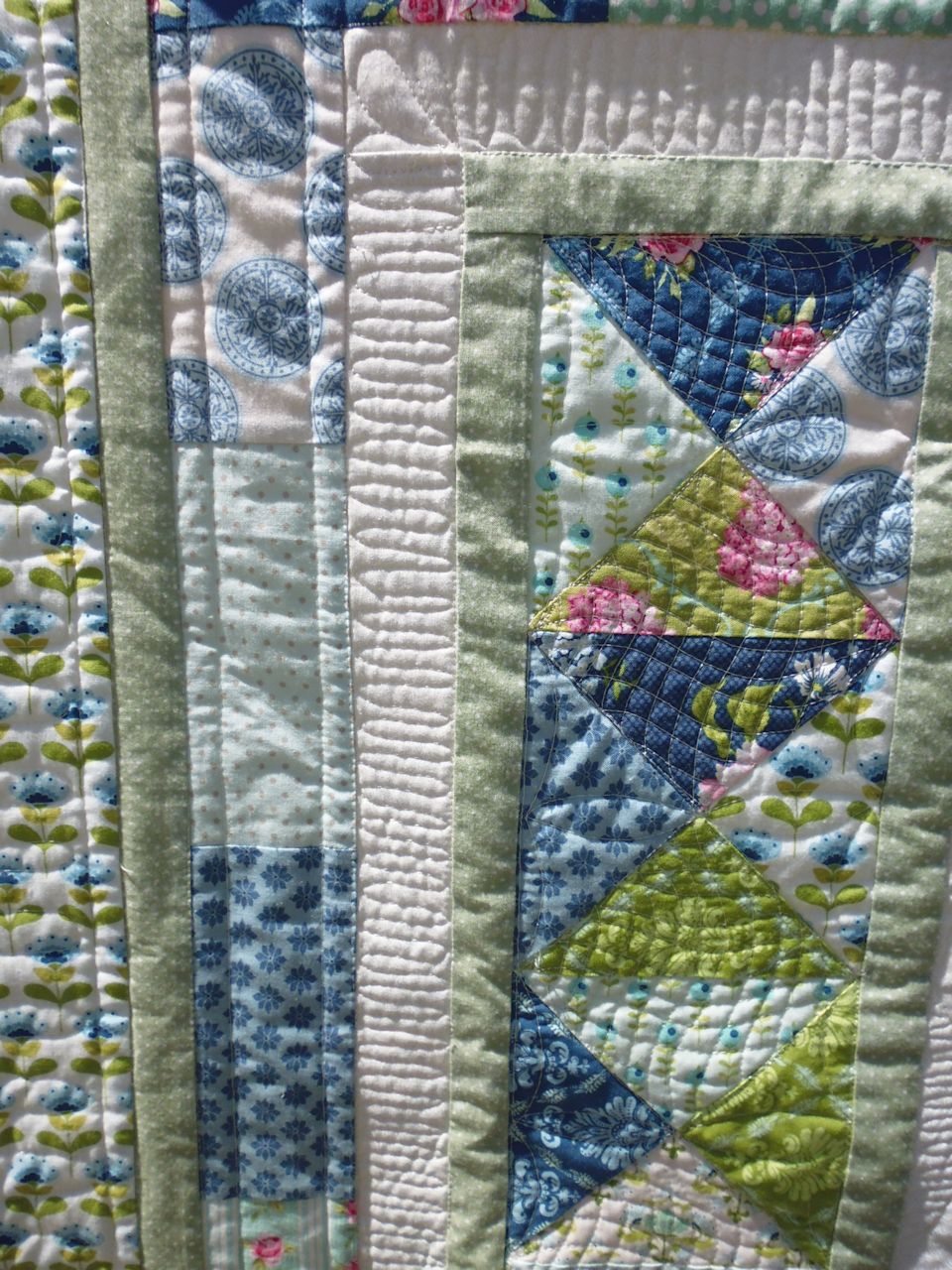
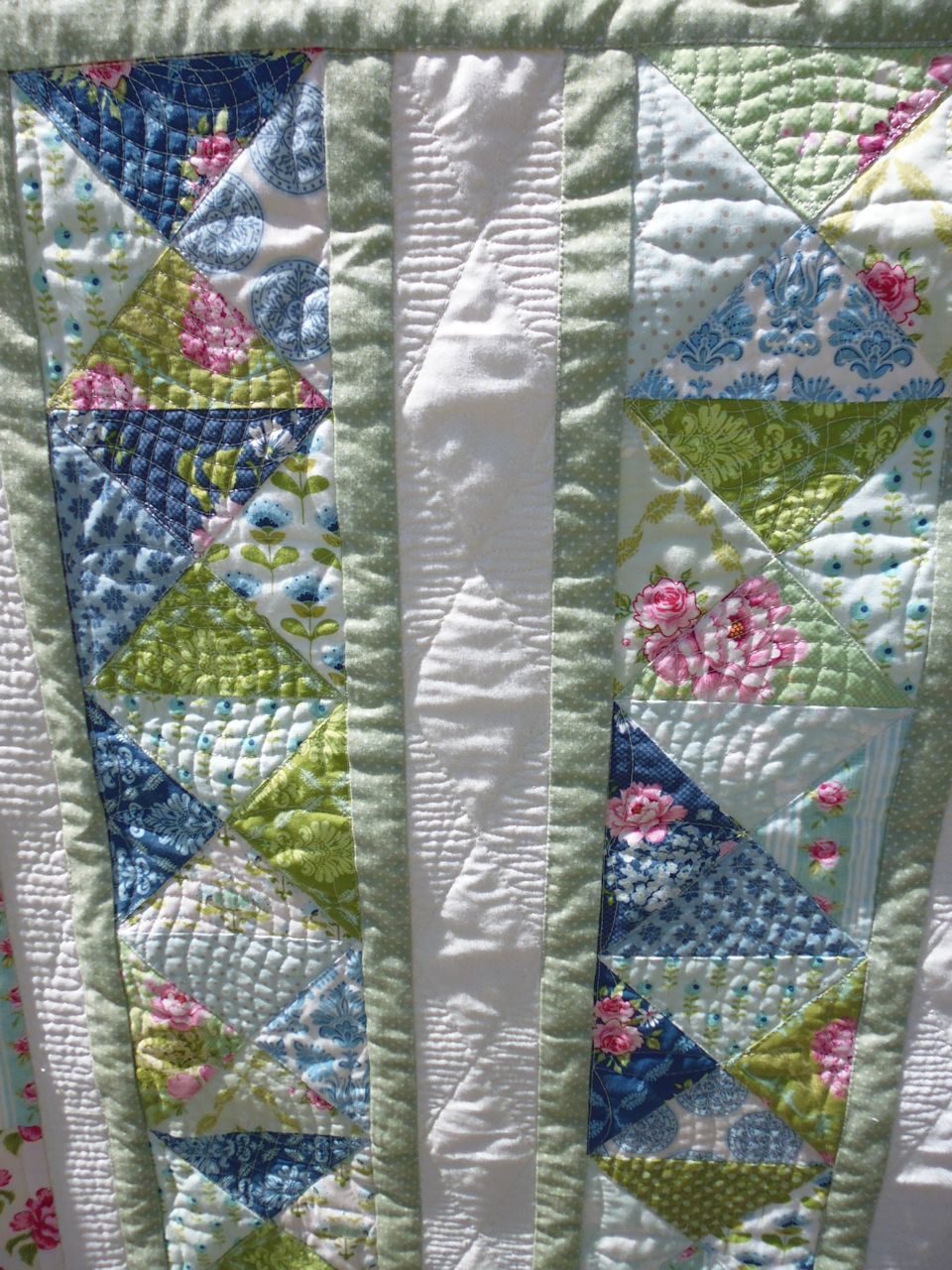
25 01 2015I liked the colours in this quilt — they were very cool and calming. And fresh.
How to quilt it? As usual, I started by stitching in the ditch around the main elements — the white strips in the middle and the borders. Then I tackled the white strips. I emulated the diamonds in the coloured strips stitching straight lines (with my Line Tamer ruler) from point to point (matching the side points of the diamonds in the coloured strips). Then I did a tight up and down ribbon stitch in the ‘background’ of these diamonds, causing them to ‘pop’.
Next, I did a wavy matrix in each coloured diamond (on-point square) in the coloured strips. But the setting triangles were too puffy, so I stitched a 3-petal flower in those to subdue the puffiness.
In the white border, I repeated the up and down ribbon motif, and then did a very large version of it in the widest border. In that border, I didn’t want the outermost points to be even, so I varied their length.
In the other borders I either stitched straight lines about a half inch from the seam lines, or left them unstitched (all the spotted green borders).
I was pleased with how it turned out — this was quite a ‘modern quilt’, and I hope my stitching showed that. And the back looked pretty awesome too 😉
(Click on a photo to view it larger)

Back:

Threads used:
- Top:Â Fil-Tec Glide ‘Linen’ (40 wt, trilobal polyester, colour 10WG1)
- Bottom: Fil-Tec Magna Glide Classic pre-wound bobbin (white)
Comments : Leave a Comment »
Tags: community quilts
Categories : Quilts and fabric stuff
Community Quilt 179
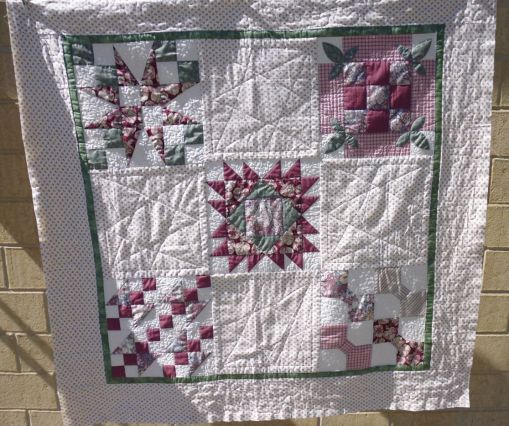
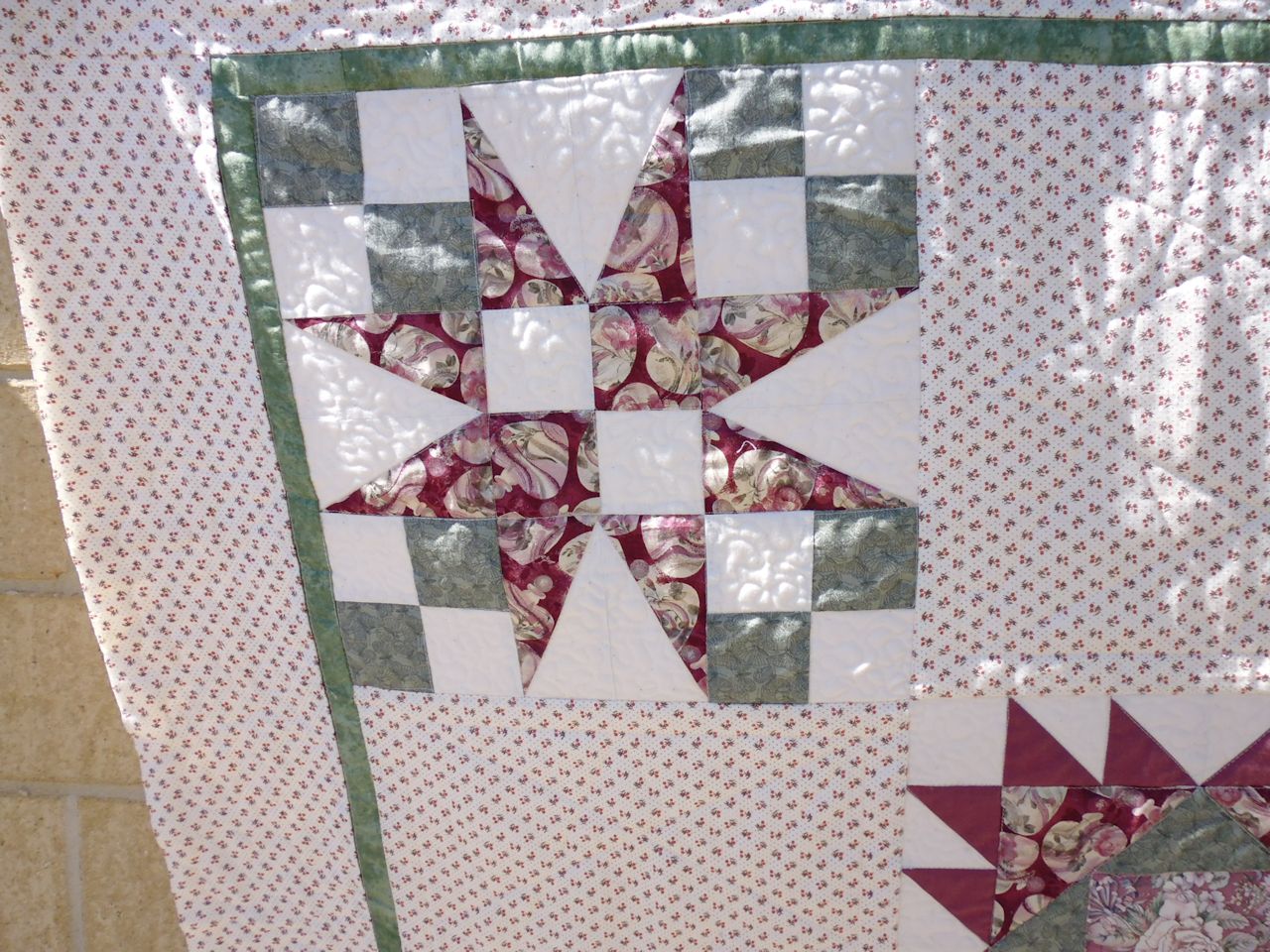
25 01 2015This was a big quilt with a lot of empty space. Each block was different but most had stars or diagonal lines, which helped me decide how to quilt the empty blocks.
First, I stitched in the ditch around each of the blocks, then around the main elements within each pieced block. To make these elements ‘pop’, I quilted the background only, in a simple smallish stipple.
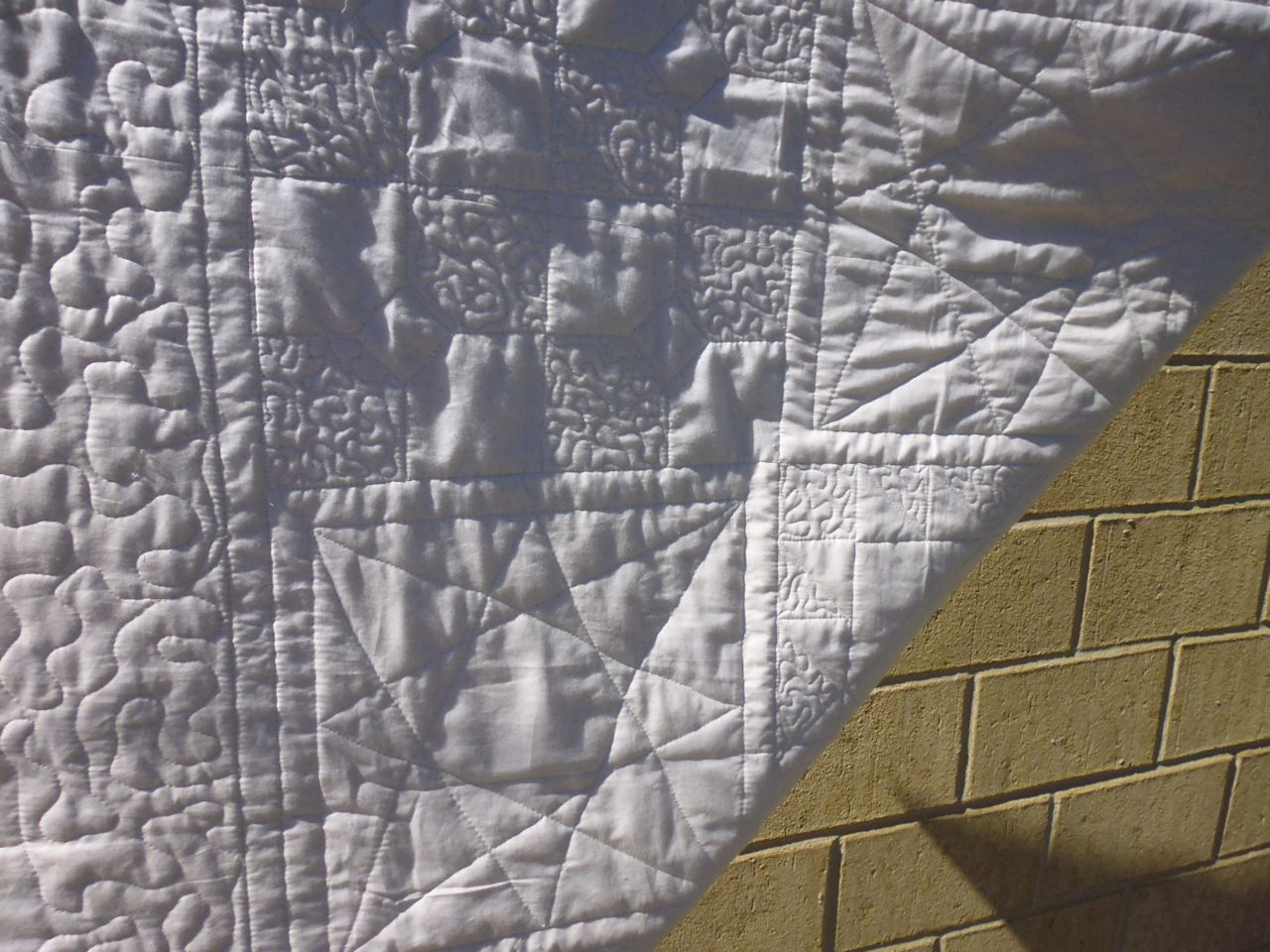
To give definition to the empty blocks, I echo quilted about half to one in from the joining seam lines, then stitched a wonky 8-point star in each to stop them puffing too much. Finally, I did a large stipple in the main border and left the green framing border unstitched.
(Click on a photo to view it larger)

Back:
Threads used:
- Top:Â Fil-Tec Glide ‘Linen’ (40 wt, trilobal polyester, colour 10WG1)
- Bottom: Fil-Tec Magna Glide Classic pre-wound bobbin (white)
Comments : Leave a Comment »
Tags: community quilts
Categories : Quilts and fabric stuff
Community Quilt 178
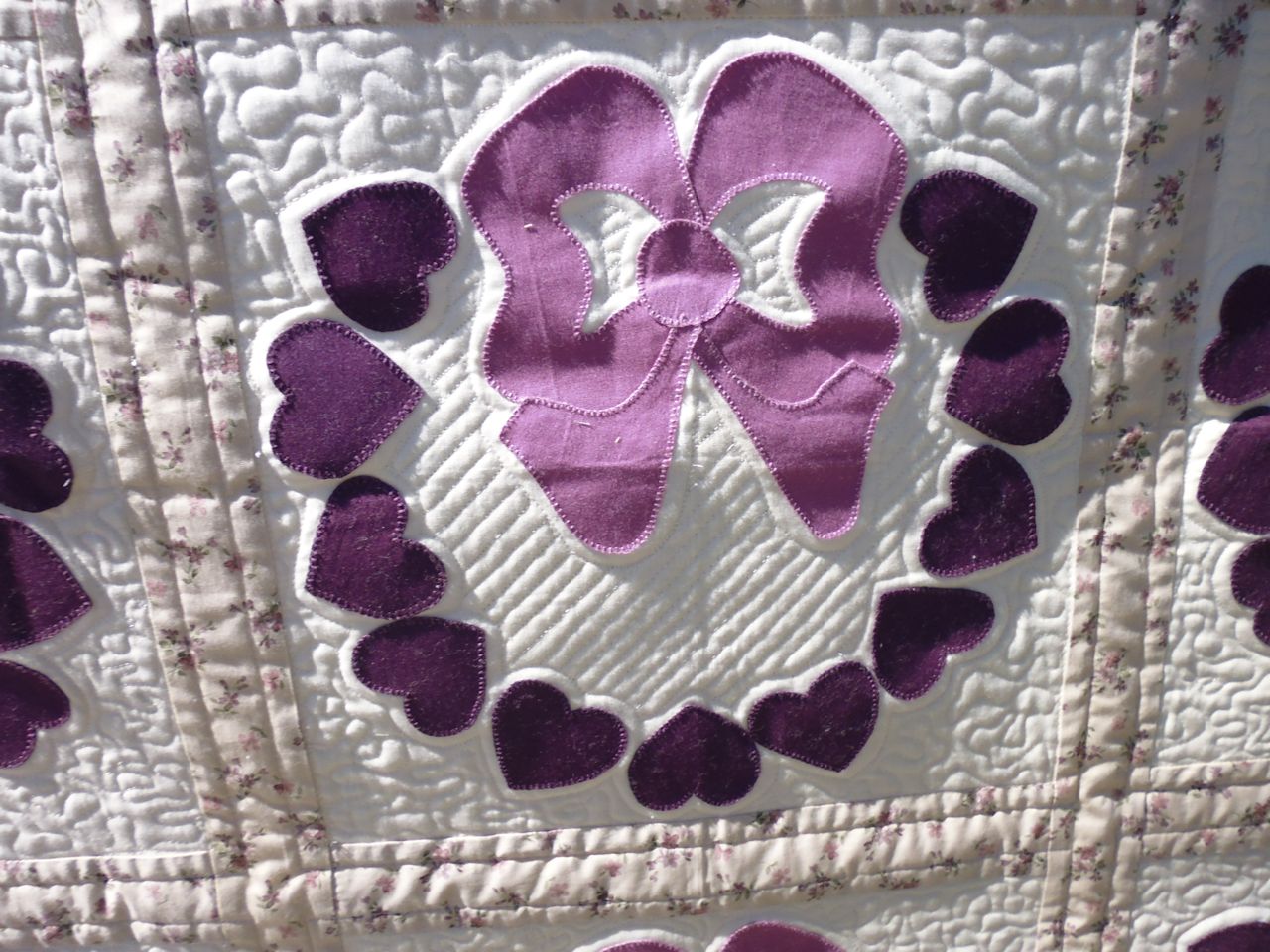
25 01 2015Someone had spent a lot of time cutting out and carefully appliquing all those little hearts and big bows to create wreaths inside each block of this quilt.
How to quilt it? I started by stitching in the ditch around all the blocks, then I echo stitched about a quarter inch out from each heart and bow. Next I used my Line Tamer ruler to stitch diagonal lines inside each heart ‘wreath’, then stippled in the remaining white space.
I kept the border simple, just stitching a straight echo line a half inch from the seams.
(Click on a photo to view it larger)

Threads used:
- Top:Â Fil-Tec Glide ‘Linen’ (40 wt, trilobal polyester, colour 10WG1)
- Bottom: Fil-Tec Magna Glide Classic pre-wound bobbin (white)
Comments : Leave a Comment »
Tags: community quilts
Categories : Quilts and fabric stuff
Handi Quilter Sweet Sixteen: Needle Sensor Failure
19 01 2015Occasionally you might get this message on your machine. Stop stitching immediately and investigate the cause.
In my experience, it’s almost always caused by something caught in the bobbin area — a piece of thread (it can be TINY), or a broken needle tip.
If you broke a needle, have you found the needle tip? It might be jammed inside the bobbin area. Mine was and my machine wouldn’t work (see https://rhondabracey.com/2013/04/22/oh-no/). I had to take it back to the dealer for them to get the tip out and to reset the timing. A broken needle jammed into the bobbin case invariably throws out the timing, which means your stitches may not form correctly even if you can get the tip out and the ‘needle sensor failure’ message goes away.
However, the most common reason I’ve found for the ‘needle sensor failure’ message is that some thread is caught inside the bobbin area, which is stopping the bobbin mechanism from moving.  If it’s thread, try these:
- Turn off your machine and turn it back on again – do you still get ‘needle sensor failure’? If yes, go to the next step; if not, try stitching again but be aware that if you get badly formed stitches (or no stitches), your timing is likely out and you’ll have to take your machine to a technician.
- Remove the needle plate and dust out any lint. Look for and remove any thread caught in the bobbin area.
- Remove your bobbin and bobbin case. Again, look for and remove any thread caught in the bobbin area.
- Slowly turn the handwheel at the back of the machine while looking down into the bobbin area – you’re looking for any piece of thread that might be stuck in there. If the handwheel is jammed, apply some pressure but don’t force it – if you can’t turn it at all, take your machine to the technician.
- Assuming you can turn the handwheel, turn it back and forth (slowly) looking for anything caught in the bobbin area mechanism. If you see any thread, remove it with tweezers.
- Turn the machine off, then back on again, replace the bobbin/bobbin case, and try to stitch. If you still have ‘needle sensor failure’, take your machine to your technician.
Comments : 13 Comments »
Categories : Quilts and fabric stuff, Tutorials
Making koala mittens
10 01 2015The call went out after the devastating bushfires in South Australia for cotton mittens for koalas to cover the bandaged burns on their paws. The mittens were to be 100% cotton (easy for a quilter — that’s pretty much all most of us sew with), a pattern was provided, and an address was provided for us to send the completed mittens to.
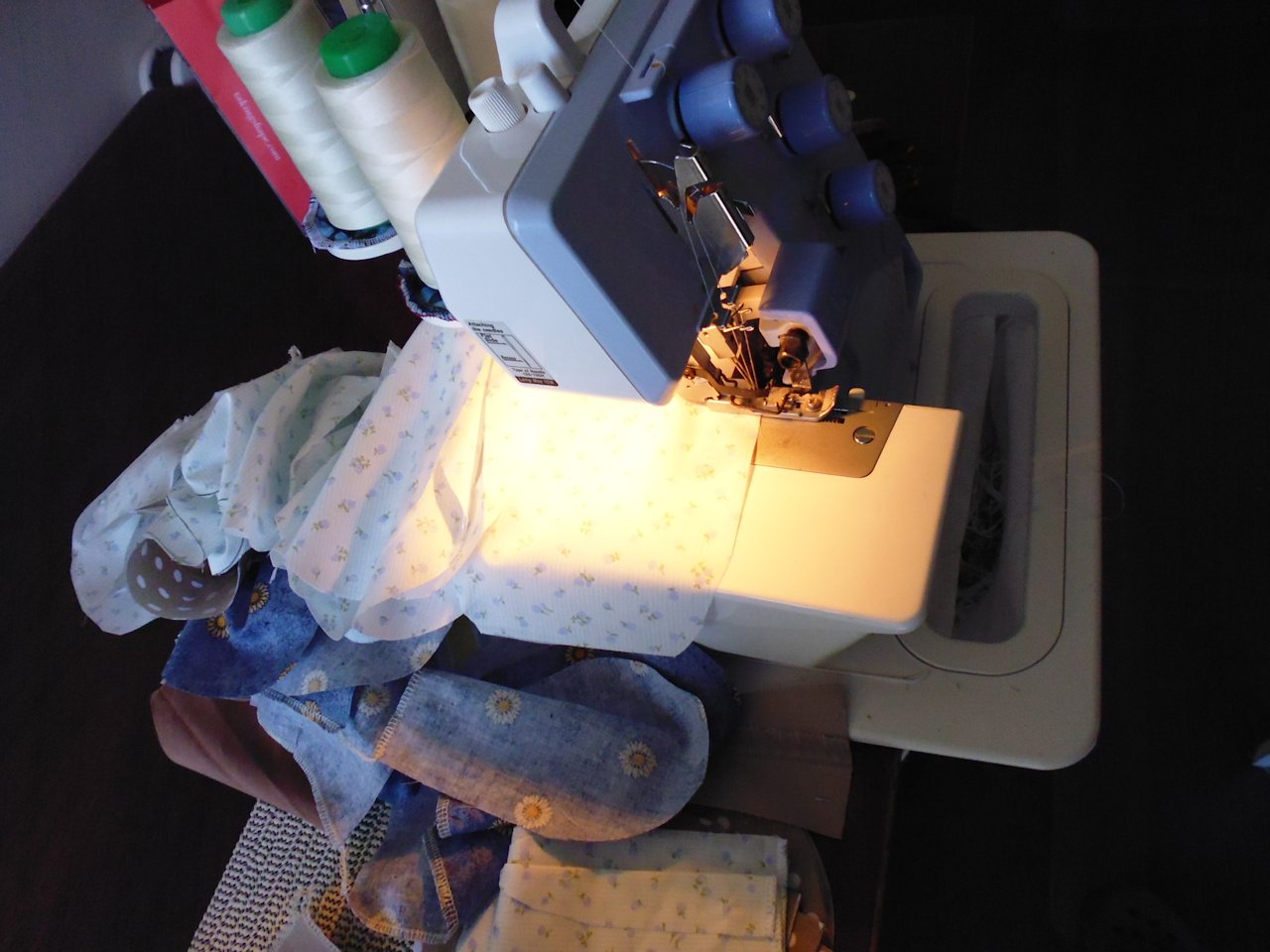
It took me no time at all to find some old fabric scraps and pieces of fabric I no longer cared for that were big enough to make mittens from. I ironed and cut out all the pieces, then dusted off my overlocker (serger), which I hadn’t used in several years. After rethreading it (fun… not!), I got sewing.
First I serged the straight bottom edges that were to remain open, chain stitching those.
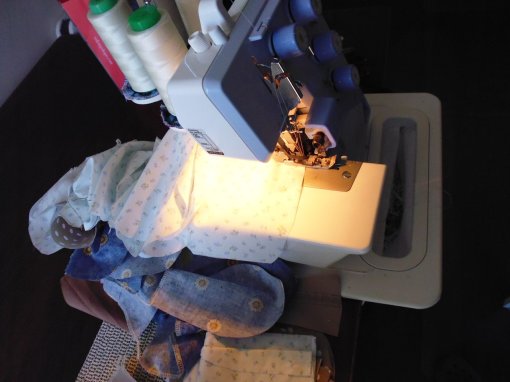
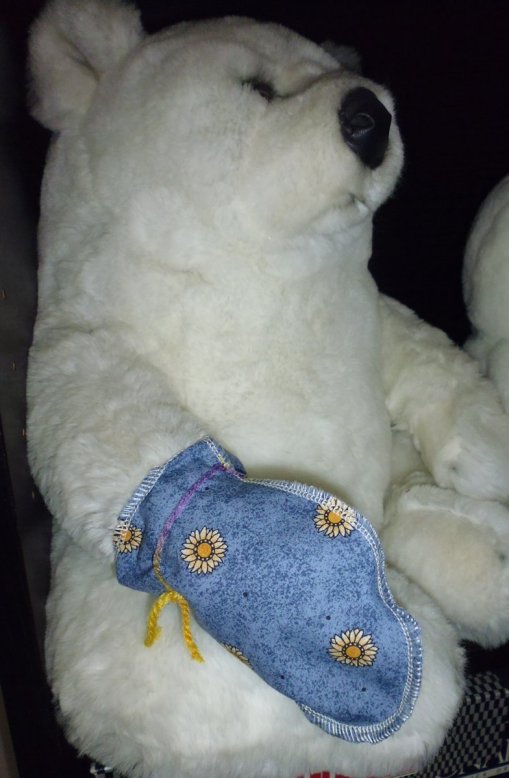
Next, I put two pieces together right sides out and serged around the edges. The reason I put the right sides out and left the stitching on the outside was two-fold — first, it was easier than stitching then turning each one, and second, I figured that having ragged seam joins inside wouldn’t be good for the koalas as their claws could get caught in any loose threads.
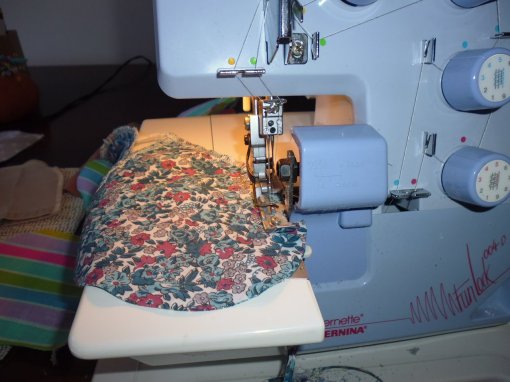

After I’d made 48 of them, I stitched on a piece of yarn to tie the mittens as per the instructions (which don’t tell you what length yarn — I used pieces about 10 to 12 inches long).

And then I modelled a completed mitten on my polar bear 😉
They are now all packed up and ready to send to the other side of Australia. I’m sure these mittens will be used for other animals too and/or distributed to other animal welfare agencies if they receive too many — I can see them being perfect for cats and smaller dogs too, as well as for the front paws of kangaroos.
Comments : 6 Comments »
Categories : Quilts and fabric stuff