Community Quilt 267

26 06 2016

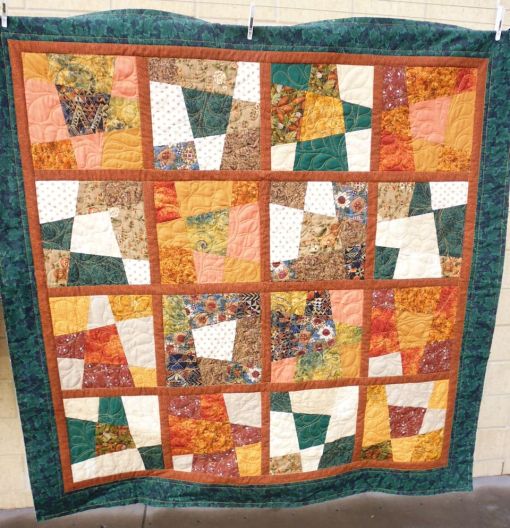
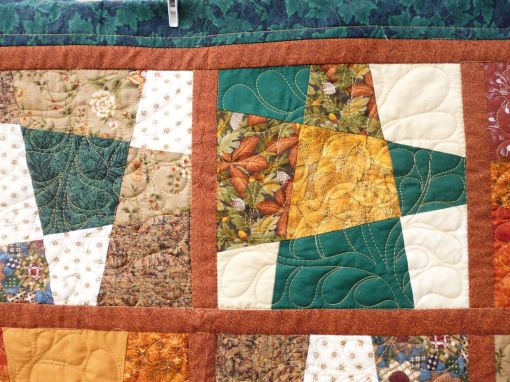
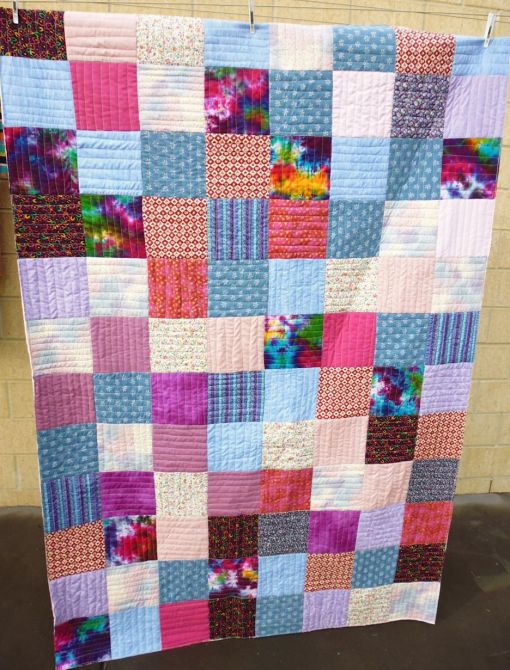
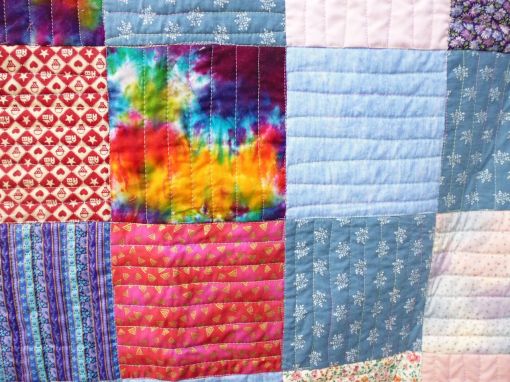
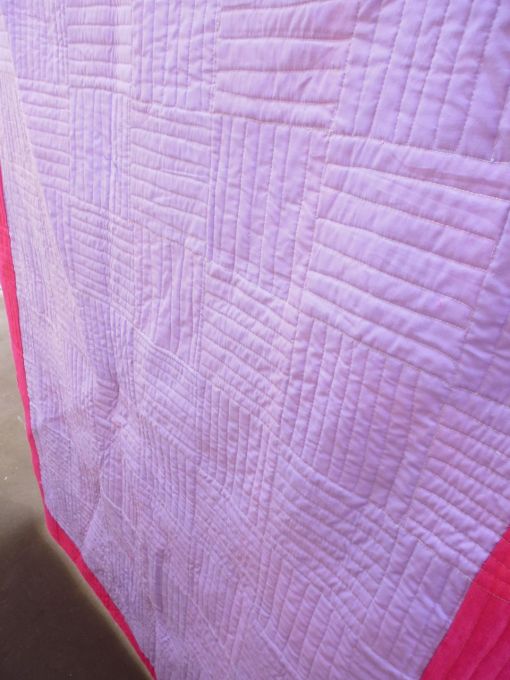
This small scrappy quilt was made up of 16-patch blocks, in various fabrics. I decided to quilt it simply using an ‘open headband‘ motif, in a pale lilac thread.

(Click on a photo to view it larger)

quilt267_01

quilt267_02


Threads used:

  • Top: Isacord (40 wt, trilobal polyester, colour Fb 3040)
  • Bottom: Fil-Tec Magna Glide Classic pre-wound bobbin (light tan)


Community Quilt 266

26 06 2016

How to quilt this scrappy quilt of 9-patch and pinwheel blocks, which had no apparent colour theme?

I decided to use a muted thread colour (a lilac) and a simple cathedral windows motif in each block, leaving the sashing strips unstitched, and with only a single straight line echo stitch in the border.

(Click on a photo to view it larger)

quilt266_01

quilt266_02

Threads used:

  • Top: Isacord (40 wt, trilobal polyester, colour Fb 3040)
  • Bottom: Fil-Tec Magna Glide Classic pre-wound bobbin (light tan)


Solved by the internet

22 06 2016

In less than two hours this morning I solved something that has bugged me for years — who made my grandmother’s ‘little boy’ figurine? I’d hunted the internet several years ago for clues as to what the maker’s mark represented but to no avail. My grandmother passed away in 1994, so she wasn’t around to ask, and I can’t recall asking her any details when I was younger.

I started by doing a Google search for ‘little boy figurine writing’, then checked the images results. I found a couple that looked like him, and discovered that they were based on (copies of!) a statue (“Enfant Ecrivant”) sculpted by Antonio Canova (Italy, 1757-1822). Then I found a website where people could ask question about pottery marks and I searched their site for the bits of the mark I could identify — an arched cat? inside a house, with an ‘H’? in the roof.

china04

The mark on the base is from the Hertwig (later Katzhutte) porcelain factory in Thuringia, Germany. Hertwig was in business from 1864 to 1958, later becoming Katzhutte (1958-1990), but the company did not survive after the reunification of Germany in 1990. According to the Porcelain Marks and More website (link below), the mark on my piece was used between 1914 and 1945. It depicts an arched cat inside a house, with an ‘H’ in the roof, and surrounded by an oval with indented dots at the compass points. The only difference between the mark I found on the internet and the one on my piece is that the cat is facing a different way — I don’t know if this is significant or if the image was reversed on the website where I saw it. I believe the figurine is made of porcelain bisque. It is 24 cm high, 8.5 cm wide, and 11.5 cm deep (9.4 x 3.3 x 4.5 inches).
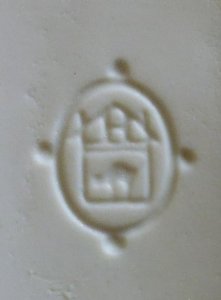
P1050713

The history of this piece in my family

My paternal grandmother (1902-1994) had this piece on her dressing table. Whenever I visited as a young child, I would stare at this little boy for hours trying to see what he was writing. I think my grandmother told me that my grandfather had given it to her around the time they got married (end of 1929), which fits the years of the mark (1914-1945). However, now that I know it was made in Germany, perhaps my grandfather, who was English, didn’t give it to her — Nana was of German descent so perhaps it was a wedding gift from one of her extensive family. That said, they came out to Australia from Germany in the 1890s, well before this mark was in use, so it’s not likely a family heirloom. My dad (b. 1930) said he always remembers it being in the house, so it’s definitely been in the family since then.

When my grandmother was moving into a retirement village and getting rid of many of her possessions, she gave it to me because I always so fascinated by it. I will give it to my nephew when I downsize.

Links:


Remembering Uncle Alf, 100 years on

13 06 2016

One hundred years ago today, my great uncle Alfred was killed in Belgium (near Ypres [now Ieper]) in WW1. He was just 20. He enlisted in July 1915 and arrived in France in February 1916. He was ‘wounded in the field’ in late May 1916, returning to duty a few days later, only to be killed two weeks later at Sanctuary Wood. Along with many thousands of others, his body was never recovered. He is memorialised on the Menin Gate Memorial.

When I started my genealogical research back in the mid-1990s, Alf was one of the first I looked for (he’s my paternal grandfather’s brother). But I couldn’t find any record of him in the British war records available on the internet at that time. As more and more information became available online, I continued looking for Alf, finally finding him via the Commonwealth War Graves Commission. But I got the biggest surprise — he didn’t fight for England, as I had presumed (this side of the family was English for many generations before him). Instead, he and one of his brothers had enlisted in Ontario, Canada, and fought for the Canadian Overseas Expeditionary Forces. I still don’t know how or when they got to Canada, or, more importantly, why they fought for Canada. I can only summise that either one or both of them were rejected for military service in England so they tried from somewhere else, or there was some derring-do associated with fighting for another country. The other brother never made it out of Canada to fight for Britain — he had all sorts of illnesses that prevented him from seeing active service.

Alf’s siblings ended up scattered around the world. Jack went to Canada and then on to the US (my Michigan family connection); Fred went to Canada with Alf for WW1, then back to England, then Canada again, then England, then Western Australia; Charles (my grandfather) came direct to Western Australia in 1923 (with Fred); Kath eventually came to Western Australia (1940s); while Daisy remained in England where she grew up. And my Dad’s middle name is ‘Alfred’, no doubt in remembrance of the uncle he never knew.


Testing various markers, pencils, and paints on fabric

24 05 2016

We had a wet and wild weekend here last weekend, so staying indoors was the only option. It gave me a chance to test some options for colouring fabric using markers, pencils, and paint. I have various types of these, but had never really given them a decent comparative test.

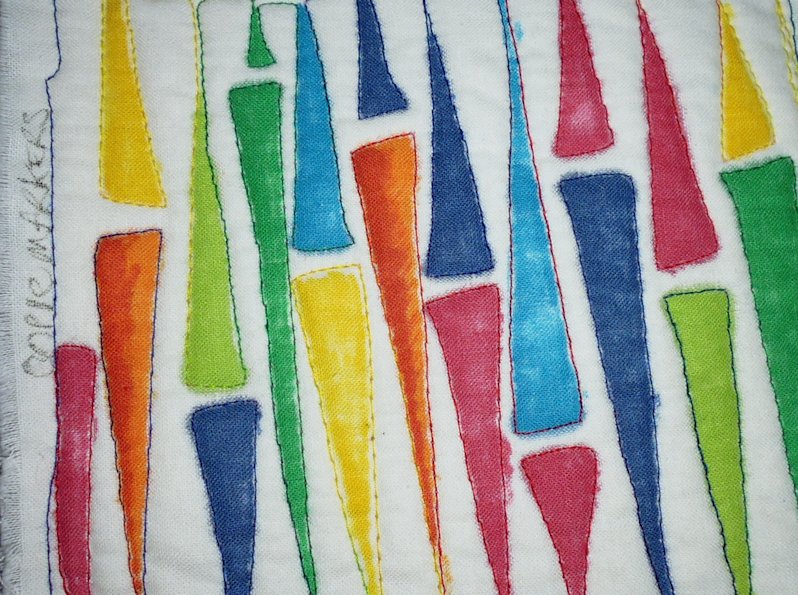
I used some of the quilt sandwich samples I made when I created a library of free motion quilting motifs based on Leah Day’s project. I needed samples that had closed spaces and found several that worked well. The fabric was a calico or quilter’s muslin (can’t recall which), with a single layer of batting (unknown type). After the first test (Copic Sketch markers), I used the backs of the samples so that the stitching wasn’t as obvious, and also to test if any of the colours bled through the fabric and batting layers (none did, so that was good). I deliberately chose rich colours for my testing as these would show bleeding more obviously than pale colours, and would be more likely to show through on the other side. I did not wash, iron, or heat set any of the samples.

For almost all tests, I just used the original colour ‘out of the box’ without trying to add shading etc. All methods were very time consuming, so I would only want to use colour from these sources on small projects, or small sections of a larger piece.

I tested:

  • Copic Sketch markers (using the brush end)
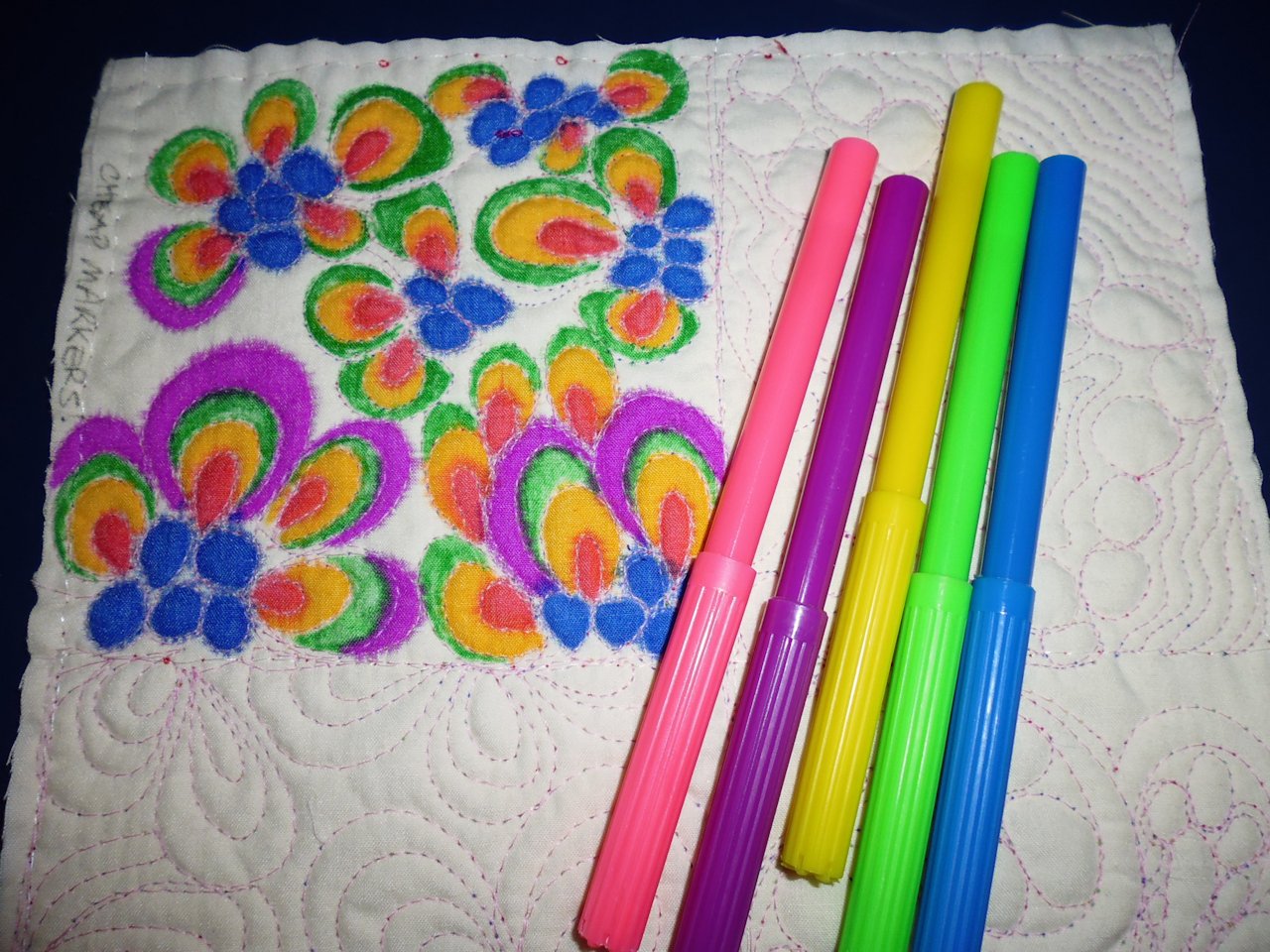
  • cheap no-name kids’ markers from China purchased from a discount store
  • Fabrico fabric markers (using the thicker brush end)
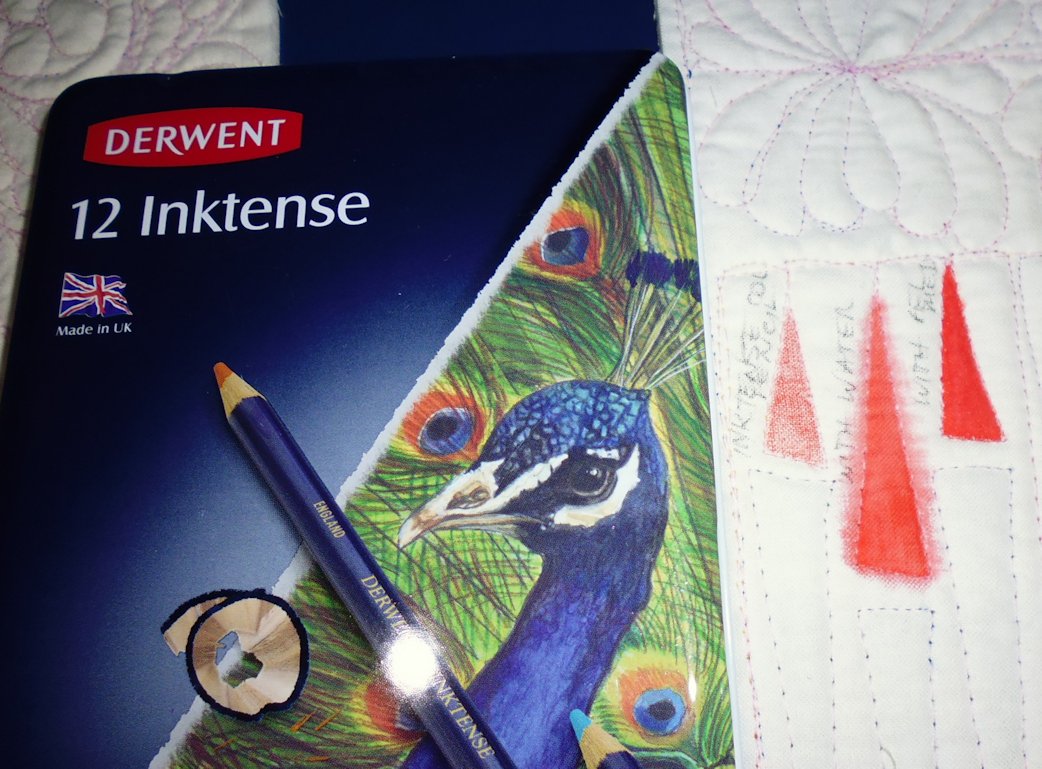
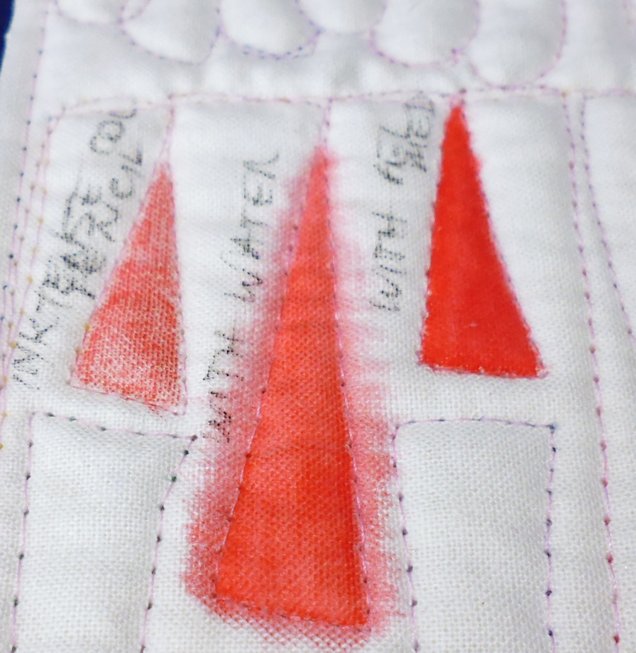
  • Inktense Watercolour Pencils — with no water, with water, and with FolkArt textile medium (Inktense Blocks should work the same, but I didn’t test these)
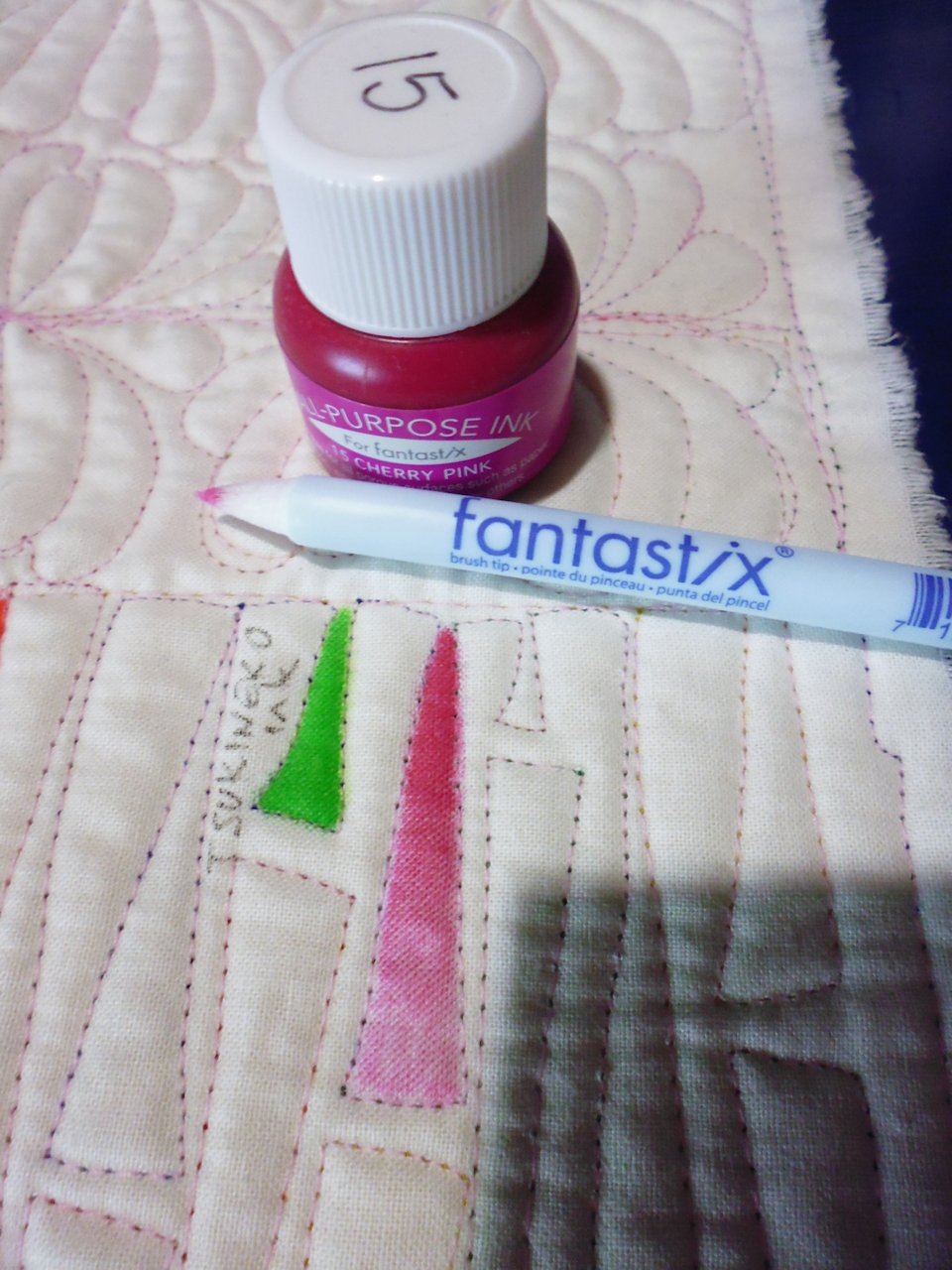
  • Tsukineko inks, applied with the pointed Fantastix applicator
  • no-brand fabric paint purchased directly from Gloria Loughman in a class I took with her several years ago — with water and with no water.

NOTES:

  • These tests are for my own purposes — your mileage may vary! Different fabrics and battings may give different results; applying heat or washing the samples may give different results.
  • I only used markers and paints I had in my stash — if you have different markers/paints, you’ll have to do your own tests.
  • Click on a photo to view it larger.

Copic Sketch markers

  • Almost no bleeding
  • Reasonably true colour
  • Can create shading by feathering in another colour, though if you do it after the original marking has dried, it may be noticeable (see the orange examples in the photo below, where I applied red after the orange had dried); it may be possible to get better results with the blender solution, but I didn’t try that
  • Easy to apply using the brush-tip end.

P1050526

Cheap no-name kids’ markers

  • Small amount of bleeding, especially with the darker colours (purple, blue in the photo below)
  • Colour runs out fairly quickly and I had to stop, put the top back on, use another colour while I was waiting for it to ‘replenish’, then use it again — this was especially noticeable with the green, which was quite patchy in its application, as you can see from the photo
  • Hard to apply — these markers only had a narrow pointed tip (after all, they’re for kids’ drawings!), so the individual line markings to create the filled colour are noticeable with some colours
  • Colours are much darker on the fabric than the colour of each marker would indicate — the pink, yellow, and green, especially, came out very dark
  • I was surprised at how well they worked — they were $6 for a pack of 24 colours, and therefore much cheaper than any of the specialty markers, which can be $10 each; they may be suitable for very small patch or fill work.

P1050527

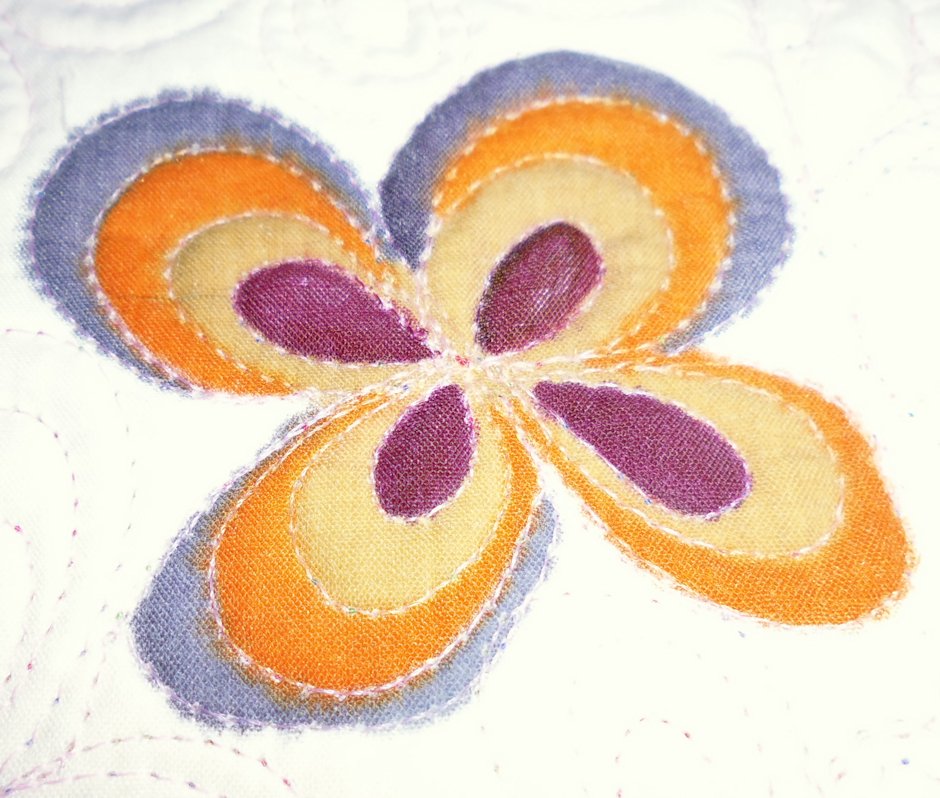
Fabrico fabric markers

  • Some bleeding
  • Easy to apply using the thicker end
  • Some colours didn’t reproduce well — only the grey looked like its marker; the ‘sand’ and the purple were much darker, and the rust was more of an orange


P1050528

P1050529

Inktense Watercolour Pencils

I coloured in the areas with the pencil, then for each area I used one of these three methods — no water, added water after applying the pencil, and added FolkArt Textile Medium after applying the pencil. I’ve used them before so had an idea what to expect.

  • No water (left in photo) — pale colour, shows fabric texture
  • With water (middle) — bleeds badly, more intense colour (Note: I added the water with a small paintbrush; I didn’t dip the watercolour pencil into water — that may have made a difference)
  • With textile medium (right) — no bleeding, very intense colour, best method for these pencils.

P1050534

P1050536

Tsukineko inks

  • Used the pointed Fantastix applicator as I needed precise control at the edges
  • Intense and reasonably true colour if painted on ‘neat’ and you continue to dip the applicator into the ink (see the green swatch in the photo below)
  • Colour gradation achieved by letting the ink dry as you brush it on (i.e. not redipping the applicator into the ink; see the pink swatch in the photo below)
  • No bleeding
  • Fairly quick method.

P1050537

No-name fabric paint

I tried this fabric paint neat (no water) and with water — see the blue swatches in the photo below.

  • No water — thick intense colour, hard to apply evenly, almost no bleeding
  • With water — bleeds, less intense colour, easier to apply.

P1050542


Community Quilt 265

18 04 2016

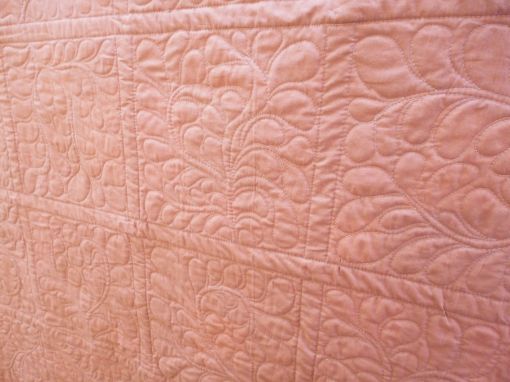
I haven’t stitched free-motion feathers for ages, but it’s amazing how that muscle memory came back very quickly! I started by stitching in the ditch around all the borders, then stitched freeform feathers in each block. Each feather has between two and five spines, and none are the same.

(Click on a photo to view it larger)

quilt265_01
quilt265_02

Back:

quilt265_03

Threads used:

  • Top: Fil-Tec Glide ‘Military Gold’ (40 wt, trilobal polyester, colour 27407)
  • Bottom: Fil-Tec Magna Glide Classic pre-wound bobbin (light tan)


Community Quilt 264

18 04 2016

Such a very simple quilt of 6-inch squares, but with a variety of fabrics that ranged from heavy-weight cottons (similar to gabardines) to very light-weight cottons (similar to lawn) and everything in between. To stabilise it, I stitched in the ditch around each square, then because the puffiness was very uneven owing to the different weights of the fabrics, I decided to do a checkerboard pattern to sew the puffiness into submission!

No rulers were harmed — in fact, none were used. All the ‘straight’ lines were done free motion, so while the stitching lines might look even at a distance, up close many are quite wonky. And I’m OK with that.

(Click on a photo to view it larger)

quilt264_01
quilt264_02

Back:

quilt264_03

Threads used:

  • Top: Fil-Tec Harmony ‘Spring’ (40 wt, cotton, colour 14062)
  • Bottom: Fil-Tec Magna Glide Classic pre-wound bobbin (white)


Community Quilt 263

18 04 2016

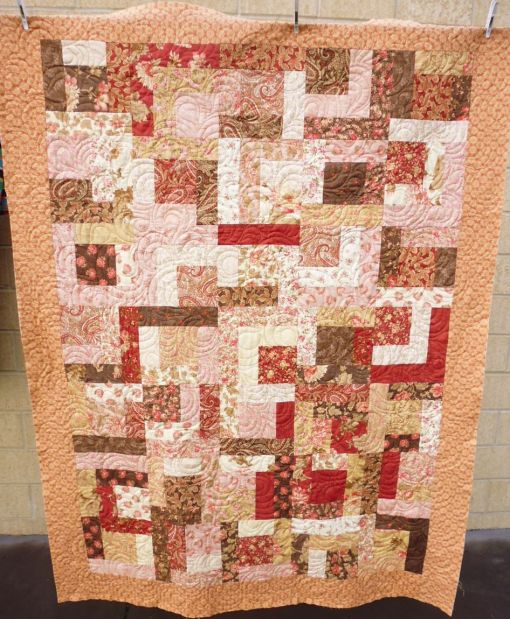
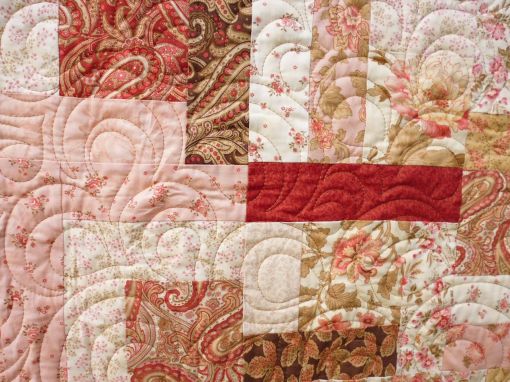
With such busy patterns in the fabrics, I opted for an all-over motif — a slight variation on the open headband motif (I added a sort of hook to some of the inner points).

(Click on a photo to view it larger)

quilt263_01
quilt263_02

Back:
quilt263_03

Threads used:

  • Top: Fil-Tec Affintiy ‘Brunette’ (40 wt, trilobal polyester, colour 60291)
  • Bottom: Fil-Tec Magna Glide Classic pre-wound bobbin (light tan)


Community Quilt 262

18 04 2016

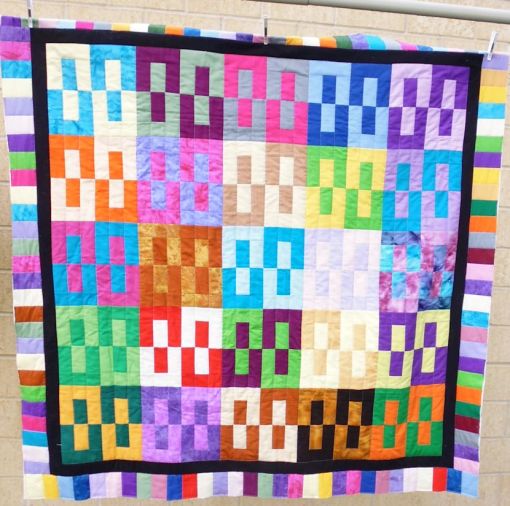
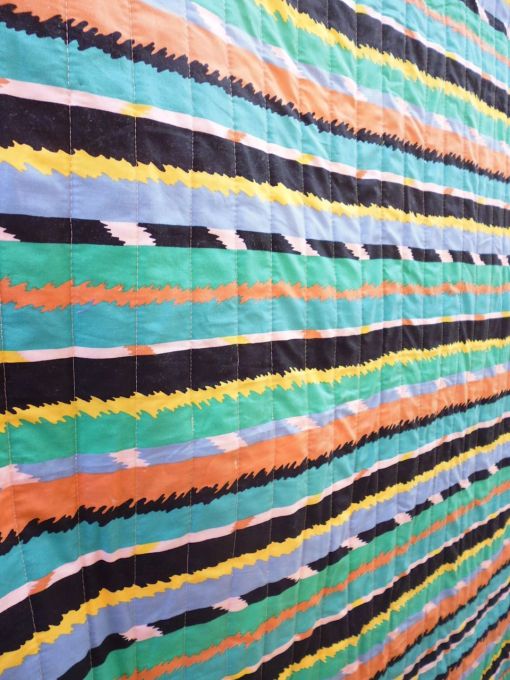
What a bright quilt this is! In keeping with the ‘modern’ lines of it, I just did some simple straight line stitching in the ditch following the verticals.

(Click on a photo to view it larger)

quilt262_03

quilt262_01

Back:
quilt262_02

Threads used:

  • Top: Isacord (40 wt, trilobal polyester, colour Fb3040)
  • Bottom: Fil-Tec Magna Glide Classic pre-wound bobbin (white)


Batting sides

16 04 2016

In case you weren’t aware, batting has a back and front (thanks to Pam Holland for teaching this to us at Empty Spools a couple of years ago).

I came up with a way to remember which way it goes: Dimples are on the face, and knobbly bits are on the bottom (interpret that whichever way you want!).

So, the dimple side faces the top and the knobbly side faces the bottom. Easy peasy!

(The reason why you put batting in the ‘right’ way is that it’s designed for the needle to punch down through the dimples, in line with how the needles punched the batting when it was made. If you have the batting in the ‘wrong’ way (knobbly bits facing up), then the needle struggles harder to push through the batting and may bring back up bits of batting with it.)

See also: