Evolution of a quilt: 6

4 01 2008

I spent some time on the dragonfly quilt yesterday, mostly learning how to work with monofilament and metallic threads!

HINT: If your metallic thread just doesn’t want to spend time in the eye of the needle, put it in the bobbin, then turn the fabric over and sew on the back! Experiment a bit first and make sure you know where the edges of your applique pieces are. I did this by stitching down the raw edge fused applique pieces with mononfilament thread in the top and a contrasting thread in the bobbin. When I turned over the top, I could see the outlines of each appliqued piece.

So here’s the progress so far… First picture is of the quilt top before arranging the applique pieces and fusing them on. Note the innovative use of the sliding glass door and window as a light box!

Background

Next came the placement of the dragonfly pieces (again, note the innovative use of magic tape!):
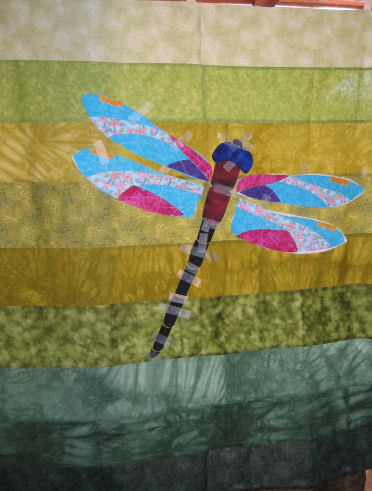
Placing the applique pieces

Oops! Forgot one step—I used silver metallic thread on the wings to create a sort of lace effect the other day. Here’s the result:

Silver metallic thread to create a lace effect

I then stitched down the applique pieces with monofilament thread in the top and a contrasting thread in the bobbin. For the dark body pieces, I used grey monofilament with black in the bobbin; and for the wings, clear monofilament with blue in the bobbin. This gave me stitching ‘boundaries’ on the back of the top.
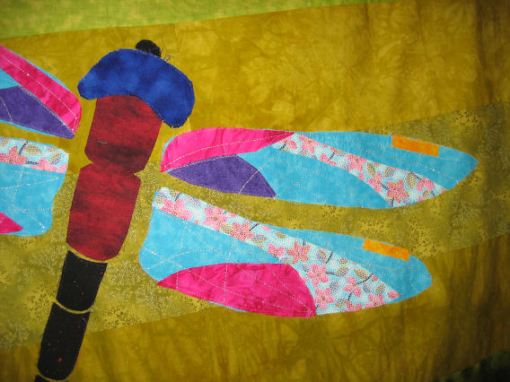
Applique pieces stitched down with monofilament

I was on a roll, so next I tried putting the silver metallic thread in the bobbin case and sewing from the back. When I’d sewn with the silver thread earlier (on the wings), it had continually ‘stripped’ in the eye of the needle, so I tried the bobbin technique and it worked like a dream! I had to adjust the tension a bit, so experiment on scraps first. Here’s the test piece to see how it looked:

First try at stitching from the back

Once I had the hang of doing free motion embroidery with the feature thread hidden (!), I went ahead and added silver highlighting to both sides of the dragonfly’s body parts.

Here’s the back of the quilt top showing the outlines I stitched within—well, sorta stitched within! I know that the edges of the dragonfly’s body will be covered with a bias tape, so I wasn’t too concerned about being 100% accurate and within the lines.

Back of quilt top showing outlines for embroidery

Then I cut out and sewed a pale blue tulle over each wing to add to the lace effect, and to soften the brightness of the blues, pinks and purples.

Embroidered and tulled

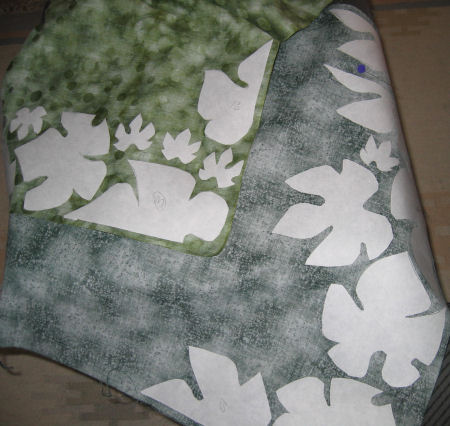
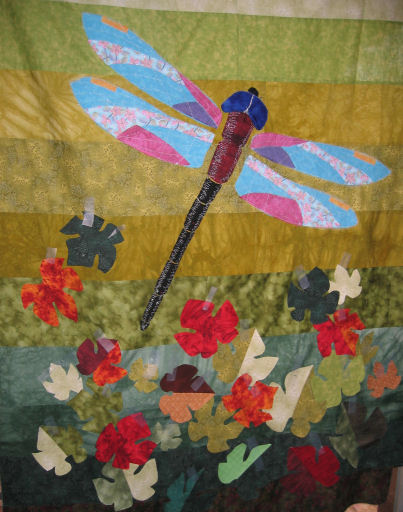
And the last steps I did before the heat and humidity stopped me working was to start placing and fusing some of the 70+ grape leaves to the background:
Placing the grape leaves

I’ve decided to only place the grape leaves in the lower part of the quilt. Two reasons: To create a feeling of leaf litter, and to let the dragonfly ‘fly’ and rise from the leaf litter.

Next immediate tasks:

  • Add gold metallic thread to the leaves I’ve already fused, emulating leaf veins
  • Place and fuse more leaves over the top of the existing ones

I might get some of this done today—it’s MUCH cooler than yesterday, and even though we’re going out for a couple of hours, I’m sure I’ll get some of this done. If I can, I’ll use the gold metallic thread as the top thread so I avoid having to outline each leaf in monofilament (70+ leaves outlined in monofilament = a lot of sewing!). Hopefully this will work—the gold metallic thread I have is thinner and less knobbly than the silver. Based on my last experience with the gold thread, I’ll have to experiment with the tension but that shouldn’t take too long to get right. And this time I’m not quilting through many layers of fabric either, so it should be a lot easier.

Links to all posts about this quilt


Evolution of a quilt: 5

30 12 2007

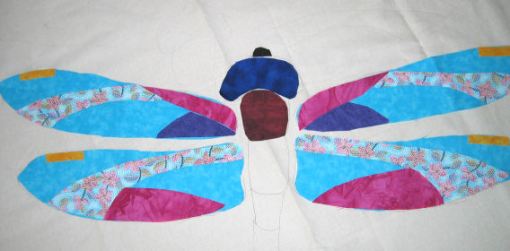
The last step before I finished yesterday evening was to use the remaining fusible web to create the dragonfly body and wing parts. I didn’t have enough fusible (back to the fabric shop tomorrow!) so was only able to get the wings completed, and a couple of small body parts. In the picture below, I’ve laid them out on top of the muslin which I won’t use now, but you can get a sense of how the dragonfly is coming together.

Fused wings

Still to do, but not in order…:

  • Finish applying fusible web to the remaining dragonfly parts
  • Position the dragonfly parts on to the background
  • Add some grape leaves (as required)
  • Possibly add some bunches of grapes,
  • Fuse applique all parts
  • Stitch the appliqued pieces down with monofilament thread so they don’t go anywhere!
  • Free motion embroider veins in the leaves and lace effect on the wings; if add grapes, free motion embroider light highlights (gold, silver metallic thread?)
  • Get some thin bias tape (gold, silver and black) and outline the dragonfly and other relevant bits with it
  • Add a border
  • Add batting and backing, and a hanging sleeve
  • Quilt the quilt
  • Add binding
  • Continue documenting the process!

Links to all posts about this quilt


Evolution of a quilt: 4

30 12 2007

Major setback: When I scattered the leaves over the muslin, there was a LOT of white poking through. Without creating hundreds more leaves, this wasn’t going to work. And even if I did create hundreds more leaves, I think the background would’ve been TOO busy and swamp the dragonfly (‘scuse the pun!).

So back to the drawing board… More thoughts, ideas, and possibilities later (and some more hours…) and I decided to use the remaining green fabrics and create a green gradient background for the dragonfly.

Some of the green fabrics laid out in a possible order:

Green fabrics for the background

The next step was deciding what to do with these fabrics. I thought of putting large patches of green over the muslin, then laying some leaves on it, but that looked weird. Next thought was to look at how I could cut the green fabrics in wavy lines so that I could get the effect of undulation (a la Ricky Tims). But I couldn’t figure out how to do that successfully! (Fortunately, I tested on small fabric scraps before cutting ANY of the green fabric!)

I then thought I could make uneven lines in the greens getting a geometric effect with long thin triangular shapes, but I tried that on four strips and it just didn’t look right, so I unpicked all those stitches and decided to go for very boring strip piecing of these 5 and 6″ strips…

Strip pieced background

Next: Create the dragonfly body and wing parts

Links to all posts about this quilt


Evolution of a quilt: 3

30 12 2007

In the previous two steps, I’ve got my inspiration and created the grape leaves for the background. Now to create the dragonfly…

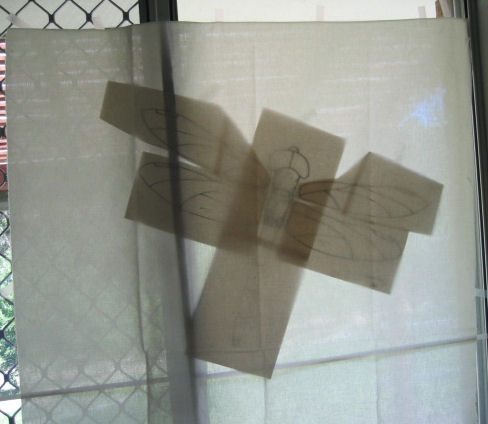
I found some pictures, traced the essential outlines so that you could tell it’s a dragonfly not a butterfly, assembled the pieces of paper, taped them to the window, overlaid them with quilter’s muslin, traced the design on to the muslin in pencil, rearranged everything and retraced the design on to the muslin in permanent marker.

Dragonfly drawing

Muslin overlaying the drawing

The reason I traced the lines in permanent fabric marker was so I could position the leaves on the muslin and applique them on without going too far into the area where the dragonfly would overlay the leaves—I needed to see where the dragonfly was going to go.

Next: The background dilemma

Links to all posts about this quilt


Evolution of a quilt: 2

30 12 2007

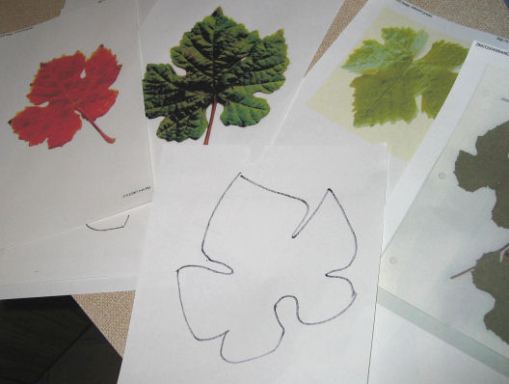
Grape leaves as a background! I like the idea… So off to the internet again to get some simple images of grape leaves that I can trace to get my outline. Not just one grape leaf either—I have to have a few variations of shape and size.

Grape leaves - inspiration

The first stage is finding suitable images (do you know how many pictures of dolmades there are???). Next, printing them off. Then I used the window as a light box and traced the outline of the photos on a sheet of paper with a black marker. Next, I photocopied these outline sheets at various increased and reduced sizes.

Then it was off to the fabric store (bliss!) to find suitable fabrics for vine leaves, and dragonfly wings, and to get some fusible web to trace the leaves on to in preparation for appliquing them on to the background. That all sounds so quick and easy, but believe me it wasn’t!

Here’s the fabric I chose sitting on top of the fusible web showing the outlines of some 70+ grape leaves that I’d traced, hoping that I’d have enough:

Fabrics

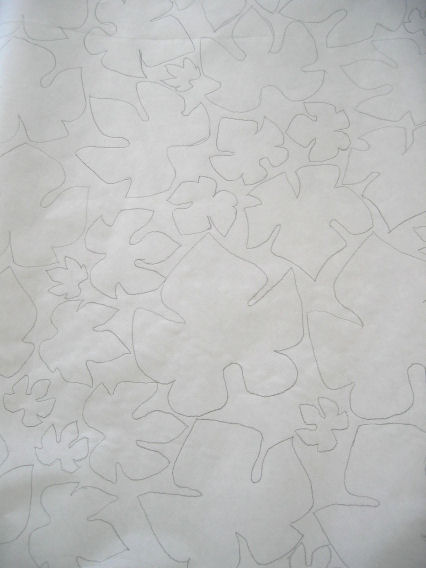
And here are some of the traced outlines making the best use of the available space:

Outlines of grape leaves

So now I have the fabric and the outlines traced on to fusible web. The next step is to cut out the tracings into individual leaves, then hot iron the fusible on to the backs of the various fabrics, then cut out each individual fabric leaf. Again, this took some hours…

Fusible web on backs of leaf fabrics

At the end, I had some 70+ leaves, about a third of which I had cut in half and joined together to get colour variation.

Grape leaves ready for fused applique

Next step: Create the dragonfly.

Links to all posts about this quilt


Evolution of a quilt: 1

30 12 2007

Since moving down south, we’ve discovered the delightful Scotts Brook wines, and I’ve been quite taken by the dragonfly logo. An idea for a quilt/wall hanging using the dragonfly has been brewing in my head for a few weeks now. With some time off over the Christmas break and with only a few social activities to attend, that idea has now started to come to fruition.

But I’m finding that without a pattern or instructions, the original idea has changed a lot since inception. That’s what this series of posts is about—how I’m going from an original idea to a finished product. It’s not finished yet, and may not be for quite a while, but I wanted to document the process, as even at this early stage, it’s changed a lot.

My original thought was to make a wall hanging using the dragonfly logo on the Scotts Brook wines, and sticking pretty much to that design. However, my husband—who’s much more artistic than me—suggested that making something that was almost all white wouldn’t be a good idea as it would look very bland. Between us we searched the internet for dragonfly quilts made in a stained glass style, and expanded the search to stained glass patterns, and images of dragonflies in all their forms.

After looking at all sorts of variations, we agreed that the dragonfly should be colourful and on an angle, and that some leaves should be in the background. However, we didn’t want the strappy leaves we saw in some designs we found as they aren’t in keeping with the local area. So I had a brainwave of creating a background of grape leaves! More in the next episode…

Original inspiration:

Scotts brook wine label

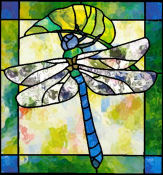
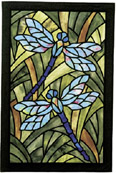
Some of the other inspirations:

Stained glass dragonfly Dragonfly with strappy leaf background

Links to all posts about this quilt


Scrappy quilt

16 12 2007

When you make a quilt, you always end up with bits of fabric left over, none of which seem to be much good for anything. But being a pack rat, you don’t want to throw the leftover bits out, and so you keep them for “Justin” (that’s “Justin” as in “Justin Case”… just in case). And that’s where a scrappy quilt comes in handy.

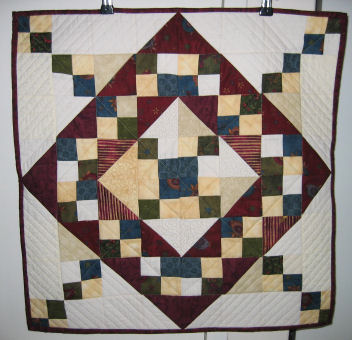
I saw a picture of the “Road to California” block and thought it would be a good candidate for some of my scraps—and so it was. I made the block, then yesterday I quilted it and made it into a 20″ cushion cover. I had to buy the fabric for the back, but the rest of the quilt was made from scraps. Now my scrap stash is a little less!

Road to California cushion cover quilt

More photos…


Quilting Tip: 6

16 12 2007

Eyeballing a quarter inch is still a bit of a black art for me. When I’m using my standard sewing machine foot, it’s easy as the foot is exactly a quarter inch from the outside edge to the central needle position. But when I’m using my ancient Bernina’s walking foot, the measurement is 3/8, not 1/4… as I found out yesterday. Fortunately, I noticed the seam allowance seemed a little wider than usual before I’d stitched too far.

I solved the problem with some painter’s tape, laying it so the left edge was exactly at the quarter inch width from the central needle position (see the picture below). Another solution is to use a small pad of sticky notes so that you get a little ridge and can’t move the fabric so that it has more than a quarter inch seam allowance. But that doesn’t work for my walking foot as the foot would be up on the ridge and thus lopsided.

Quarter inch mark with painter’s masking tape


It’s show time!

24 11 2007

It’s the annual Bridgetown Show today. The weather’s hot, so it’ll be very unpleasant in the exhibition halls and out in the sun. We haven’t been to the Show here before so it will be interesting to compare it to the last regional show we went to in Innisfail, Far North Queensland. I’ve submitted three quilts ($1 entry fee for each; $4 prize money to the winner in each category—it’s a BIG deal! <grin>), and will have to return to the showgrounds after 4pm to pick them up. But we’ll try and get there late this morning to avoid the worst heat of the day.

The other big “show time” today is the Federal election for the Senate and House of Representatives candidates. This is where we choose the party we want to govern Australia for the next 3 years. While we don’t have ‘presidential’ elections as such, over the years the egos of those who would be Prime Minister have taken on presidential qualities. So while we have to vote for a local representative, everyone really knows that they are voting either for John Howard (the PM for the past 11 years and leader of the Liberal Party) or Kevin Rudd (leader of the Australian Labor Party). Even a vote for the minor parties is a vote for one of the two big ones—the preferential voting system sees to that. Voting is compulsory and you’re fined if you don’t vote, so we can’t ‘vote with our feet’ and say we don’t like either party!

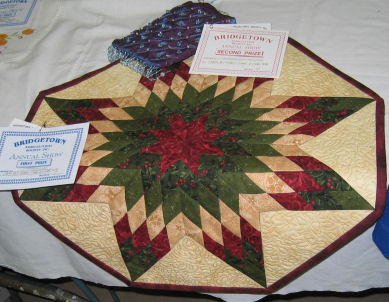
Update: We went to the show—didn’t think it was worth the $12 per person entry fee… We were there probably less than an hour, most of which was in the Centenary Hall where the handcrafts, flowers, photos etc. were on display. I won TWO first prizes!!! One for my “Christmas Star” quilt (Category: “Item by first-time exhibitor”), and the other for my quilt tote bag (“Category: “Sewn bag”).

After we voted, we did another “show time” thing—and went for a swim in the local pool which opened for the summer today. Nice refreshing dip, though tired afterwards! I did about 6x 25m laps very slowly—and with fins on. And the ‘show time’ connection? Our white bodies were on show to the sun for the first time in ages!!!

Quilt tote bag

Christmas Star quilt


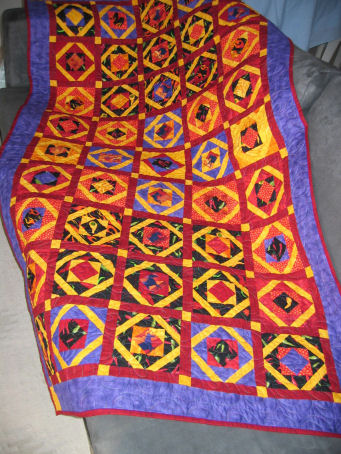
South of the Border quilt

8 11 2007

Back in June, I attended a foundation piecing workshop run by my friend Bobbie, the QuiltMouse. Not being one for flowers and pastels, I decided on some bright fabrics, including some blacks and chilli patterns. After making the sample blocks, I decided to go for broke and make a lap quilt for the chilly (chilli!) nights we get here in Bridgetown. You know, the sort of quilt you wrap around your legs when you’re on the sofa watching TV or reading a book.

So some months later it’s finished! Bobbie created the block pattern; I chose the fabrics, did the design/layout, and pieced the top; Judy quilted it all together using her big long arm commercial quilting machine; then I finished it off with the binding. I deliberately used a wool batting for warmth come next winter.

I’ve called it “South of the Border” as it has all the elements of the New Mexico/Arizona region we love (yes, I *know* that’s not south of the US border, but some I’m using some artistic license here!).There are lots of fabrics with chillis, capsicum (peppers for the US-ians), horses, cacti, etc., as well as the bright reds, yellows, and purples reminiscent of Santa Fe and other places in that region.

The red backing and sashing fabric actually has a slightly Japanese feel to it, with some stylised calligraphy and very faint reeds in the pattern. But I thought it worked well with the other colours.

While it may look like a jumble of blocks, there *is* a pattern in there—the purple cross in the centre, surrounded by the yellow, orange, and red toned blocks, followed by the black.

South of the Border quilt

It’s already been hung at the local “Hanging by a Thread” quilt exhibition last Saturday and I’m putting it in the local show (along with the other quilts I’ve made this year) at the end of this month.

More photos of this quilt (including close-ups)…