Chain letters, 1935 style

28 12 2013

I’m doing some family tree research on my summer break and part of that process is to check digitised newspaper articles for family notices (births, deaths, marriages, etc.). As I’m checking dates, names etc. I’m also correcting the electronically translated text for the entire section, not just for my relatives’ information. (The National Library of Australia has this amazing online collection of digital articles [http://trove.nla.gov.au/] that can be edited by anyone, thus harnessing the true power of crowd sourcing — for example, by noon today, some 150,000 edits had been made to newspaper text.)

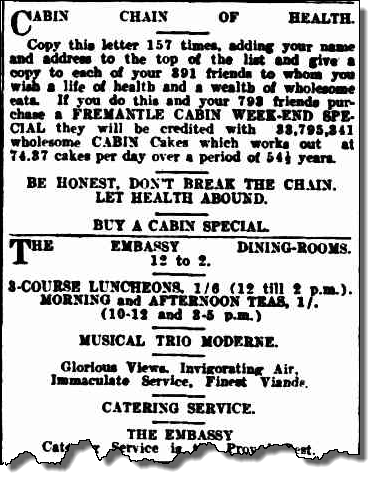
Anyhow, I’d just finished editing the family notices for a particular date in 1935, when I saw this at the end in the classified advertisements:

ad_the_West_9_Aug_1935

Very strange! Fancy asking someone in 1935 to copy a letter 157 times (that would be BY HAND), then giving that letter to 891 friends (I’m not sure how 157 letters becomes 891… and even you did have 891 friends [or even 157 friends] then no doubt you’d have to mail some of these HANDWRITTEN letters at YOUR cost…) and then 793 of those friends have to purchase these ‘cabin weekends’ so that you get 33 million cakes at 74 cakes a day for 54.5 years! Even using a calculator I couldn’t get that maths to work.

And there’s no information on how you go about purchasing a ‘Fremantle cabin weekend special’.

Very weird… perhaps it was a coded message for someone? Or maybe someone was predicting Facebook and the like where you *could* have 891 friends and post something to them all 😉


Mohawk and Zulu heritage

26 12 2013

I have two ‘protective’ pieces of cultural heritage in my house (actually, I probably have many more, but these ones are pretty unusual for someone living in Australia).

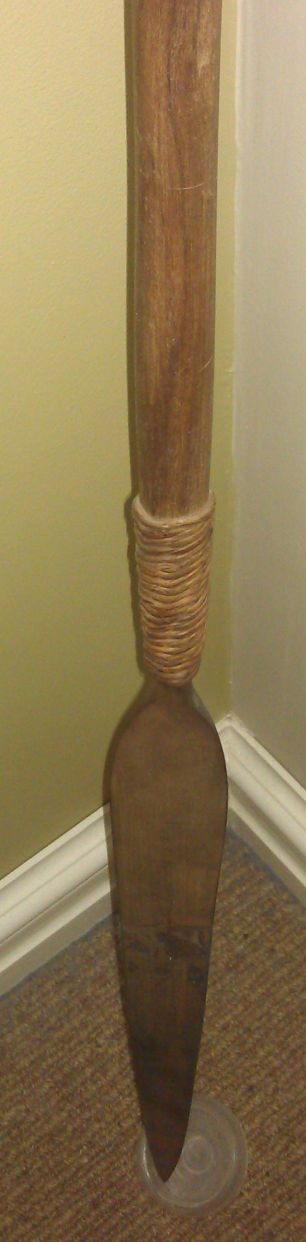
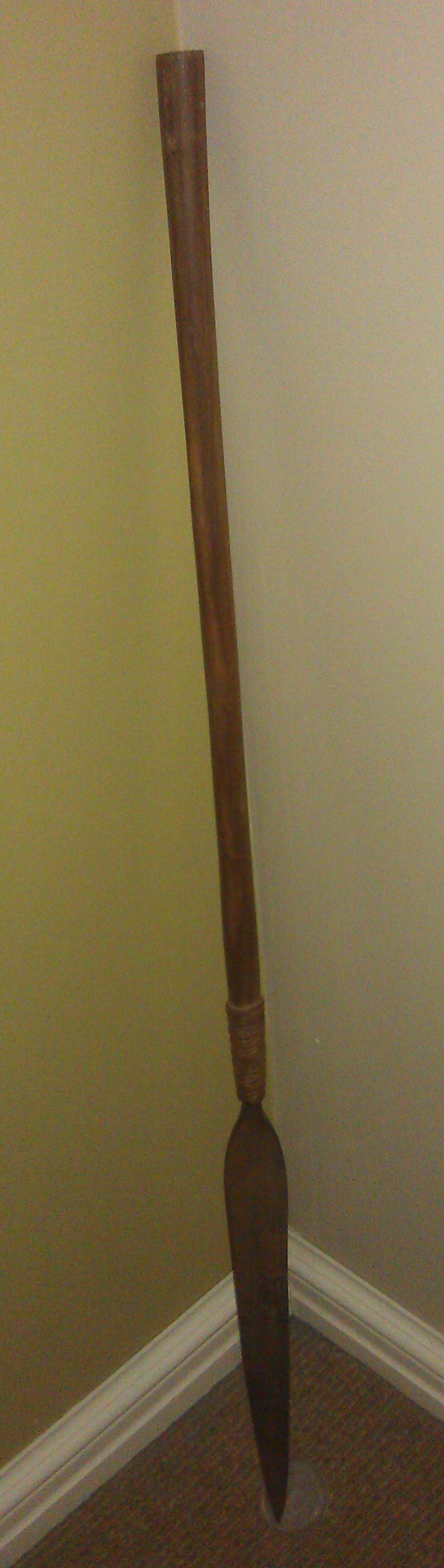
The first is an assegai that came from my maternal grandparents, who were both born and raised in South Africa, and who came to Western Australia in 1927. They returned to South Africa a couple of times in their later years, and my grandmother died there while visiting with her family on one of their trips back (1978); my grandfather died in Western Australia in 1994. In their house they had a few African pieces, and for some reason I have their old assegai.

I don’t recall how I got it — whether my Mum gave it to me after my grandad died, or whether I asked for it (though I can’t recall ever doing so, as I don’t even think I can remember seeing it when I used to visit as a child). Anyhow, I’ve always known it as an assegai, though some might call it a spear. When I checked Wikipedia, the description on an assegai perfectly fits what I have — a wooden shaft, with a crude iron spear, which is about 30 cm long. I guess I always knew it was some sort of weapon, but that Wikipedia article confirms it.

african_assegai01

african_assegai02

The other is a Mohawk ‘dancing stick’ that I purchased from a Tyendinaga Mohawk store in 1986 when I lived in Ontario, Canada.

I can vividly recall going into the store and wandering about looking at all the stuff. The only thing that really drew me in the store was this dancing stick, which was hanging high on the ceiling well out of reach and which wasn’t for sale, according to the chap serving in the store. He said it was a ceremonial stick and it wasn’t for sale as they still used in it ceremonies and it was a traded gift from another tribe. It was only in the store for display and storage purposes. At least, that was his story and I had no reason to disbelieve him. I kept coming back to it and looking up at it, and kept asking if it was for sale, and about the history of it and what it was made of (deer antler, white tailed deer hide, deer suede, eagle feathers, and blue and red beads). Then I’d move off, then come back.

mohawk_dancing_stick_1986_canada01

I was drawn to this piece of Canadian First Nations culture for some reason. I was the only one in the store, and he could see me going back to it time and again. Eventually, I decided it was time to move on. But on my way out he stopped me and said he could see how drawn I was to this piece. So he sold it to me, knowing it would go to Australia to live out its days. I can’t recall how much I paid for it, but that’s totally irrelevant anyway.

Australian Customs is notoriously harsh about ‘fur, skin, and feathers’, so when my box of belongings arrived in Fremantle Port some four months after I’d sent it home from my year in Canada, I had to go down to Fremantle Port Customs to claim it and to declare the dancing stick. There was always a risk that it would be confiscated and destroyed by Customs, but that was a risk I was prepared to take. The guy at the counter was really good about it — he said it would have to be gamma radiated, but as their unit was a fixed size, they’d have to cut the stick in two! However, he said they’d try to cut it where the cut couldn’t be seen. A week or so later I got a call to come pick it up, and when I did so, I couldn’t see where they’d cut it in half. The guy at the counter told me they’d pushed back the deer suede and cut it in half there, then had joined it by using a piece of dowel in the centre and gluing it back together again. I still cannot see the cut!

The main reason I’ve written this blog post is so that I have some documented history of these pieces and how I came to own them (or they came to own me!). And the reason I’ve written about them now is that a small piece of deer fur fell off the dancing stick last night (possibly where that cut had been made and the deer hide glued back?) and I glued it back on today. And took some photos of it.


Taking care of direct summer sun

26 12 2013

My office at home (I work from home exclusively) faces west, so come the afternoon on summer days, the windows get the full force of the sun and heat. Even if there’s a sea breeze blowing from the west (we’re close to the ocean), I have to close the windows (which have blinds, and 70%+ window tinting on them) so the sun and heat don’t come straight into the office and overheat me or the computers. Closing the windows on a hot day and thus preventing the sea breeze from coming in also means turning on the air conditioning (A/C) to keep the computers at a happy temperature (I’ve got one computer that tells me it’s getting hot by ramping up the fan speed once the ambient temperature in the room hits about 28C!).

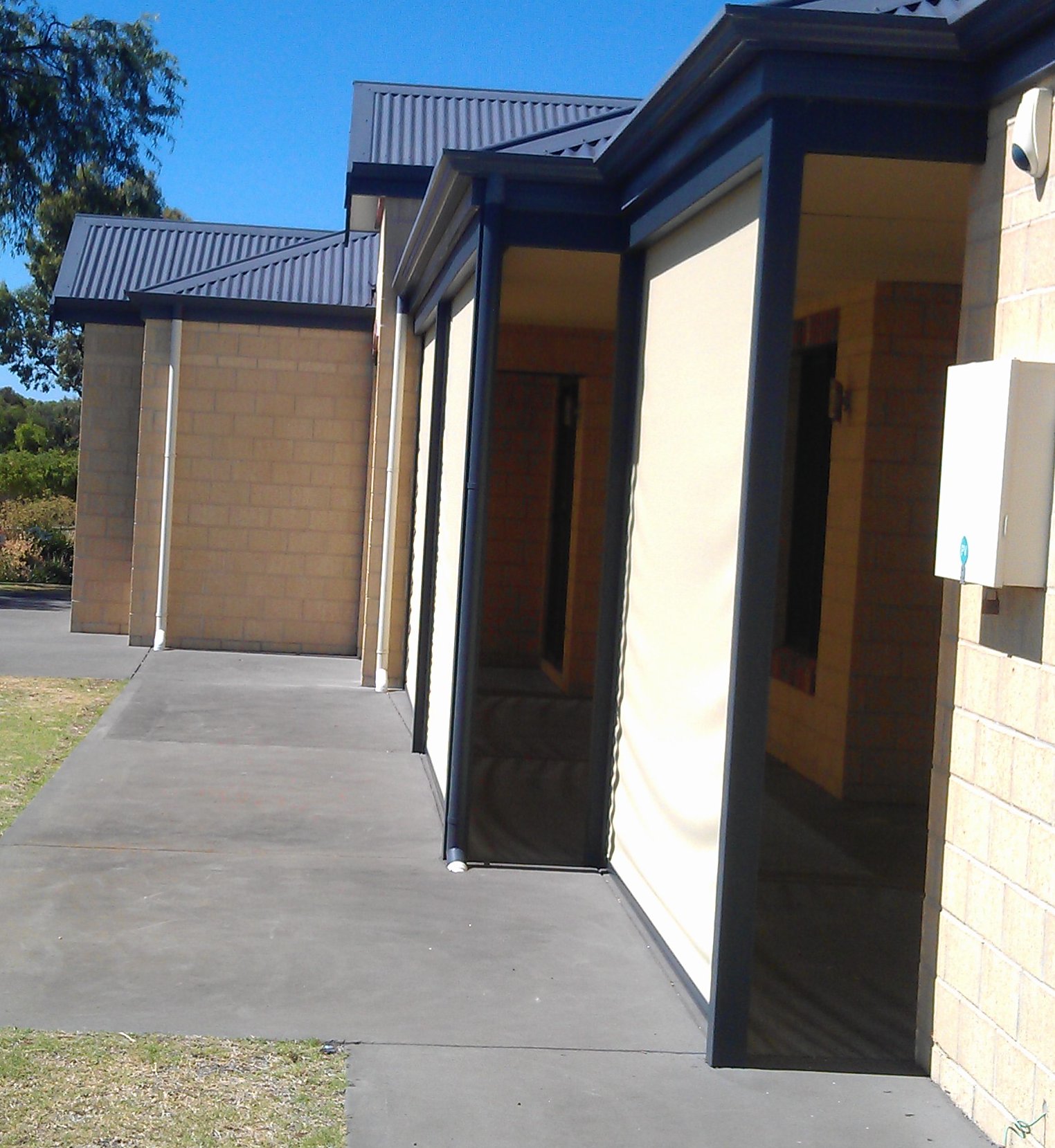
I’d been thinking about getting shade screens on the front of the house since we moved in, but it wasn’t until we sold a property and had some ‘spare’ cash from that sale that I could justify such an expense. Fortunately, since I first thought of doing it some four years’ ago, technology has moved on and the days of manually unwinding/rolling up these screens are long gone — it’s all automated and done by remote control from inside the house now 😉

The roller screens were installed just before Christmas and already they’ve made a huge difference on those pleasant summer days where it’s not really hot enough to have the A/C on and the days when a nice cooling sea breeze is blowing. I no longer have to shut the windows mid-afternoon and turn on the A/C, just to keep the direct sun out.

I choose a light colour for the screens as the window tinting already adds a lot of darkness to the office, so with the screens down, I can keep the office windows open to catch the breeze, while still letting light in, but not the direct sun or heat. Of course, if it’s REALLY hot, then the A/C comes on AND the screens go down.

IMAG1577

(Yes, I need to talk to the company about the ‘slack’ in the screens as I had expected them to be quite taut.)

IMAG1578

You can see how the screens minimise the direct sun from the front of the house — there’s a LOT of shade between them and the front door and windows

The day after they were installed, I checked the heat coming through the bedroom windows (which aren’t shaded, but which have the same tinting on them) — I put the back of my hand on the inside of the window and it was HOT. I then went to one of the shaded windows and the temperature of the glass facing into the room was pretty much the ambient temperature of the room.

I should have done this years ago…


Cleaning stubborn water stains from a toilet

26 12 2013

We moved into our house nearly four years ago. When we moved in, the house was three years’ old and the toilets were stained (the water here is fairly hard), as were the plug areas of the white porcelain hand basins in the bathrooms.

Below is an example of the staining — yes, these are WATER stains!!!

2nd_toilet02

I tried everything possible (e.g. CLR, Steradent, abrasive and non-abrasive cleaning gels, sprays, solutions etc.) to clean them, all to no avail. They remained stained. A plumber we’ve used over the past few years said that we’d never clean them as ‘there was a bad batch made about the time your house was built and the porcelain was porous and therefore the stains were ingrained’. Short of replacing the toilets with new ones, we were stuck with toilets and hand basins that were clean but that looked dirty.

I even emailed pictures of the stained toilets to the manufacturer back in November (I’m still awaiting a reply…), as the building guy I spoke to said they had a 10-year manufacturer’s warranty.

Meantime, we had some roof plumbing work done by a plumber just before Christmas  and I asked him about his availability for replacing the two toilets. He came inside, took one look, then beetled back to his van where he grabbed some abrasive mesh. He rubbed a small area of one toilet bowl and voila! The stains had disappeared!!! and there was some milky stuff in the water. He said they were calcium stains (which accounted for the milkiness) and that the porcelain was fine — we just needed to get the calcium off and they’d be as good as new. He even gave me about 30 cm of the mesh he used and warned me not to press too hard with bare fingers as I’d cut them. The porcelain doesn’t get scratched by this process either — it was very smooth where he’d rubbed the calcium off.

So, wearing rubber gloves, I got to and over the past couple of days I’ve cleaned both toilets and hand basins and they are all shiny new again! And even better, I’ve saved myself the expense and inconvenience of having to replace toilet pedestals and hand basins. All it required was the right ‘tool’ for the job and a fair amount of elbow grease.

Here’s one of the toilets with one side cleaned, and then finished.

2nd_toilet_during01

2nd_toilet_after01

Below is this magical abrasive mesh (I think the AO is for aluminium oxide and the 180 is for the grit level).

IMAG1580

You don’t need much of it to make a big impression, and you can use it wet or dry — I found wet was best:

IMAG1582

I’ve since attacked a few other areas around the house with this stuff, but be careful as it will scratch metal surfaces if you put too much pressure on it. I haven’t tried it on the glass shower screens yet, but I suspect it may scratch glass too. However, a light rubbing removed rust-type stains from aluminium without obvious scratching.

When I’m next in town, I’ll try to buy a roll of this stuff from the plumbing supplies place — plumbers use it for filing off rough edges on copper pipes etc. I figure that I’ll need to give these toilets a periodic rub down with the mesh as our hard water issue isn’t going away any time soon.


The ideal tradesperson

12 12 2013

I think I have discovered the ideal tradesperson (my new handyman)! Why? Well, here’s a list for starters:

  • arrives on time (never more than 5 minutes after he’s told me, or else he’ll phone and let me know that he’s delayed and by how much)
  • cleans up after himself
  • protects my floors etc. with drop cloths
  • explains what’s important on my list and what’s not
  • explains in plain language why some issues are happening
  • takes extreme pride in his work
  • notices other things and fixes or lets me know (e.g. was checking something in ceiling and noticed a pinhole elsewhere in the roof, so fixed it there and then)
  • charges a reasonable hourly rate
  • works at a good pace but not so quick as to be rough-shod and not so slow as to eke out the hourly rate
  • looks me in the eye when speaking to me
  • tells me if something is beyond his capabilities (e.g. plumbing work other than minor stuff) and then offers his recommendation for another tradesperson (but only if asked, so he’s not trying to fob off others on to me)
  • treats my house like his own (e.g. takes off his shoes when inside – without asking)
  • can turn his hand to most things (though he’s quite young, he has built his last two houses himself)
  • does a good thorough job.

Notice that ‘does a good job’ is not the first thing on my list, so while that is very important, all those other things add up too, and any one of them could have relegated him to ‘so-so’ status.

He’s an absolute keeper for future handyman work around the house and I’ve already recommended him to others. He’s only recently gone into business on his own, so I’m more than happy to give him my business now and in the future.

Update December 2022: He’s definitely been a keeper! Everything I wrote 9 years ago about Tony remains the same today, and even though he now lives about an hour away, I still get him to come and work through my ‘Tony list’ each year (typically just once a year unless there’s some sort of emergency) to keep our house in good condition.


Funny user review

11 12 2013

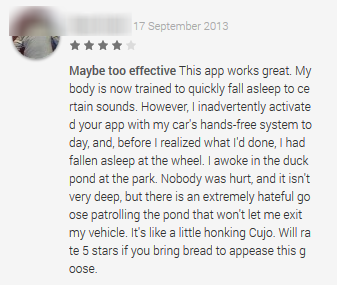
So I’m looking at the Google Play store for a relaxing ambient noise app to see if I can mask my mild tinnitus at night when trying to fall asleep, and I come across this review:

ambient_noise_review

Too funny! No, I haven’t downloaded/tried the app yet…

(Text for those who can’t read the image: 4 stars: Maybe too effective. This app works great. My body is now trained to quickly fall asleep to certain sounds. However, I inadvertently activated your app with my car’s hands-free system today and before I realized what I’d done, I had fallen asleep at the wheel. I awoke in the duck pond in the park. Nobody was hurt, and it isn’t very deep, but there’s an extremely hateful goose patrolling the pond that won’t let me exit my vehicle. It’s like a little honking Cujo. Will rate 5 stars if you bring bread to appease this goose.)


Perth, late November

30 11 2013

We had to go to Perth a week or so ago to do some legal business. We parked on the edge of the city and caught the free buses into and out of the CBD (all TransPerth buses as well as the CAT buses are free within in the main city blocks — a brilliant strategy introduced by the State Government many years ago).

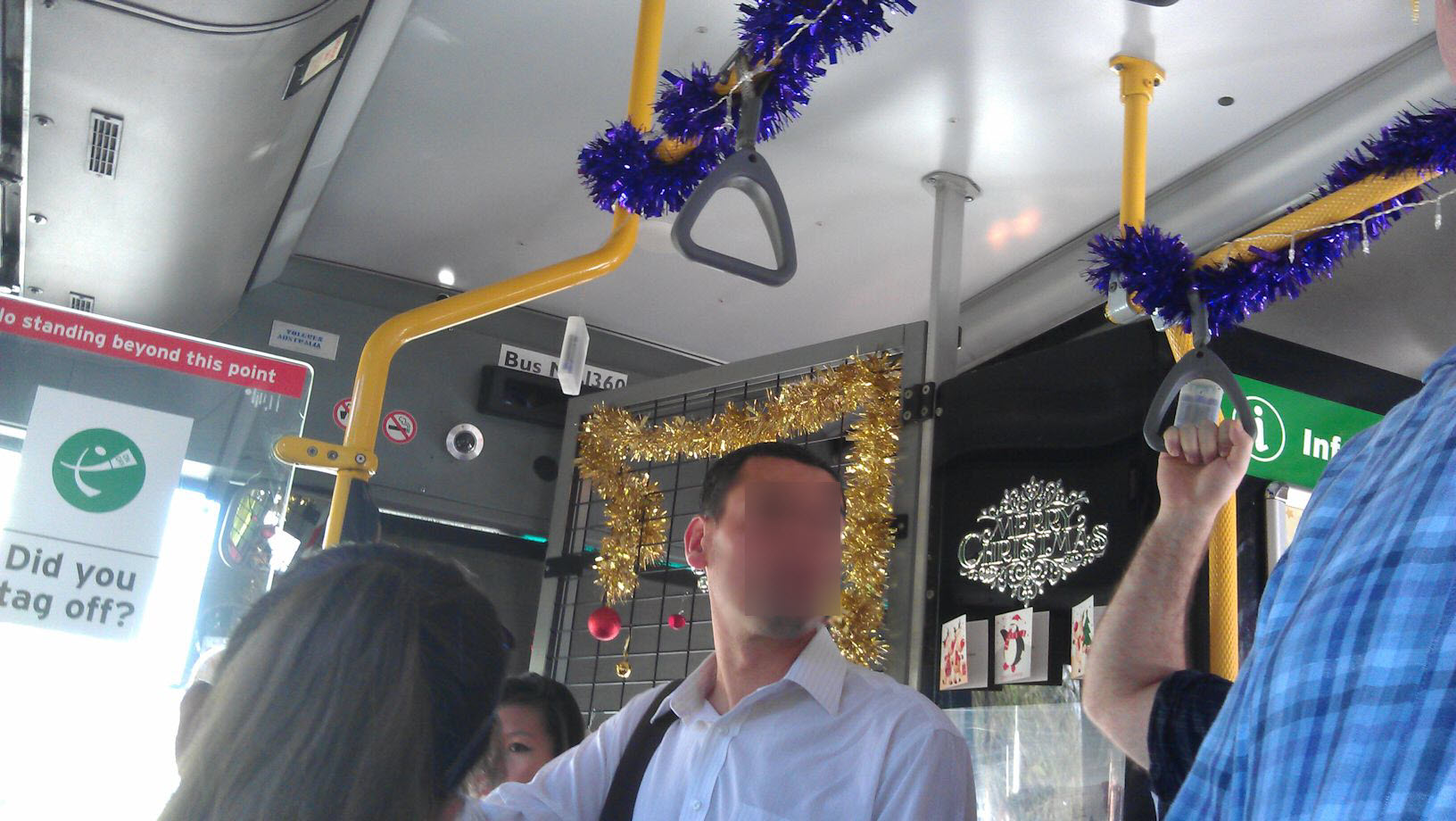
The bus we caught into the CBD was all decked out in Christmas paraphernalia, which brought a smile to everyone’s faces. The female bus driver had gone to a lot of trouble to decorate her bus. And she was really good with the passengers too, calling out to ‘The lady from the airport, your stop is the next one.’ to a tourist who had just arrived in our city. What a great introduction to Perth for that person.

bus

Once we were in the city and had breakfast, we waited in the gardens at the Central Park building for our appointment time. It was a gorgeous day and the all the trees in Central Park were well laden with leaves and a surprising number of birds. Here’s the view from the park bench we sat on, with the soaring Central Park building dominating the sky.

central_park


Development?

17 11 2013

I live in a beautiful part of the country. Close by are farms, farmlets, a large estuary, etc. Work has been going on to run power and install a street light at the intersection of the main road into our subdivision. I wondered if there was more to it than that…

And at the end of last week I found out. On my drive into town, I saw several earthmoving trucks and vehicles on the farmland opposite the newly installed street light, and noticed the cattle were all gone (the horses and the camel went ages ago). A temporary road has been constructed into the farmland and it looks like a new subdivision will be going in there. I checked the local shire’s minutes on their website and found that the land is being divided into six lots, presumably ‘special rural’ lots with small acreage. (Update: I found more info on the application for subdivision on the Shire’s website and each lot will be 5 to 10 hectares — that’s about 12 to 25 acres for those who can’t convert hectares to acres! Further update (Dec 2013): There are five blocks with ‘For Sale’ signs on them, all around 5 hectares, and priced ‘from $690,000’, though I can’t find them listed on the real estate agent’s website yet.

I know I shouldn’t be a NIMBY as somewhere along the line the land where I live was also once farmland, but it’s a shame this beautiful farmland will be subdivided. Where do to the cattle go now?

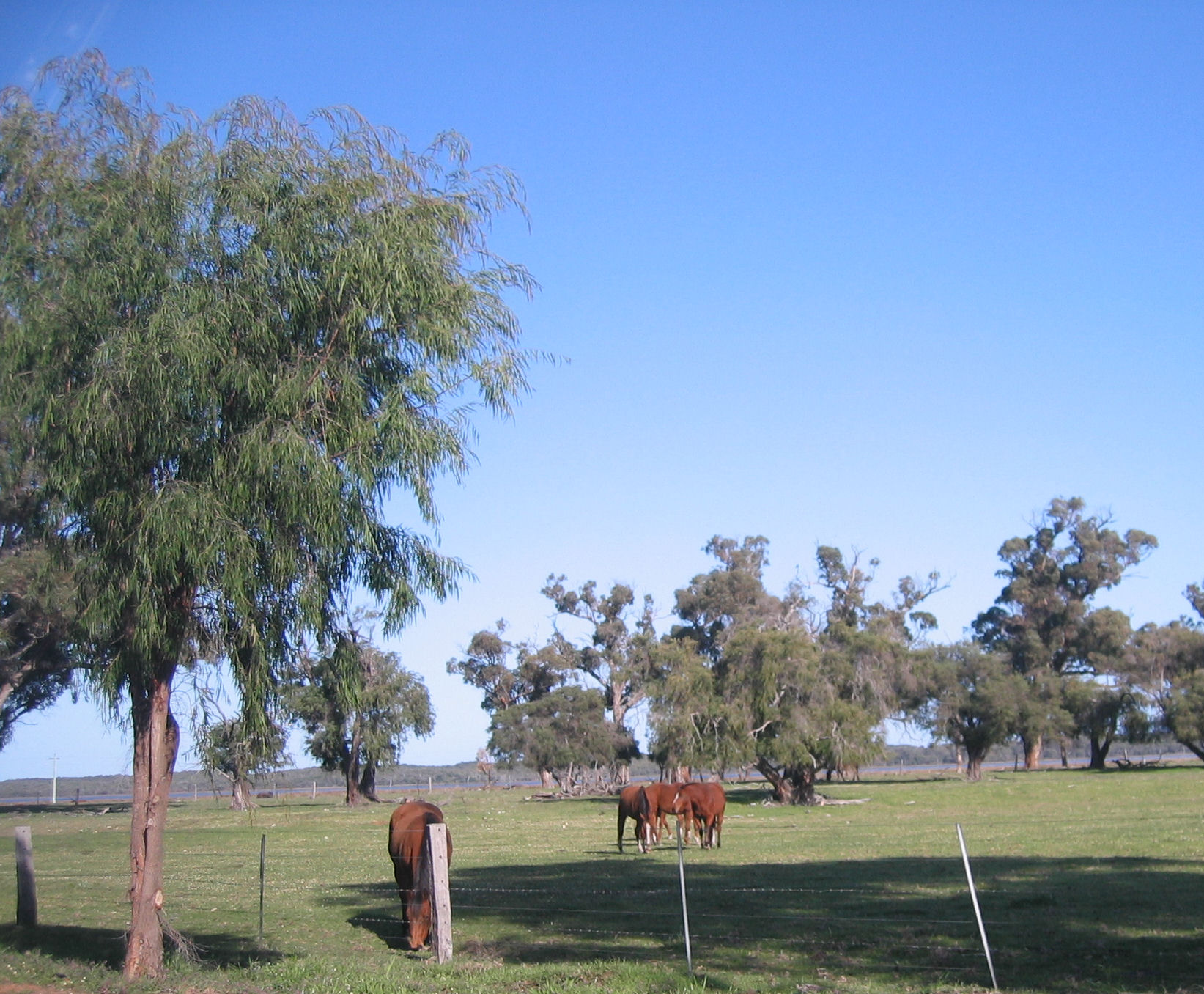
Here’s some photos of the area I took back in 2010:

cathedral_ave01

cathedral_ave05_horses

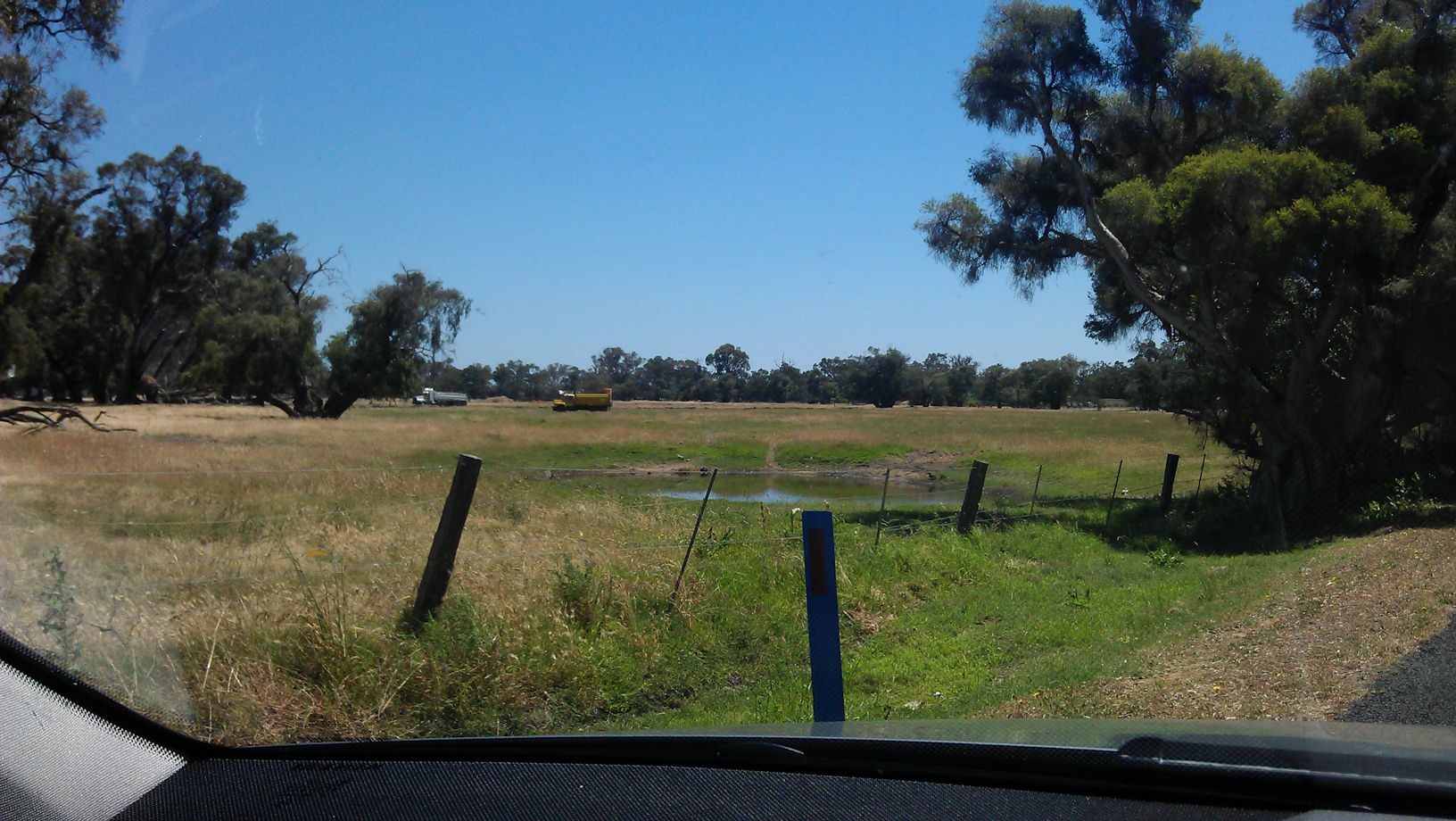
And here’s a photo I took on Friday showing the first stages of the development:

development

I hope they’ll keep all the ancient peppermint and tuart trees…

Update February 2014: Well, I bet the developers aren’t happy! Within about two to three weeks of the ‘for sale’ signs going up, the local shire/State health department put up this notice about 20 metres just before the southernmost driveway into these lots (there might be one at the northern end too, but I haven’t driven that section for a few weeks). Nothing like putting off prospective buyers!

development02

Yes, we live in a high risk area for mosquitoes, and you’d have to be Blind Freddie or living under a rock not to know that; it was one of the considerations we had when deciding to purchase here. But this really spells it out for any prospective purchaser, particularly someone from another state or country who may not know that the entire south-west corner of Western Australia (including Perth) is subject to mosquitoes carrying Ross River Virus, especially areas close to still water, such as the estuary that these blocks front on to.


Strict or what?

3 11 2013

Still on genealogical research, I came across this apprenticeship contract in the notes attached to one of my family tree records. It’s from 1861, and while it’s interesting reading, the parts of highlighted in yellow caught my eye. Talk about harsh!

(click on the image to view it larger)

genealogy02

BTW, my relative was 14 or 15 years old when he signed this, and he was indentured to this ‘master’ under these conditions until he was 21 or 22. (Note that his father [aged 41 at the time] couldn’t write and left a mark.)

Can you imagine any such contract being agreed to by a 15 year old boy these days?


The heartbreak of genealogical research

3 11 2013

Every so often, I work on the British side of my family tree (finding the Dutch South African and German/Prussian sides is too hard!). Such was the case on Friday, when I filled more gaps as a result of the continued release of 1911 UK Census data on Ancestry.com.

And while doing that I found evidence of tragedy, just in the dates of birth and death recorded in my family tree software.

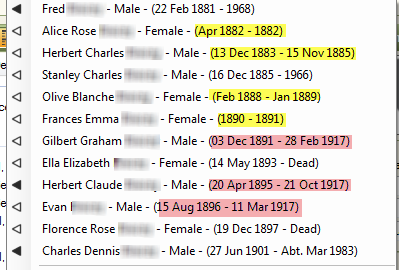
In this family of 12 children (all third cousins of mine, three times removed…), four children (I highlighted them in yellow) died in infancy (there’s no record of miscarriages or perhaps stillbirths, so it’s possible this family lost even more children) and another three (highlighted in red) were killed in World War 1.

genealogy01

I couldn’t find death records for two of the females. It’s possible one (Ella) was married or working in service to another family at the time of the 1911 Census as she would have been 19 years old then. However, Florence is a concern as she would only have been 13 at the time of the Census, so either she had also died, or perhaps was staying/living with relatives on Census night.

Two of the male children were likely too old to fight in WW1, and one was too young.

Of those 12 children I could find records for, only a possible five survived past 1918.

How does a family cope with that sort of loss?