My journey with Wegovy

28 04 2025

I’m overweight, ‘morbidly obese’ in medical terms. I’ve been overweight (in my head) since I was a teenager, but on the scales probably in the past 30 years. I see photos of me when I was 17 and at 27 and marvel that I EVER thought I was fat at that time. But, like many women, I did. My battle with my weight has been constant in my teen and adult life. I go up, I go down a bit, then up a bit more. Like many, I’ve tried almost everything to keep my weight under control—starved myself of certain foods/drinks or types of food, counted calories, spent oodles on weight loss programs (I’m looking at you, Jenny Craig, and the thousands I spent on your crappy meals, only to be told eventually that they couldn’t do anything more for me after I’d plateaued for 6 months—I’m sure I was messing up your figures and you wanted me off your books!), joined gyms and went up to 5 times a week for months and even years on end, followed the Scarsdale, cabbage, keto and other diets religiously, tried various protein shakes, walked, walked and walked some more… you get the picture. I might lose a few kilos (always less than 10, except once when I lost 23 kg) then back they’d come again in a few months or so, and this time they’d bring all their friends.

Some friends of mine have had gastric banding done, and although all have lost weight, some have put it back on because they’ve substituted food with the empty calories of alcohol—it’s much easier to drink a liquid than to eat food with gastric banding. Gastric surgery was never going to be for me.

I’ve never been comfortable being overweight, and it’s got worse the older I’ve got and the more portly I’ve become. Bending down to put on socks, tie up shoes, clean between my toes in the shower, pick up the newspaper from the driveway etc. has become hard. Balancing is harder. And I have sleep apnoea. In the past couple of years, my liver function tests haven’t been good and I was diagnosed with non-alcoholic fatty liver disease a few years ago, and also with pre-diabetes (I’m out of that range now). The stress on my internal organs just to keep my body going can’t be good, and I’m at an age where heart issues will become more likely.

So I read with interest the ‘miracle’ cure of the semaglutides (Ozempic, Wegovy and others). Then I waited a year or two for the hoopla to die down and the celebrities to use up all the supplies before broaching the issue with my doctor. She said I was a good candidate medically because reducing my weight will reduce the likelihood of heart, lung issues, likely ‘cure’ my sleep apnoea, and keep me out of diabetic range. She prescribed Wegovy for me. Because I’m NOT diabetic, I couldn’t get it as a PBS medicine so paid the full price for the first pack of 4 injections of 0.25 mg each—some AU$270. After a month, she’ll reassess and decide if I need to go to the next dosage level (0.5 mg), then after another month, whether to continue increasing the dosage over the next few months (it goes up to 2.4 mg). Update: The price for 0.25, 0.5 and 1.0 was around AU$270, but jumped to $360 for the 1.7 dose and to $460 for the 2.4 dose.

The nurse at the medical practice gave me my first injection on 23 December 2024, and she showed me what to do so I could do it myself for future injections (yeah, right!) (BTW, the printed instructions inside the package are EXCELLENT and in plain language and large font). Some of you might be wondering why start so close to Christmas—well, as it happened, we weren’t going anywhere for Christmas or having any big meals as my DH had had urgent and unexpected surgery only a few days before and was recuperating.

Week 1: 23 to 29 December 2024

Before going to the medical centre, I weighed myself and took all my measurements (bust, waist, hips, neck, right arm, right thigh) and noted them down in an Excel spreadsheet.

The injection was absolutely painless! The needle tip is only a few millimetres long and is VERY fine. The nurse injected it into my gut fat. Because it was painless, I figured I should be able to do this myself, provided I can get over the psychological barrier of deliberately poking something sharp into my skin. However, she said they’d do it if I couldn’t.

I’d read dire stories about bad reactions (Dr Google is NOT your friend!), but experienced absolutely none of them during the first week—no nausea, no constipation, no diarrhoea, no headaches (except a small headache on Day 1 and likely because I didn’t have my daily Diet Coke that morning, thus it was a slight weaning off the only caffeine I have in a day).

I felt no different, except I had NO desire to snack while prepping meals, or at any other time. I continued to eat healthily for all my meals, and enjoyed what I ate, but I wasn’t hungry in between times, and not even really hungry at meal times. I stopped drinking alcohol and Diet Coke as they can bring on bad reactions as well as hinder any progress.

Throughout the week, breakfast was mainly a small serving of fruit-free toasted muesli with Greek-style yoghurt, a splash of light milk, and some fruit (blueberries, nectarines, bananas). Lunch was a salad (any combination of avocado, cherry tomatoes, a quarter of an apple, some raspberries, a small slice of cheese, lettuce, celery, cucumber, raw cauliflower, a few cashews, and balsamic vinegar for taste, plus a small piece of fruit). If I had some leftover steak or bacon etc. I’d add that too, and this coming week I’ll hunt out some smoked salmon I have in the freezer. Dinner was what we would normally eat, but a slightly smaller serving (I already have a small serving). We never have dessert, so that wasn’t an issue. But we often have a snack mid-evening while watching TV—I had NO desire for such a snack. I only drank water.

My sleep was as normal, but my normal incidental activity was down because it was Christmas week (no work) and I was trying to help my DH with his pain management and sit with him during the times he could sit in the recliner and watch TV.

Week 2: 30 December 2024 to 5 January 2025

Before girding myself to give myself the injection, I did all my measurements. My weight after the first week was down 1.8 kg and my overall measurements of all the different parts of my body (see above) were down by a total of 6 cm. That’s a pleasing result for me. I’m not feeling any different in my clothes, but based on previous times when I’ve lost weight, that could be some weeks away yet. But the figures don’t lie, so yes, there was a loss.

After a bit of faffing about (technical term), I was able to inject myself successfully. The faffing about wasn’t the actual injection, which was surprisingly quick and easy and painless (as I expected), but trying to get the dosage thingy on the pen to work. Because I’d seen a drop of fluid at the needle tip, I assumed it would just turn, but no, you have to actually follow the steps EXACTLY and press the dose button to get some out before the dosage wheel turns and you can inject the correct dose. Once I’d figured that out, it was easy peasy! I don’t know what I was worried about.

31 December: What I have noticed is that my desire for food and the ‘food noise’ in my head has abated—a lot. Far more than this time last week, I think. I still enjoy what I eat, but I don’t have any desire to eat any more. This is A Good Thing(TM).

3 January 2025: Another thing I’ve noticed the past couple of evenings is a desire to go to the toilet, but it’s only wind.

6 January 2025: A further thing I’ve noticed is a slight desire to eat more and/or snack as my week comes to an end. Perhaps this is a result of the efficacy of the drug wearing off over time? I take it on a Monday, and by the weekend, I have this slight desire. I haven’t given in to it, as yet, and hope not to.

Week 3: 6 to 12 January 2025

Before giving myself the weekly injection (much easier and quicker this time), I took all my measurements—I’d lost another  1.1 kg and 7 cm total off all the places I was measuring. That’s a total of  2.9 kg and 13 cm in 2 weeks.

Week 4: 13 to 19 January 2025

Before giving myself the weekly injection (I’m getting the hang of this!), I took all my measurements—I’d lost another 0.8 kg and 9 cm total off all the places I was measuring. That’s a total of  3.7 kg and 22 cm in 3 weeks. This week I see the doctor for a new script for the next month’s supply, this time the 0.5 dose.

My loss hasn’t been as quick as some, but I’m OK with that. Small and steady is fine by me. What I have noticed, however, is that some foods (notably the Chinese food from the restaurant we go to each week) have upset my gut a little—nothing drastic, just made it very burbly. I suspect those who have a really bad gut reaction to the drug are possibly eating or drinking some things that they should be avoiding.

16 January 2025: The doctor is pleased with my progress and has given me scripts for the 0.5 and 1.0 doses (plus the 0.25). I’m to start the 0.5 on Monday, but if it makes me feel sick for more than a day, she suggested going back to the 0.25 (which is why she gave me another script for that). If the 0.5 is fine, then I’ll stay on that for 4 weeks, before filling the script for the 1.0. She wants to see me again in mid-March, just after I’ve had my blood test for cholesterol, fatty liver, and diabetes markers, and if all goes well, she’ll up the dose to the next level (1.7, and then later 2.4, which is the maximum dose).

Week 5: 20 to 26 January 2025

My loss last week wasn’t quite as good as previous weeks as I spent 2 days in the city with my sister and didn’t hold back on what I ate. However, no snacks at all. In week 4, I lost 0.6 kg and 2cm, for a total of 4.3 kg and 24 cm.

Monday was the day for the higher dose injection—0.5. No side effects throughout the week so it looks like I’ll be on that dose for the next 3 weeks. However, I did have a touch of diarrhoea one day toward the end of the week, but as this was 4 to 5 days after the injection I consider that’s it was likely unrelated to the drug.

Week 6: 27 January to 2 February 2025

As per my Monday routine, I took my measurements after my morning shower and before giving myself the next injection. My loss in week 5 was 1 kg and 3 cm, for a total of 5.3 kg and 27 cm in 5 weeks.

I’ve started to notice a tiny change in how my clothes fit, but it’s minor at this point. No-one, including my sister last weekend (who hadn’t seen me since early December), has made any comment like ‘Have you lost weight?’ or similar. But that’s not really surprising—back in the early 2000s before menopause and when I weighed about 10+ kg less than my starting point this time, I lost 17 kg before anyone started to notice. With luck the fat is coming off all the places it shouldn’t be, like around my vital organs and my belly.

Summary

Week Date Loss / total (kg) Loss / total (cm) Notes
Week 1 23-29 Dec 2024 1.8 / 1.8 6 / 6 see above
Week 2 30 Dec-5 Jan 2025 1.1 / 2.9 7 / 13 see above
Week 3 6-12 Jan 2025 0.8 / 3.7 9 / 22 see above
Week 4 13-19 Jan 2025 0.6 / 4.3 2 / 24 see above
Week 5 20-26 Jan 2025 1.0 / 5.3 3 / 27 see above
Week 6 27 Jan-2 Feb 2025 0.4 / 5.7 4 / 31 see above
Week 7 3-9 Feb 2025 0.7 / 6.4 5 / 36 (none)
Week 8 10-16 Feb 2025 1.0 / 7.4 0 / 36 (none)
Week 9 17-23 Feb 2025 1.0 / 8.4 4 / 40 Started the 1 mg dose for the next 4 weeks
Week 10 24 Feb-2 Mar 2025 0.3 / 8.7 2 / 42 (none)
Week 11 3-9 Mar 2025 0.7 / 9.4 5 / 47 (none)
Week 12 10-16 Mar 2025 0.3 / 9.7 1 / 48 (none)
Week 13 17-23 Mar 2025 0.4/ 10.1 2 / 50 Started the 1.7 mg dose for the next 4 weeks
Week 14 24-30 Mar 2025  0.4 / 10.5 0 / 50 (none)
Week 15 31 Mar-7 Apr 2025  1.2/ 11.7 2/ 52 Had colonoscopy 7 Apr, so purged for 24+ hours beforehand
Week 16 8-13 Apr 2025 0 / 11.7 -6 / 46 day late with injection as had colonoscopy 7 April 2025; weight remained the same as after the colonoscopy but measurements up a tad (could be how I measured)
Week 17 14-20 Apr 2025  0 / 11.7  7 / 53 Started the 2.4 mg dose for the next 4 weeks; seem to have plateaued. Wondering if effects of colonoscopy catching up or if Easter treats I ate!
Week 18 21-27 Apr 2025 1.7 / 13.4 -6 / 47 Dropped quite a bit – possibly leveling out since colonoscopy?
Week 19 28 Apr – 4 May 2025 0/ 13.4 5/ 52 (none)
Week 20 5-11 May 2025 0.3 / 13.7 7 / 59 (none)
Week 21 12-18 May 2025 0.6 / 14.3 -4 / 55 (none)
Week 22 19-25 May 2025 0.5 / 14.8 7 / 62 (none)
Week 22 to 26 26 May -29 Jun 2025 xxx / xxx xxx / xxx Overseas in Europe and on a cruise for 2 weeks, no measurements taken
Week 27 30 Jun – 6 Jul 2025 1.5 / 16.3 3 / 65 Despite a 4-week trip to Europe (Switzerland and Italy mostly) including a 14-day cruise, I continued to lose weight!
Week 28 30 Jun – 6 Jul 2025 xxx / xxx xxx / xxx on retreat on measurement day, so no measurements taken
Week 29 7-13 Jul 2025 1.1 / 17.4 -3 / 62 6 monthly blood tests – cholesterol lowered, liver function almost normal!
Week 30 14-20 Jul 2025 -0.4 / 17 3 / 65 (none)
Week 31 21-27 Jul 2025 0.9 / 17.9 3 / 68 (none)
Week 32 28 Jul – 3 Aug 2025 0.4 / 18.3 0 / 68 (none)
Week 33 4-10 Aug 2025 -0.1 / 18.2 2 / 70 (none)
Week 34 11-17 Aug 2025 0 / 18.2 0 / 70 (none)
Week 35 18-24 Aug 2025 0.1 / 18.3 -3 / 67 (none)
Week 36 24-31 Aug 2025 0 / 18.3 -4 / 63 (none, though I seem to have plateaued)
Week 37 1-7 Sep 2025 xxx / xxx xxx / xxx Overseas in Bali (6-20 Sep)
Week 38 8-14 Sep 2025 xxx / xxx xxx / xxx Overseas in Bali (6-20 Sep)
Week 39 15-21 Sep 2025  0.8 / 20.1 5 / 68 xxx
Week 40 22-28 Sep 2025  -0.2 / 19.9 3 / 71 xxx
Week 41 29 Sep-5 Oct 2025 xxx / xxx xxx / xxx xxx
Week 42 6-12 Oct 2025 xxx / xxx xxx / xxx xxx
Week 43 13-19 Oct 2025 xxx / xxx xxx / xxx xxx
Week 44 20-26 Oct 2025 xxx / xxx xxx / xxx xxx


My Mum

16 05 2024

Our beautiful and most loving Mum passed away peacefully a week ago today, surrounded by the love of her family. She was 92 and in excellent health all her life, until an aggressive glioblastoma came to live in her head (occipital lobe) just a few weeks ago. She had no pain. She passed just 11 days shy of the first anniversary of Dad’s death.

I am so blessed to have spent time with her on the cruise in February and early March, just a week or so before her diagnosis. On the ship she was always the first to take the stairs instead of the elevators, and except for a few visual issues, none of us had any clue that anything was seriously wrong.

You did good and your work is now complete. Go dance with Dad for eternity, Mum. We’ll love and miss you forever.

This photo was taken just 3 weeks after her diagnosis and 5 weeks before she passed.


Protected: Mercedes 2008 C200 Kompressor Elegance Sedan

10 12 2023

This content is password-protected. To view it, please enter the password below.


Purging paperwork

1 12 2023

I had a shelf-load of paperwork I needed to sort out. That was the start of a major undertaking!

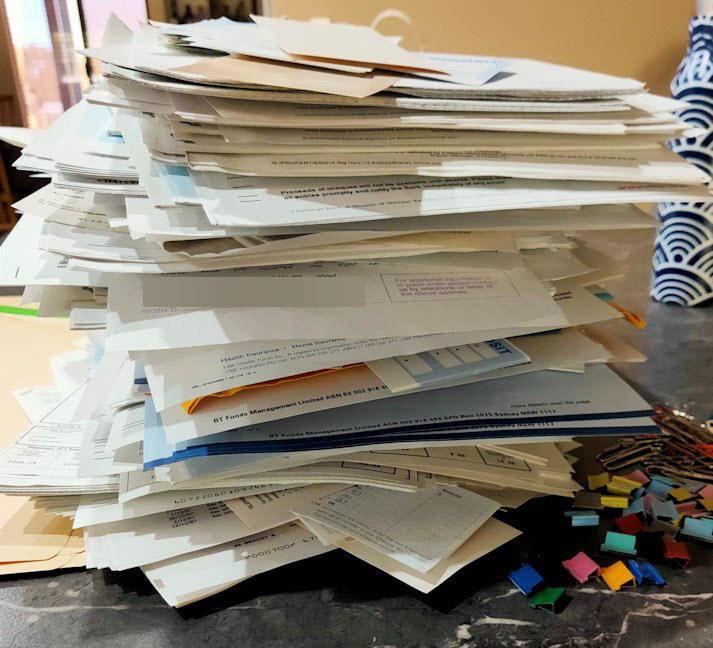
When I put the tub of that paperwork out in the shed, I saw tubs of documents from years ago and decided to tackle one of them. Just one at a time otherwise it’s too overwhelming! The first tub was personal tax information from 1994 to 2003! I have NO idea why we’ve kept it all these years (by law we only need to keep tax info for 7 years). At the end (about an hour, so not as daunting as I first thought), I’d reduced the first tubful of paper to just a handful of sheets to keep and a mountain of paper to shred.

I found a couple of interesting things in amongst it all—my first-ever invoice from iinet in 1998 for my internet connection (I’m still with them some 25 years later!), an invoice for my first-ever digital camera (a Sony Mavica for the princely sum of nearly $1200 in 1997! Yes, it took 3.5″ floppy discs and was a clunky monster), an old group certificate which showed my gross income in 1995 was some $45K, and a 1997 bill from the Qantas Club offering various membership levels. I think I opted for life membership after this period expired, an option that hasn’t been offered by Qantas for many years now.

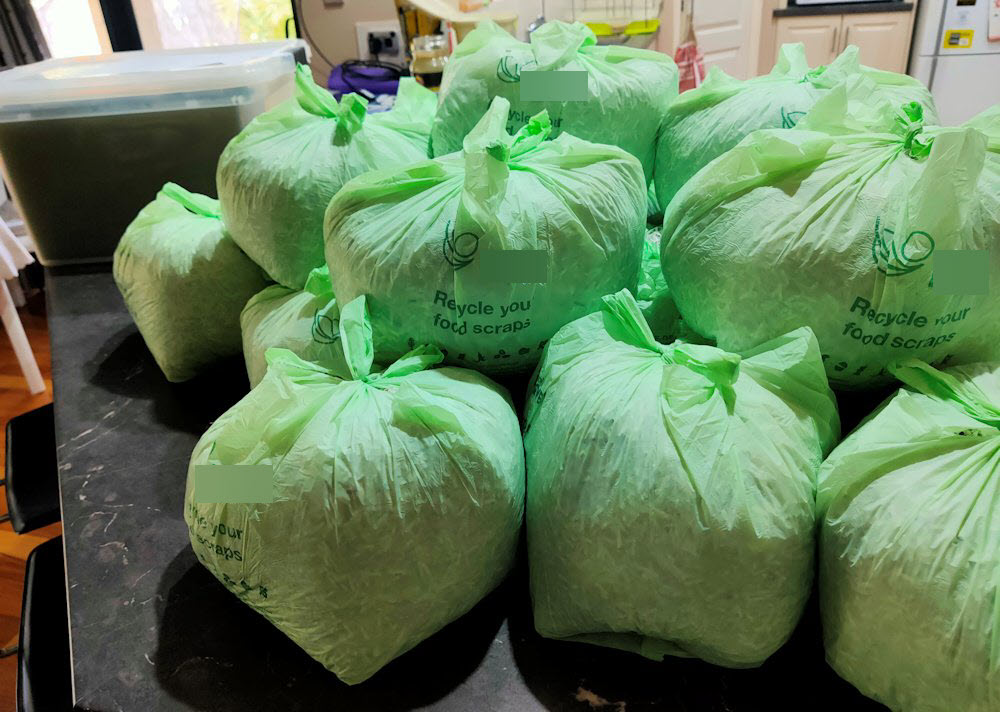
I’ve since tackled quite a few more tubs though I haven’t yet started on the business paperwork (I’ve had my business since 1999). And I’ve created mountains of bags of shredded paper! Those 10 L kitchen caddy compostable bags (the pale green ones in the photo above) were running out quickly. But Bunnings had 54 L ones! So I bought 2 rolls (40 bags), and have already filled nearly 10 of them! Three are already in the 240 L FOGO* bin, 1 is partly full next to the shredder, and these 6 are awaiting their turn to go into the region’s compost heap!

My husband, sister, niece and nephews should be grateful I’ve done this now!!!

  • FOGO = Food Organics, Garden Organics, and yes shredded paper is allowed in this bin


When mortgage interest rates were 17%

1 12 2023

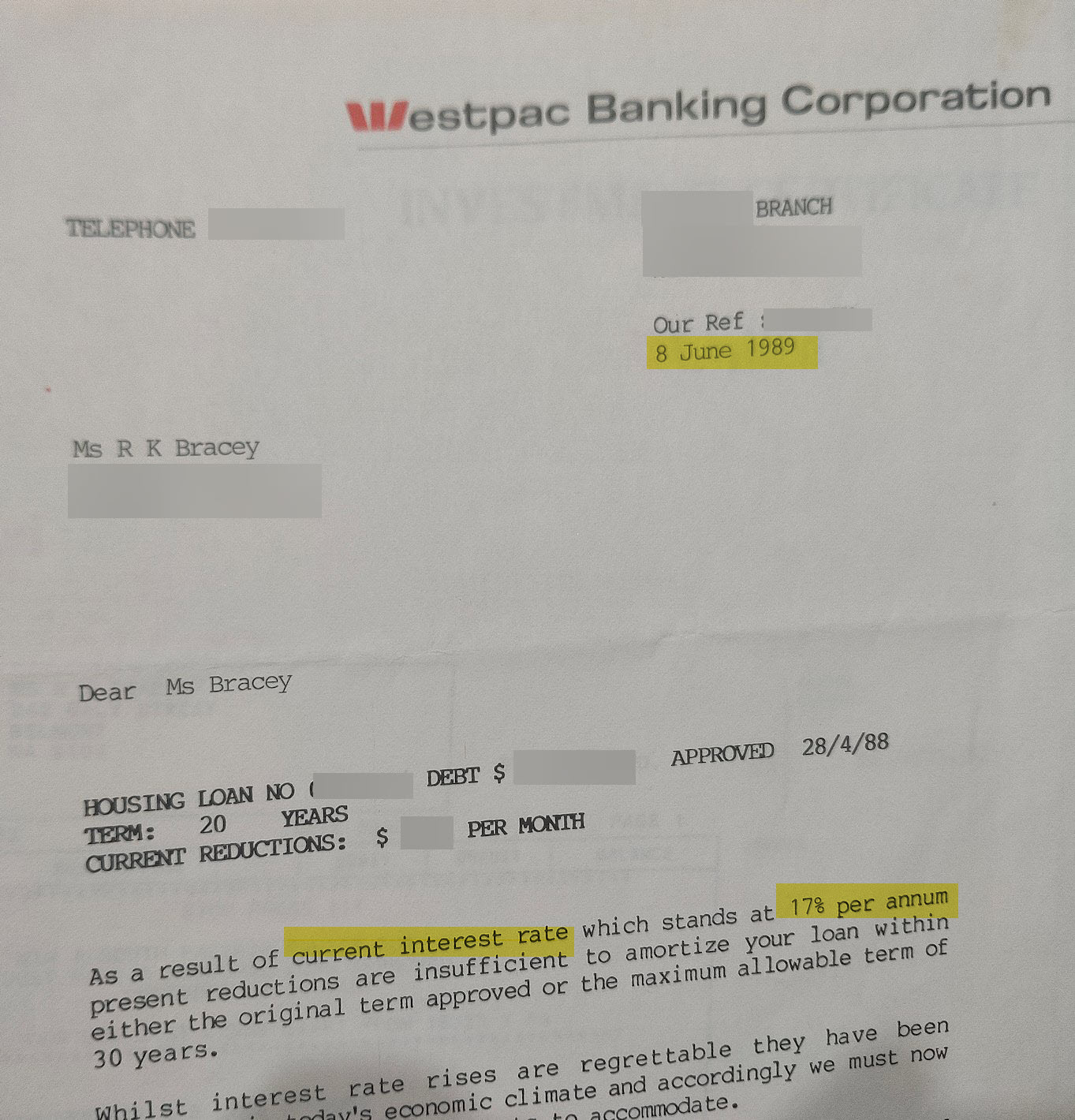
I’ve been purging old paperwork from the storage boxes in the shed. And I found this gem today. The struggle was real folks, with the bank saying you will no longer be able to pay your mortgage in the original time frame and offering suggestions for what you could do.

In my case, I got someone in to share my house (and made a lifelong friend as a result!), which certainly took some pressure off. And yes, that mortgage interest rate was 17%!!!! I’d taken out the loan 12 months earlier when it was 13.25% and had budgeted for 15%, but by the time it got to 17%, everything was hurting because my teaching salary was fixed and going nowhere.


Adventures in plumbing

26 10 2023

Back in Feb/Mar 2023, we had our en suite bathroom renovated. The first step in that process was stripping out all the old bathroom fittings, tiles etc. (https://rhondabracey.com/2023/02/13/bathroom-renos-day-1/), and as part of that process, the now-open pipework was capped or covered to prevent things falling down it or smells coming up from it.

Fast forward to September and I started to notice some occasional issues with the en suite toilet and hand basin—the water in the toilet would rise almost to the rim on flushing, then disappear fairly quickly, coming to rest at a lower level than usual in the pan. And while this happened, the hand basin would gurgle and occasionally spit up water from the trap (it smelt of toothpaste!). It was disconcerting to say the least but it only happened a couple of times. But over the next few weeks, it became more regular. So it was time to call the plumbers.

I’d pretty much diagnosed that the issue was somewhere in the line from the en suite to the main line to the septic tank (we’re not on sewerage here). No other areas of the house had flushing or water dispersal issues, and nor did the shower in the en suite—no gurgling from there. When I looked at the house plans (which only had rudimentary and indicative markings for the plumbing), it appeared that the en suite shower was on a different line, which fit with my layperson’s assessment of where the problem was,because there seemed to be no issue with the shower.

The plumbers tried many things to free the blockage on their first visit—plunging the toilet and putting an acid down the pipes to be left for 24 hours. They told me that if that didn’t fix it, they may have to cut out part of the concrete path outside or remove the (new) toilet pan. These sounded like drastic measures! Putting a drain snake down from the toilet wasn’t really an option as it’s motorised and thus very powerful and could smash the toilet or damage the floor tiles. This did not sound like a good option. After 24 hours, I flushed the toilet 3 times and had the hand basin running at the same time—all appeared to be well. Until I had to flush solid matter, and the problem resurfaced.

On the second visit, the plumber they sent (Bryce) was fantastic in trying to diagnose the issue—he tested one variable at a time and tested multiple times to emulate the problem. At one point he removed the trap from under the hand basin and suddenly everything seemed to work well. He thought it was a venting issue because as soon as he put that trap back on, the issue returned. He installed a new trap with a vent on it, but that made NO difference. The problem remained. He asked me about the renos and what was done—I showed him the pictures I took each day, which proved that the strip-out guys and the renovation company had capped all pipe openings and put a large sponge into the toilet water pipe. I doubted it was a problem that stemmed from the renos because the reno had happened more than 6 months ago, and surely any issue would’ve made itself known long before now. Bryce was as baffled as me.

He decided to look for the inspection opening (IO) outside the bathroom window. But there wasn’t one! We discovered that ALL 6 IOs that were on the house plan I had from the previous owners (who built the house) were ALL under the concrete path! Who does that???? I contacted the building company to see if they had better plumbing drawings, but they didn’t. They also confirmed they did none of the concreting/paving etc. around the house—it was all done by the original owner (and he was in the construction industry contractor so I’m pretty sure he did it all himself). I also contacted the Shire to see what they had—they found a 7 page document from the septic tank installers, which had a bit more detail than the house plans, but not a lot. I also spoke with the manager of the reno company—he was as baffled as me and the plumber, especially with the time since the reno—we all agreed it couldn’t possibly be as a result of that.

The weekend came and I continued to use the other bathroom as I’d been doing for nearly a week. First thing Monday morning, the reno manager called and asked if he come and take a look (he’s an ex-plumber) because it had been nagging at him all weekend. He also did various things to try to dislodge whatever was blocking the line (BTW a mop is a handy thing to use to plunge the toilet if the water is fresh), and we talked at length about the possibilities. He confirmed that everything had been capped, and I agreed—I’d watched every step of the process and had photos to confirm this. We both agreed that it was extremely unlikely to be a result of the renos, but as I don’t have kids, grandkids, or pets, there was no way anything else could have got into the pipework other than the usual toilet paper and solid and liquid waste. Also, the toilet is a ‘smart’ one, with bidet functions, so toilet paper usage is far less than for a standard toilet (https://rhondabracey.com/2023/04/02/using-a-smart-toilet-for-the-first-time/). Looking at the plans and using his knowledge, we identified where we thought the pipe exited the house and thus where the IO was likely to be. He said he COULD remove the toilet pan, but was reluctant to do so, except as a last resort, and I agreed.

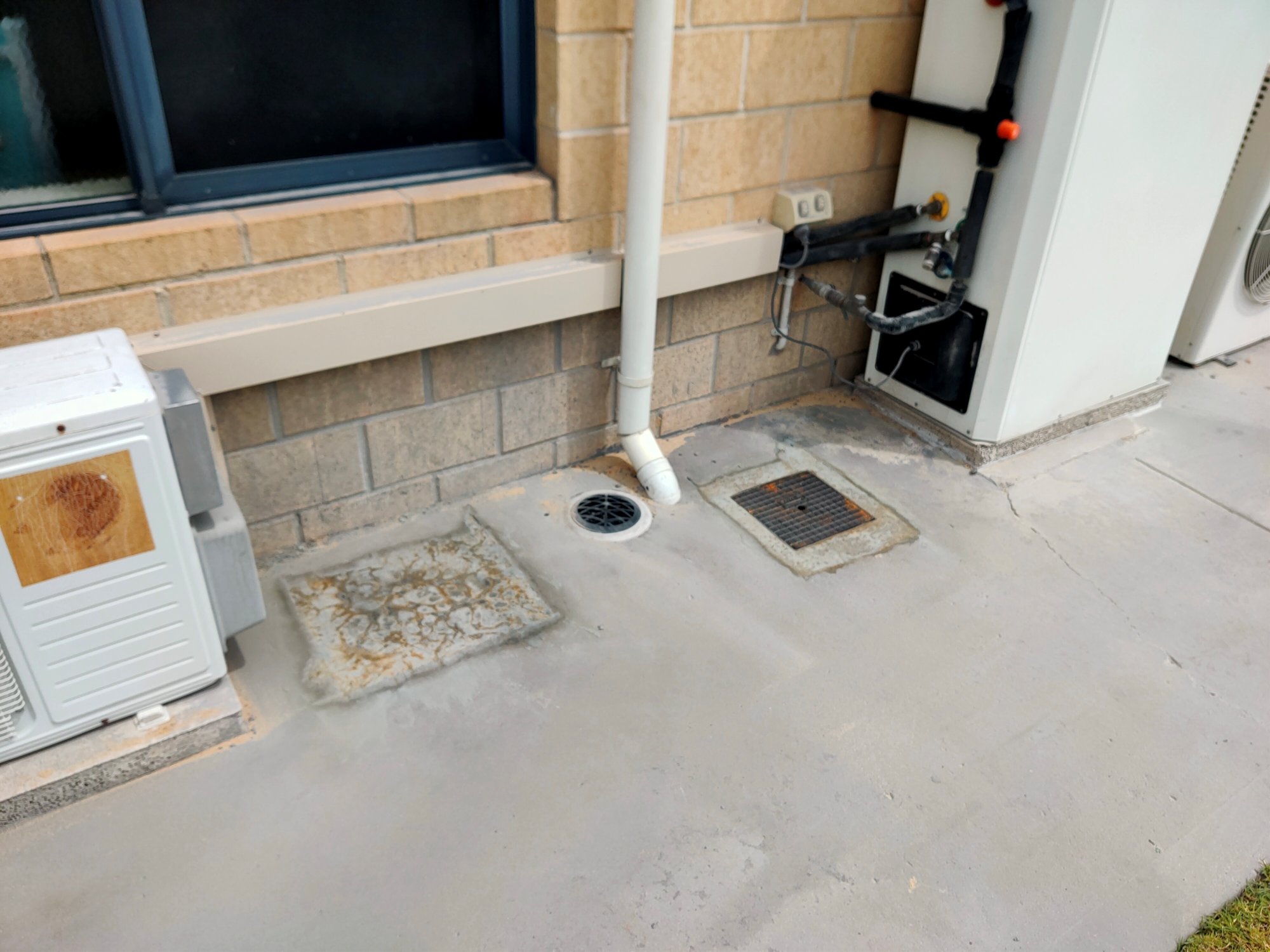
Meantime, the plumbing company arranged for Bryce to come out again on Wednesday (I was away on Tuesday, and on Monday I was still waiting on plans from the Shire etc.). I showed him the newer plans I had and where the reno manager and I had calculated the pipe exited the house. So he cut a square of concrete out of that section of the path and started digging. And digging and digging. He went down >500 mm and under the sides almost a similar amount (he had to be careful as there was a heavy heat pump for the hot water system [HWS] sitting right next to the hole and he didn’t want to undermine the structural integrity of that piece of concrete). Nothing. No pipe, and you really can’t miss a 100 mm pipe! And because no pipe, no IO. Where was it??? There was no point going deeper as he was already level with or below the level of the opening into the septic tank, and the pipe would have to be higher than that to have the appropriate fall to the septic. He and I were baffled as to where the pipe could be.

Digging the first hole, but nothing found

I came inside and related this to my husband. He said it would be great if there was geophys (ground-penetrating radar) they could use to find pipes underground. And then it came to me—why not listen for the sound of water flushing through the pipe? I suggested this to Bryce and he was willing to try, because he was rapidly running our of options and I was despairing that we’d never find it and get the blockage cleared. He lowered half his body into the pit he’d dug and I flushed the toilet. He couldn’t hear the water (too much ambient traffic noise from the highway) but got me to do it again. This time he put his hand on the sand and felt the vibration of the gurgling! It was about 500 mm to the right of where he’d already dug and certainly NOT where the plans indicated it would be.

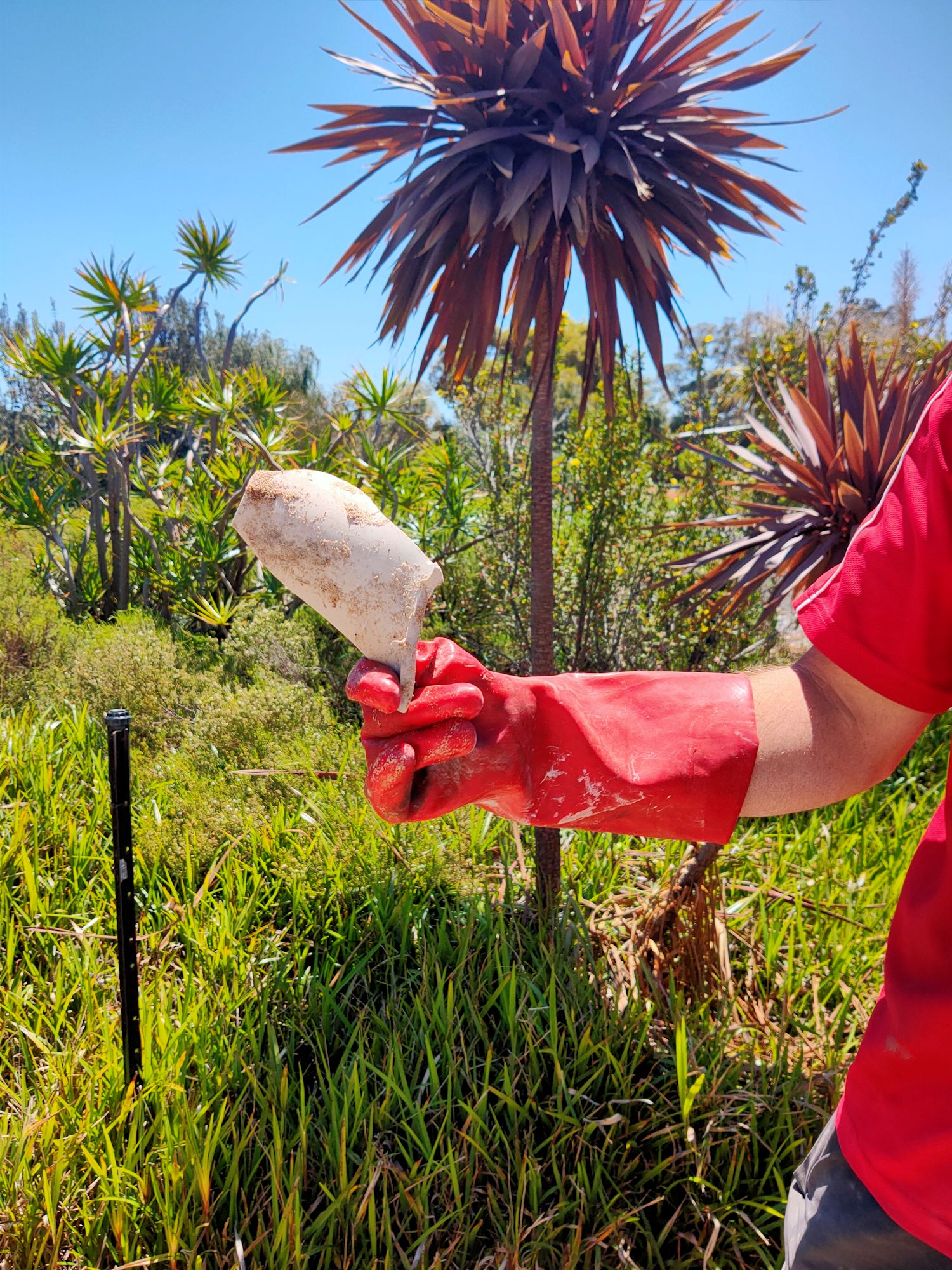
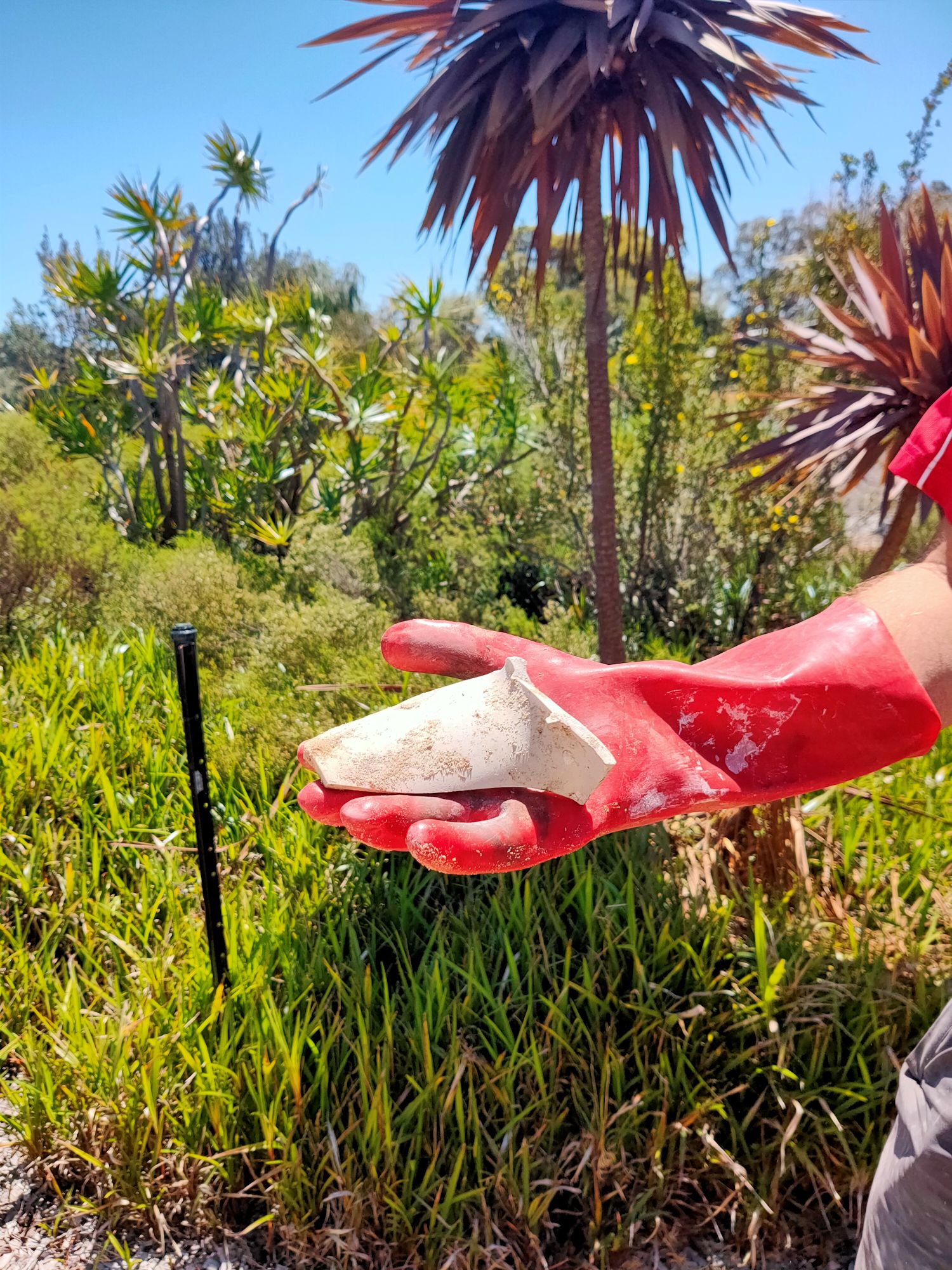
Bryce cut another hole in the concrete further along (past the dry floor waste opening and a rainwater downpipe) and found the pipe and the IO! The IO was partially covered by the downpipe’s pipework (who does that??), but that pipe (40 mm?) was flexible enough to be gently moved aside. As soon as he took the IO cap off, he came inside to get me to show what he’d found. There was matter clogging up to the top of the IO—yuck. So he donned a chemical glove and started to remove it. A couple of minutes later he called me outside again—he’d found the culprit! It was a piece of curved and broken off ceramic that looked like it had come from a toilet. And so it was (as confirmed by the reno manager when I sent him the photos). After clearing everything out, we test flushed the toilet many times, along with filling the hand basin to confirm that everything was now flowing as it should.

IO and angles of the pipework where the blockage was

Blocked pipe

We think what happened was that when the strip out was being done, the toilet pan had broken and a piece (not small—it was about 140 mm long) had fallen into the toilet waste pipe before it was capped. The strip-out guys wouldn’t have heard it fall (it was the noisiest time of the whole reno) or seen it in the pipe, and then they capped the pipe, which was later further blocked off with the sponge and then the new toilet was installed over the top of the pipe. It likely lay in situ for a while, gradually moving down the pipe until it hit the (small) angled bend and could go no further. It took 6+ months to do this. Meantime, because of its shape, most waste had gone past it without a problem. Until it didn’t. Once it got to the bend (where the IO was), it lodged there, and while some waste passed it by, not everything did, so there were times when it was fully blocked and so the water backed up the pipework, causing the gurgling and spitting in the basin and toilet. And then it would drain away, to a degree.

The sense of relief at finding the cause was palpable and Bryce revealed that he was at a complete loss as to what to do next if he hadn’t found the IO and that piece of ceramic. My sense of relief was equally as great as his!

I sent photos off to the reno manager—he’d asked me to keep him in the loop. And he and the strip-out people agreed to pay a third each of the bill (I paid the other third because had the previous owners done the right thing, all the IOs would have been accessible).

Bryce filled in the hole where nothing was found and concreted it over again, and put in a cast iron IO box above the IO and pipe, with a removable lid, and concreted around it so at least one of the IOs is now accessible if there are any future problems with that pipe.

You can see from the photos below why he couldn’t just extend the hole he’d already dug (the one on the left)—there was too much immovable infrastructure around it (HWS heat pump on the left, electrical wiring in the metal box, dry floor waste opening, downpipe, electrical outlet, and then the HWS itself. Oh, and we think, based on where this IO was, that the one for the shower is likely UNDER the HWS. Great…

Bonus: I now know more about plumbing, and specifically this house’s plumbing, than ever before!


Using a smart toilet for the first time

2 04 2023

Regular readers will know that we had our en suite bathroom renovated recently, and as part of that renovation, we had a ‘smart’ toilet installed (an Arcisan Neion Intelligent Toilet NEO41005; details:
https://www.streamlineproducts.com.au/neion-wall-faced-intelligent-toilet-with-remote-and-arcisan-concealed-cistern).

So, what’s a ‘smart’ toilet? Why did we buy one? And what advice do I have for anyone, like me, who is using one for the first time? Read on… (content warning: I won’t get too graphic, but naturally, I’ll have to talk about bodily functions at times)

Bottom line (sorry!): Would I get one again? Yes!

What is a ‘smart’ toilet?

In a nutshell, it’s a toilet with built-in cleaning (bidet) functions. But unlike classic European bidets (that I’ve read about, but never used), it’s not a separate item in the bathroom that you straddle (facing the wall). Instead, you use it as you would any other western-style toilet, with the cistern at your back.

The built-in bidet functions of the one we have includes settings for women and men (for the anal, perineal, and perhaps vaginal areas only, not for the urethral area on women), adjustments for cleaning wand position, temperature and flow rate of the water, temperature of the drying function, self-cleaning and deodorising functions, and the ability to program different sequences of settings for 2 users (not tried yet). There may be more functions I haven’t tried.

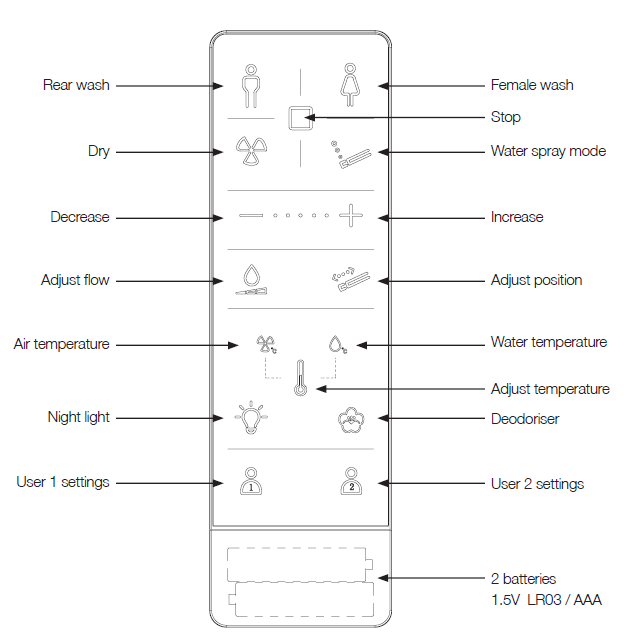
It’s operated by a battery-powered remote control (see image below) and/or a knob on the side of the toilet seat that you push or turn in various directions for the various cleaning and drying functions (I haven’t tried the knob yet).

In the case of the one we have, it also has an built-in night light so that you don’t have to turn on an overhead light in the middle of the night and thus cause your eyes to adjust both to the brightness and then back to the dark as you go back to bed after a middle of the night pee. A light may not be as necessary for women, but it’s very necessary for men.

Notes:

  • None of the functions relates to flushing—that’s still done manually. One of the biggest questions I had when I was investigating the toilets was ‘What happens if the power is out?’ and the answer is that you still use the toilet as per any other manual toilet because the flush mechanism is manual and not connected to the power at all. You just can’t use the cleaning and drying functions during a power outage.
  • The electrics for this toilet had to be hard-wired behind the scenes (there are strict rules in Australia about water and power in bathrooms and how close they can be), and I think the electrician installed a junction box inside the wardrobe of the spare room behind the en suite bathroom. He also added an on/off switch for the entire toilet underneath the light and fan switches inside the toilet (also not used—we just keep it turned on, but if we were going away for more than a day, we’d consider turning it off because you don’t need the light etc. to remain on).
  • This brand/model doesn’t have a heated seat function, which really isn’t necessary where I live in Australia—there might only be a couple of days a year where I’d think that would be ‘nice to have’. Speaking of the seat, the seat and the lid are ‘soft close’, so no worries about dropping the seat in the middle of the night and waking up anybody else.
  • The water usage for the 3-minute (default, but you can stop it at any time) cleaning function is between 350 and 650 mL/min, depending on the flow rate chosen, so between 1 and 1.9 L of water. I haven’t measured the power usage as yet, but when I do, I’ll report back.
Handheld remote control for the smart toilet, showing the icons for each function

Handheld remote control for the smart toilet, showing the icons for each function

Why did we get one?

These smart toilets aren’t cheap—in fact, they cost quite a bit more than a high-end standard toilet, so why did we get one? In simple terms—age.

No-one is getting any younger and the aim of our bathroom reno was to make our en suite bathroom as accessible as possible to cater for us as we age (we’d like to ‘age in place’ in this house for as long as possible).

That meant:

  • having doors wide enough to cater for a wheelie-walker, wheelchair, someone on crutches etc.
  • adding a grab rail to help someone with an injury or disability or just plain wonky on their feet to help themselves onto the toilet or in getting up from it
  • adding a toilet that could help someone who has difficulty twisting to wipe themselves, or little power in their hands to do that for themselves, or who has temporary or long-term continence issues. No-one likes even thinking about the idea of having to help their life partner with toileting, cleaning up after them, etc. And the person this has to be done for may find it very difficult and ‘undignified’ to give control of something so personal to someone else.

One scenario we hadn’t considered was recovery from an abdominal operation and the resulting bowel issues that came with the effects of the drugs, and then the laxatives to make toileting easier so that constipation and straining didn’t cause the surgery to tear and create a hernia. But less than a week after the bathroom renos were finished, I had an emergency appendectomy. I was extremely thankful for the grab rail in the toilet as it meant I could get myself up and down without assistance. I was also extremely grateful for the cleaning functions of the toilet because I couldn’t twist my body easily without the fear of tearing anything, and because the violence of some of the diarrhoea I experienced meant that my bum was red raw, and even the thought of using a very soft toilet paper wasn’t appealing. The gentle warm-water wash of that toilet was a godsend!

Advice for new users

I’ve now been using our smart toilet for almost 3 weeks, so I’m still a new user. I certainly haven’t tried all the functions, but I have settled into some of those that seem to work for me. Everybody’s body and how you sit on a toilet is slightly different, so trial and error is the name of the game for the first few weeks or so. Read the operating manual and try each function—you can’t break it.

Other advice and general comments:

  • The remote control is a bit finicky to respond. I’ve tried hard presses, soft presses, medium presses and still haven’t figured out what the optimum is. In some cases I’ve had to press a button 2 or 3 times before it activates. I’m sure with time I’ll get better at figuring this out, but for someone who has limited hand mobility or arthritis this may be a problem, in which case it may be easier to learn the controls on the side-mounted knob.
  • The remote control is a beige colour and the icons are medium-grey outlines—there isn’t good contrast, and for someone whose eyesight is not particularly good, this could be a big issue as they can’t see the icons clearly. This is a design issue, where the manufacturers seem to have gone for fashion over function. It would be good to have an optional overlay (or a choice of remote styles at the time of purchase or later) so that the contrast is far better than now.
  • When a function is activated on the remote, it beeps and then is lit from behind with a blue LED, which is reasonably easy to see.
  • The lid and seat beep anytime you open or close them, or sit down and cover the sensor. There’s only a couple of beeps and they aren’t too loud, but they’ve been a bit disconcerting and I’d prefer to turn them off, but I can’t find any information on whether I can or how to. Again, I’ll likely get more familiar with them over time and eventually I may not even hear them.
  • For the first couple of weeks, every time I sat on the toilet (even just to pee), there was a noise that sounded like the cistern was filling with water or a motor starting up. I had assumed this was in preparation for the cleaning function, and it was annoying to hear it when I just wanted to pee! However, this got solved a little later once the flushing issue got sorted out (see below) and the noise stopped completely.
  • Flushing: The bathroom reno project manager told us that after we’d had a bowel movement to push the full flush button in and hold it in until we heard the tank fully empty. We did that, but it just wasn’t enough. In most instances, we had to do a second (full or half) flush, which was counter to the idea of conserving water. (For non-Australians: Australia has mandated dual flush toilets for several decades, and over time the amount of water for each flush has also decreased—initially it was 11 L for a big flush and 5.5 L for a small flush, but modern toilets sold in Australia these days are now around 6 L and 3 L respectively, though some are set for 4.5 L and 3 L [see https://en.wikipedia.org/wiki/Dual_flush_toilet ]). After we complained about having to do 2 flushes almost every time, the project manager (he’s an ex-plumber) came out and adjusted the float in the cistern—it had been set by default to 4.5 L, so he raised it to the maximum 6 L, and the issue with having to flush twice has gone away (and that refill noise when we sat down has also gone too!). He did say that the government (and industry?) push is for making 4.5 L and 3 L the standard, and he believed that all new toilets would go to that in time. Fortunately, ours was one where 6 L was still a possibility.
  • Usage advice:
    • Remember, I’m still getting used to this, so my advice may change over time. Remember also, that your body shape and how you sit on a toilet is likely marginally different to someone else. Manufacturers do their best to cater for the most common shapes and positions, but they aren’t the same for everybody. You will need to trial the settings and adjustments to find what’s right for you.
    • I initially tried the ‘anal wash’ setting only (the one with the male icon), but found it wasn’t for me. Then I tried the female setting—that was a bit better, but I’ve had to drop the flow rate a tad and activate the oscillation icon to suit me better. No matter which setting you choose, the water flow (even at the highest rate) is comfortable and not at all unpleasant. Same for the temperature (which I’ve adjusted down a tad for the drying function).
    • Because all bodies are different, you may need to wriggle around a bit on the seat or lean forwards or backwards to get the coverage you need. With luck you’ll find settings that can cater for that, over time.
    • You don’t have to let it run for the maximum 3 minutes for either the washing or drying, and you might only want the wash not the dry. It’s completely up to you. You can press stop at any time.
    • The big one: toilet paper! When do you use it (before or after), how much do you use, do you use it at all? Well, of course, there are as many recommendations as there are people. Again, you’ll have to trial this for yourself. A US friend of mine who is a BIG bidet fan, suggests a quick wipe before the wash, while the project manager suggested a quick wipe after (for drying mostly, especially if you haven’t used the drying function). Some say a little before and after. Some website articles suggest you’ll never (or rarely) need to use toilet paper again (some even compare the ‘cost’ in water etc. of making toilet paper with the amount of water and electricity used in operating a bidet once or twice a day—the manufacture of one roll toilet paper comes out as far less environmentally friendly). All state that you WILL use less toilet paper, though few claim you’ll use none at all.

Bottom line (sorry!): Would I get one again? Yes!

[Links last checked April 2023]


A ride in an ambulance and a short stay in hospital

25 03 2023

Short summary: I had an emergency appendectomy on Saturday 18 March 2023, after being taken to hospital by ambulance late the day before. This post is a compilation of notes, emails, and Facebook posts I wrote at the time and in the days following, plus my memory of what happened.

Friday 17 March 2023

There’s always time for new experiences! Today I had an ambulance ride to hospital and tomorrow I get my appendix removed!

Around 2pm I had some abdominal cramping and thought it was my guts/wind. At 3.30pm I went to pee and had bad pain in my lower right side when getting up from my office chair, and even worse pain when trying to get up from the toilet. It was a sharp pain like I’ve never felt before, and a pain I certainly couldn’t ignore—this was not going away, it was getting worse. I asked my dear husband (DH) to confirm where my appendix is (he knows far more about anatomy than me). Yep, the appendix was right where I was having pain and I knew I’d never had mine out. He offered to take me to the doctor, but that could be 2 week wait! I said I’d call the ambulance. He said he could take me but I refused because an ambulance will do an initial assessment, give drugs for the pain, let the hospital know I’m coming and what their initial assessment is, and admit me to emergency via a different route. If he took me, we could be in triage with the general public for hours before getting seen.

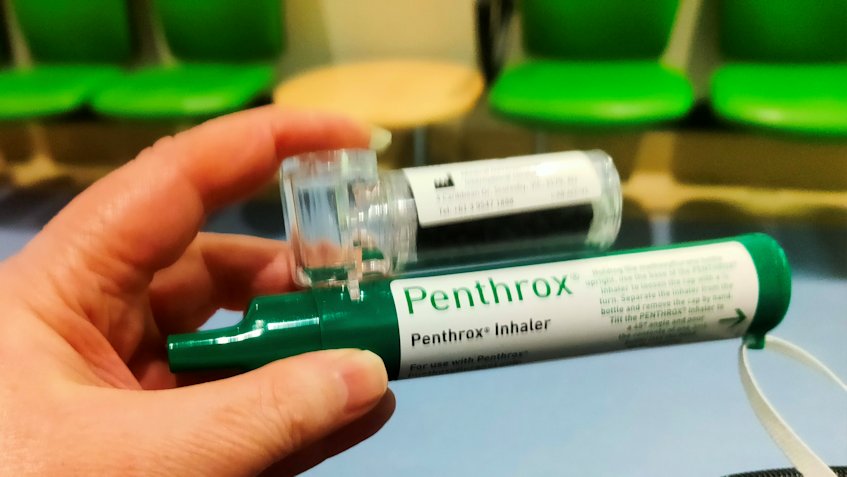
I called the ambulance just after 4pm, and, based on where we live, I knew it would be 30 minutes at least before it got to me. I stood for the entire time while I was waiting as sitting or moving was excruciatingly painful. The ambulance arrived around 5pm (from the Brunswick Junction subcentre) and the volunteer ambos (the angels called Rodney and Wendy) did an initial assessment, measured my blood sugar and blood pressure, asked me lots of questions, took lots of notes on their iPad, and gave me the ‘green whistle‘ (a device that dispenses a pain inhibitor straight to the brain), then rolled me into the ambulance on their fancy collapsible gurney and I was at Bunbury Regional Hospital’s emergency department by 6pm (no sirens and no fast speed, thank goodness). Fortunately, ours was the only ambulance in the ambulance bay (BONUS: no ramping at 6pm on a Friday!) and I was the only one in the triage area at the ambulance entrance, which meant it didn’t take long for the handover to the hospital (into a wheelchair) and they could depart for other calls. At home I’d told my DH NOT to come in until I called once I knew what was going on—there was nothing he could do, and until we knew what it was and how long I might be in hospital (if at all), there was just no point.

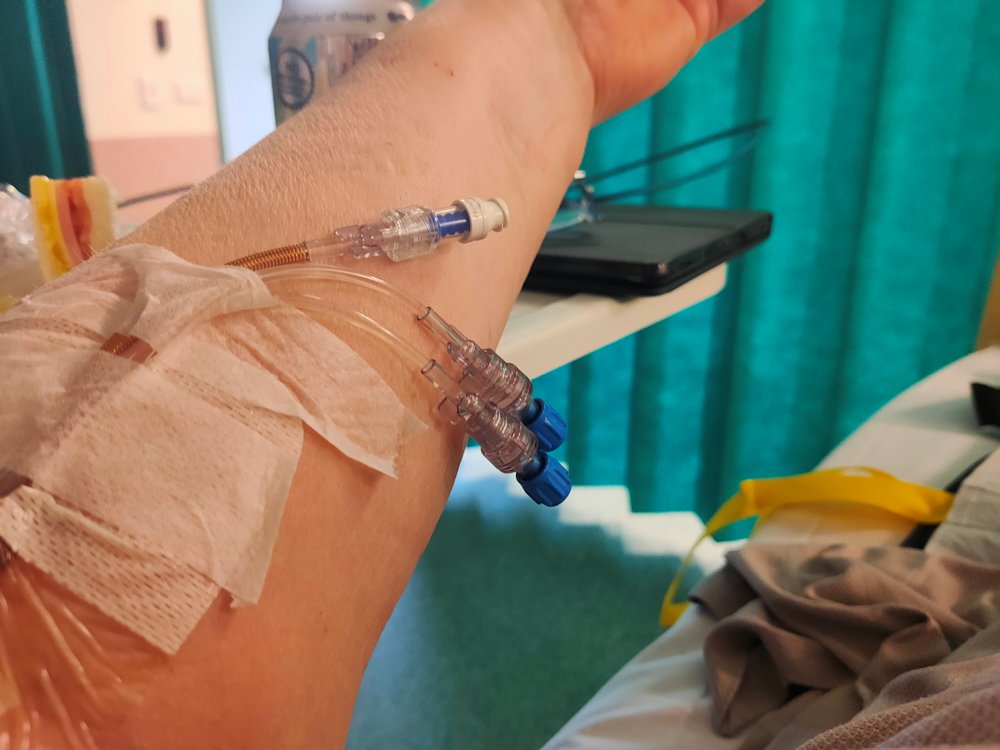
Despite an easy entry into the hospital, and then past the main triage area to the ‘fast track’ area, much of the rest of the night was spent waiting (and sucking on the green whistle). I estimate it was about an hour before I saw a doctor (Dr Rachel), who drew blood, put in an IV line, prodded and poked around my belly (she was very gentle), got me to pee in a tiny container** then set me to wait in another area. After more waiting, I was taken further into the hospital to wait some more, this time for a CT scan. The operator told me he’d inject a dye into my IV line and that it would feel like I wanted to pee (yep!), but that was the drug/dye marker. I had to hold my arms over my head (while lying on the narrow platform), which is not something I found easy (2 shoulder surgeries will do that). After several trips in and out of the CT scanner, I was left outside to wait in my wheelchair (not one I could propel myself) for someone to collect me and take me back to the previous waiting area. I asked the operator what the dye did and he explained that it goes into the blood and quickly goes to all areas of the body. If there are areas of infection/inflammation, the dye will concentrate there because the blood is trying to fight the nasties. If the dye was really obvious at my appendix, then that would confirm my initial self-diagnosis. (BTW, the ambulance people had said that while it may be appendix, it could also be something like kidney stones or a twisted bowel or something else entirely.)

The nurses then put me on a drip for pain and hydration (but I wasn’t able to have any food in case they needed to operate that night—not that I felt hungry!) while they waited for the results of all my tests (the CT scans had to be checked by people in Perth—thank goodness for the internet!). Around 10:30pm a nurse came out and told me it looked like it was my appendix, but that would be confirmed soon by a doctor. Around 11pm or later, the emergency surgeon (Dr Natasha) sat with me to explain what would happen next and to get my consent, and to ask many of the same questions I’d already been asked numerous times since I made that call to 000 some 7 hours before (I know they have to do this to cover their asses, but really?? When you’re in pain and drugged up and can’t think clearly, this is the last thing you want). The scan had confirmed the appendix hadn’t burst, which they likely knew because I didn’t have the symptoms of a burst appendix. And I was told they’d do surgery tomorrow to remove the appendix (likely laparoscopic surgery, with 3 small incisions, though she warned me that in about 10% of cases they have to cut you open). She also said that I would have to curtail my activities for at least a week, possibly two or more—rest and Netflix were to be my priorities, no cooking or cleaning, no lifting anything (possibility of a hernia), no driving for 1-2 weeks (an emergency braking situation could also cause a hernia), etc.

Somewhere in there I called my DH and asked him to bring a bag of stuff in for me (I’d phoned him throughout the night as I’d found out various things, so while he was worried, I don’t think he was panicking as I was keeping him up-to-date). Oh, and someone brought me a very welcome sandwich (I hadn’t eaten for 12+ hours by then and could have it prior to surgery in the morning as it was outside the fasting times). My DH arrived around midnight and soon after I was taken to a bed on the day surgery ward. The nurse quickly shooed him out (I think he got lost getting out of the hospital and ended up in the private hospital next door and exited via their front doors!) and asked me to have a pre-op shower with a special soap, got me prepped with drugs, IV drip (delivering painkillers too), oxygen prongs, ear plugs, and a compression socks to combat DVT etc. I think she did an ECG as well.

The operation is scheduled for first thing in the morning. I tried to sleep but even in the middle of night, hospitals are noisy places with all the different beeps of the various machines—the ear plugs certainly helped, but I was limited in how much I could move, what with the pain (masked) and the various bits and piece sticking out of me.

** About tiny urine collection containers… Really? 50% of the population is female and those collection bottles just don’t suit the female anatomy, especially when you’re in excruciating pain if you move. It’s 2023 yet we women still have to suffer the indignity of peeing over ourselves while trying to position a tiny container underneath ourselves to try to get a urine sample into the container. They want mid-stream? They’re lucky they get ANYTHING! Challenge to inventors: Devise a urine collection container for female anatomy.

Saturday 18 March 2023

Next morning I was told I was first on the surgical list and that the operation would happen around 8am. One of those doing the surgical rounds about 7am was Dr Natasha from the night before, which was comforting. From what she said, I was under the impression she’d be doing my surgery.

By 9am nothing had happened. I was still in bed waiting. And the reason was that the scheduled anaesthetist had called in sick because his 2 kids had gastro and he didn’t want to give it to anybody else. The hospital had to call in an emergency anaesthetist but he wasn’t due until after 10:30am (it’s a regional town so there aren’t many around—with those times, it’s possible he had to come from Busselton, Mandurah or even Perth). Eventually, I was wheeled into theatre at 11:00am, so my surgery (and everyone else’s that day) was pushed back for 3 hours. Which means Dr Natasha didn’t perform my surgery, even if she’d been scheduled to, because her shift would’ve ended by then.

One thing I recall before I went into surgery is that they put sticky things on my forehead (as well as around my heart). I was told the ones on my forehead were to measure my brain activity—normal is 100% and when it drops to 30% with the anaesthetic, I’d be well under and they can start the surgery.

Of course, I have no memory of the surgery at all, just being wheeled into the operating theatre and squirming painfully onto the table from my bed, trying not to get any of the IV lines etc. caught up. Then nothing.

I recall people talking to me as I was coming to, but I couldn’t respond with anything intelligible, so I held my thumbs up to let them know I was hearing them and responding. By 3:45pm I was fully awake and in the day surgery ward, though in a different bay. There was lots of post op monitoring by the nurses for the first 6 hours, and a huge number of different beeps. And painkillers into the IV line. And a visit from my DH.

I slept well—lots of drugs in my system plus ear plugs. No pain… and no appendix either!

Sunday 19 March 2023

All clear to go home this morning, with strict instructions from the nurses and doctors about what I can and can’t do, which includes no cooking! My DH is so pleased….. Not! 😁
Basic rules are rest and Netflix! Have emailed my clients that I’m not available all this coming week and possibly the following week, and why.

Moving very gingerly and carefully, mouth tastes like crap no matter how many times I clean my teeth (drugs?), showering is interesting as the dressings, which I can’t see, have to be changed (DH has been wonderful). I’m taking all the drugs (including antibiotics) but not the heavy painkillers—just Panadol and Nurofen as advised. Can’t use the foot thingy on my recliner as it was super hard to push in with my legs before the operation and would no doubt rip things apart inside if I tried now, so I’m sitting fairly upright in the chair and using a footstool for my feet (new powered recliners are in our future?). Getting into and out of the car is done super carefully. For the first few days post-hospital I slept at least 3 hours in the afternoon, in addition to normal sleep at night—I never do that, so obviously my body needs that extra sleep to heal.

And I’ve given thanks for the smart toilet and grab rails that were only installed a couple of weeks ago as part of our en suite bathroom reno! The grab rail certainly came in useful the first few days, as did the toilet’s in-built bidet function, which meant I didn’t have to twist my body to wipe (yeah, TMI!) and thus put my healing body in danger of herniating. Another reason for getting a bidet I hadn’t thought of…

Days since

Each day the pain has been abating, and what I can do gets a little easier. To get me out of the lounge chair, DH took me to see my parents on Tuesday, and we went for another drive on Wednesday too, stopping for a lovely lunch overlooking the Dawesville Cut near Mandurah. By Thursday I could sit at my computer for a short time, and by Friday 24 March the horrible taste had all but gone (thank goodness—it was very metallic and put me off eating or drinking anything other than water), and I could spend more time in my office chair. Sitting at the dining table is still a bit sore, because I’m bent forward to read the newspaper, do the crosswords etc.

Silver lining

I had a realisation that all this was incredibly well-timed (you’ve got to look for a silver lining, right?). The conference I’ve been attending and speaking at in the US since 2015 (except COVID years) started this week (23 March) in Columbus, Ohio. Some 6 months ago, which is usually about when I book airfares, accommodation etc. and make plans for visiting friends and family or doing a course, I decided that I was still COVID-shy and still wasn’t ready to get on a plane. Besides, the airfares to the US were horrendously high in all classes, AND Qantas still owed me several thousand dollars, which I’d been trying to get from them since August 2022 (they eventually paid up earlier this month). So I decided not to go this year’s conference. Which was bloody lucky for me!

Had I decided to go, I either would’ve already been in the US when this happened, OR somewhere in the many flights between Western Australia and Ohio, one of which is about 17 hours non-stop. I cannot IMAGINE what either of those scenarios would’ve been like. Neither would have had good outcomes. Having appendicitis on a long flight across the Pacific would likely have meant either dealing with the pain with whatever the flight crew (or a doctor) had on board and hoping my appendix hadn’t burst or that bursting wasn’t imminent, or causing the plane to detour to a Pacific island to get medical attention for me, and thus likely being offloaded somewhere from where I would find it hard to move onward or return home one I’d received medical attention. As it was, I really only experienced that excruciating pain for a couple of hours before getting suitable drugs—that certainly wouldn’t have been the case on the plane. And had I had appendicitis on a US domestic airline, I can’t imagine what would’ve happened or even if anyone would’ve believed me (I certainly don’t have much faith in US domestic airlines). Travel insurance would’ve kicked in (NEVER leave home without travel insurance, particularly if you’re going to the US), but I doubt I’d have been in a fit state to contact the insurance people, and there’s a possibility my luggage wouldn’t have been with me either.

The other scenario is this happening after I arrived in the US. And that’s almost as unthinkable, because I have no idea how I would’ve got treated as a foreigner in another country where all my usual medical safety nets didn’t exist, and where I may have got treated but only after getting the travel insurance to kick it, assuming I was in a mental state to follow that up. How would I have got medical attention and an ambulance anyway? This could’ve happened in a hotel room and I may not have been able to contact anyone to help me (I would’ve been a single traveller). And that’s not considering that I have NO medical insurance (except travel insurance) to cover the costs of the US hospital system, which means that I may not have got treatment in a timely manner and could’ve waited days or weeks for surgery and then be left with an eye-watering bill at the end of it, assuming I survived, or had to pay in full upfront before I got treated.

Which brings me to cost…

Cost of all this

I’ll get a bill for the ambulance (probably about $1000; Update: It was $300 with the 50% rebate applied), but my private health insurance should cover that in full (if I didn’t have private health insurance, I could’ve opted for full ambulance cover for less than $100/year).

I may get some minor bills from the hospital, but that’s unlikely. Most likely, this whole experience (drugs, dressings, IV lines, surgery, doctors, surgeons, nurses, anaesthetists, bed in a public hospital for 2 nights etc.) will cost me absolutely NOTHING. My tax dollars at work!

Why? Because Australia has universal health care for all, which we call Medicare (same name as the US scheme, but a totally different model).

One of my US friends asked how this works, because something like this (or worse), could bankrupt many Americans. So here’s a quick (simplistic) summary of how the Australian health system works:

  • Universal health care is a federal responsibility of the Australian Government (states are responsible for providing and staffing public hospitals etc.)
  • All Australians who earn above a certain amount (from wages, salary, investments etc.) pay a Medicare levy of between 0 and about 2% on top of their income tax, depending on their taxable income each year. If you don’t earn much, you don’t pay the levy, but you still have access to public hospitals etc. If you earn a lot, you pay around 2% extra on top of your income tax rate, so if you were on the 30% tax rate based on taxable income, you’d actually pay 32%.
  • Income tax (and the Medicare levy) is a federal responsibility, so Medicare is for ALL Australian citizens and permanent residents. States raise their taxes in other ways, such as license fees, land tax, etc.
  • Public hospitals and some GP visits for some people (such as concession card holders) are funded by our Medicare system, which means we pay nothing for them. BUT for things like elective surgery (knee, hip replacement etc.), the wait lists for such procedures in a public hospital can extend many months and even years, and you won’t get your doctor/specialist of choice, just whoever’s on duty at the time. NOTE: Except in an emergency situation, you cannot see a specialist without going to your GP first and getting a referral—this stops people just calling up a surgeon, for example, and saying they want surgery. Your GP has to assess you first, then refer you to the specialist. The referral letter typically explains their assessment, and in most cases it expires after 12 months, so you have to revisit the GP if you need to see the specialist again at a later date (a real pain for lifelong conditions that need monitoring).
  • Emergency department (ED) waits at public hospitals can also be long and as with many EDs around the world you get seen based on medical need (triage), not on your ability to pay. I only know of one ED in a private hospital in my state, though there could be more now—all are in Perth, some 2 hours away.
  • Private hospitals also exist, and some specialists and GPs charge well above the set Medicare fee for their services. If you attend any these WITHOUT having private health insurance, or concessions (e.g. pension, veterans card), you would be up for the full cost, which COULD bankrupt you.
  • Private health insurance is an option for all Australians, but it NOT compulsory—like any other insurance, you can choose to pay it or not, and how much you pay depends on the level of cover you want. In my case, I’m on top hospital and top ancillary (e.g. dental) cover and I pay about $240/month (just under $3000/year) for that private health insurance. I don’t HAVE to have private insurance… I choose to for the ability to get (elective) surgery done in a hospital of my choosing and with a specialist of my choosing and not be in a very long wait list for similar surgery in the public hospital system. Emergency is a different thing altogether… you need it and need it now. No wait list.
  • Depending on your cover, private health insurance may cover you for a stay in a private hospital (often in a private room), specialist attendance while in hospital, some of the gap (co-pay) between the scheduled Medicare fee and what a specialist charges, and other ancillary services, such as dental, optical, physiotherapy etc. Even if I’d had this appendix operation done in a private hospital (most don’t have EDs, so that’s a moot point), it would’ve only cost me $150 co-pay (we call it excess) based on my private health insurance cover plus perhaps some (small) co-pay for anaesthetists etc. Oh, and that $150 excess I’d pay for private hospital surgery? That’s $150 for the year, no matter how many surgical procedures I had to have. Most years I’ve never needed it, but in 2015 I had 3 surgeries (shoulder, eyes, and breast lumpectomy and milk duct removal) and it cost me $150 TOTAL for the 3 hospital procedures, and maybe a bit of co-pay for some of the specialists, but not much (certainly well under $500).
  • No health cover in Australia (private or Medicare) is tied to your employer. Employers have NOTHING to do with whether you have coverage or not—the Medicare levy is only based on your income at tax time and the federal government doesn’t care who pays you that income. Private health insurance is your CHOICE and the government doesn’t care about that either. My understanding is that in the US many jobs have the ‘benefit’ of employer-paid health and/or dental insurance—to me, that’s just a very heavy chain to keep you locked in to an employer, never allowing you the freedom to leave that employer, especially if you have sick kids, a disability etc. as you are unlikely to get similar cover with another employer. And god forbid you have your own business or are a freelancer, or are unemployed, or are single and thus have no spouse who has those ‘benefits’ for the whole family!

It would be extremely rare that getting sick in Australia (as an Australian citizen) would come anywhere close to bankrupting you. Our health care system certainly isn’t perfect, but getting sick won’t cost you your home, except in very rare cases. As I said, it’s not perfect, but it sure beats everything I hear about the US system.

Ambulance

In Western Australia, the ambulance system is run by St John Ambulance (SJWA) (other states have different systems). I believe the state government subsidises ambulance costs (50%?) for those meeting certain criteria. In my case, my private health insurance will cover whatever isn’t already covered or subsidised and I should effectively pay nothing.

In regional areas, especially smaller towns, SJWA is purely a volunteer organisation, staffed by angels called community members. I emailed the subcentre that looked after me to thank them for their care, and I got this reply:

Thank you for your delightful email. You made my day and I’m sure all our volunteer ambulance officers will be just as delighted to read your lovely words, especially Wendy and Rodney. It’s not often we get feedback. I’ve never tried the ‘green whistle’ personally but we’ve all seen the magic it can work.

You are why we choose to volunteer. I can’t imagine what the ambulance service would be like without so many dedicated volunteers adding value to the delivery of an ambulance service in a state as vast as WA. Our subcentre is self-funded—we get no direct funds from SJWA nor the State Government. Our funds come from our capacity to invoice our patients and from fundraising by attending events, both of which are set up by SJWA and the WA Health department. Our subcentre does not pay honoraria or wages to any of our workforce—we are all volunteers. We are about to take delivery of a brand new ambulance from monies the subcentre has raised over many years. We are very excited and looking forward to delivery of the ambulance.

And yes, I’d asked about donating to them specifically, and have now done so.


Bathroom renos: List of fittings etc.

13 03 2023

For my own reference in case I ever need to replace anything…

Bathroom reno done by Armanti in Bunbury, Western Australia. All warranties etc. held by them.

[Links last checked March 2023]


Bathroom renos: Day 19 (final day!)

13 03 2023

All done! Final tweaks and washdown done, carpet reinstated to doorway, and final payment made. I got the PM to install the old towel rails I’d salvaged from the strip-out to the backs of the sliding doors. Two towel rails only hold 2 towels, but not a damp bath mat, face washers, old towel to mop up excess water after squeegeeing the shower, etc. You can never have too many power points or towel rails!

I’m looking forward to a decent night’s sleep back in our own bed after a month in the spare bedroom!