Update June 2019: This Handi Quilter Blog article clearly explains the type of needles you need to buy for your longarm or Sweet Sixteen machine: https://handiquilter.com/all-about-needles/
On the Handi Quilter sit-down model Yahoo! group someone asked about whether they could use their domestic sewing machine needles in their HQ Sweet Sixteen (or Babylock Tiara) machine.
In a word, NO!
The needles are made differently, with the prime difference being the shape of the shank. On a domestic sewing machine needle, the shank is flat at the back. On an industrial machine needle, the shank is fully rounded.
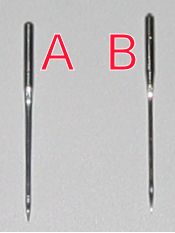
The needles used in the Sweet Sixteen are industrial needles and do not have this flat piece on the shank. In the diagram below, A represents an industrial sewing machine needle looking down from the top, whereas B is a domestic sewing machine needle from the same angle — note the flat part on the shank.
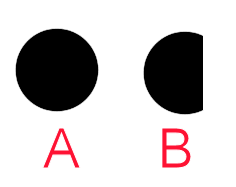

The fronts of industrial (A) and domestic (B) sewing machine needles look just the same.

However, the backs are different. The industrial machine’s needle (A) is fully rounded at the back; whereas the domestic sewing machine’s needle (B) has a flat back on the shank.
Domestic sewing machine needles have the flat side on the shank to make it easy for you to insert the needle correctly into the needle holder on the machine. However, with the industrial needles, you have no guide as to where to place the needle. Thus you need to be careful when inserting the needle in your Sweet Sixteen to make sure the long groove is facing you, and the scarf (the notch on the back) is away from you.
One way to do this successfully is to take the old needle and place its point into the eye of the new needle (with the long groove facing towards you), then insert the needle so that the old needle is at the 6 o’clock position, perpendicular to the new needle. Some people position the needle just off centre, at the 5:30 position (this is what I do) and that’s fine. But don’t position it too far away from the 6 o’clock position otherwise the bobbin thread won’t be picked up correctly and you will not be able to form a stitch correctly.

For more information about sewing machine needles and how they work, check out the excellent videos on needles (videos 16 and 17) from Superior Threads: https://www.superiorthreads.com/videos/thread-therapy-with-dr-bob-educational-videos/. Note: These videos focus on domestic machine needles (particularly topstitch needles), but much also applies to industrial machine needles, especially the information on needle sizes. As an aside, I mostly use 40 wt threads for my quilting and a size 100/16 134 R Groz-Beckert needle in my Sweet Sixteen (the 134 is important).
For more information on needles suitable for Handi Quilter machines, see this free video: http://www.qnntv.com/videos/tnt-threads-needles-tension-with-handi-quilter/ or http://www.youtube.com/watch?v=dZBNUKsCyxg (needles and their relationship to thread is discussed in the first 10 minutes).
Update: R versus MR needles: A further question from the group was about whether we can use MR needles instead of R needles in the Sweet Sixteen. Handi Quilter is quite clear on that — NO! See https://www.handiquilter.com/forums/discussion/1375/needle-confusion (To quote from that 2015 forum post response by the Handi Quilter Educator: “Handi Quilter recommends the R needles for the Sweet Sixteen, the Avante and Fusion machines and the MR needles for the Infinity machine.”)
There’s a picture of an MR needle here: http://www.schmetzneedles.com/category/Long-Arm-Needles-27 — you can see the difference in the shape of the needle, so I can see why HQ says NOT to use them in the S16.
Groz-Beckert describes the tips of the needles (which give the letter designation such as ‘R’) in the ‘Cloth points’ article here: https://dev.groz-beckert.com/mm/media/en/web/pdf/Cloth_points_from_Groz-Beckert.pdf . And Superior Threads has more information on the codes on Groz-Beckert needles here: https://www.superiorthreads.com/education/groz-beckert-needle-package-numbers.
These are the main needles I buy (in sizes 12 to 20, though mostly 14 and 16):

Two final hints:
- Hint 1: Use the groove on the front of the needle to help thread your needle easily every time. Instead of trying to get the end of the thread into the eye of the needle, run it down the groove and it will pop into the eye without a problem almost every time (assuming the end of the thread is snipped, of course, and not frayed).
- Hint 2: Discard your old sewing machine needles, pins etc. into a safe, sealed container. I use an old glass spice jar as I couldn’t justify the expense of an official ‘sharps’ container from the drugstore. It will take a long time to fill this jar, and once full, I’ll
throw out the sealed jar take this jar to my local pharmacy for correct disposal and grab another one for my dead needles.











 Rhonda Bracey: At Random