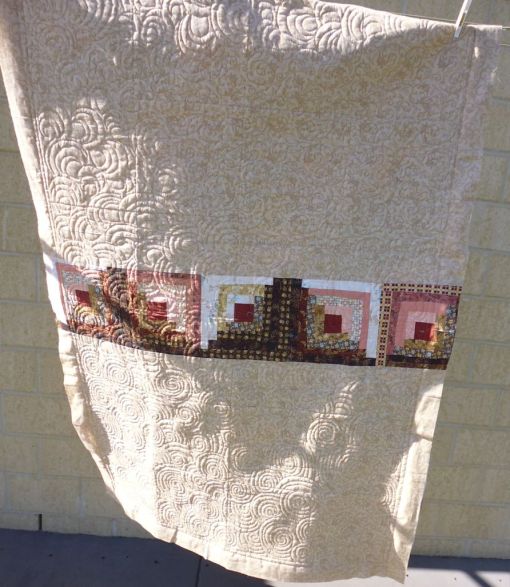
Community Quilt 246

11 12 2015

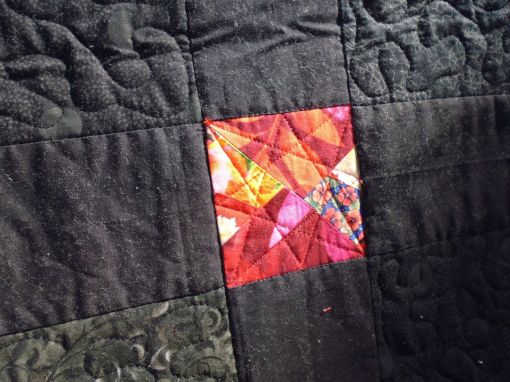
This quilt had bias edges on the diamond shapes that needed to be dealt with as they were causing quite a bit of puffing as they were stretching out of shape.

I started by stitching in the ditch around all the blocks, borders, and stars. Then I echo stitched (in red) inside each of the diamonds, filling every alternate diamond with ribbon candy and the others with some more ruler work. All this stitching was successful in stopping the puffiness caused by the bias fabric.

I finished off with a wonky star in the centre square and some basic stippling in black backgrounds around each star, leaving the sashing strips and borders unstitched.

(Click on a photo to view it larger)

quilt246_04

quilt246_03

quilt246_02

quilt246_01

Threads used:

  • Top: Robison-Anton ‘Tuxedo Red’ (40 wt, rayon, colour 2420); black
  • Bottom: Fil-Tec Magna Glide Classic pre-wound bobbin (black)


An era has come to an end

7 12 2015

And it’s all good!

Late in October we had a call from the real estate agent that someone wanted to look at the final investment property we owned. Within a week contracts were signed, building and termite inspections done (and passed), and the waiting game began for final settlement (‘closure’ for my US friends), due to occur before Christmas. Considering we haven’t had even a nibble in the 5.5+ years it’s been available for sale (though on ‘silent listing’ for most of that time), this was a very welcome surprise.

One of the sets of documents we had to sign was for the discharge of two (small) mortgages that were linked to that property. And I realised that with the discharge of those mortgages, we would be totally debt-free as far as housing is concerned! (Yes, there’s always credit card debt, but we pay that off in full every month.)

After more than 35 years of mortgage payments, suddenly there’ll be none.

And that got me thinking about the properties/houses I’ve bought and that we’ve (my DH and me) purchased together (all in Western Australia; all dates approximate)…

  • Me: Guildford — 1979 to 1987 (residence)
  • Me: Subiaco — 1987 to 1991 (residence)
  • Us: South Perth — 1991 to 2007 (residence)
  • Us: Busselton — 1995 to 2013 (investment/rental house)
  • Us: Geraldton — 200? to 2010 (investment/rental unit)
  • Me: Nedlands — 200? to 2007 (commercial investment/office)
  • Us: Bridgetown — 2004 to 2015 (investment/rental house, and main residence from 2007 to 2010; this is the one just sold)
  • Us: Bridgetown — 2005 to 2010 (vacant land)
  • Us: Bridgetown — 2005 to 2013 (vacant land)
  • Us: near Bunbury — 2010 to now and ongoing (residence; we paid cash for this house and have never had a mortgage on it)

Except for our current house and the South Perth house, all these properties were purchased below the median price for the area at the time, and probably sold at around the median price, so we’re not talking property moguls here! Many were properties in regional areas, and regional real estate doesn’t reflect city real estate in its growth or price movements.

I purchased my first house before I was 25, in an era where it was very unusual for banks to lend money to single women for buying a house. I borrowed 100% of the funds for that first house as I had very little savings, having taken the previous year off work to finish my degrees. How did I borrow 100%? Well, for starters, I didn’t use a bank — I didn’t want the humiliation and misogynistic platitudes about getting a husband/bread winner first! I borrowed the deposit as a personal loan from a teachers’ credit union I belonged too, then used that as collateral to borrow the remaining amount from another credit union/friendly society (later it became a bank). In those days they didn’t check where the deposit money had come from — I doubt you could do that today 😉

I was able to make all my mortgage payments throughout the years, except for 1987/1988 when interest rates jumped to 17+%. I’d taken out the mortgage on the Subiaco house just a few months earlier at around 13.25% interest. I budgeted a buffer up to 15%, not even thinking that rates would keep increasing to 17%. Like many, I was in mortgage stress — I’d only just purchased the house and had stretched my finances to do so, then suddenly I was looking down the barrel of ballooning payments on a static income. Fortunately, I met up with an old friend who knew someone who was new to Perth and was looking for somewhere to live. Although sharing my house wasn’t my preferred choice, I ended up with a 23-year-old American girl as my ‘roomie’ — I had to pay that mortgage somehow! We ended up sharing the house for a couple of years, and we’re still good mates. Thanks Kris — you may never have known until now how much your rental contribution kept me from going under.

But as at noon today, it’s all over. NO MORE MORTGAGE PAYMENTS. EVER.

It feels very good to say that!

And look! 0.00 balances on the mortgages!!

mortgage-free


Community Quilt 245

4 12 2015

This cute panel quilt of Australian animals and birds was easy to quilt — it was small, had obvious motifs to stitch around, and obvious designs in the borders to follow. I think I finished it in under an hour.

(Click on a photo to view it larger)

quilt245_02

quilt245_01


Threads used:

  • Top: Fil-Tec Harmony ‘Tweed’ (40 wt, cotton, colour 14076)
  • Bottom: Fil-Tec Magna Glide Classic pre-wound bobbin (light tan)


Community Quilt 244

4 12 2015

Another BIG quilt, this time a jelly roll strip quilt in lovely blue batiks.

How to quilt it? To counter the straight lines of the strips, I decided on an old favourite — an all-over spiral design. I think I can do that one in my sleep! I left the purple border unstitched, and in the blue border I stitched Vs/Ws, but instead of points, I squared off the bases to match the design in the fabric.

(Click on a photo to view it larger)

quilt244_01
quilt244_03

quilt244_02

quilt244_04

Threads used:

  • Top: Floriani (40 wt, rayon, colour PF373)
  • Bottom: Fil-Tec Magna Glide Classic pre-wound bobbin (dark gray)


Cutting board rack

24 11 2015

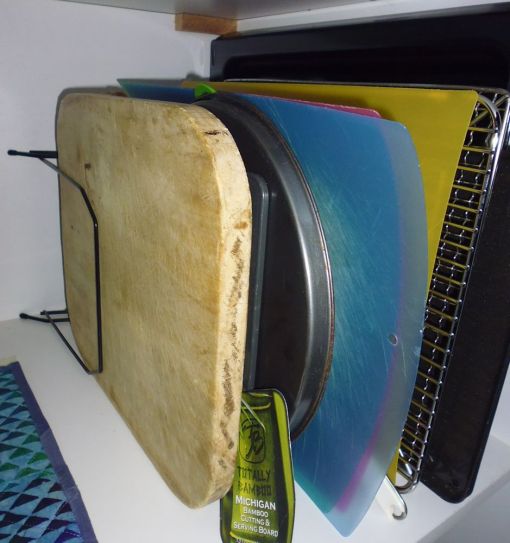
I saw something on the internet the other day about using spring-loaded expandable rods inside your cupboards to create vertical space for storing your cutting boards, baking trays, cooling racks, etc. Well, I couldn’t find these rods in Bunnings (like Home Depot in the US), except in full shower rod lengths. But when I was in Officeworks (like Office Depot in the US) looking for something else, I decided to see what they had in the way of possible storage solutions I could repurpose.

And I found the PERFECT solution for storing my boards and racks vertically — a wire rack for storing file folders on a desk! I tipped it on its side, and voila! A storage system that won’t let these items fall over or slide down. And it takes up less space than the previous storage solution (a wine box). It was cheap too — about AU$14. Now that’s a hack 😉

wire_vertical_file


board_rack


Community Quilt 243

24 11 2015

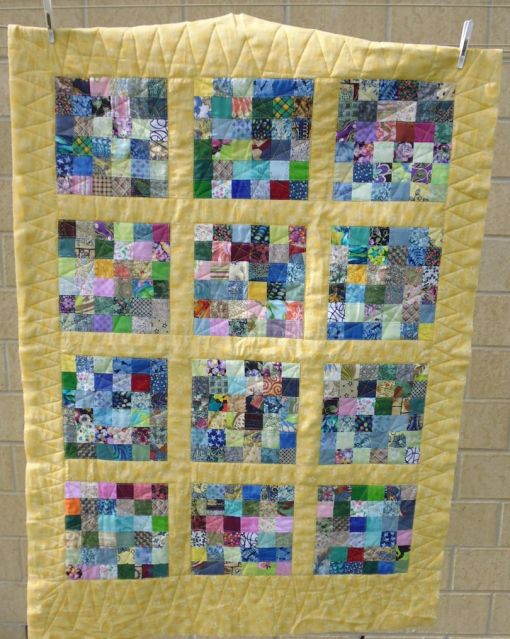
Compared to the most recent quilts I’ve done, this was a tiny one 😉

Again, a scrappy quilt, this time set off with yellow sashings and borders. As it was such a busy quilt, I decided to keep it simple, stitching wonky stars in each block (using my Line Tamer ruler) and mountains (or Vs or Ws) in the borders.

(Click on a photo to view it larger)

quilt243_01

quilt243_02

Threads used:

  • Top: Floriani (40 wt, rayon, colour PF546)
  • Bottom: Fil-Tec Magna Glide Classic pre-wound bobbin (light tan)


Community Quilt 242

24 11 2015

Another big scrappy quilt, this time set off with black. I decided to keep with the geometric theme of this quilt and so quilted it all over with a squared-off meander using an aqua thread. I liked the end result, both the motif and the thread colour I chose.

(Click on a photo to view it larger)

quilt242_01

quilt242_03

quilt242_02


Threads used:

  • Top: Floriani (40 wt, rayon, colour PF373)
  • Bottom: Fil-Tec Magna Glide Classic pre-wound bobbin (black)


Community Quilt 241

24 11 2015

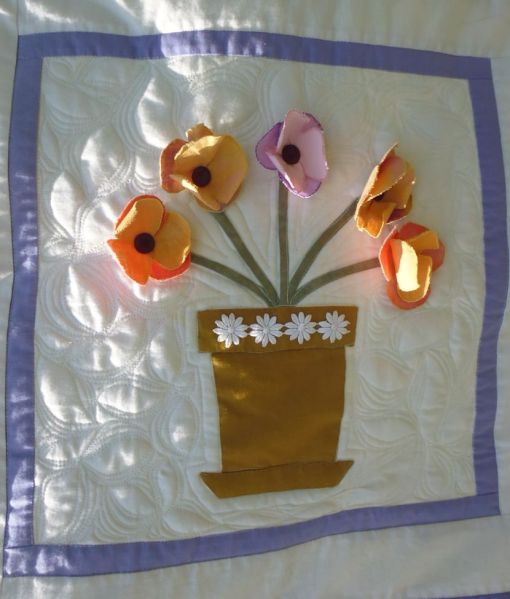
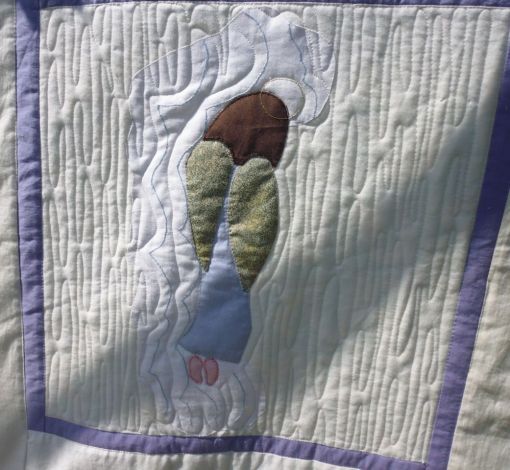
This was a HUGE quilt, and it had been partially hand quilted by its creator. My job was to finish the quilting, which took many hours (especially the McTavishing in the large border on three sides). I started by stitching in the ditch around each block, border, and applique piece that wasn’t already hand stitched, then stitched various quilting motifs to fill in the backgrounds of the borders and the unstitched blocks. I still can’t figure out the connection of the horizontal angel in the waves with the other blocks…

Note: In the photo of the whole quilt, one of the borders is folded over the clothesline to prevent the quilt dragging on the ground, and the quilt is sideways on the clothesline too. It was a big quilt!

(Click on a photo to view it larger)

quilt241_01

quilt241_06

quilt241_05

quilt241_04

quilt241_03

quilt241_02


Threads used:

  • Top: Fil-Tec Glide ‘Linen’ (40 wt, trilobal polyester, colour 10WG1)
  • Bottom: Fil-Tec Magna Glide Classic pre-wound bobbin (white)


Community Quilt 240

24 11 2015

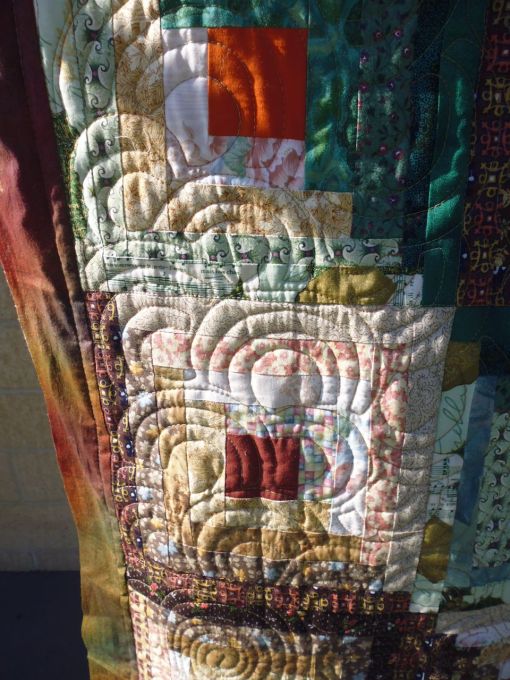
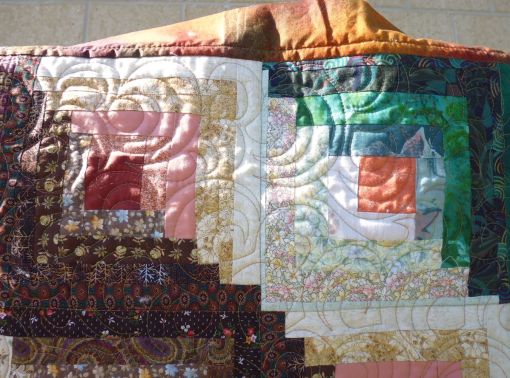
This big log cabin quilt was created with some lovely autumnal scrappy fabrics.

How to quilt it? I stitched in the ditch around the large blocks first, to stabilise it. Then countered the geometric nature of the log cabins with large spirals in a variegated thread, morphing into squared-off headbands, and then into open headbands. So there are three quilting motifs in this quilt. In the border I echo stitched a straight line (using the Line Tamer ruler) about half an inch from the seam line.

(Click on a photo to view it larger)

quilt240_05
quilt240_03

quilt240_02

quilt240_01

Back:

quilt240_04

Threads used:

  • Top: Fil-Tec Harmony ‘Tweed’ (40 wt, cotton, colour 14076)
  • Bottom: Fil-Tec Magna Glide Classic pre-wound bobbin (light tan)


Pond mother bleeping peacefully

15 11 2015

I’ve been researching family history, following leads in the National Library of Australia’s ‘Trove’ digital newspaper collection. One of the great things about this collection is that in addition to the scanned images of the newspapers, they’ve also been converted to text using OCR (optical character recognition).

Anyone who’s scanned text using OCR will know that the resulting text is hit and miss — the accuracy depends on the state of the original document/image, the OCR software, and the settings you use when converting. And so it is with these images — some are good, some are great, some are just woeful. Anyone can correct the resulting text, and with many people doing just that, over time the text becomes more readable — and most importantly, correctly represented in the indexes used for searching.

As I’m doing family history research, I’m looking for dates of birth, marriage, and death, so some of the entries I read are heartbreaking. Others are just plain funny because the OCR has incorrectly translated certain letter forms to other letters — e.g. F to P, i to l, H to II, S to B, 8 to S etc.

Although this one was not part of my family, I corrected it anyway. This is before…

pond_mother