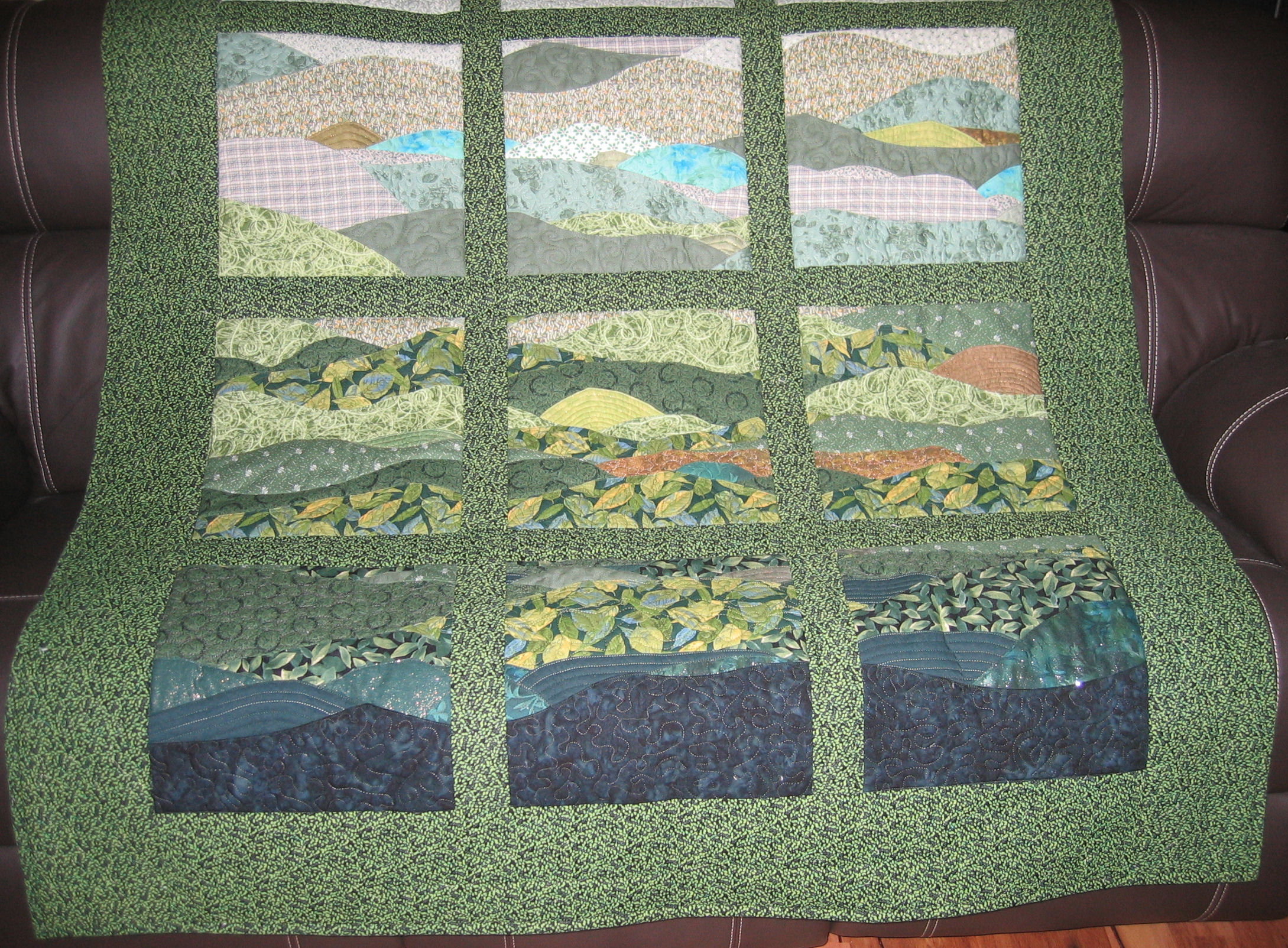
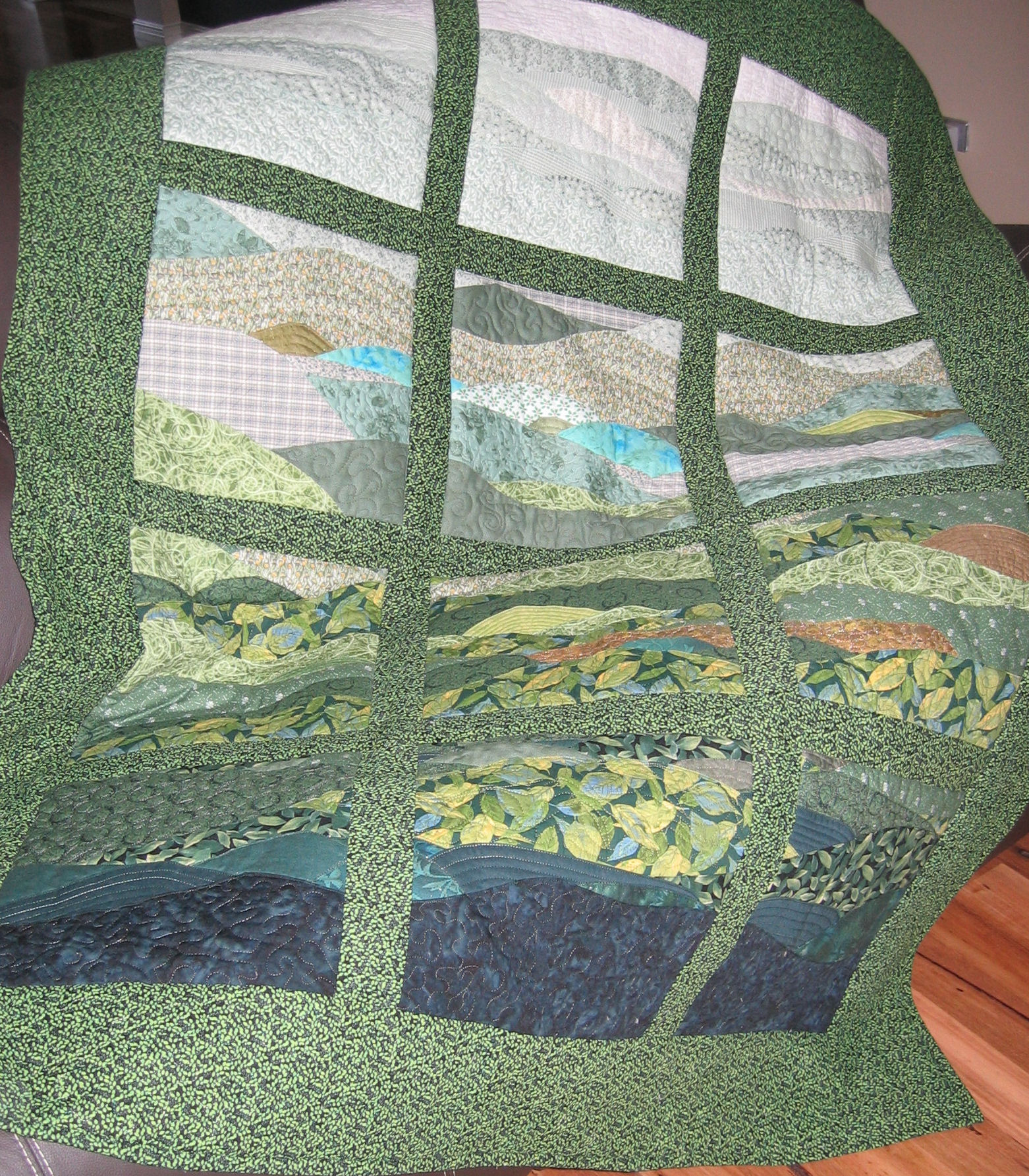
Quilt: How green was my valley

18 07 2010

Inspirations for this quilt:

  • Husband saw me put my feet into my quillow’s* pocket and asked whatever happened to other quillow we used to have. The nights have been cold and he wanted somewhere to warm his tootsies while watching TV. I knew which one he meant, but it went missing years ago. So I asked if he’d like me to make him another one — he said no, but I thought of my Dad, who’s having his 80th birthday in a few months’ time.
  • I have a lot of green in my stash and scrap bins and didn’t know what to do with it all. Some of the fabrics I have never liked, but they came with other fabrics so I ended up with them.
  • I had some baby blanket-like flannel in soft cream and soft green, and another minkie-like fabric in yellows and greens. I figured those fabrics would be nice and warm for the backing and the quillow pocket!

Summary of process:

This quilt was not made with any sort of pattern. It was me constructing things as I went — in my head, with a few scratchings on paper. I didn’t even attempt to make it a proper quillow — I just wanted a lap/body length quilt with a pocket for feet on the back!

  1. After choosing my likely fabrics, I chose several pieces that had a full width of fabric (approx 42″) in light, medium, medium-dark, and dark fabrics. These were the baselines for the wave cut fabrics.
  2. I freehand wave cut fabrics, turned over and pressed their cut edges a quarter inch, then pinned and sewed them to the baseline piece, building up each layer until I had a piece approximately 15″ high and 42″ wide in each of the colourways. I say approximately because this wave cut technique seems to grow the dimensions and I ended up with several pieces that were much longer than 42″ at the top! Each strip of 15″ x 42″ had a lighter fabrics in that colourway at the top and a darker fabrics at the bottom. Lots of pressing was involved.
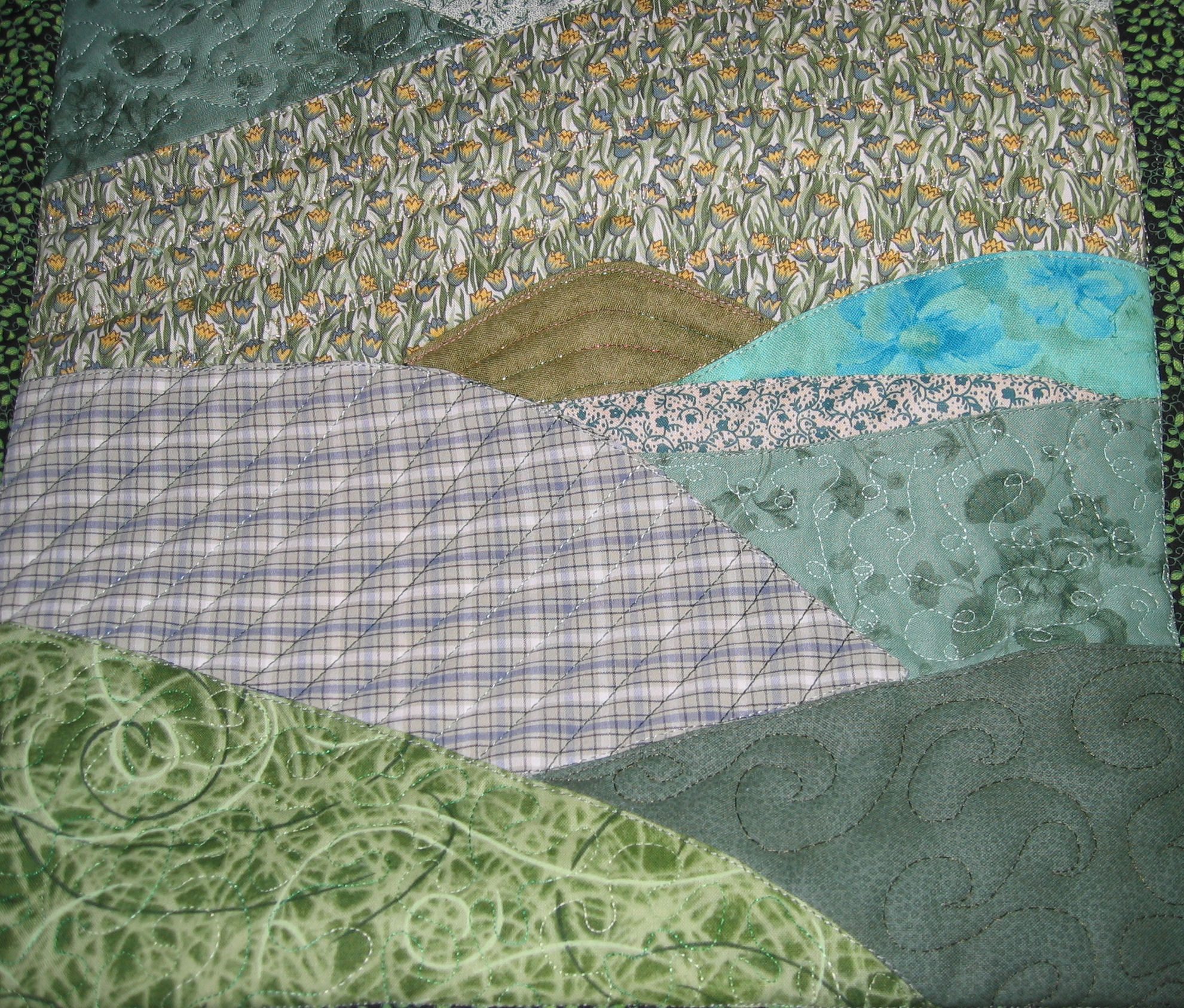
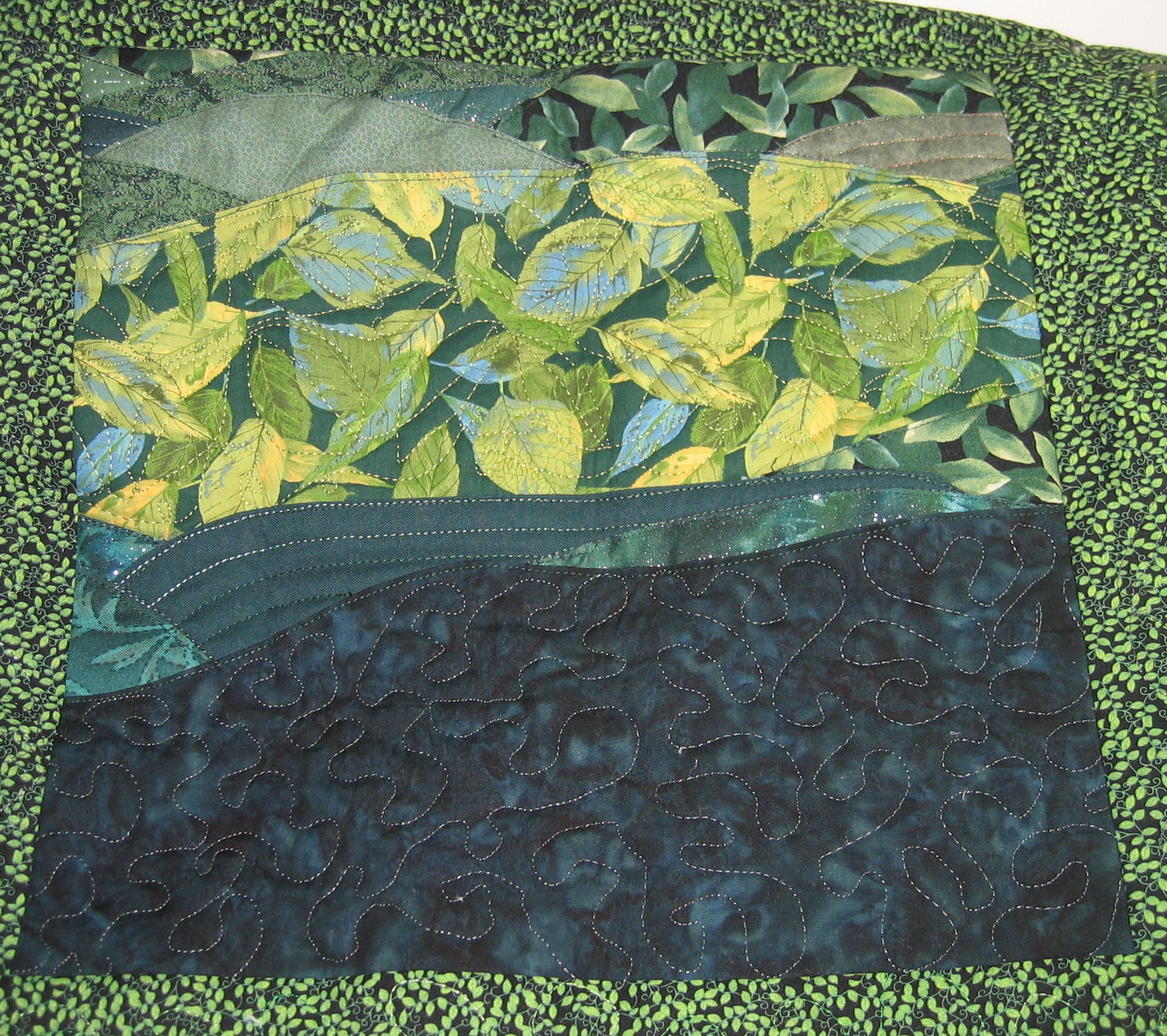
  3. I cut each strip into three blocks, approximately 14″ x 14″, then fused each block onto 14″ x 14″ Pellon (I numbered the backs so that I knew which went where). I then used free motion quilting to quilt each block. I quilted within most of the ‘hills’, leaving some unquilted so they had some puffiness, giving them a 3D quality. I now had 12 large quilted blocks, which I cut down and squared off to 13″ x 13″ each.
    (Click the image below to see a close-up of some of the quilting stitches)
  4. Next came the sashing. I used a matching green and black tiny leaf fabric for the sashing, the border, and the binding. Each sashing strip was 3″ wide, and the border strips were 6″ wide. I added sashing strips to the right sides of blocks 1 and 2 (of three across), then sewed each strip of blocks back together. I pressed the sashing strips, then fused thin strips (about 1.5″) of Pellon on the back of the sashing strips, then added stitching to quilt them down. Finally, I added long sashing strips to the bottom edges of strips 1, 2 and 3 (of four), and sewed the strips together, adding Pellon and quilting these sashing strips too. Yes, this is all very unconventional!
  5. After making sure everything was still square (amazingly, it was!), I fused 5″ strips of Pellon to the middle of the border strips (making sure I left half an inch of fabric either side of the Pellon). I did this quilting separately as I knew I’d have difficulty with the weight of the top to quilt the borders once I added them. I then sewed the borders to the quilt top.
  6. Next came the backing. I didn’t have enough flannel in a single colour to make a solid backing, so I cut 19″ x 19″ squares of each colour, then sewed them together to make a chequerboard effect. I didn’t sew the final row until I had created a pocket with the printed flannel and attached it to the centre block of the last row. (The pocket was simple — I just cut two 19″ squares from this patterned fabric, put them right sides together and stitched across one seam. I then turned it out and laid it over (and slightly down) on the middle block of the last row.
  7. Finally, I laid out the back, sandwiched it with batting, then laid the top over it all. I pin basted the entire quilt, then machine basted the outer edges. This quilt was really heavy by this stage and as all the feature quilting was done, I only needed to make sure all the layers were stitched together. As a result, I only ditch stitched the inner edges of each quilted block. Even with that, it was still a very heavy and bulky quilt to get through the throat of my machine. Once it was all done, I machine stitched the folded binding to the front of the quilt, then hand stitched it to the back.

Result:

I reckon this quilt took 20+ hours to make. It was fiddly, but enjoyable too. And I didn’t buy a single piece of fabric or spool of thread extra — I used everything for this quilt from my existing stash!

Update (October 2010):

Dad loved his quilt! And my almost-30 nephew loved it too and insisted on calling it a ‘blankie’ and then said he’d like his own ‘blankie’ too — in grey!
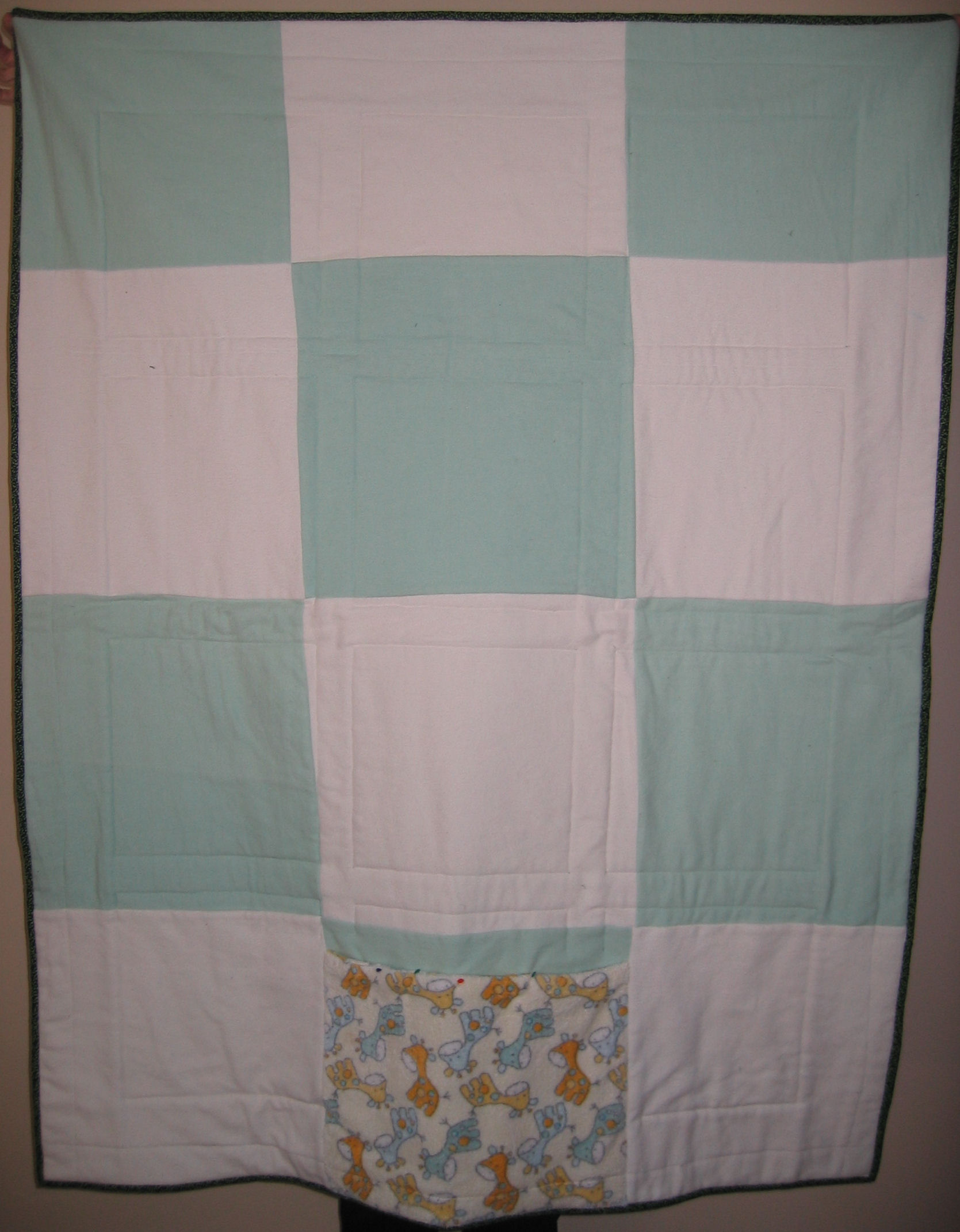
Click thumbnail images below to view large image:

* Quillow — cross between a quilt and a pillow. It’s a quilt that can be folded into a ‘pocket’ and, once inside the pocket, the pocket becomes a cushion.



Scary statistics

14 07 2010

A good friend of mine and her business partner have taken on another business — one that you wouldn’t normally think of, and one that some people might feel uncomfortable about discussing in their 30-second ‘elevator pitch’.

Their new business is Moon Pads (http://www.moonpads.com.au), and they make and sell washable menstrual products (or ‘feminine hygiene’ products as the advertisers would like us to say, demurely). Their products don’t use chemicals for absorption, are reusable, last for years, and don’t go to landfill.

Well, I was chatting to Suzanne via instant messaging today (she’s based in Tasmania), and we were talking about her new business and how it was going. She also sent me a prototype of their new brochure for my opinion. And I got to thinking about this chemicals-going-to-landfill thing with respect to the commercial, disposable menstrual products that Western women (at least) have been using for the past 60+ years. And I started to think about some statistics. And it was scary.

There are some 6.5 billion people in the world, but for ease of calculation, let’s make that 6 billion. Half of them are women (3 billion), and of those a good proportion are between 12 and 55 (again, I’m using these ages as approximations for the onset of puberty through to menopause). As I don’t know what women in places like many African nations, India and China do about menstrual products, I’m going to assume that they don’t use the commercial, disposable, chemical things those in the so-called developed countries do. That removes some 1.5 billion women from my estimates (1 billion alone from China and India, and I’m guessing another half billion from Africa). Let’s remove another half billion of those left to account for those who are under 12 or over 55.

What we’re left with is approximately 1 billion women of reproductive age in the so-called developed world. Now it gets interesting…

Let’s assume that EACH woman in that 1 billion cohort:

  • has 12 periods per year
  • has her period for 5 days per month
  • uses an average of 4 tampons or pads per day of their period
  • has periods for approximately 40 years of their lives

So, each woman will use some 9600 disposable tampons or pads (12 x 5 x 4 x 40) over their menstrual life.

Over 40 years, and assuming 1 billion fertile women from the so-called developed nations, that’s 9600 BILLION disposable tampons and pads that are sent to landfill or incineration for the chemicals to leach out into the earth’s groundwater or pollute the earth’s atmosphere. That’s some 240 BILLION per year!! And I think my numbers are conservative. If you add another billion to represent the fertile women of Africa and India and China, double those figures.

This is BIG business — and it has terrible environmental consequences.

From Wikipedia (http://en.wikipedia.org/wiki/Menstrual_pad):

The materials used to manufacture most pads are derived from the petroleum industry and forestry. The absorbent core, made from chlorine bleached wood pulp … with the addition of polyacrylate gels …. The remaining materials are mostly derived from the petroleum industry, the cover stock used is polypropylene …, with the leakproof barrier made from polyethylene film. The extraction, production and manufacture of these plastics contributes nitrogen oxide, sulfur dioxide and carbon dioxide – ozone depleting gases; human toxins that lead to cancer and birth defects as well as chemicals that cause the acidification of trees. The high plastic content of these products ensures they remain in our environment for centuries as they are neither biodegradable nor recyclable. Disposal of used sanitary products by either flushing out into the oceans of the world, incinerating or depositing in landfill creates various pollutants including dioxins deposited in the sea through sewerage waste and air pollution from incinerators.

No wonder Suzanne and her business partner have taken on the production of reusable, washable menstrual products. Even if only a small percentage of fertile women switched to cloth, the environmental savings would be enormous. (And yes, I know that various chemicals were used in manufacturing the cloth used in reusable napkins. But this would be nowhere near the amount of petrochemicals used to produce the commercial, disposable products.)

And then there are the savings to your wallet. A package of around 12 pads costs between $5 and $6 here in Australia. Assuming you used two packs per period, that’s some $10-$12 per month or $120 to $144 per year. Cloth pads from my friends’ store (http://www.moonpads.com.au) average about $15 each, so to cover two days’ worth, you’d need about eight ($120). But this outlay covers you for many years of use, not just one year.

Maybe it’s time women stopped being conned by the ‘health’ industry into thinking that they have to use these highly-manufactured and environmentally toxic products and that there aren’t alternatives.

I’ll try not to think of the other disposable things manufactured with lots of chemicals that we can’t live without these days, like tissues (when I was a kid, we all had cotton hankies — when did tissues become the ONLY thing to use?). I’m as guilty as anyone of using tissues, paper towels, and similar. Perhaps handkerchiefs and cotton hand towels need to make a comeback?


Etsy Treasury #23

7 07 2010

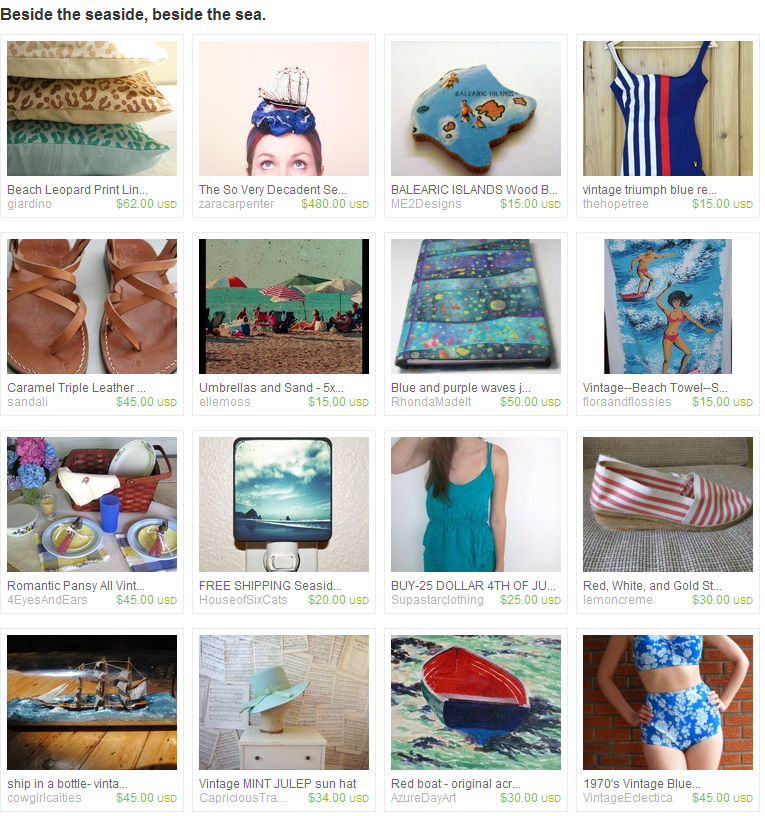
One of my blue and purple waves journal covers was featured in an Etsy Treasury (my 23rd) of seaside-themed items today. The surprising thing is that the fabric has nothing to do with the sea at all — it’s a sort of spotted batik that looks a bit astronomical to me. I free-hand cut the fabric in curvy lines then sewed it back together, giving it a wavy effect.


Love this quote

20 06 2010

Deirdre Scherer, in Quilting Arts Magazine (April/May 2010, p65), said:

“From birth until death, we are wrapped in cloth — it directly stirs our sense of touch — which makes fabric an intimate and deeply associative language.”

She continued:

“My primary medium is thread on fabric. Scissors and sewing machine are my drawing tools.”

I like that!


Etsy Treasury #22

20 06 2010

My orange fish has been featured again in an Etsy Treasury. Everyone who’s seen it loves it — but no-one’s parted with any money for it yet! 😉 It’s totally unique — if I make another fish, it won’t be like this one as I used up the last scraps of some fabrics on it.

Thanks for featuring my fish, RogueMagnolia!


Photos from the retreat

15 06 2010

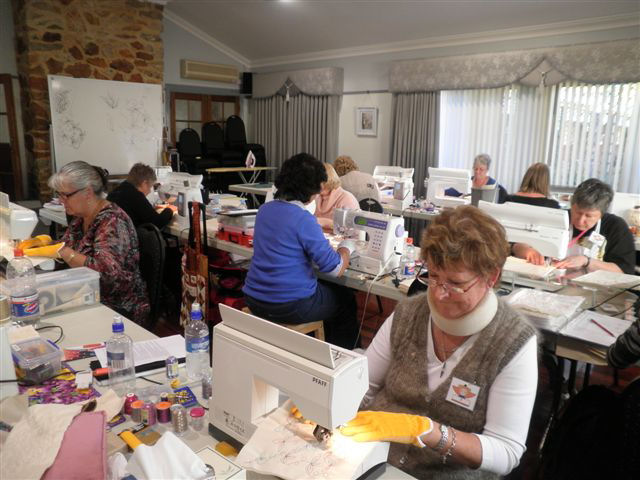
Michelle, our awesome teacher, took some photos of ‘the girls’ at the free motion quilting retreat I went on over the weekend. Here’s a couple to show our group and the amazing light we worked in — it was as bright at night too (yes, most of us also spent Saturday night at our machines…).


Fishy experiment

10 06 2010

I needed to make a dent in my fabric scraps. Not my fabric stash — my tubs of scraps. Offcuts, little leftover bits that were too ‘good’ to throw out, but not big enough to create something new from them. I use bigger offcuts to make bookmarks or luggage tags, or as backings for bookmarks. These other scraps might only be an inch or two square, or are the awkward bits like triangles or odd shapes. Gorgeous fabric — too good to throw out, but not big enough to make something from.

Then I saw a fish in a quilting magazine, made by Susan Carlson! It was made from lots of pieces of fabric, and I had the thought that here was a project for my scraps! (Of course, I have enough fabric scraps to make a whole school of fish, but hey, you have to start somewhere…)

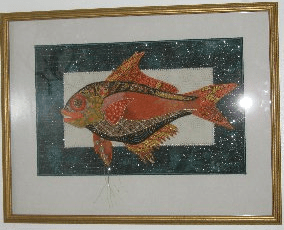
So I made my first fish, and after some 10 hours of creation here it is:

I had a lot of fun deciding on the fabric scraps to use, then laying out the fish and embellishing him with free motion stitching. And no, I have no idea if my fish is a ‘he’ or ‘she’, so I’ll go with ‘him’. BTW, if you like him, you can buy him! http://www.etsy.com/listing/48905308/fish-of-the-day-orange He would look good in a picture frame on a wall!

I think my next fish will be made of lots of individual scales. More work, but it should use up a few more of those little bitty scraps I have…

Update: Two days after listing my fish, it appeared in an Etsy Treasury of lots of fish (my 21st appearance) — that was fast!

(http://www.etsy.com/treasury/4c1126e878348eef6e48b942/give-a-man-a-fish#4c115fb30a5a6d91fc39652e)

Update: My fish went to Alaska! A colleague in Portland, Oregon purchased it as a gift for his parents who live in Alaska. So off it went, swimming all the way from Western Australia to Alaska (where you’d think they have enough fish!). His parents framed it and here it is in their home:


Etsy Treasury #20

6 06 2010

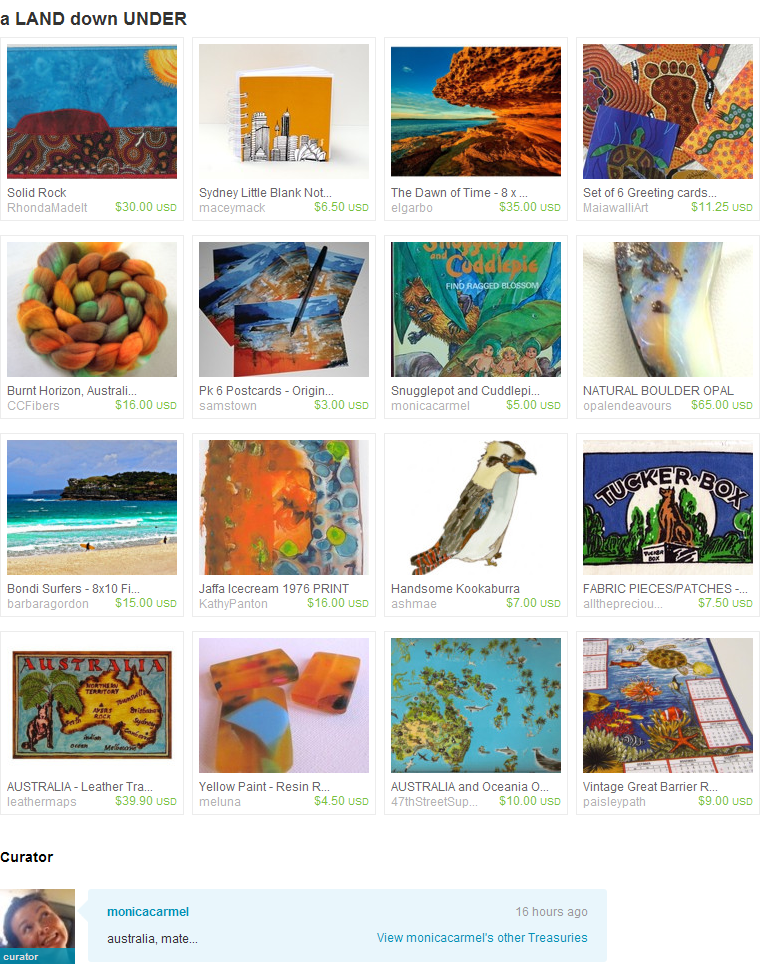
Solid Rock‘, one of my earliest fabric art pieces that’s still for sale (most have been sold now) was featured in an Etsy Treasury for ‘A land down under’ today — see the screen shot below. Thanks MonicaCarmel!


Etsy Treasury #19

16 05 2010

My Fall Flowers bookmarks were featured in an Etsy Treasury (my 19th) today. Thanks TrueJune, for including my bookmarks.


Peacock blue Etsy Treasury

9 05 2010

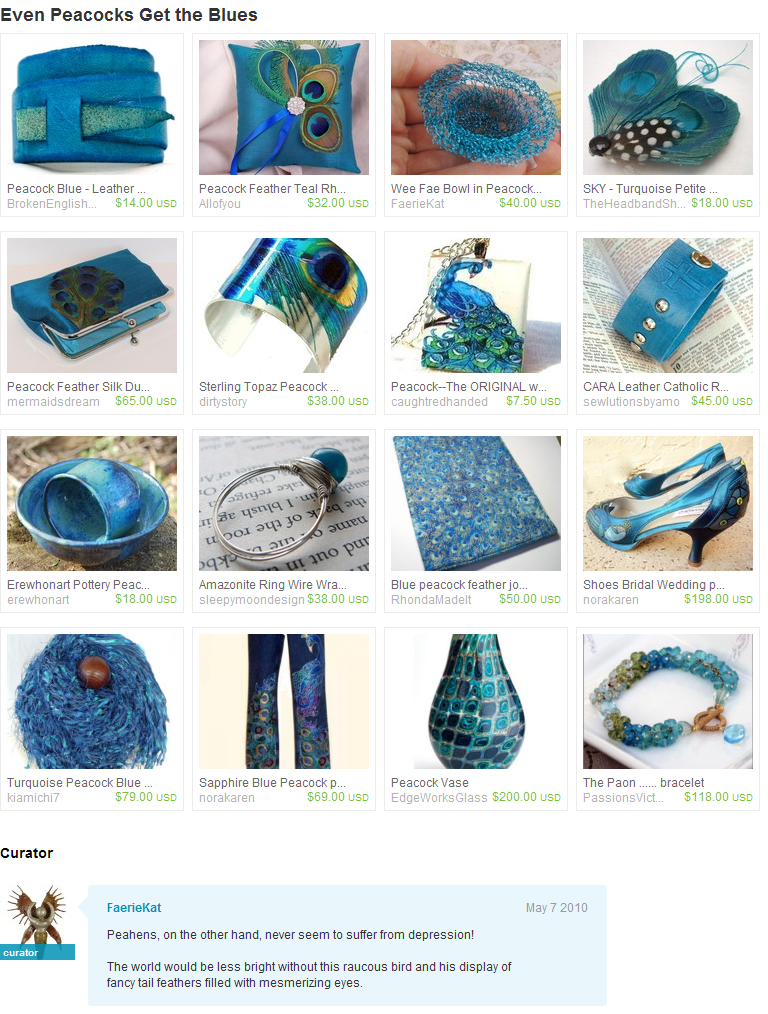
I woke this morning to a message from FaerieKat that she’d included my blue peacock feather journal cover in her GORGEOUS Etsy Treasury.

Here’s a screen shot; click the image to see it in full size:

Etsy Treasury #18 for me!