QV2024: Perth to London

13 10 2024

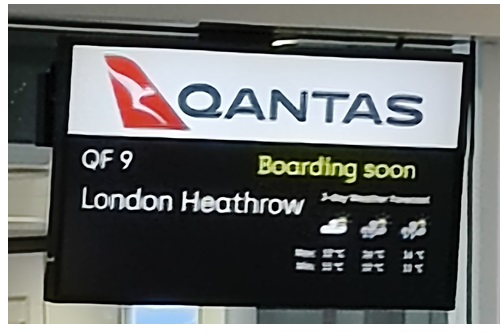
First up, Perth to London on Qantas is one of the longest direct flights in the world at around 17.5 hours. Add in 2 hours to drive to Perth, check-in 3 hours beforehand, and before you know it, you’re up to nearly a full day.

Our flight path was a little off the usual course last night. According to the flight map, we did a few little zig zags and I figured there were some strategic decisions made as to where we went. And so it was.

At one point about 2 hours before landing, I was waiting to go to the forward loo. The captain (1 of 4 pilots on board) was making a strong coffee and I commented about the route. He said that they had made some late changes because Iran had fired missiles into Israel. Of course we knew none of this as we were 15 or more hours into the fight and had no connection with the outside world.

If you check the map below, you’ll notice a slight change of course at the Arabian Peninsula, then we crossed into Egypt near the Suez Canal, then we skirted the bottom of Greece and followed the Adriatic Sea until we got to northern Italy and crossed into Europe. (At one point, this flight used to go over the Middle East and Ukraine, but the Ukraine path stopped several years ago.)


QV2024: We’re back!

13 10 2024

The last QuiltVenture (QV) tour I went on was in 2018, to the Pacific NW, British Columbia, Alberta and finishing in Houston at the International Quilt Festival. A tour went to Japan in January 2020 for the Japanese Festival of Quilts, but I’d already decided not to go on that one as I was due to have a 6-week trip in April/May. Many on the Japan tour got quite sick and I suspect it was with COVID. Then COVID came and the world of travel changed for a very long time.

But now we’re back, this time with a new 3-week trip to the UK, specifically London (5 days) and Scotland (the remainder). The focus is on textiles, but this time we won’t be finishing on a big exhibition like Houston. And I’m OK with that.

The next few posts will be my thoughts about each day of our tour (I’m starting writing this a week or so in, and basing these posts on my Facebook posts at the time). I’ll only share a few photos — I’ve already taken hundreds, but I’ll pick out some of the highlights.


Air fryer: Scotch eggs

4 06 2024

It’s many years since I made Scotch Eggs, but I did so on the weekend because I found a simple air fryer recipe for them!

Ingredients:

  • 3 eggs (soft boiled or hard, depending on how you like them; cooled before using)
  • 500g pork mince
  • seasoning (I used salt, pepper, cumin, oregano, and chilli flakes)
  • panko breadcrumbs.

Mix meat and seasonings together, divide into 3 patties, wrap patty meat around each egg to enclose it, roll in panko breadcrumbs.

Air fry for 12 minutes on 200 C, turning once (use a heatproof spoon) about halfway through.

Delicious, and NO extra fat or frying oil. These will do me for 6 lunches!


My Mum

16 05 2024

Our beautiful and most loving Mum passed away peacefully a week ago today, surrounded by the love of her family. She was 92 and in excellent health all her life, until an aggressive glioblastoma came to live in her head (occipital lobe) just a few weeks ago. She had no pain. She passed just 11 days shy of the first anniversary of Dad’s death.

I am so blessed to have spent time with her on the cruise in February and early March, just a week or so before her diagnosis. On the ship she was always the first to take the stairs instead of the elevators, and except for a few visual issues, none of us had any clue that anything was seriously wrong.

You did good and your work is now complete. Go dance with Dad for eternity, Mum. We’ll love and miss you forever.

This photo was taken just 3 weeks after her diagnosis and 5 weeks before she passed.


Second (and last?) cruise

6 03 2024

I’ve just returned from a 15-night cruise with my Mum (92). We went around New Zealand and parts of the east coast of Australia. It was my second-ever cruise and may well be my last! Why? Because despite everything else being fine, the high winds, seas and swells we encountered were NO fun. We were on a small ship (max 684 passengers), but I doubt that would’ve made a lot of difference when you’re encountering waves/swell of 6.2 metres (that’s 20+ feet for those who aren’t metric) and 50+ knot winds. The 6+ metre waves were constant for 2 to 3 days as we were crossing the Tasman Sea, but we’d started encountering bad swells after the first 2 days, with them getting bigger and stronger day after day until the Tasman crossing. After 2 days docked in Hobart, we had the Bass Strait run to do—but that was an ‘easy’ 4 m swell!

Suffice to say, many drugs were consumed, sea sickness bands were worn, and not much sleep was forthcoming. Think of bad plane turbulence where you rise up and are partly weightless, followed by being pushed down in your seat. And then the bang and shudder of the hull hitting the waves or the waves hitting the hull—whatever… Then imagine 50+ hours of that with no let up. It was discombobulating to say the least. I didn’t actually get seasick or nauseous, though I chose to leave the dining room table one night before my meal arrived as I didn’t think I could face it.

But it wasn’t all bad. The places we visited and the people we met were lovely, the daytime weather was invariably good (except crossing the Tasman), the crew were incredibly friendly and polite, while being consummate professionals. The other passengers were nice, the food was good (and way too plentiful), and the ship’s environs were perfect for the demographic (passenger ages appeared to range from 50 to 90, with the 60–75 demographic likely being the majority; the crew were mostly under 40).

We started our adventure with an overnight 7-hour flight from Perth to Auckland, boarding around 2pm and departing Auckland at 6pm. The cruise line we were on (Azamara) tends to sail at night allowing the ships to spend most days in port where we can get a taste of local life. This is a great policy.

Day 2 was spent in Tauranga, with Day 3 in Napier (both on the North Island of NZ). Because we were in the same ports as the massive Celebrity Edge ship (~3000 passengers), I wasn’t able to find any shore excursions for us to do by ourselves so we either stayed on board or caught the free shuttle from the port into town and wandered about for a bit (shore excursions organised through the ship are incredibly expensive and are often in big groups). Napier had their annual Art Deco Festival on, so the place was packed with visitors, locals in 1920s and 1930s clothing, vintage cars, etc.

We then separated from the Celebrity Edge and went on to Wellington (Day 4), while they went somewhere else. We did a half day guided tour of Wellington, before leaving at 9pm for Picton on the South Island. Cook Strait was our first introduction to swells above 2 m, and certainly not the last. After Picton (Day 5) was Christchurch (Day 6), where we did an excellent half-day guided tour of Lyttelton and Christchurch.

From there the swells just got worse. Dunedin (Day 7) was the next port of call and we did a 3.5-hour tour of the bays, beaches and some bird sanctuaries, also seeing some sea lions on the beach.

Day 8 was at sea, sailing from Dunedin around the bottom of the South Island to Milford Sound, where we spent a few hours, though we didn’t dock. By late Day 8 we were in the Tasman Sea and the swells, waves and wind just got worse. Days 9 and 10 were at sea, trying to come to terms with the never-ending movement.

7:30am on Day 11 couldn’t come soon enough—we docked at Hobart where we stayed for 2 beautiful days of calm waters and stunning weather, and a few hours with a friend of mine from years ago in Perth. We left Hobart at 8pm on Day 12, knowing that the winds etc. were going to pick up throughout the night and through Day 13, when we were at sea crossing Bass Strait and heading north to Eden, NSW. Eden (Day 14) was a delightful little town and we did a 2-hour guided nature tour there, leaving port at 2pm. (The photo below shows the damage to the paintwork on the bow done by the pounding we had crossing the Tasman Sea—they repainted it in Sydney.) The rest of Day 14 was at sea, and we pulled into Sydney Harbour at 7:30am on Day 15. Disembarkation was early on Day 16 in Sydney.


No-knead bread in the air fryer

1 01 2024

I wanted to see if I could make no-knead bread in my dual basket Ninja air fryer. Various YouTube videos and websites said you can certainly bake bread in an air fryer, so it was time to see for myself. I used the same recipe I’ve used with much success before (see: https://rhondabracey.com/2020/07/15/trying-again-with-no-knead-bread/), adding cheese, jalapeños and chilli flakes to the mix. The dough was quite wet, which was a bit of a concern (was the flour or the yeast too old?). But I continued on anyway, doing all the steps I would normally do to make and prove the dough except for turning on the oven and heating a cast-iron dutch oven.

When the dough was near the end of the first proving stage, I took 2 small foil BBQ trays and made sure they fit the air fryer baskets (I had to turn up the edges and squeeze them a bit, but they fitted OK), then added some parchment paper to each, enough to cover the sides and beyond. When the dough was ready for the final forming into a ball, I added the small cubes of cheese and chopped jalapeños, rolled it a bit on a floured board, then split the mix into two, adding one to each of the foil BBQ trays in the baskets. Then let it sit for the final proving. Once that time was up, I cut away the excess parchment paper and then ‘tented’ the baskets with foil to keep the steam in when cooking (make sure you tuck the foil down the sides of the foil trays otherwise it will fly up into the heating element inside the air fryer).

I knew from what I’d seen and read that I might have to lower the temperature a little and almost certainly would need to lower the cooking time. I didn’t preheat the air fryer—just put the foil-covered baskets into the machine, set it to Air Fryer mode, 210C, for 20 minutes. When it finished, I removed the foil tents. Then I tipped the partially baked bread out of the parchment paper and put it back into the foil trays to cook for a further 10 mins (Air Fryer, 210C). It was lovely and brown and crusty, but the bottoms needed more, so I flipped the bread over and gave it an extra 5 mins at the same settings.

All up, I cooked the bread for about 30-35 minutes, which was about 10 mins less than in the conventional oven, and at a slightly lower temperature. The bonus was no need for preheating time (typically 45 mins waiting for a standard electric oven to heat up to 230C).

The verdict? Two small loaves of bread with far more crusty bits than usual! Very delicious!!! Good crumb, texture, and density, but they didn’t rise as much as I expected (as I said earlier, the mix was very wet and so I suspect the yeast or the flour may not have been at their prime, or it just needed more flour—or it could have been the air fryer style of cooking). In the photos below, I’ve included some tongs to you can get some idea of the size of the loaves. And yes that yellow oozy stuff is cheese!

Would I try it again? Yes!


Protected: Mercedes 2008 C200 Kompressor Elegance Sedan

10 12 2023

This content is password-protected. To view it, please enter the password below.


Purging paperwork

1 12 2023

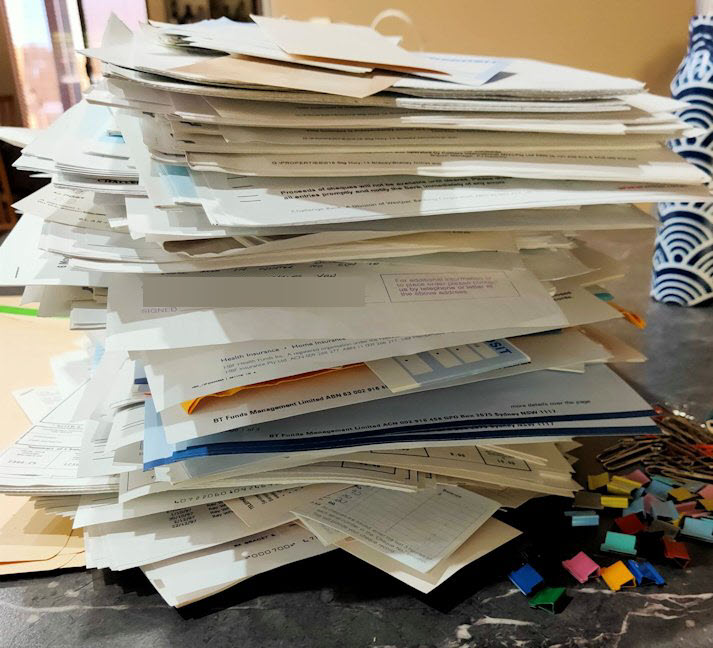
I had a shelf-load of paperwork I needed to sort out. That was the start of a major undertaking!

When I put the tub of that paperwork out in the shed, I saw tubs of documents from years ago and decided to tackle one of them. Just one at a time otherwise it’s too overwhelming! The first tub was personal tax information from 1994 to 2003! I have NO idea why we’ve kept it all these years (by law we only need to keep tax info for 7 years). At the end (about an hour, so not as daunting as I first thought), I’d reduced the first tubful of paper to just a handful of sheets to keep and a mountain of paper to shred.

I found a couple of interesting things in amongst it all—my first-ever invoice from iinet in 1998 for my internet connection (I’m still with them some 25 years later!), an invoice for my first-ever digital camera (a Sony Mavica for the princely sum of nearly $1200 in 1997! Yes, it took 3.5″ floppy discs and was a clunky monster), an old group certificate which showed my gross income in 1995 was some $45K, and a 1997 bill from the Qantas Club offering various membership levels. I think I opted for life membership after this period expired, an option that hasn’t been offered by Qantas for many years now.

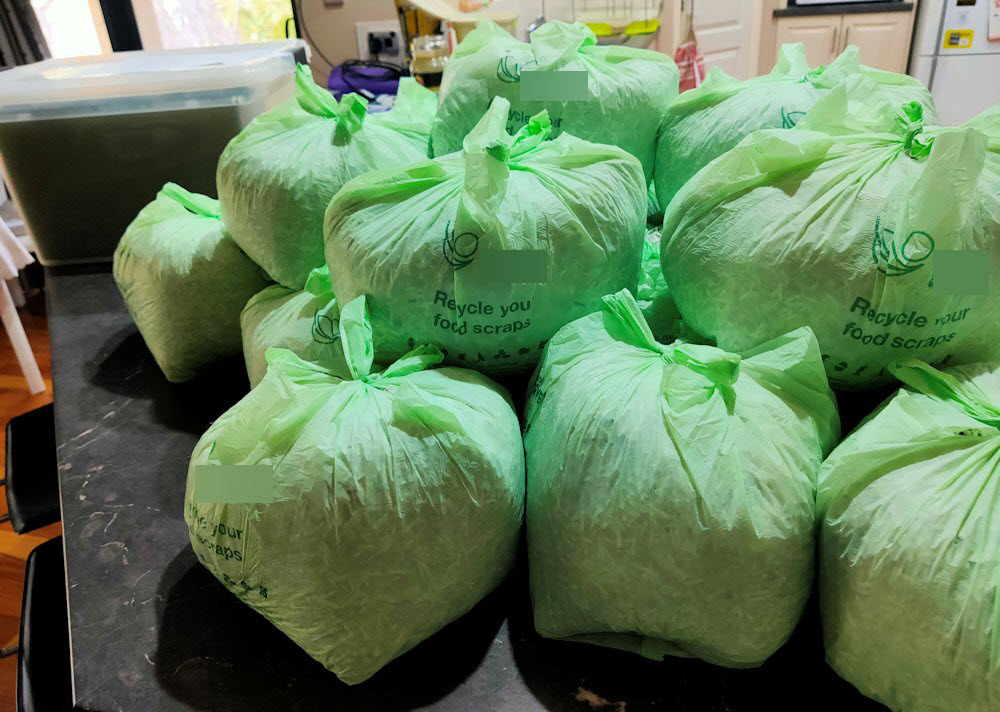
I’ve since tackled quite a few more tubs though I haven’t yet started on the business paperwork (I’ve had my business since 1999). And I’ve created mountains of bags of shredded paper! Those 10 L kitchen caddy compostable bags (the pale green ones in the photo above) were running out quickly. But Bunnings had 54 L ones! So I bought 2 rolls (40 bags), and have already filled nearly 10 of them! Three are already in the 240 L FOGO* bin, 1 is partly full next to the shredder, and these 6 are awaiting their turn to go into the region’s compost heap!

My husband, sister, niece and nephews should be grateful I’ve done this now!!!

  • FOGO = Food Organics, Garden Organics, and yes shredded paper is allowed in this bin


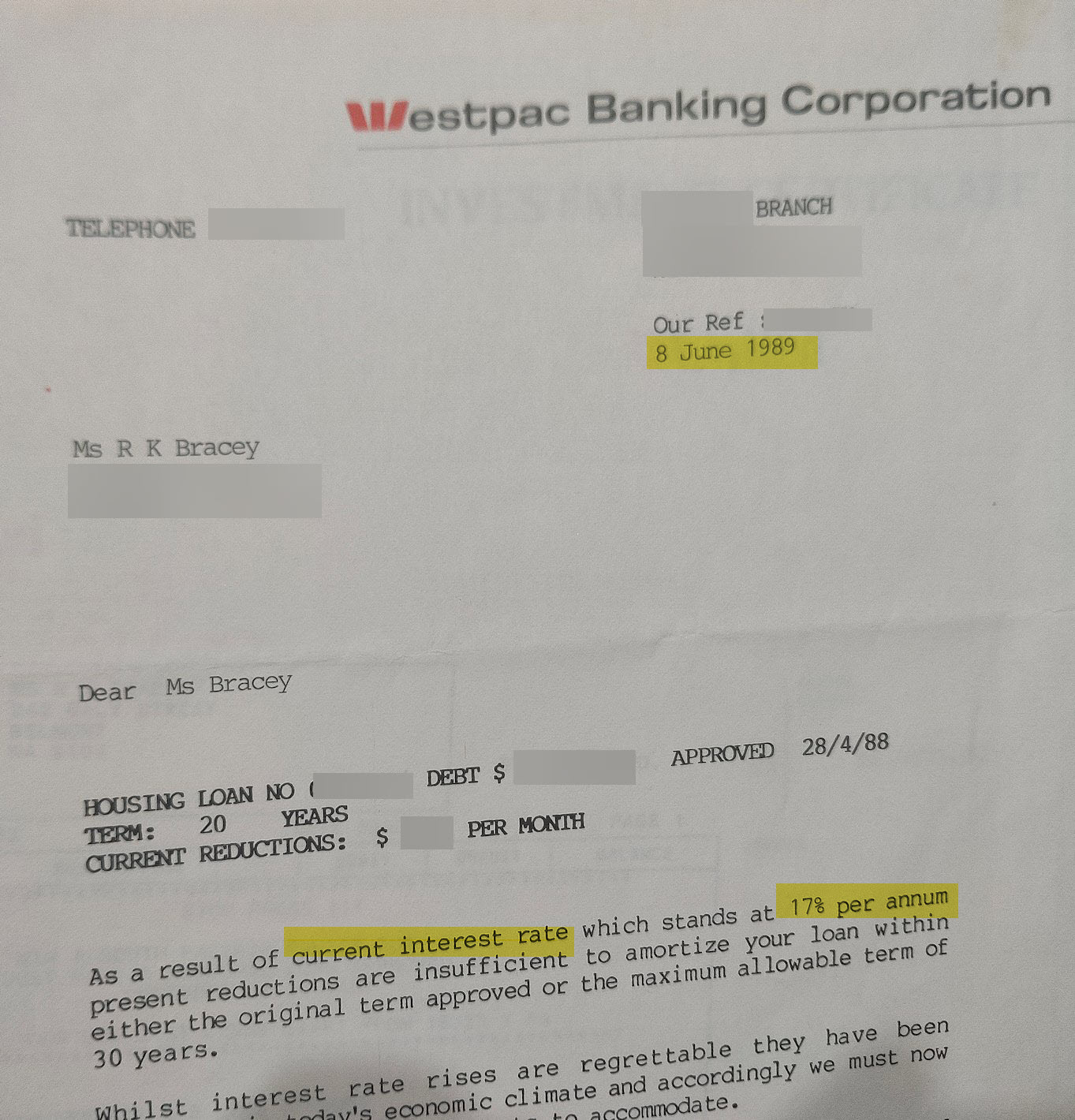
When mortgage interest rates were 17%

1 12 2023

I’ve been purging old paperwork from the storage boxes in the shed. And I found this gem today. The struggle was real folks, with the bank saying you will no longer be able to pay your mortgage in the original time frame and offering suggestions for what you could do.

In my case, I got someone in to share my house (and made a lifelong friend as a result!), which certainly took some pressure off. And yes, that mortgage interest rate was 17%!!!! I’d taken out the loan 12 months earlier when it was 13.25% and had budgeted for 15%, but by the time it got to 17%, everything was hurting because my teaching salary was fixed and going nowhere.


Adventures in plumbing

26 10 2023

Back in Feb/Mar 2023, we had our en suite bathroom renovated. The first step in that process was stripping out all the old bathroom fittings, tiles etc. (https://rhondabracey.com/2023/02/13/bathroom-renos-day-1/), and as part of that process, the now-open pipework was capped or covered to prevent things falling down it or smells coming up from it.

Fast forward to September and I started to notice some occasional issues with the en suite toilet and hand basin—the water in the toilet would rise almost to the rim on flushing, then disappear fairly quickly, coming to rest at a lower level than usual in the pan. And while this happened, the hand basin would gurgle and occasionally spit up water from the trap (it smelt of toothpaste!). It was disconcerting to say the least but it only happened a couple of times. But over the next few weeks, it became more regular. So it was time to call the plumbers.

I’d pretty much diagnosed that the issue was somewhere in the line from the en suite to the main line to the septic tank (we’re not on sewerage here). No other areas of the house had flushing or water dispersal issues, and nor did the shower in the en suite—no gurgling from there. When I looked at the house plans (which only had rudimentary and indicative markings for the plumbing), it appeared that the en suite shower was on a different line, which fit with my layperson’s assessment of where the problem was,because there seemed to be no issue with the shower.

The plumbers tried many things to free the blockage on their first visit—plunging the toilet and putting an acid down the pipes to be left for 24 hours. They told me that if that didn’t fix it, they may have to cut out part of the concrete path outside or remove the (new) toilet pan. These sounded like drastic measures! Putting a drain snake down from the toilet wasn’t really an option as it’s motorised and thus very powerful and could smash the toilet or damage the floor tiles. This did not sound like a good option. After 24 hours, I flushed the toilet 3 times and had the hand basin running at the same time—all appeared to be well. Until I had to flush solid matter, and the problem resurfaced.

On the second visit, the plumber they sent (Bryce) was fantastic in trying to diagnose the issue—he tested one variable at a time and tested multiple times to emulate the problem. At one point he removed the trap from under the hand basin and suddenly everything seemed to work well. He thought it was a venting issue because as soon as he put that trap back on, the issue returned. He installed a new trap with a vent on it, but that made NO difference. The problem remained. He asked me about the renos and what was done—I showed him the pictures I took each day, which proved that the strip-out guys and the renovation company had capped all pipe openings and put a large sponge into the toilet water pipe. I doubted it was a problem that stemmed from the renos because the reno had happened more than 6 months ago, and surely any issue would’ve made itself known long before now. Bryce was as baffled as me.

He decided to look for the inspection opening (IO) outside the bathroom window. But there wasn’t one! We discovered that ALL 6 IOs that were on the house plan I had from the previous owners (who built the house) were ALL under the concrete path! Who does that???? I contacted the building company to see if they had better plumbing drawings, but they didn’t. They also confirmed they did none of the concreting/paving etc. around the house—it was all done by the original owner (and he was in the construction industry contractor so I’m pretty sure he did it all himself). I also contacted the Shire to see what they had—they found a 7 page document from the septic tank installers, which had a bit more detail than the house plans, but not a lot. I also spoke with the manager of the reno company—he was as baffled as me and the plumber, especially with the time since the reno—we all agreed it couldn’t possibly be as a result of that.

The weekend came and I continued to use the other bathroom as I’d been doing for nearly a week. First thing Monday morning, the reno manager called and asked if he come and take a look (he’s an ex-plumber) because it had been nagging at him all weekend. He also did various things to try to dislodge whatever was blocking the line (BTW a mop is a handy thing to use to plunge the toilet if the water is fresh), and we talked at length about the possibilities. He confirmed that everything had been capped, and I agreed—I’d watched every step of the process and had photos to confirm this. We both agreed that it was extremely unlikely to be a result of the renos, but as I don’t have kids, grandkids, or pets, there was no way anything else could have got into the pipework other than the usual toilet paper and solid and liquid waste. Also, the toilet is a ‘smart’ one, with bidet functions, so toilet paper usage is far less than for a standard toilet (https://rhondabracey.com/2023/04/02/using-a-smart-toilet-for-the-first-time/). Looking at the plans and using his knowledge, we identified where we thought the pipe exited the house and thus where the IO was likely to be. He said he COULD remove the toilet pan, but was reluctant to do so, except as a last resort, and I agreed.

Meantime, the plumbing company arranged for Bryce to come out again on Wednesday (I was away on Tuesday, and on Monday I was still waiting on plans from the Shire etc.). I showed him the newer plans I had and where the reno manager and I had calculated the pipe exited the house. So he cut a square of concrete out of that section of the path and started digging. And digging and digging. He went down >500 mm and under the sides almost a similar amount (he had to be careful as there was a heavy heat pump for the hot water system [HWS] sitting right next to the hole and he didn’t want to undermine the structural integrity of that piece of concrete). Nothing. No pipe, and you really can’t miss a 100 mm pipe! And because no pipe, no IO. Where was it??? There was no point going deeper as he was already level with or below the level of the opening into the septic tank, and the pipe would have to be higher than that to have the appropriate fall to the septic. He and I were baffled as to where the pipe could be.

Digging the first hole, but nothing found

I came inside and related this to my husband. He said it would be great if there was geophys (ground-penetrating radar) they could use to find pipes underground. And then it came to me—why not listen for the sound of water flushing through the pipe? I suggested this to Bryce and he was willing to try, because he was rapidly running our of options and I was despairing that we’d never find it and get the blockage cleared. He lowered half his body into the pit he’d dug and I flushed the toilet. He couldn’t hear the water (too much ambient traffic noise from the highway) but got me to do it again. This time he put his hand on the sand and felt the vibration of the gurgling! It was about 500 mm to the right of where he’d already dug and certainly NOT where the plans indicated it would be.

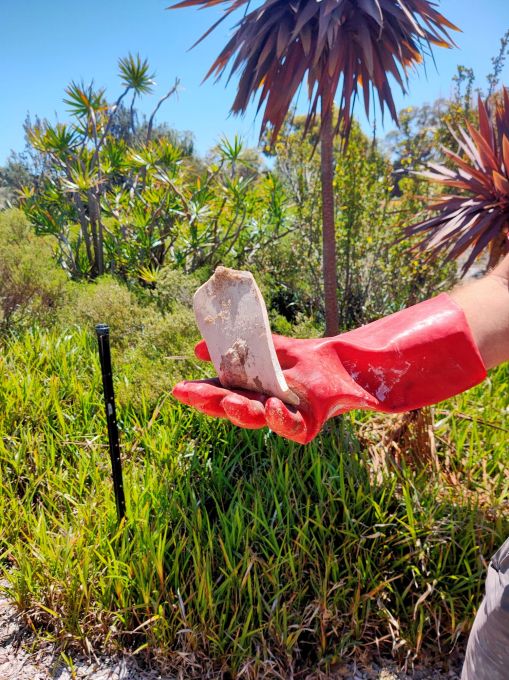
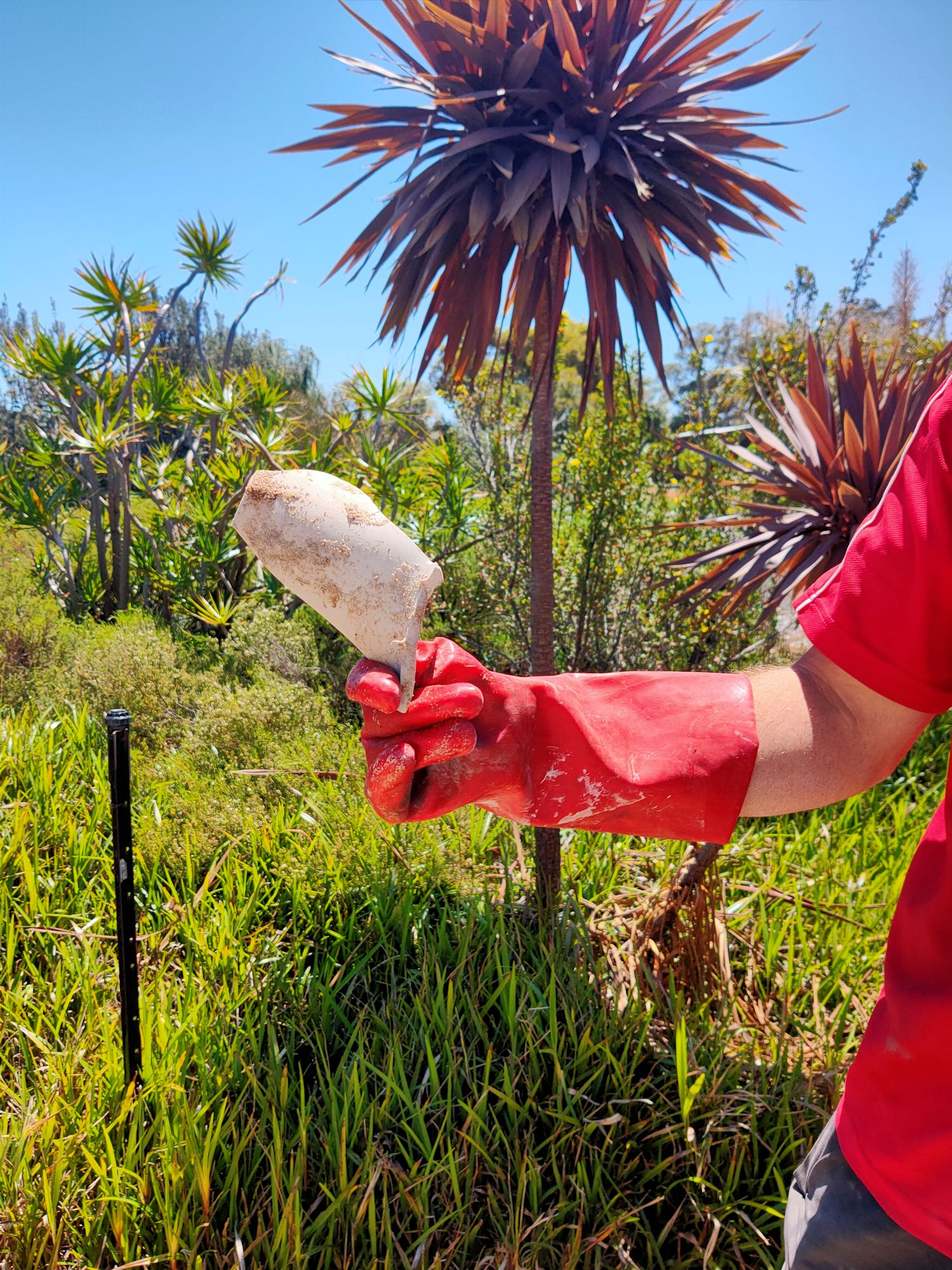
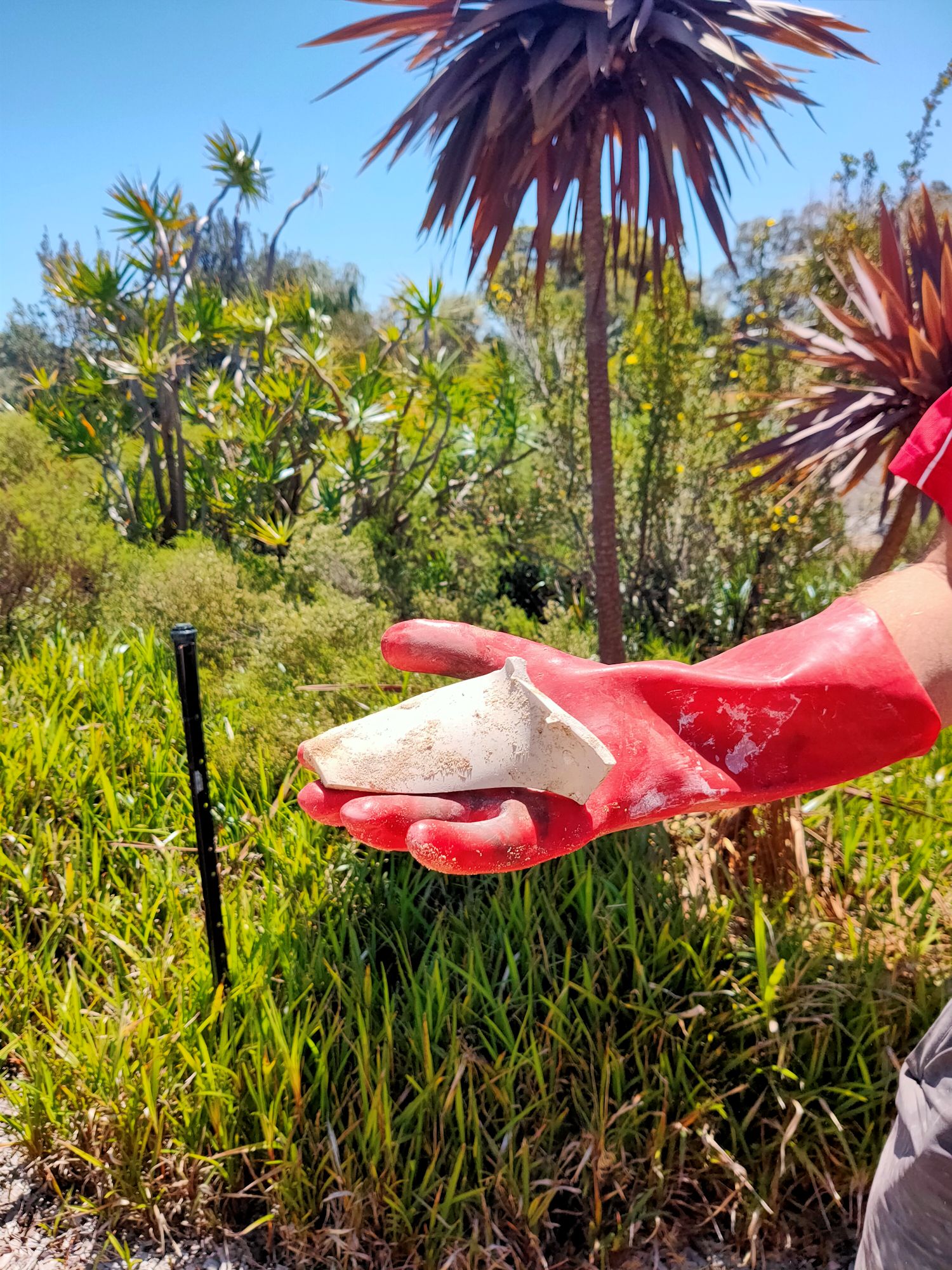
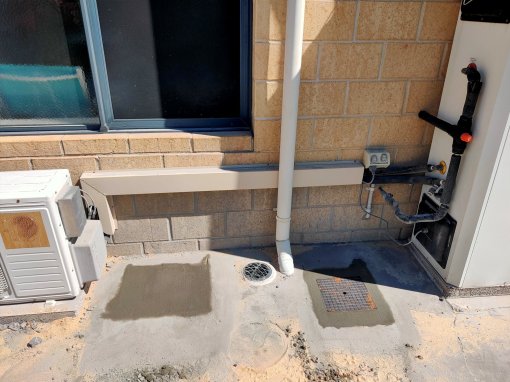
Bryce cut another hole in the concrete further along (past the dry floor waste opening and a rainwater downpipe) and found the pipe and the IO! The IO was partially covered by the downpipe’s pipework (who does that??), but that pipe (40 mm?) was flexible enough to be gently moved aside. As soon as he took the IO cap off, he came inside to get me to show what he’d found. There was matter clogging up to the top of the IO—yuck. So he donned a chemical glove and started to remove it. A couple of minutes later he called me outside again—he’d found the culprit! It was a piece of curved and broken off ceramic that looked like it had come from a toilet. And so it was (as confirmed by the reno manager when I sent him the photos). After clearing everything out, we test flushed the toilet many times, along with filling the hand basin to confirm that everything was now flowing as it should.
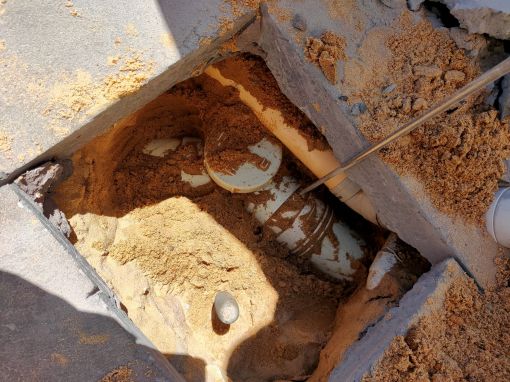
IO and angles of the pipework where the blockage was

Blocked pipe

We think what happened was that when the strip out was being done, the toilet pan had broken and a piece (not small—it was about 140 mm long) had fallen into the toilet waste pipe before it was capped. The strip-out guys wouldn’t have heard it fall (it was the noisiest time of the whole reno) or seen it in the pipe, and then they capped the pipe, which was later further blocked off with the sponge and then the new toilet was installed over the top of the pipe. It likely lay in situ for a while, gradually moving down the pipe until it hit the (small) angled bend and could go no further. It took 6+ months to do this. Meantime, because of its shape, most waste had gone past it without a problem. Until it didn’t. Once it got to the bend (where the IO was), it lodged there, and while some waste passed it by, not everything did, so there were times when it was fully blocked and so the water backed up the pipework, causing the gurgling and spitting in the basin and toilet. And then it would drain away, to a degree.

The sense of relief at finding the cause was palpable and Bryce revealed that he was at a complete loss as to what to do next if he hadn’t found the IO and that piece of ceramic. My sense of relief was equally as great as his!

I sent photos off to the reno manager—he’d asked me to keep him in the loop. And he and the strip-out people agreed to pay a third each of the bill (I paid the other third because had the previous owners done the right thing, all the IOs would have been accessible).

Bryce filled in the hole where nothing was found and concreted it over again, and put in a cast iron IO box above the IO and pipe, with a removable lid, and concreted around it so at least one of the IOs is now accessible if there are any future problems with that pipe.

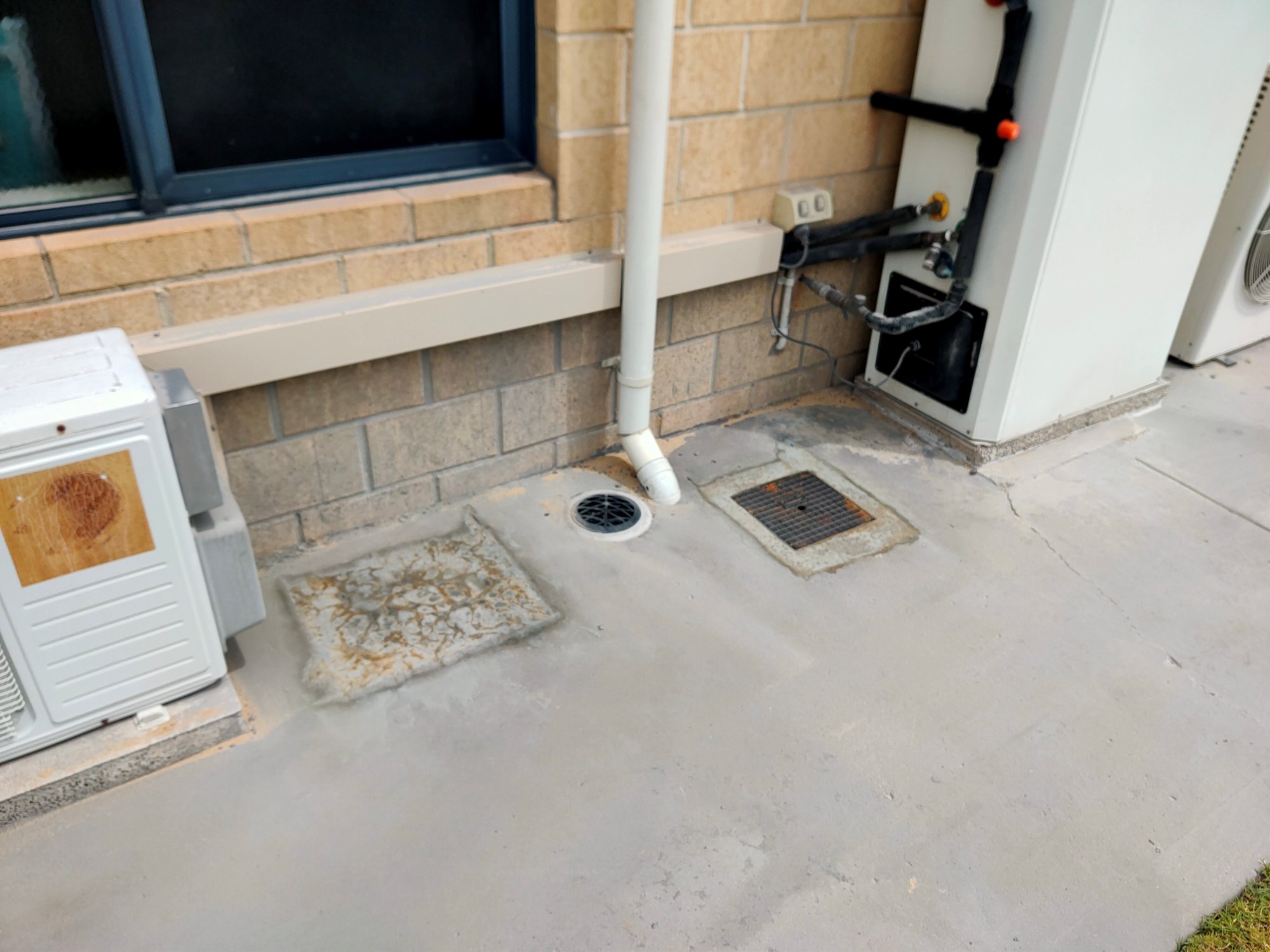
You can see from the photos below why he couldn’t just extend the hole he’d already dug (the one on the left)—there was too much immovable infrastructure around it (HWS heat pump on the left, electrical wiring in the metal box, dry floor waste opening, downpipe, electrical outlet, and then the HWS itself. Oh, and we think, based on where this IO was, that the one for the shower is likely UNDER the HWS. Great…
Bonus: I now know more about plumbing, and specifically this house’s plumbing, than ever before!