I’ve been busy: 2

30 12 2008

So, the abstract inchies were my first experiment in this short Christmas/New Year break.

My next experiment was a small landscape. We actually have hills here (99% of Western Australia is flat!), and they are the most amazing shades of green from about April until October. I had some green fabric… so I created a hilly scene on about a two inch wide piece of interfacing.

The green hills of home

The green hills of home

Close-up of The Green Hills of Home

Close-up of The Green Hills of Home

From the hills to the beach… The next fabrics that grabbed my attention in the scrap pile were some gorgeous aqua blues. So two beach scenes later and I was on a roll! Both beach scenes are about 4 inch wide (that’s 10 cm for the metric minded). I wanted to capture the clear blue sky of summer, the shades of blue/green of the water near Busselton, the white foam of the low waves, and the sand. I added some seagulls and some seagull (or human?) footprints. And a sun to one and a bright beach umbrella to the other.
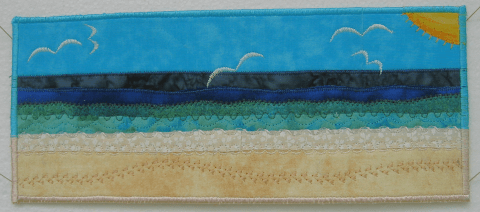
Busselton beach
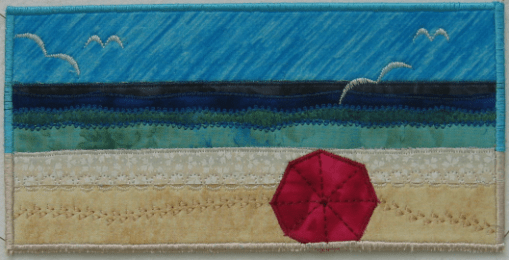
Busselton beach

Busselton beach in summer

Busselton beach in summer

Next, was an attempt to use a plastic template I’d drawn in the shape of a slender gum leaf. I had some grey/green batik that was perfect for the leaves, and I backed them with a deep bottle green. I only had a short width and length of interfacing so this became a bookmark. I discovered the joy of working with shiny rayon thread too — metallic thread just has too many issues, so I’m now using it sparingly. But this Madera rayon thread is pretty darned good. It has a shine and it works really well in a satin stitched border.
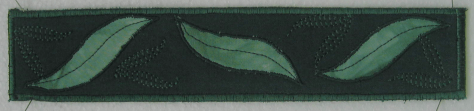
Gum leaf bookmark

Gum leaf bookmark

I’d also drawn a large leaf template, so a set of four 4-inch square leaf coasters were next… Each has the same fabric on the back as I used for that coaster’s leaf. And each leaf’s highlight thread (veins, edge) is the same as the thread used in the satin stitched edging. I stuck with various beige, tan, and mushroom thread colours to match the contrast with the leaf.
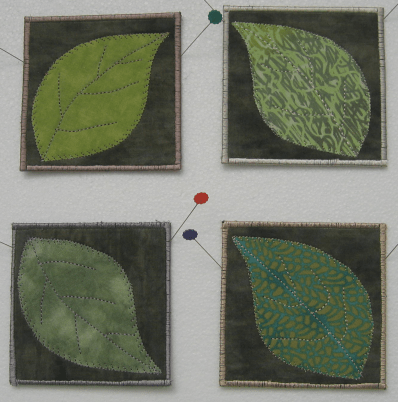
Leaf coasters

Leaf coasters

Finally (for now at least), I made a couple of Christmas inchies, which could be used as tree ornaments. The red one is not quite an ‘inchie’ — it’s about 2.5 inches square, and the green one is about 1.5 inchies square. I added some leaf embroidery to both too.

Christmas inchies

Christmas inchies

And in amongst all this, I thought I might set up an Etsy store to sell these little works of ‘art’. Your thoughts? (NOTE: I’m well aware that there’s very little money in handcrafts — you can never be adequately paid for your time, but covering the costs of materials is a good start!)

See also: I’ve been busy: 3


I’ve been busy: 1

30 12 2008
Breaks where you have nothing planned are a great way to recharge the batteries. And the creative urge.

Just before Xmas I thought I’d use some left over stiff interfacing (the sort that works well for placemats and coasters). I made some Christmas coasters using some of Bobbie’s foundation paper piecing blocks off her ‘In my garden’ CD.

But I still had some of that 2 mm thick  interfacing left — and lots of fabric scraps from other projects that I’ve been keeping for a ‘rainy day’. Well, it’s summer and hot and not raining, but the heat’s enough to keep me indoors, so I decided to experiment with using fusible web to applique random patches onto the interfacing.

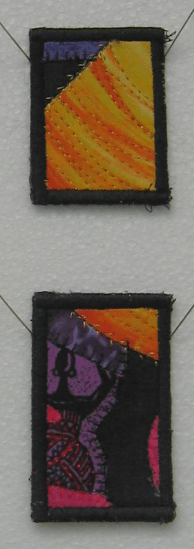
My first experiment was some abstract ‘inchies’, which I first saw on the Feathered Fibers blog. I covered the front and back of the interfacing strip in black fabric, then fused on scraps of colour and did some machine applique using various stitches and threads to embellish them (and hold them down). But the back looked really awful, so after I’d finished the thread work, I added another layer of black fabric to cover the back of the stiching, then stitched in the ditch to hold the backing fabric to the front — I was going to cut it so something was needed to hold the little backs to the fronts.

Before cutting the strip into inchies

Next, I cut the strip in two lengthways, then cross cut the lengths into pieces between one and three inches. Finally, I satin stitched the edges with black thread.

Voila! A whole heap of little Mondrian-like inchies! Add a flat magnet and they can be fridge magnets, add a brooch pin and they become fabric jewellery, add a metal loop and they become keyrings…

So far, they’re just inchies! (the photos show little bits of the pins used to hold them in place, in case you were wondering what those funny silver bits were!)

Abstract inchies 1

Abstract inchies 1

Abstract inchies 2

Abstract inchies 2

Then I went further and decided to see if I could make ‘scenes’ using scraps, fusible web, and machine applique… See part 2.


Australian National Quilt Register

29 12 2008

I happened upon the National Quilt Register site today: http://discover.collectionsaustralia.net/nqr/index.php. A small group of women is attempting to document the old (pre-1965) quilts of Australia, with assistance from the public.

If you have an old Australian quilt and know something of its history — perhaps it’s been in the family for a few generations and the story of the quilt has been passed down to you by your mother, aunts, or grandmother — you can add pictures and details of it to this register (http://discover.collectionsaustralia.net/nqr/addyours.php).

You can find out more about this collection and the intrepid women putting it together here: http://discover.collectionsaustralia.net/nqr/about.php.


Log Cabin Quilt: 7

19 12 2008

At last, the back is finished! And now the top, the back and the batting are ready to be taken to Judy, a local quilter who has one of the super-duper long arm quilting machines for the actual quilting.

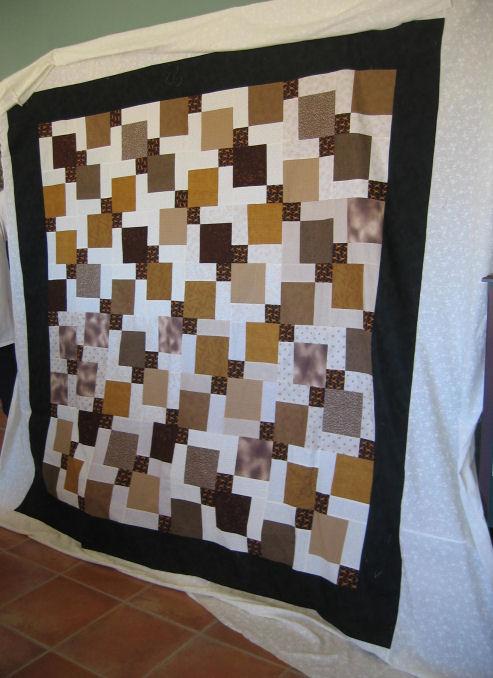
Here’s part of the back — despite the size of Bobbie’s design wall where I pinned it, I couldn’t fit it all in! The cream border fabric alone is 15″ wide all round.

Back of quilt

Back of quilt

See also:


Mini quilts: Christmas coasters

7 12 2008

I had some foundation paper piecing patterns from Bobbie, so decided to make half a dozen Christmas coasters (perhaps as gifts—I’m not sure what I’ll do with them yet). Yesterday I made the blocks, and today I added the backing and batting, did some stitch-in-the-ditch quilting on them, and added the binding. I still have to finish hand sewing the binding on the other five, but here’s the first one finished.

This was a great way to use up some fabric scraps! Each coaster measures 12cm x 12 cm (about 4.5 inches) square, and each has taken about 1 hour to complete. This is NOT a cheap gift for a set of six if you take into account the cost of my time. Lucky I do it ‘cos I enjoy it! 😉

Christmas coaster - tulip block

Christmas coaster - tulip block


Watch those search terms!

7 12 2008

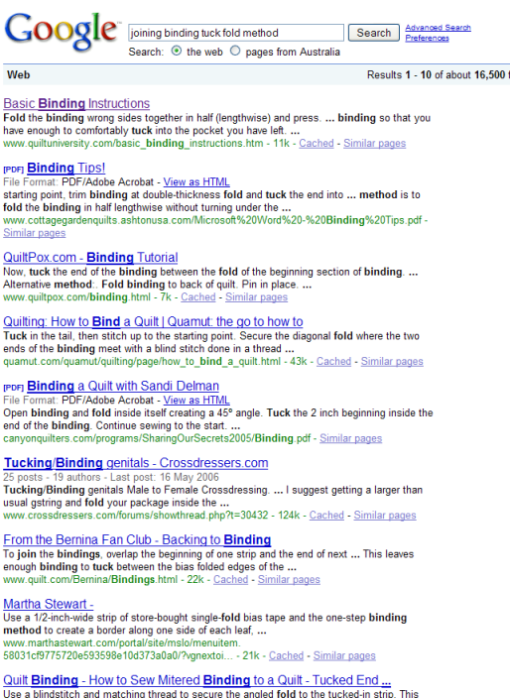
I needed to find out how to do the tuck/fold method of joining binding strips on some mini quilts I’m making. Bobbie had shown me a few weeks ago, but I’d forgotten. So it was off to Google again…

I forgot to add ‘quilt’ as a keyword—here are my search results. Almost all are related to quilting (and I found my answer amongst them). But look carefully… Result #6 is interesting…

Search results

Search results


Excellent video on machine quilting

7 12 2008

I’m a raw beginner at machine quilting and have tried to learn more just by practising, reading some stuff on the internet etc. Then I came across this EXCELLENT 43 min video on doing free motion machine quilting. Now to practice some of the techniques…


Log Cabin Quilt: 6

29 11 2008

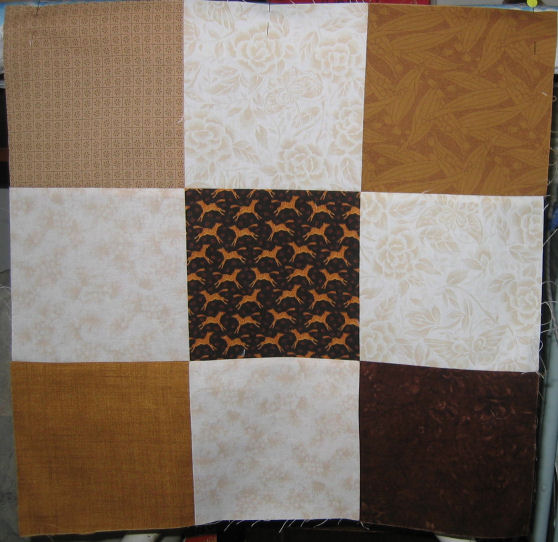
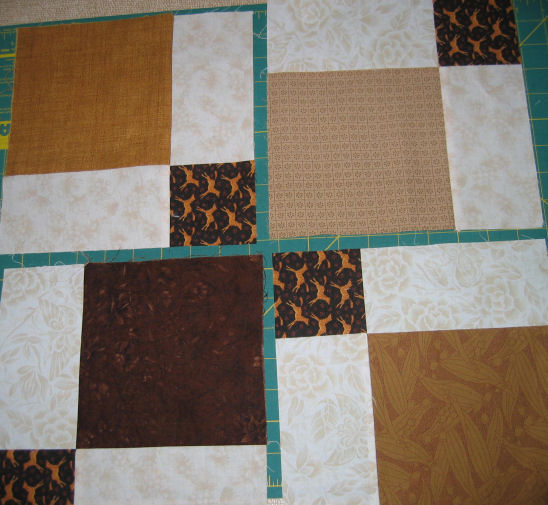
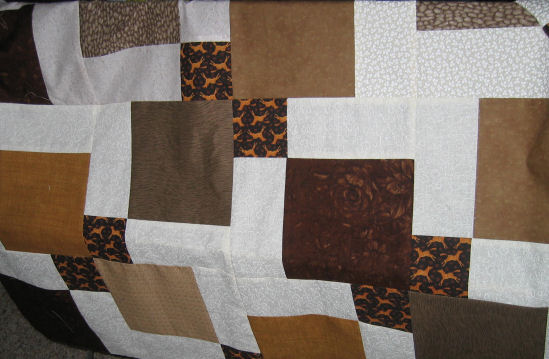
As promised, here are some photos of the Disappearing Nine Patch I’m doing for the back of the log cabin quilt. Basic instructions are in the photo captions.

9-patch of 6.5 inch squares

9-patch of 6.5 inch squares

Cut the 9-patch across the middle both ways

Cut the 9-patch across the middle both ways

Turn two diagonally opposite patches 180 degrees

Turn two diagonally opposite patches 180 degrees

Sew back together again

Sew back together again

Join the big blocks together

Join the big blocks together

Yes, my mother also wonders why I would take perfectly good pieces of fabric, cut them up, join them together, then cut them and join them again! 😉

See also:


Log Cabin Quilt: 5

26 11 2008

I’ve now joined all the strips together but before I did so, I decided to save some heartache and add the border pieces to the ends of each strip, then the top and bottom border strips to the top and bottom 4-block wide widths (got that?!). Initially, I thought I might do some blocks with similar colours in the border, but it looked too much, so I went with plain black. A lot less work!

Here’s the finished top, all joined together and pinned to my friend Bobbie’s design wall (thanks, Bobbie!). I should have taken a picture without the flash too, as the pink blocks look very much the same even though there’s quite a bit of contrast in them.

Finished Queen bed top

Finished Queen bed top

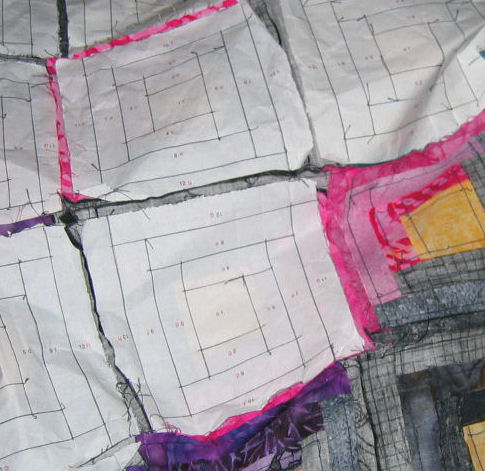
Next step is to remove every piece of paper from the back of 144 blocks! That’s 13 largish pieces of paper for every block, plus the 1/4″ narrow pieces for the seam joins… over 2000 pieces altogether. Each strip of paper has to be torn away from the stitching, without damaging or ripping out the stitches, so you can’t just rush this job. A great job to do—with tweezers—in front of the TV!

Removing foundation paper pieces

Removing foundation paper pieces

And being a masochist (!), I’ve decided to piece the back of this quilt too! I’m using ‘coffee and cream’ colours (in total contrast to the log cabin top, making a nice reversible quilt when it’s finished). I’ve cut out and started to join the 144 x 6.5 inch blocks for a quick Disappearing Nine Patch quilt. Unlike the log cabin, this will come together very quickly. Photos to come in another post…

See also:


Feeling chuffed

22 11 2008

I entered five completed quilts into this year’s Bridgetown Agricultural Show (like a town fair for my American friends), and every one won a prize! I got three first prizes and two seconds. And I got two of the four ‘special prizes’ for the overall ‘Handcrafts’ category, which means I was up against entries in nearly 80 categories ranging from crocheting, knitting, sewing, doll and bear making, tapestry, cross stitch, embroidery, and everything in between. To get two out of the four possible special prizes was pretty good — I was chuffed!

The two special prizes ($25 cash each) were for my dragonfly quilt and the Japanese meshwork table mat; they also won first prizes ($4 cash each). The other first prize was for the convergence quilt, and the two seconds ($1 cash each) were for the ‘blanket of love’ and the ‘scrappy’ cushion cover.

As it only cost $1 to enter each item, a $64 return is not too bad! 😉 Better than the stock market is paying these days… (though, of course, the cost in fabric, thinking and creating time, workshops, is not factored in at all in calculating this ‘return’).