Community Quilt 83

20 05 2013

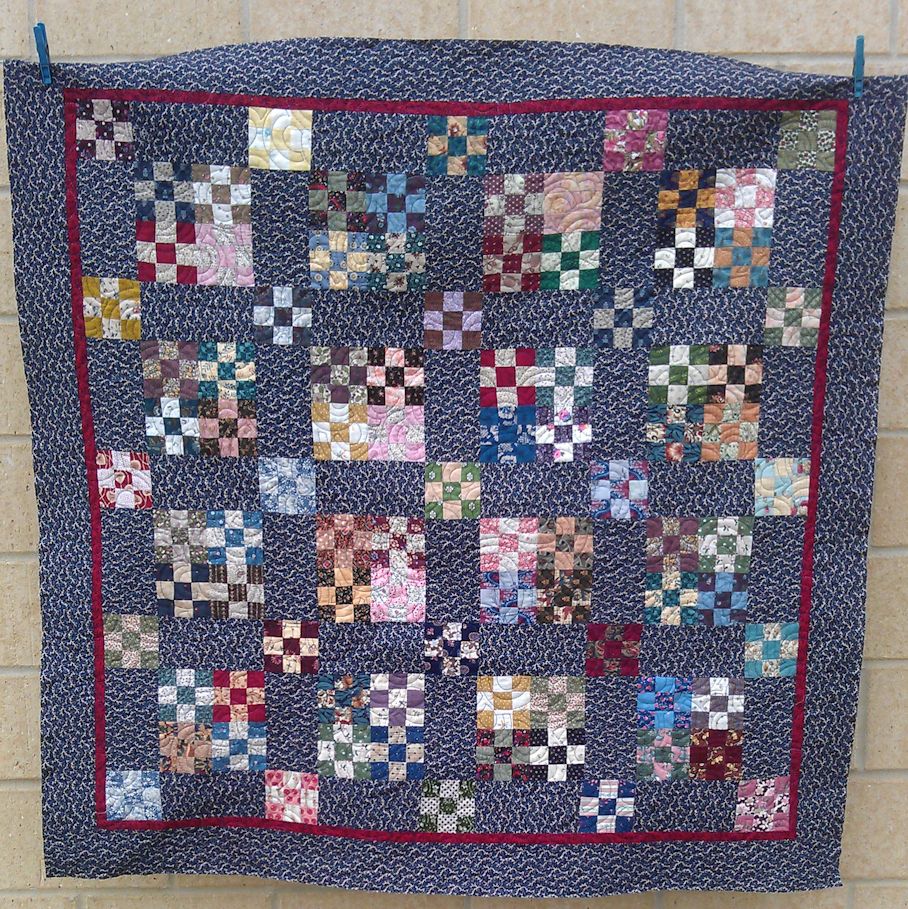
Not my colours, not my favourite design, but hey — when you do community quilts, you get to quilt what’s been given to you 😉 And that’s part of the fun of the challenge!

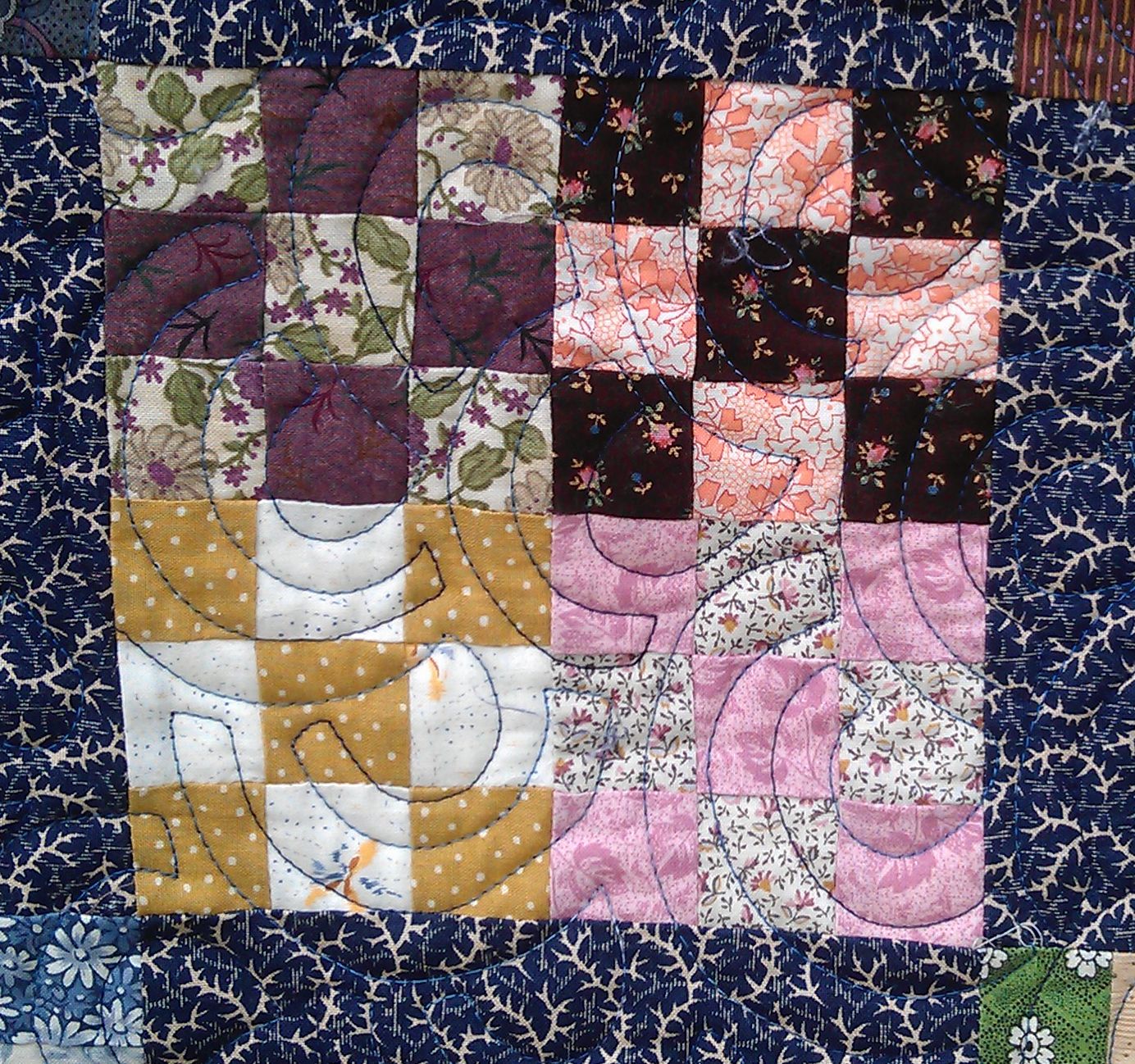
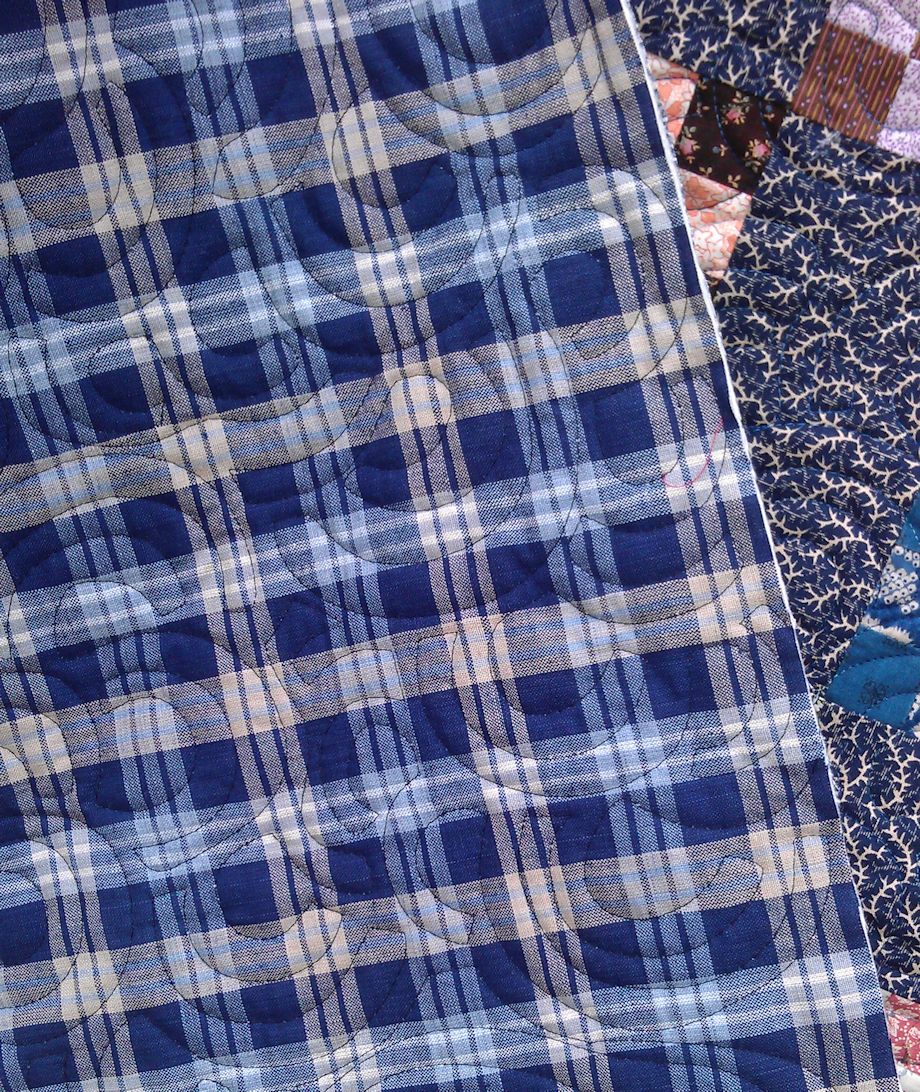
For this one, I decided to use a matching variegated dark blue thread so that it disappeared into the quilt and didn’t try to overpower it. I also used a squared off ‘open headband‘ motif because I wanted to add some curves to the very geometric quilt design, but flowers etc. weren’t going to work for this fairly dark and masculine quilt.

(Click on a photo to view it larger)

quilt83_01

quilt83_02

Back:

quilt83_03

Threads used:

  • Top: Wonderfil Tutti (50 wt, Egyptian cotton, colour TU24
  • Bobbin: Invisifil (100 wt, navy)


Community Quilt 82

20 05 2013

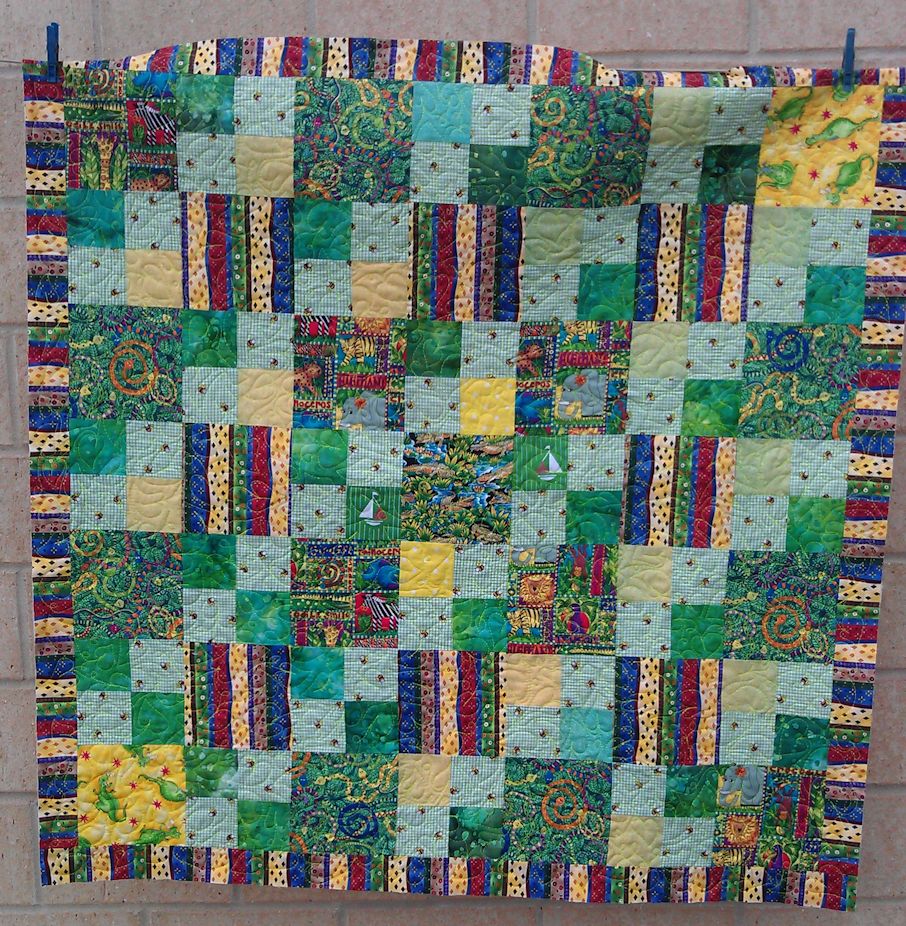
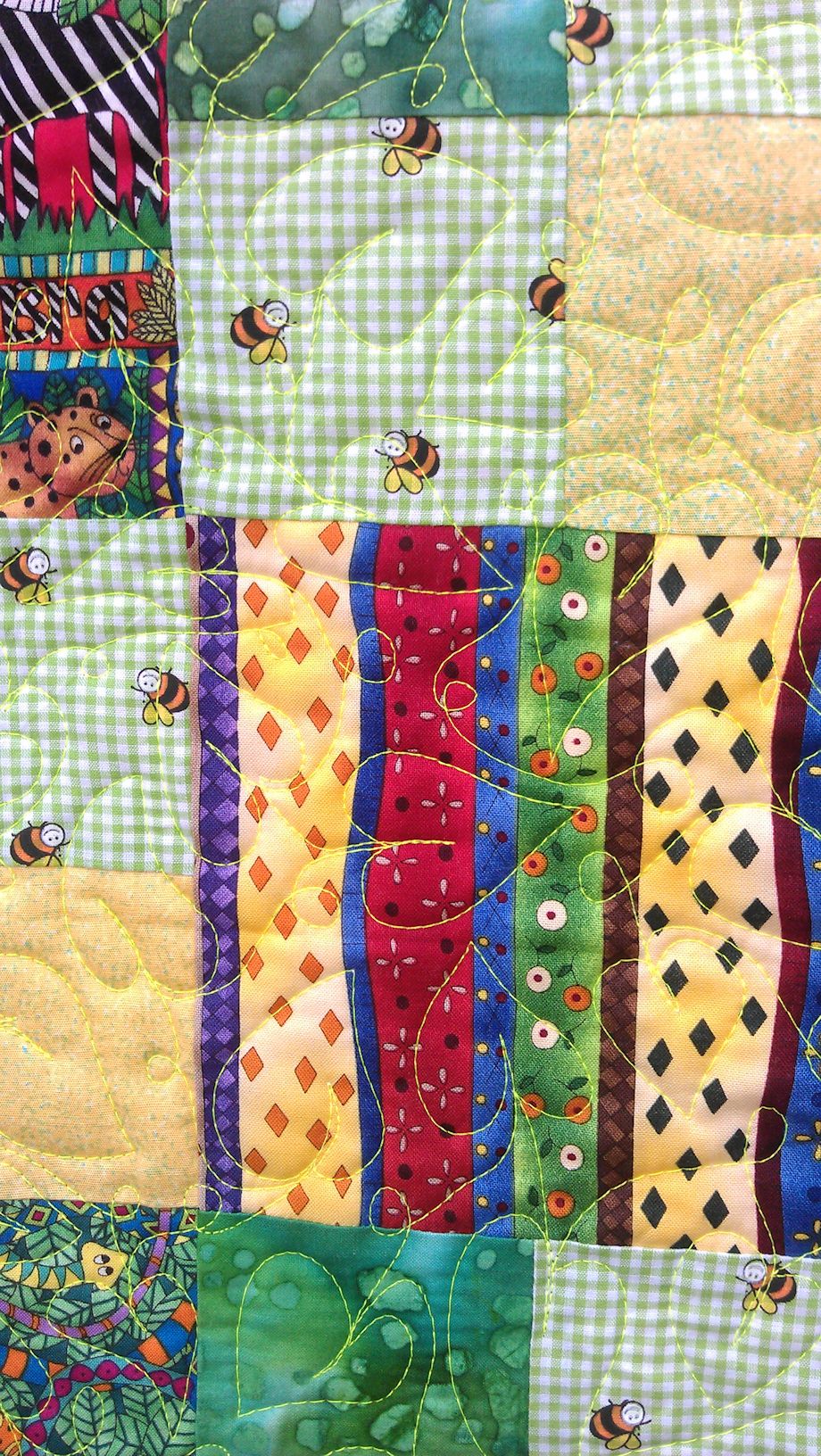
What a bright, fun quilt! Some child will love this one as it’s full of jungle animals and other animals, and has such gorgeous bright colours.

Deciding on a all-over leaf quilt design was pretty easy with that jungle theme going on… and deciding on a bright fluoro lime green was easy too.

Unfortunately, it was quite a dull day when I took the photos, so they’re a little washed out.


(Click on a photo to view it larger)

quilt82_04

quilt82_03

quilt82_01

Back:

quilt82_02

Threads used:

  • Top: Isacord (40 wt, trilobal polyester, colour #6010)
  • Bobbin: Bobbinfil (white)


Community Quilt 81

14 05 2013

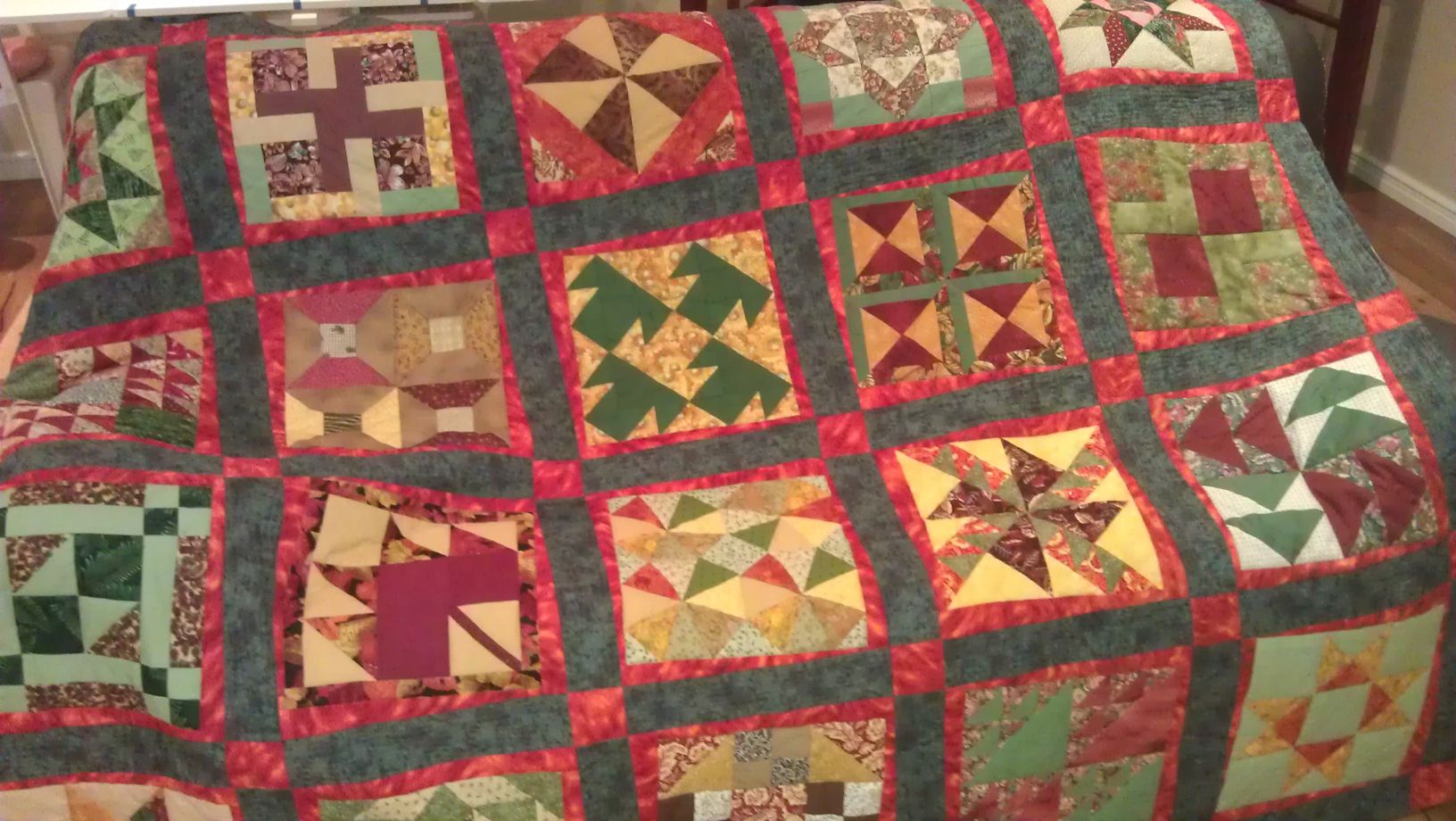
I had high hopes for this quilt. It was big and it had a rich backing fabric that led me to believe that the top would be as exotic. Unfortunately, it wasn’t as exotic as I’d hoped for. And the batting was a high-loft polyester wadding, which meant that this quilt was hard to handle as it kept wanting to ‘run away’ from me.

As a consequence of its sheer size and the thick polyester wadding, my first job was to stitch it down. Normally, basting pins are sufficient, but this one needed the ‘ESS’ touch (‘[stitch] Every Stinking Seam’ — attributable to Cindy Needham), so I stitched in the ditch around every block, and then within the blocks using a very lightweight (100 wt) thread in a matching beige. While I didn’t quite achieve ESS, I came close. I started using my Line Tamer ruler for the stitch in the ditch, but as some of the blocks only had short straight lengths, I discarded it and went for ‘eyeballing’ the straight lines.

Although I was tempted to do some quite detailed quilting in each block, time was against me (and I really didn’t like the ‘hand’ of the quilt with all that polyester wadding), so instead I decided to just quilt the sashing borders with a decorative orange thread, spiralling in the keystone blocks, and doing vertical and horizontal wavy lines between the spiral blocks.

I had to take the photos of this quilt inside as it was bucketing with rain outside and I was in a hurry to get this one packaged up and taken with me to Perth to be dropped at the Community Quilts coordinator’s house. So the photos are a little blurry.

(Click on a photo to view it larger)

quilt81_01

quilt81_02

Threads used:

  • Top: Robison-Anton (40 wt, rayon, colour Dk Tex Oran #2469); Invisifil (100 wt, light tan/beige)
  • Bobbin: Invisifil (100 wt, navy)


Swapping out the circuit board on my Sweet Sixteen

14 05 2013

As a precaution and in case it may have contributed to the issues I had with the various light rings on my Handi Quilter Sweet Sixteen, my dealer swapped out the circuit board in my machine when I took it up to her on the weekend (the board was swapped out on 11 May 2013). I also got the new light ring (Handi Quilter now has a new supplier and, as a bonus, brighter lights!).

Because I thought that swapping out the board and replacing it with a new one might mean that all my stitch counts would likely be reset to zero, I took a photo of my total stitches prior to the replacement board being put in.

In the two years I’ve had my Sweet Sixteen, I had done some 8.53 million stitches! If you look at the leading zeros, you can see that the board on the machine can tally up to 999,999,999 stitches. Whether the machine itself would last that long is something to be confirmed at a much later date 😉

stitches_HQ16_two_years_may2013

Now, if you looked at the stitch count only, my machine appears to be brand new as the new board had just 249 stitches recorded on it, which I’d guess was done as part of the manufacturers’ testing.

I wonder how long it will take me to reach another 8.5 million stitches…

Update August 2014: I got the new software upgrade (C-pod replacement) and the stitch count since this post (May 2013) was 6.2 million stitches, for a total to August 2014 of approximately 14.7 million stitches.


Community Quilt 80

6 05 2013

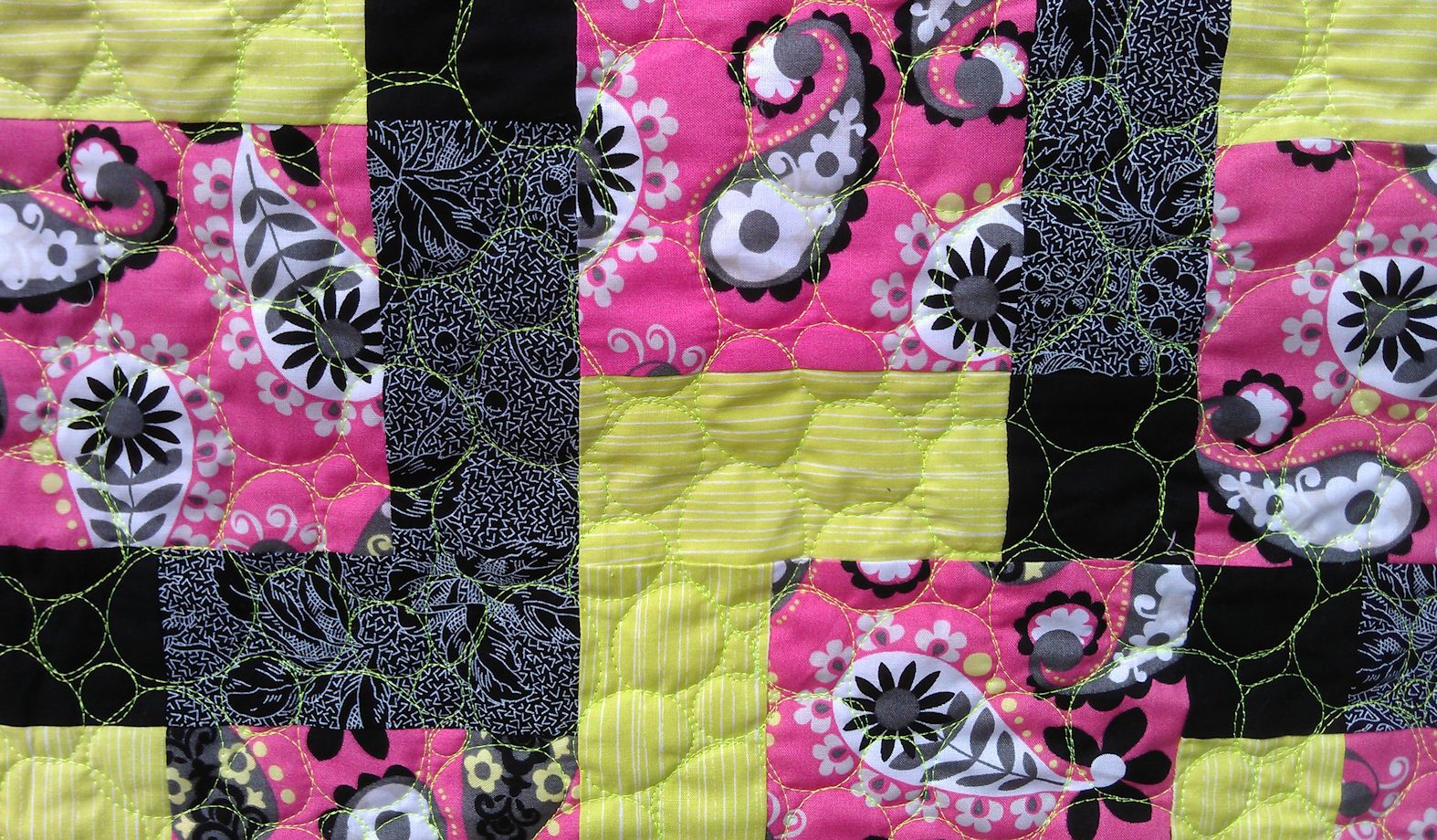
And then there are the quilts that are just so bright and, well, jolly! This was one of them. Who’d have thought that flouro lime green and bright pink would go together? But with the addition of black, they sure did.

But how to quilt it? I thought about emulating the paisley motif in the pink fabric, or doing just straight lines (a la modern quilts), but ended up opting for largish circles in a neon/fluoro lime green thread in the main top, then a sort of ‘stem and leaf’ motif in neon/fluoro pink in the borders, leaving the solid pink border empty of any quilting.

I had fun doing the circles, but the stem/leaf borders took much longer than I expected.

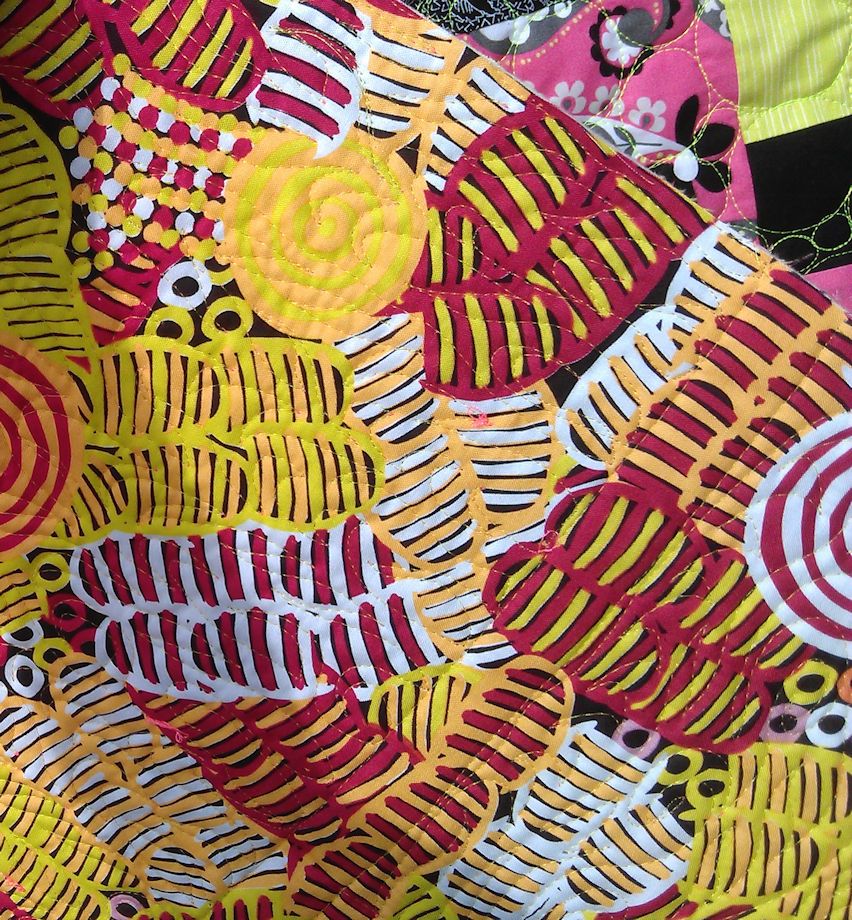
I also loved the Aboriginal design backing fabric on this quilt, and felt it was a bit lost there — it would make a good quilt in its own right.

(Click on a photo to view it larger)

quilt80_01

quilt80_03

quilt80_02

Back:

quilt80_04

Threads used:

  • Top: Mettler Poly Sheen (40 wt polyester, colour 5940 [lime green]); Isacord (40 wt trilobal polyester, colour 1940 [pink])
  • Bobbin: Bobbinfil (white)


Community Quilt 79

6 05 2013

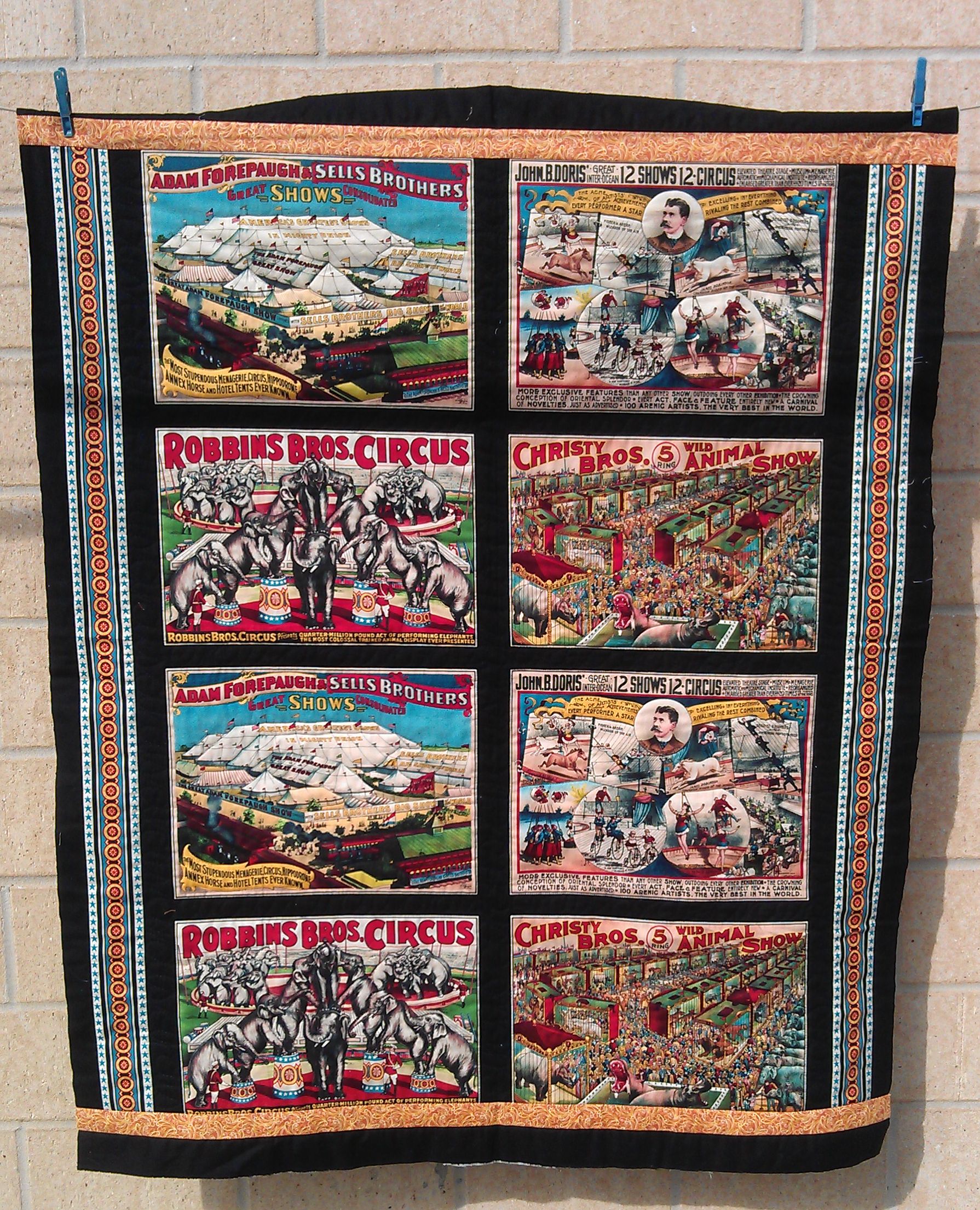
A few of the quilts I get to quilt for the Community Quilts program are just weird, in my opinion — this one falls into that category. I have no idea what inspired Windham Fabrics to make this circus panel from the 19th century/early 20th century, or what inspired someone to buy it, or what/who inspired them to make a quilt with eight panels rolled straight off the bolt of this strange fabric!

I suspect this is an old panel, as the backing fabric also looked old and a dessicated carcass of a beetle feel out when I opened it up. Also, it had been hand basted and the thread used for the basting felt old too.

So, how to quilt it? There was so much going on in the panels that I decided to just outline the main features in a 100 wt almost-black thread. I wasn’t sure what — if anything — to do with the ‘sashing strips’ surrounding the panels and eventually decided to just stitch the cursive word ‘circus’ multiple times (in the same thread) to hold them down.

A very strange quilt…

(Click on a photo to view it larger)

quilt79_01

If you look carefully, you might see the word ‘circus’ stitched in the black sashings/borders:

quilt79_02

Threads used:

  • Top: Wonderfil Invisifil (100 wt polyester?, colour IF 179)
  • Bobbin: Wonderfil Invisifil (100 wt polyester?, colour IF 179)


Community Quilt 78

6 05 2013

I loved the colours in this quilt, and with the fish and the butterflies, I was always going to quilt it with a flowing motif. And to enhance the colours in the quilt, I used a bright neon/fluoro lime green top thread!

I started in the centre with big dipping waves across the quilt, echoing these waves (to a degree) from the centre out, gradually making the waves less steep by the edges.

Update: I found out after I’d done it that what I thought were fish were actually parrots!!!

(Click on a photo to view it larger)

quilt78_04

quilt78_03

quilt78_01

Back:

quilt78_02

Threads used:

  • Top: Mettler Poly Sheen (40 wt polyester, colour 5940)
  • Bobbin: Bobbinfil (white)


Handi Quilter Sweet Sixteen: Using bobbin thread as the top thread

29 04 2013

I had a devil of a time with a small spool of 100 wt Wonderfil Invisifil thread — it kept getting caught in the slot on the spool that secures the thread, or wrapping itself around the vertical or horizontal thread spool holder. It was the only spool of that colour that I had and it was perfect for the top stitching I wanted to do. But how to get it off the horrible spool and put it onto something that wouldn’t catch?

I had a lightbulb moment — I’d use the bobbin winder and wind the thread onto a bobbin then put the bobbin on the spool holder and I could use the thread without it catching every few seconds. Easy peasy. But not so fast, Batman…

Once I’d wound the thread off the spool and onto the bobbin, I was reminded that the Handi Quilter Sweet Sixteen has a thicker rod for spools than it does for bobbins! (that’s a silly design flaw, in my opinion — if the spool rods were a tad narrower they could take both spools and bobbins, not just spools). That meant that I couldn’t put the full bobbin onto either the vertical or horizontal spool holder. And I couldn’t wind the thread back off the bobbin and onto a different sort of spool as the bobbin winder can’t do that. Thwarted…

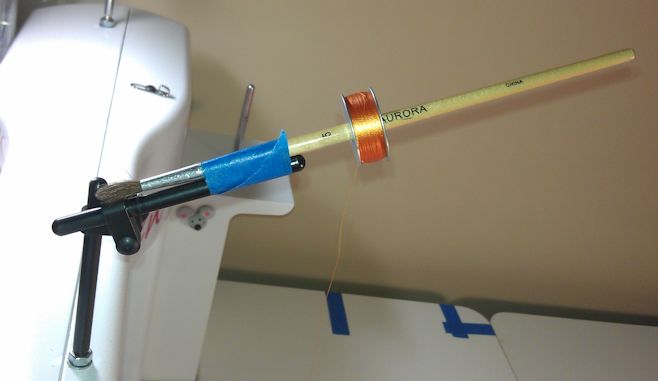
Except the previous day I’d rigged up a temporary lighting system for my Sweet Sixteen 😉 Surely I could do the same for the bobbin so I could use it as the top thread? Off to the sewing room, the kitchen and the shed to see what would work. I came back with an artist’s paintbrush, a roll of painters tape, and a satay stick. Well, the satay stick wasn’t going to work as it was way too thin. But the paintbrush was an option — the bobbin spun nicely on it, until I set it up, when I found that the 100 wt thread just wanted to spool off the bobbin and get wrapped around the paintbrush. So that was no solution.

bobbin_as_top01

This solution didn’t work as the thread kept coming off the bobbin and winding around the paintbrush

The problem was that there was nothing to prevent the thread from coming loose from the bobbin and winding itself around whatever makeshift spool holder I had. I needed a cap of some sort… Just like on my domestic machine. My husband brought out a screwdriver that was the perfect diameter — my domestic sewing machine caps and felt pads fitted perfectly. It was then a matter of attaching the screwdriver to the machine with painters’ tape and off I went!
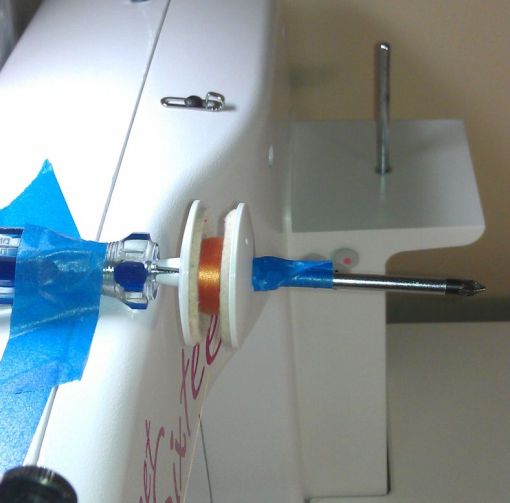
bobbin_as_top02

This solution was perfect — the felt pads and the caps from my domestic sewing machine kept the bobbin thread where it belonged, and the diameter of the screwdriver was such that the bobbin spun smoothly.

So now my Sweet Sixteen looks like some sort of makeshift Heath Robinson invention! I have an OTT Task Lamp tied to the left side with twist ties, a floor lamp on the right, and now this screwdriver spool holder for my bobbin full of the thread I wanted to use 😉

This option would not have been necessary if Handi Quilter had built these machines with slightly narrower diameter spool holders that would comfortably take thread spools and cones, AND M bobbins. Such a small design change would offer more thread delivery options to users.
Necessity is the mother of invention

28 04 2013

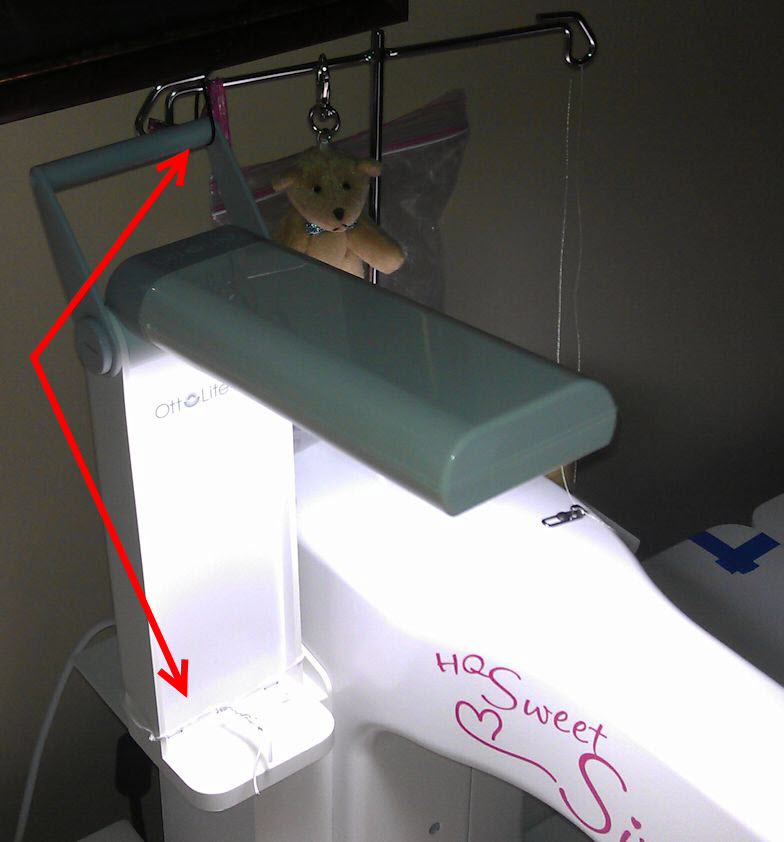
Another light ring on my Handi Quilter Sweet Sixteen has started flickering… So, as I need to use my machine, I’ve turned the light off to stop the strobing effect. But there’s not enough natural light to see what I’m doing and the overhead lights are too yellow and just create lots of shadows. So I’ve placed a floor lamp with a white light on the right on the table, and I’ve ‘jerry-rigged’ an OTT Task Lamp on the left.

I used long twist ties to tie the OTT light to the spool holder on the left and to tie the handle to the left side of the thread mast. It’s not as good as the light ring, but it works!

ott_lite


Community Quilt 77

26 04 2013

And then there are the wonky quilts… This one was the wonkiest I’ve tackled so far. All those bias edges were wonky when sewn into the blocks, and the border was wonky.

So how to quilt a wonky quilt with fabric that bunched up in many places? You beat it into submission with lots of fairly dense quilting! 😉

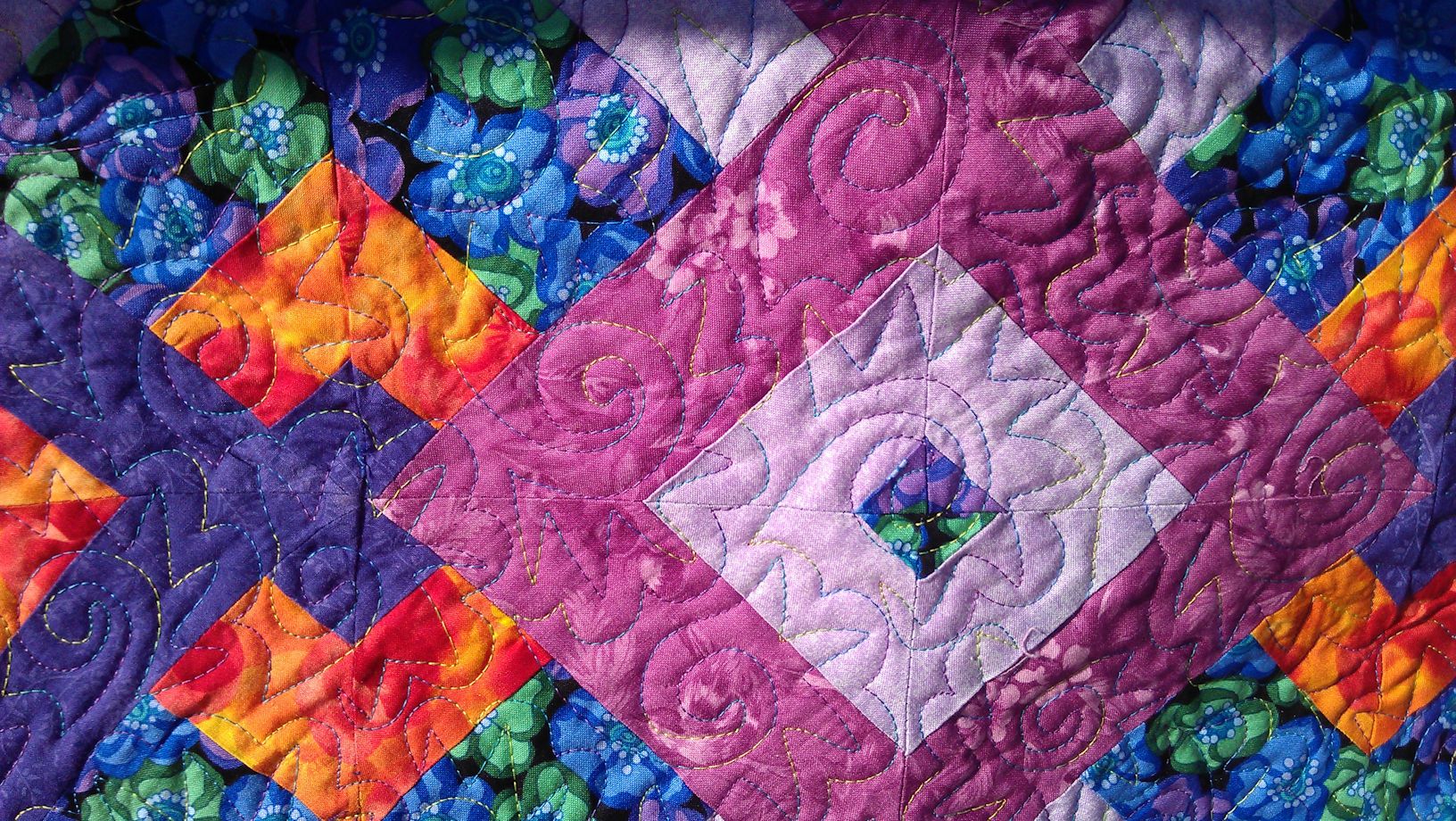
I chose a matching variegated thread in blues, greens and purples, using a rounded spiral morphing into spikes, then echoed with rounded hops. I have no idea what this design is called but it achieved the end result of flattening this very wonky quilt top.

(Click on a photo to view it larger)

quilt77_01

quilt77_02

Back (still with some loose threads caught):


quilt77_03

Threads used:

  • Top: Superior King Tut ‘Cairo’ (40 wt cotton, colour 932)
  • Bobbin: Wonderfil Invisifil (100 wt, red)