A is for Apple

19 05 2014

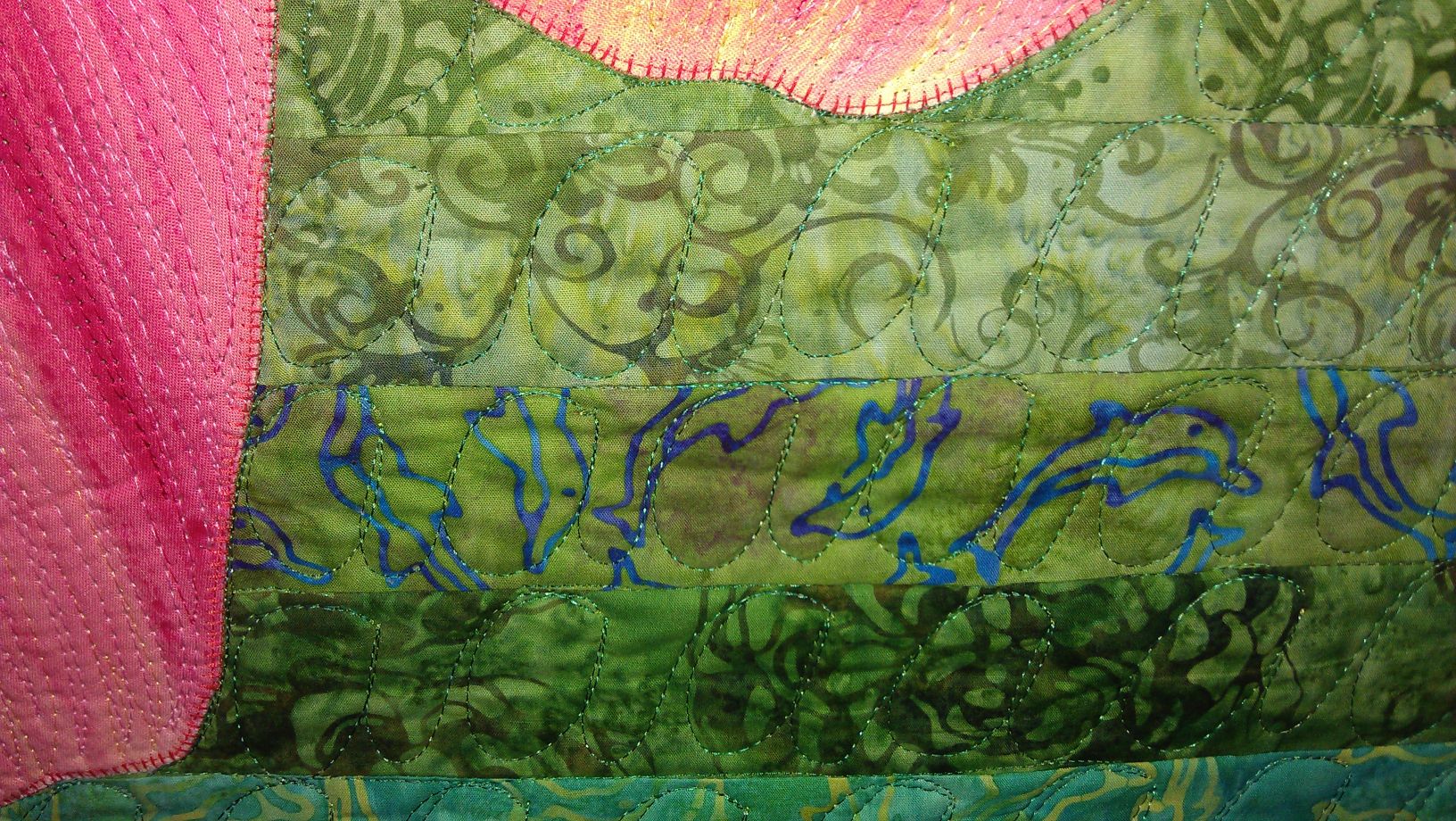
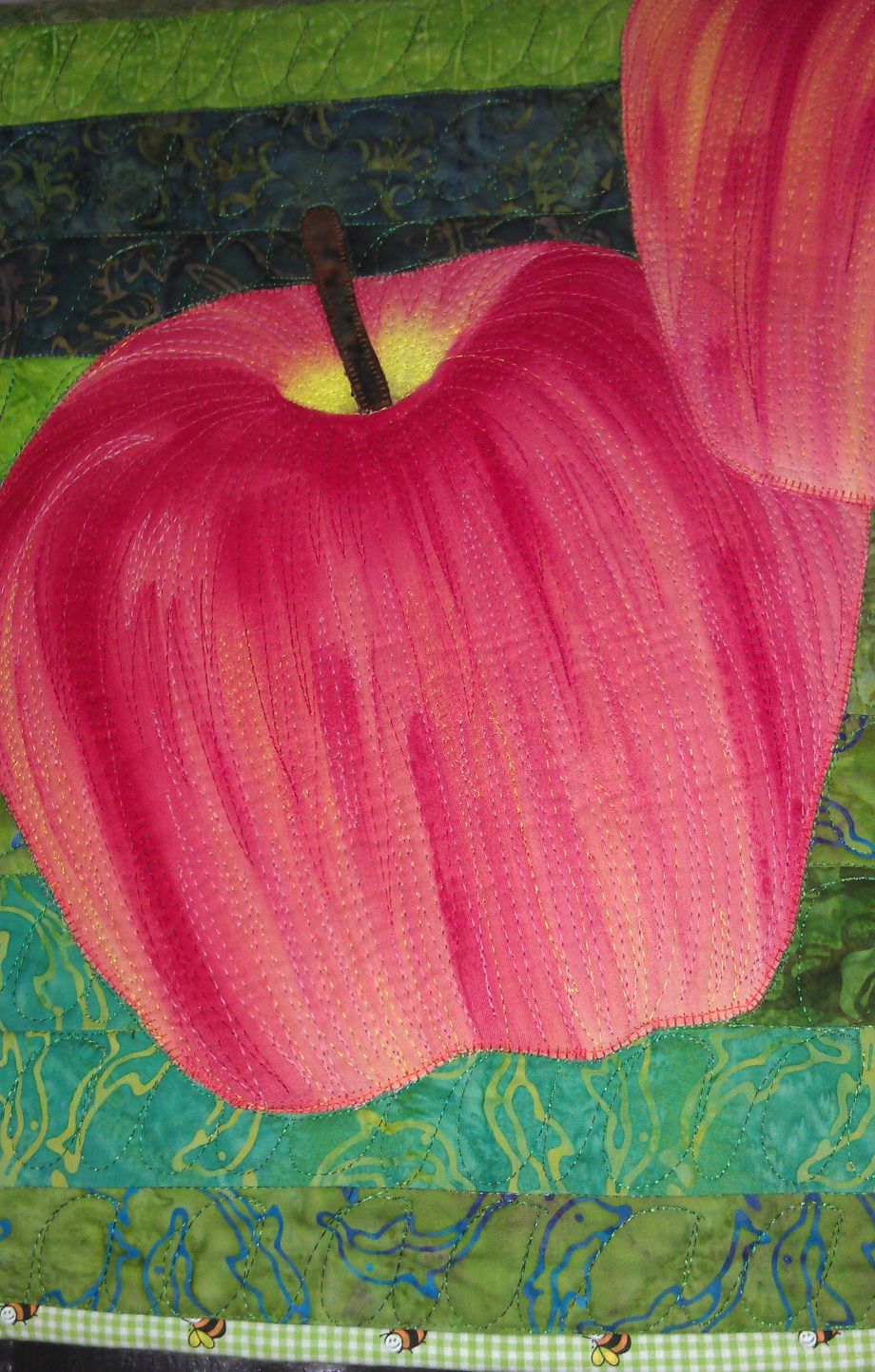
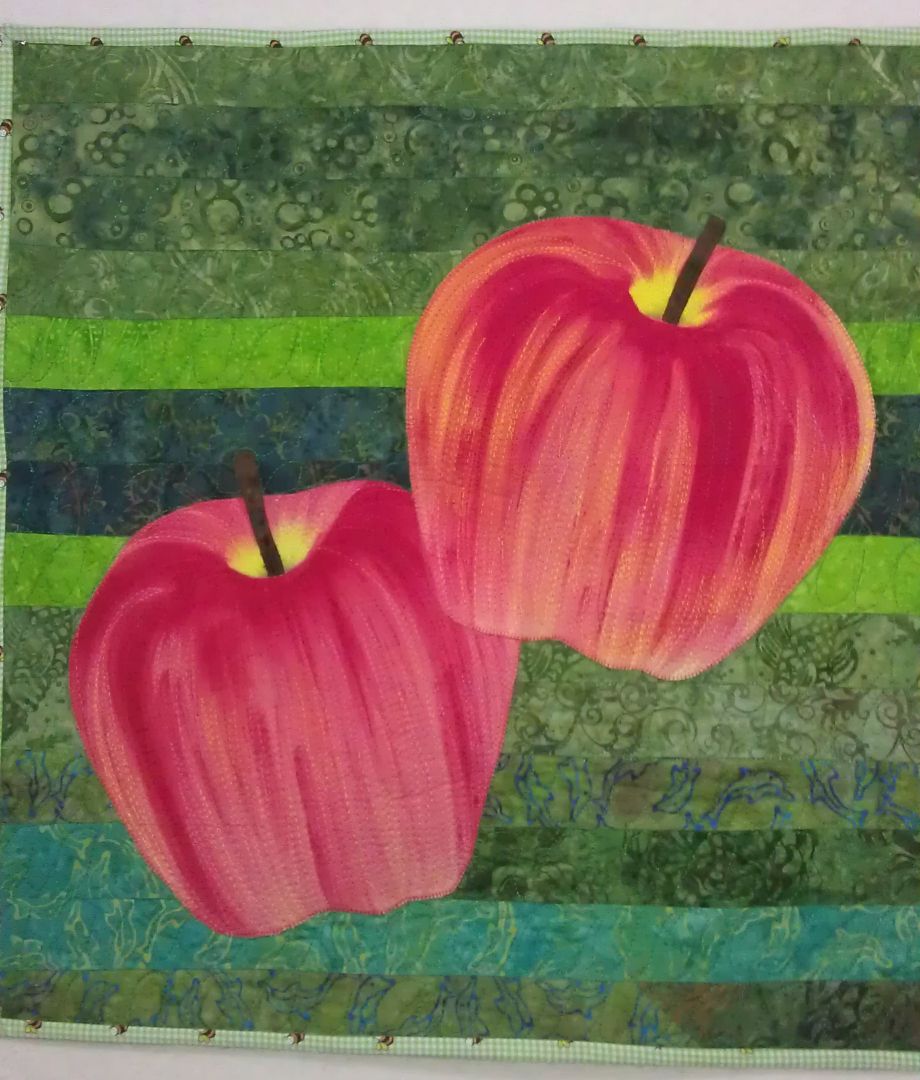
A is for apple, B is for bee, and D is for dolphin! And all come together in this wall hanging.

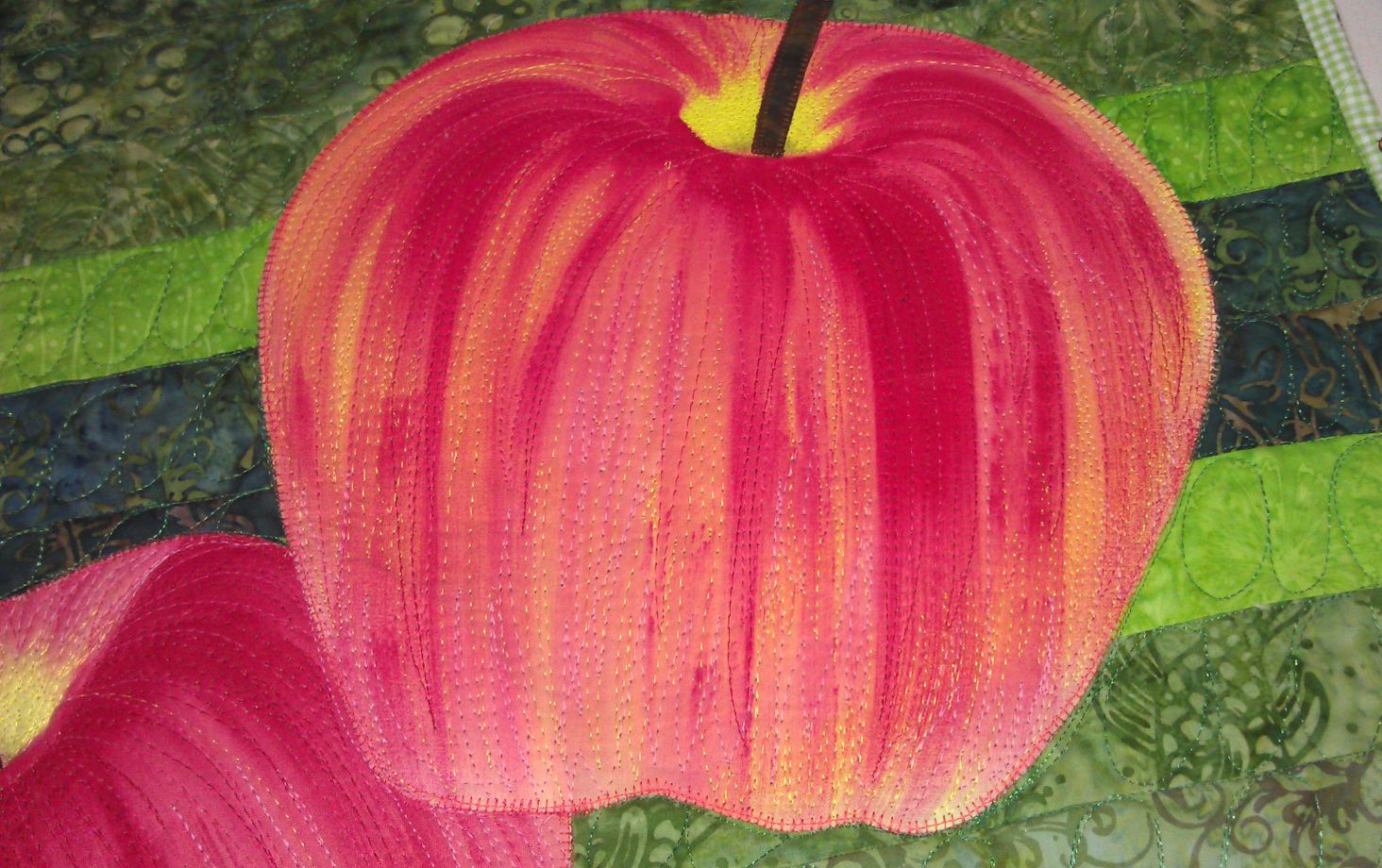
Last year, one of the fabric painting techniques Velda Newman showed us to do was how easy it was to paint an apple. My apples had just been lurking in the sewing room, and I wondered if I’d ever use them in a quilt. Then I was hunting through some fabric and found my green jelly roll strip quilt top, and for some reason put them close together on the design wall, and Voila! a new quilt top emerged. This one can be for a nursery or an early childhood classroom. With the painting on the apples, I wouldn’t recommend it as a baby quilt/play rug. Although the artist acrylic paints are unlikely to be a problem, it’s not something I’d want to risk.

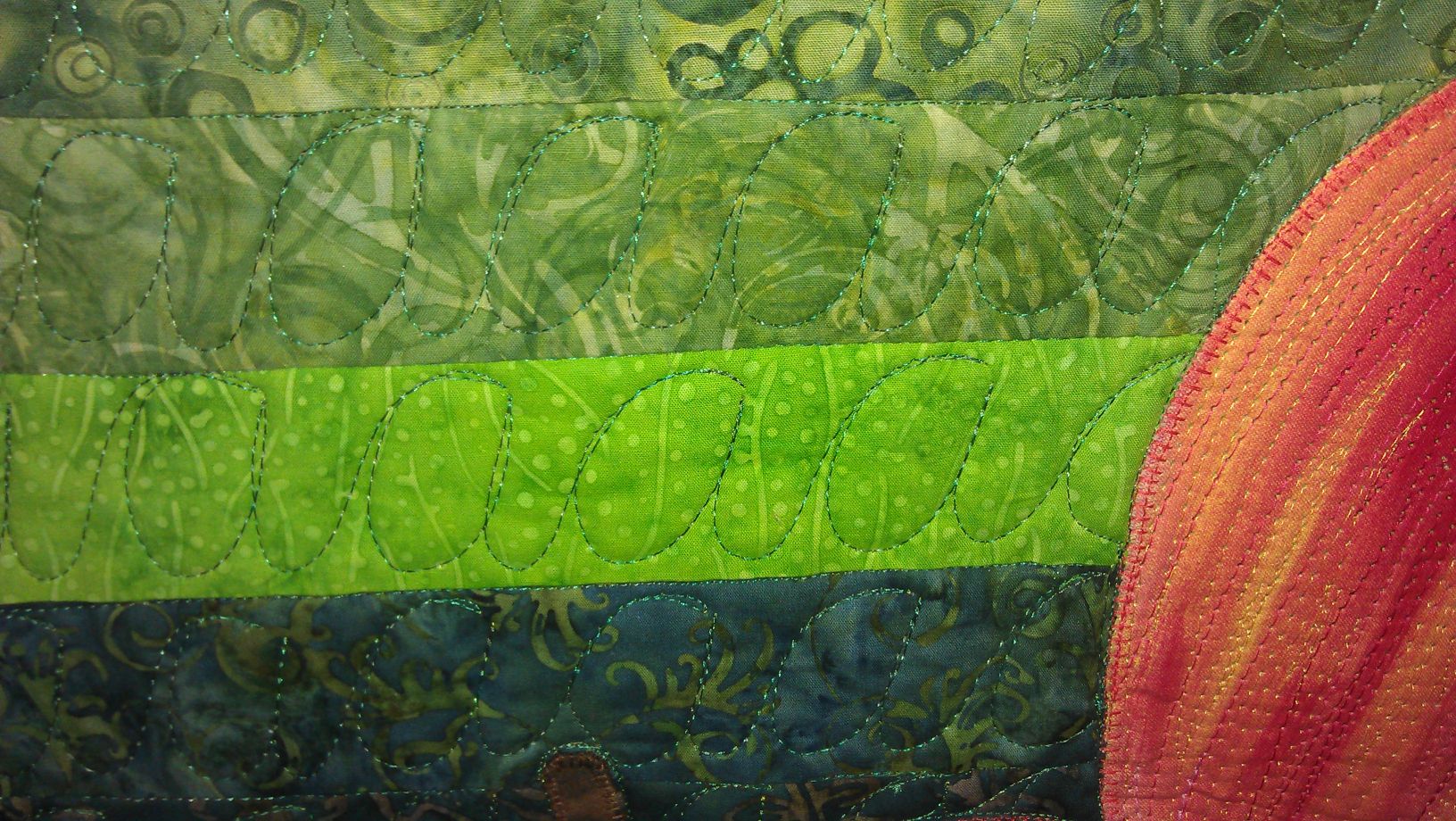
Anyhow, here’s how this wall hanging came together — I fused the apples to the quilt top, then stitched around them with blanket stitch on my domestic sewing machine, added the batting and backing, stitched in the ditch along all the seams, then stitched the lower case letter ‘a’ (for apple) in all the spaces between the lines. Then I surface stitched the apples in four different colours of thread — red, orange-red, yellow, and pink. I added a border that contains bees (‘b’ is for bee), and then noticed that a couple of the batik fabrics near the bottom of the quilt contained dolphins (‘d’ is for dolphin). Thus ‘A is for apple’ is born!

This art quilt is now available for sale from my Etsy store: https://www.etsy.com/au/listing/618937617/a-is-for-apple-wall-hanging-art-quilt

apple_quilt06

apple_quilt01

apple_quilt03

apple_quilt04

apple_quilt07

apple_quilt08

apple_quilt09

apple_quilt10

apple_quilt11

apple_quilt12

The back:
apple_quilt02

apple_quilt13


Retiring…

19 05 2014

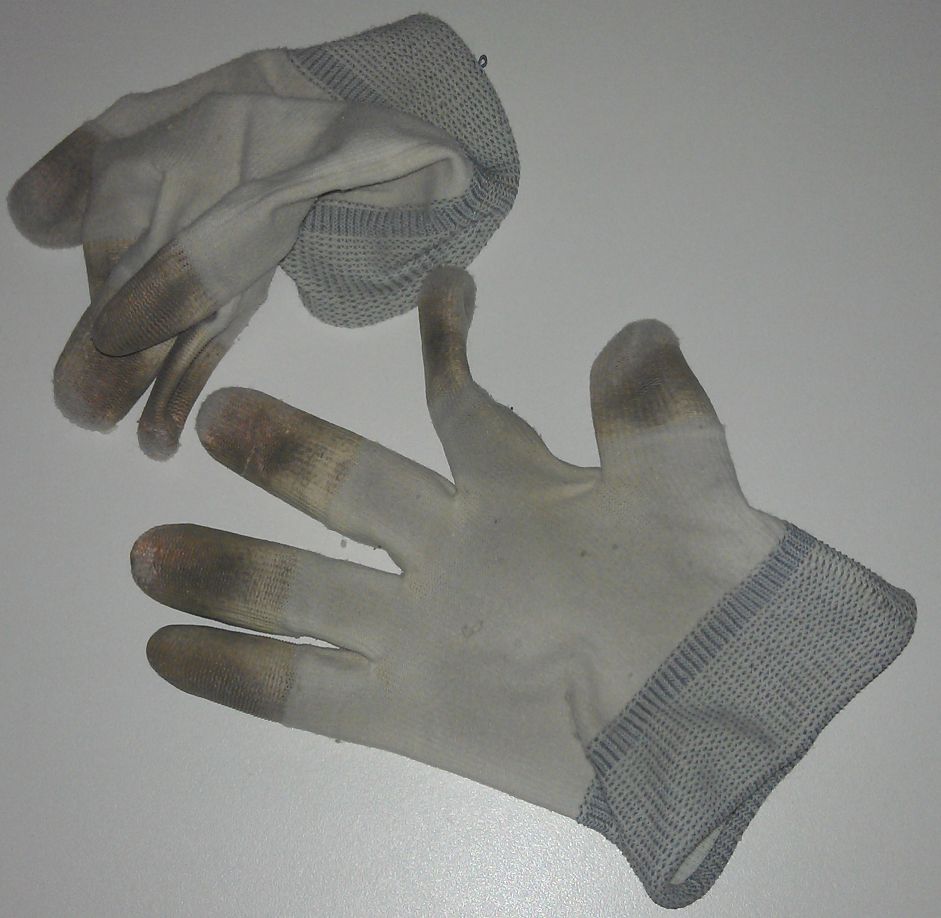
Not me! My first pair of Machingers quilting gloves! I’m retiring this pair after faithful service for 3 years, 150+ quilts, and some 13.5 million stitches on my Sweet Sixteen. I have two other pairs, so it’s time for this first pair to be retired.

Yes, they look grubby, and yes, I’ve washed them, and yes, they still work, but the rubberised finger tips are almost worn through, and the elastic wrist bands are floppy and won’t stay on my wrists anymore.

I wear them for every quilt, and find I have to grab the quilt much more if I don’t put them on.

So it’s the bin for these faithful servants… The new pair is already out of the packet and ready to go to work.

machingers


Community Quilt 142

11 05 2014

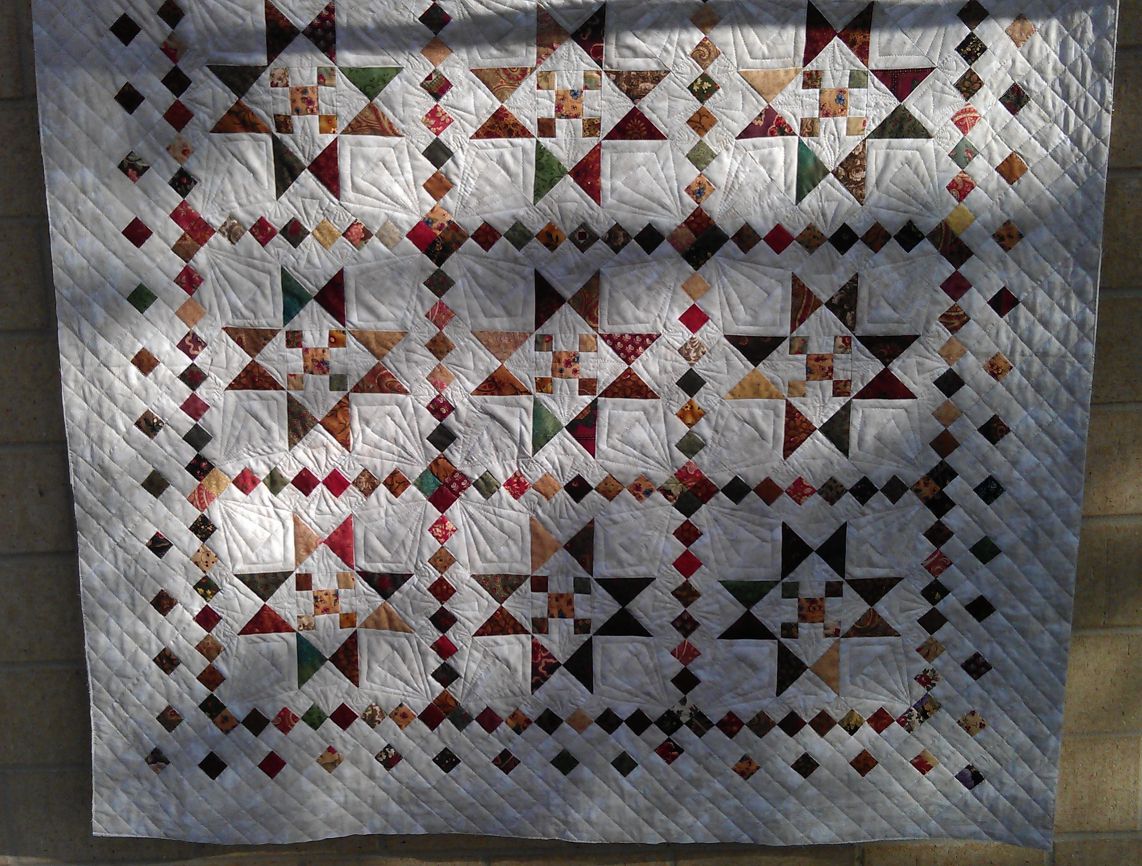
This pretty quilt was almost perfectly square, which was some achievement considering the triangular/bias blocks in the border! How to quilt it?

I started by stitching in the ditch around every stinkin’ coloured piece of fabric… Yep. Every one.

Then I auditioned some designs by putting a plastic sheet over the top of the quilt and marking on it with a marker, erasing, marking again, etc. until I got something I thought would work. The borders were always going to be cross-hatched to match the fabric seams and the angles of the little coloured squares in them, so that was easy. And I decided not to stitch the coloured fabrics, just the white space.

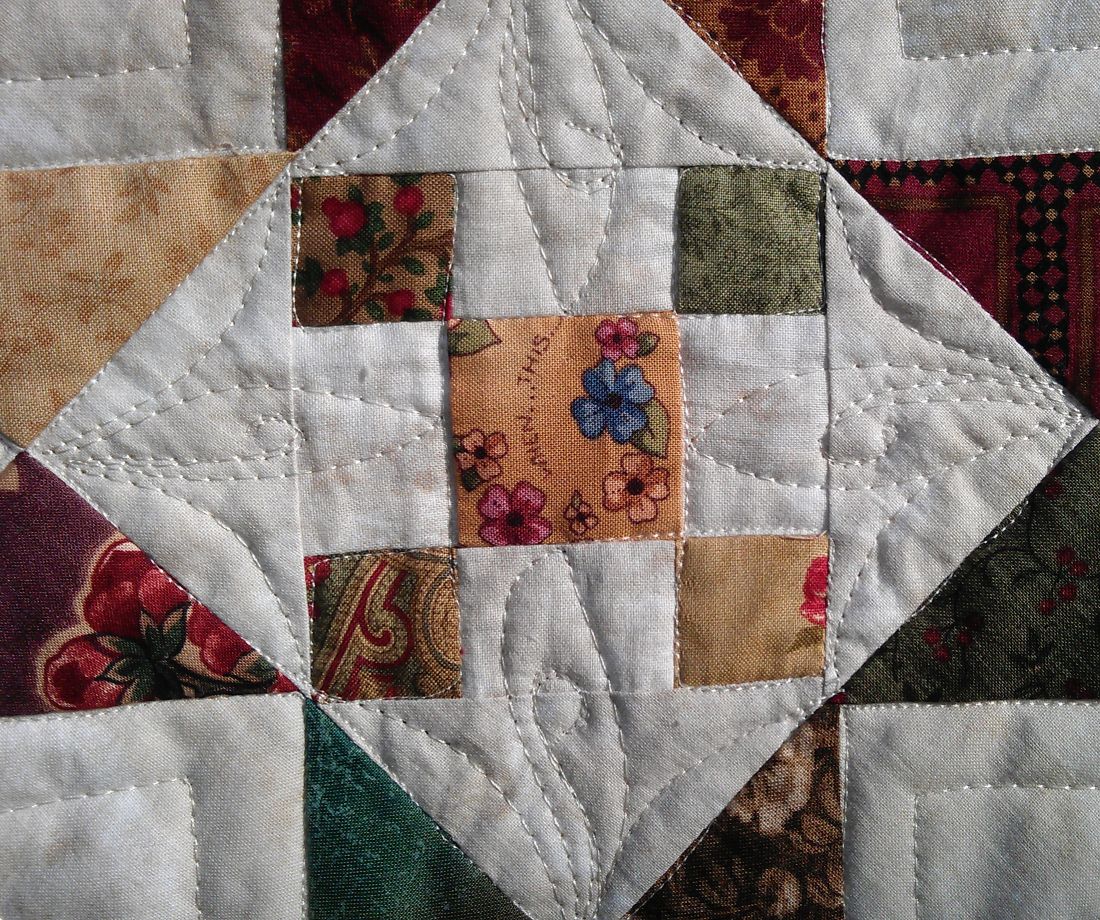
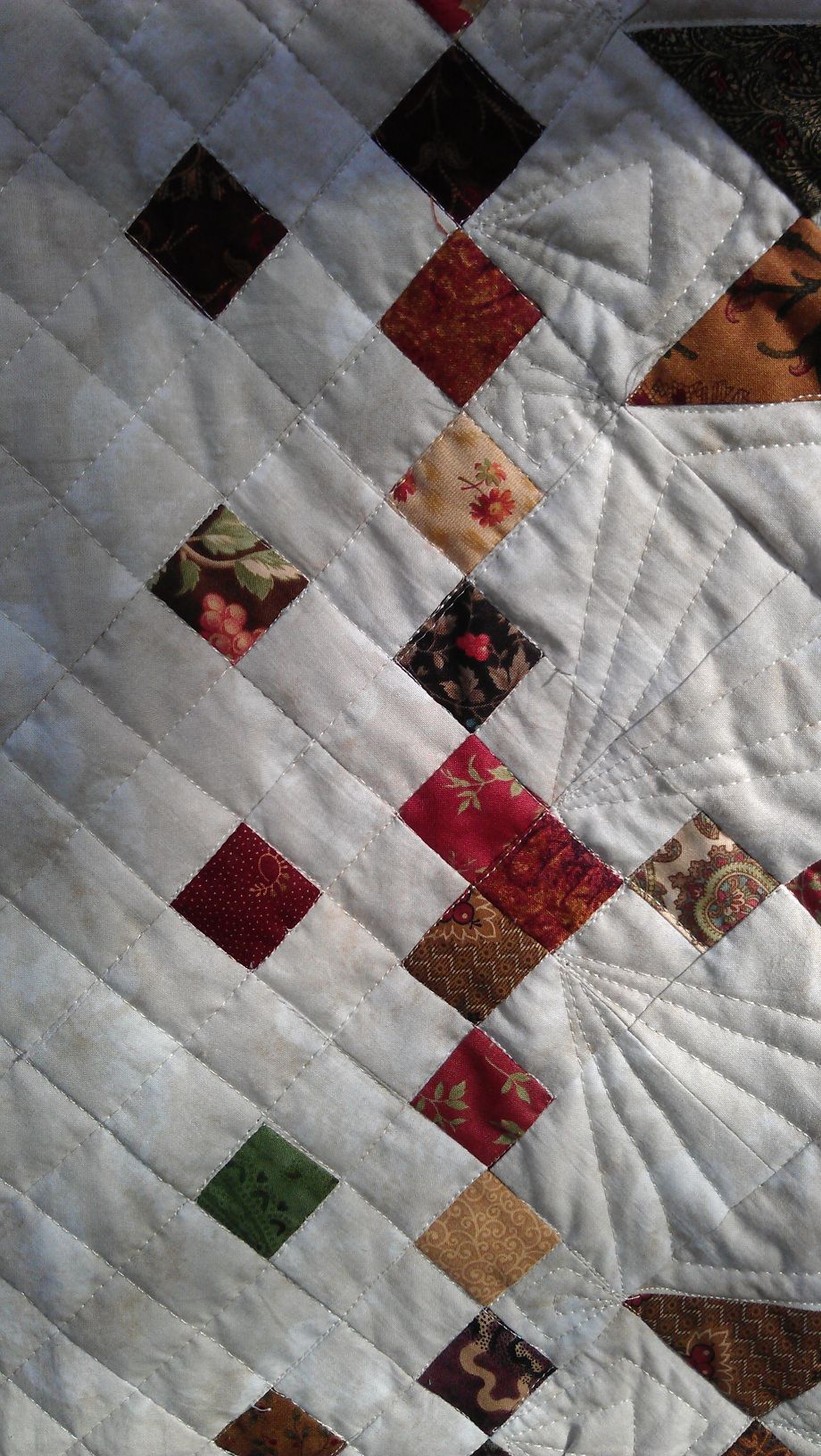
For the main star blocks, I did all sorts of things — 3-petal half flowers with a curlicue in the centre of the central petals; art deco style triangular type things in the squares (some facing one, some facing out), then finally big art deco style lines in the odd shapes.

I used my Line Tamer ruler for the cross-hatching in the borders, and for the very large outlines of the odd-shaped diamonds; everything else was free motion, including the stitch in the ditch straight lines.

I quite liked the overall effect.

(Click on a photo to view it larger)

quilt142_01

quilt142_02


quilt142_05

quilt142_04

quilt142_03


Threads used:

  • Top: Fil-Tec ‘Glide’ (40 wt trilobal polyester, colour ‘Cream’ #20001)
  • Bottom: Fil-Tec Magna-Glide pre-wound bobbin (white)


Community Quilt 141

11 05 2014

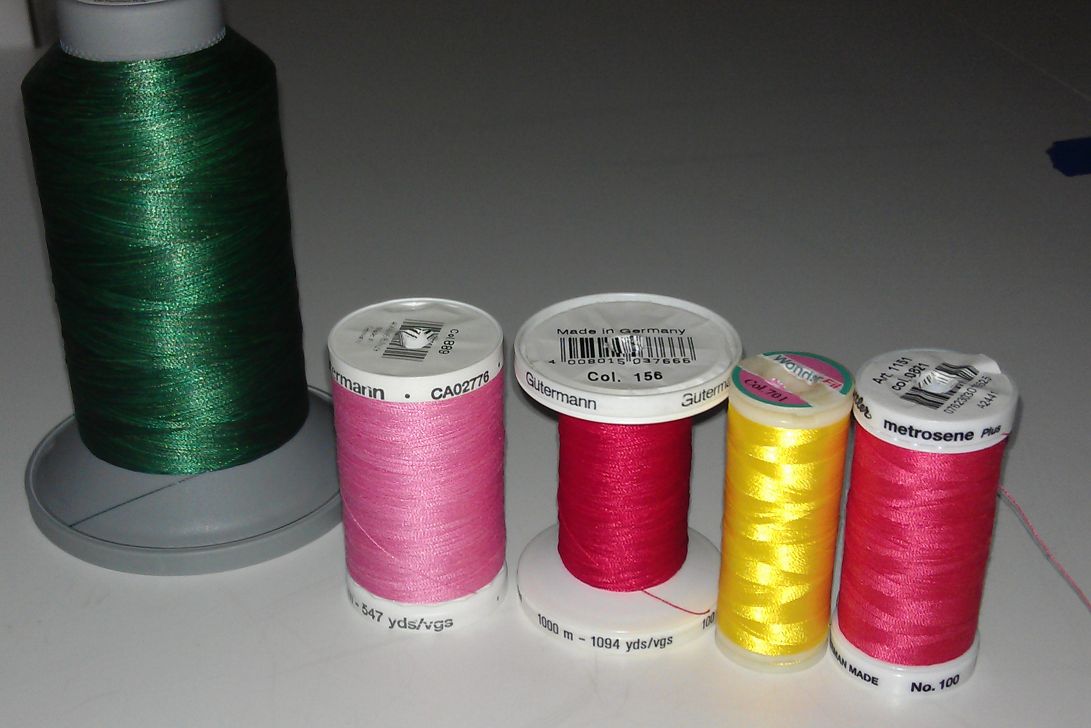
How to quilt this large quilt? I started by stitching in the ditch around all the blocks to stabilise it. Then I tackled the sashing strips and border as the fabric design ‘told’ me to do vertical stripey things. I added a spiral at each green corner join.

For the main blocks, I did a 3-petal flower type thing in the cream triangles. And then I came to a screeching halt. What to do in the 3-strip centre blocks?

I decided to alternate the motif, doing a curvy matrix in one, then a star in the other. The star goes from mid-point to opposite corner, to opposite mid-point etc. and I think it was quite effective. I used a soft green thread for these centres.

No rulers or marking pens were harmed in quilting this quilt 😉 It was ALL free motion. Even the stitch in the ditch… I’m getting much better at almost straight lines on my Sweet Sixteen.

This was a big quilt. I think it took about 6 hours to quilt.

(Click on a photo to view it larger)

quilt141_01

quilt141_03

quilt141_02


quilt141_04


The back:


quilt141_05

Threads used:

  • Top: Fil-Tec ‘Glide’ (40 wt trilobal polyester, colour ‘Cream’ #20001); Madeira Rayon (40 wt rayon, colour 1047)
  • Bottom: Fil-Tec Magna-Glide pre-wound bobbin (white)


Community Quilt 140

5 05 2014

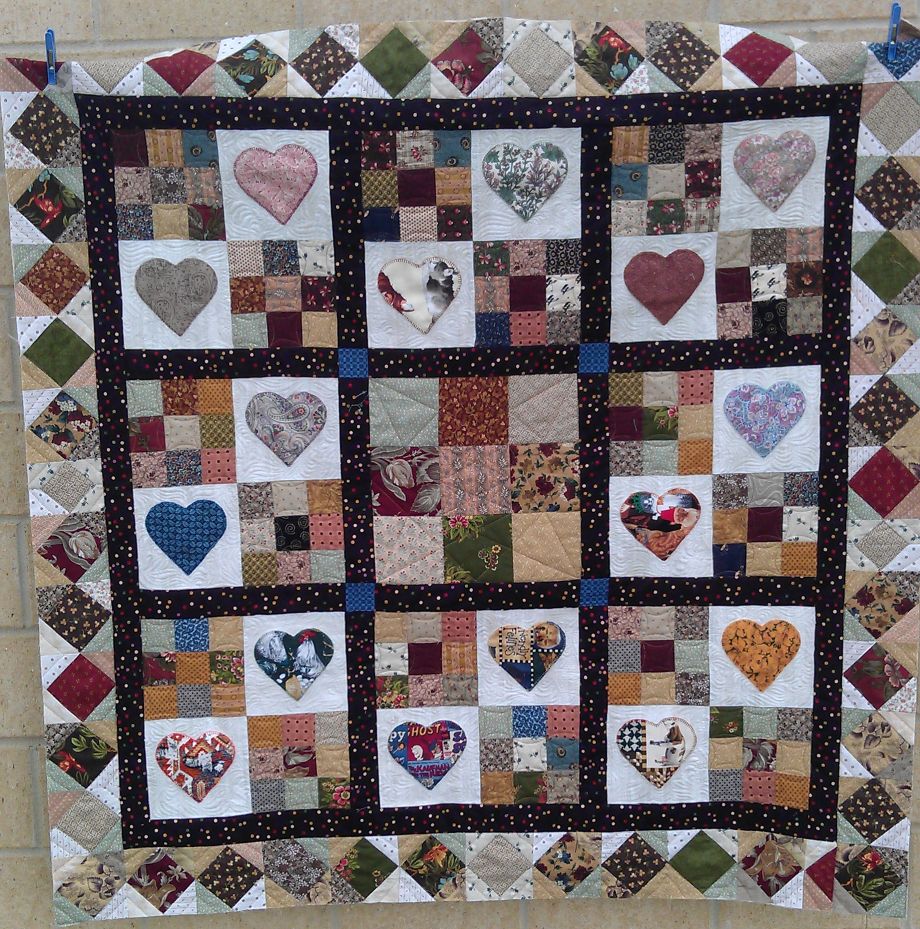
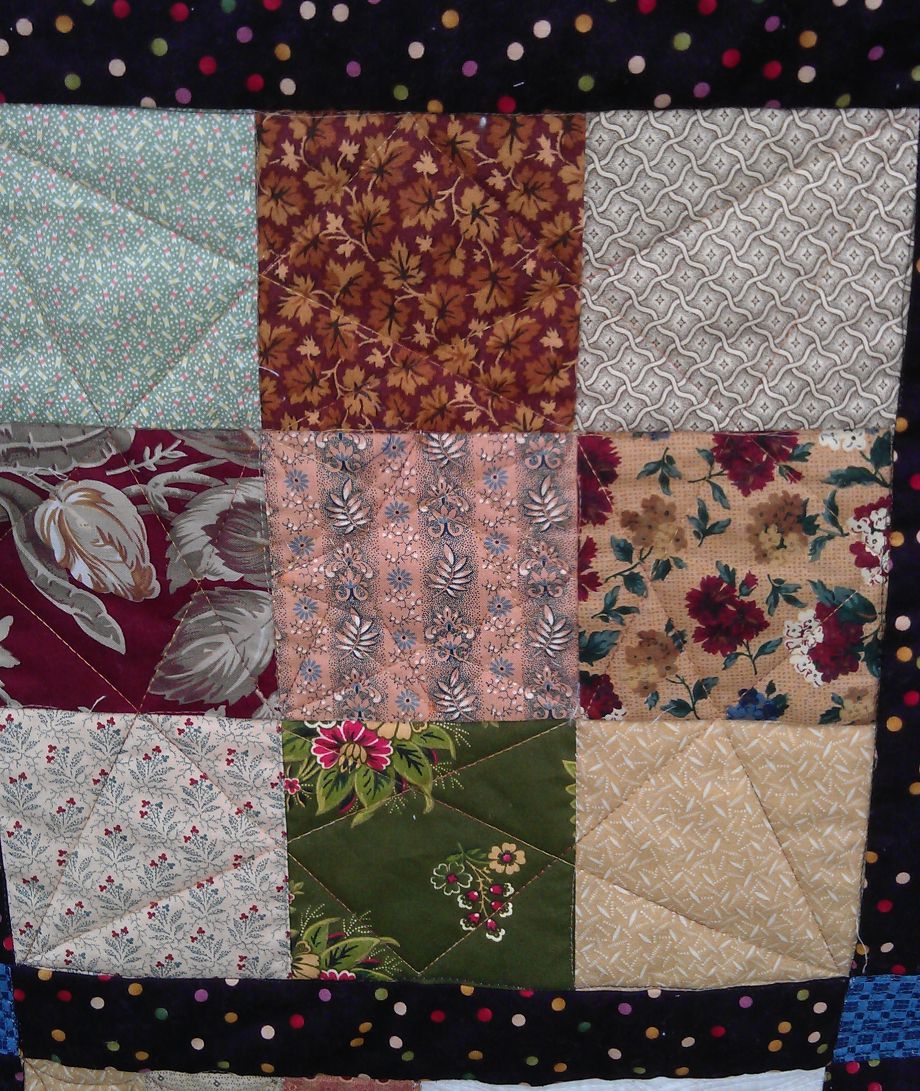
This smallish scrappy quilt had a lot going on — different blocks, various colours and shapes. How to quilt it?

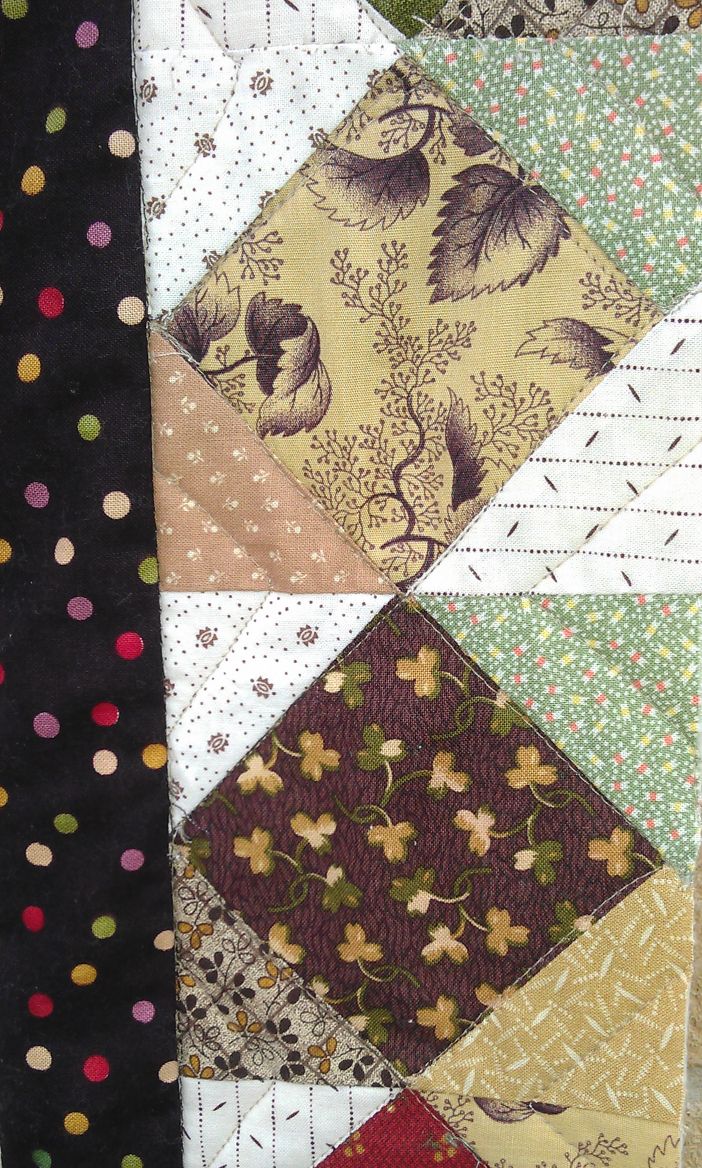
I started by stitching in the ditch around each block in a dark brown to match the sashing. Then I did the same to each diamond in the border, using a tan poly-cotton thread. Then I added detail to the border free stitching ‘straight’ lines from the centre point of each triangle to the centre point of the join, creating a chevron effect.

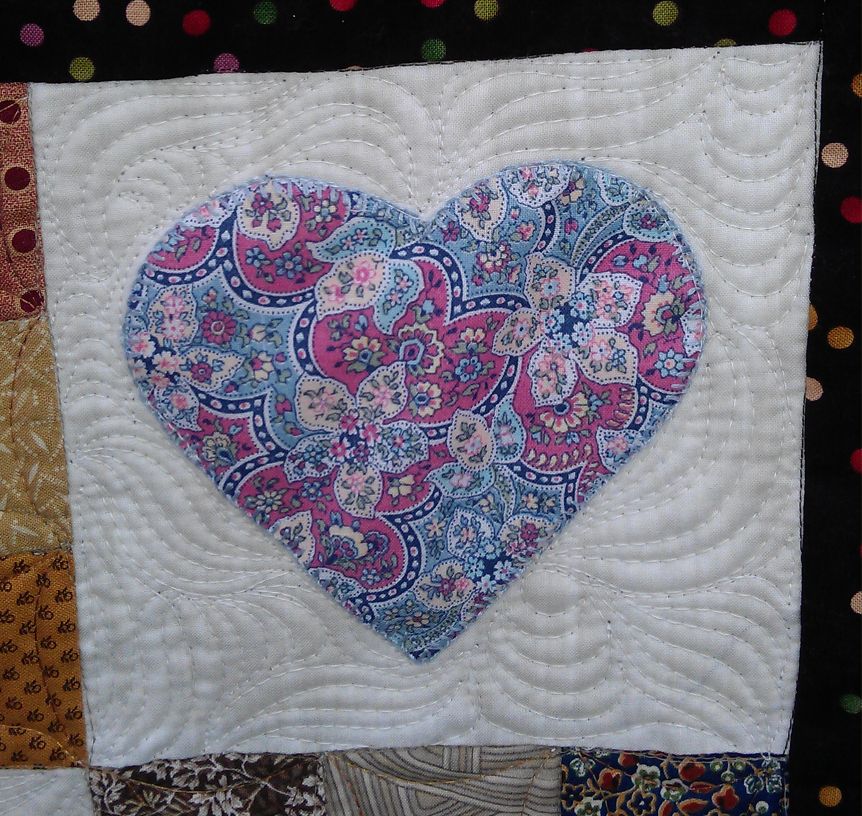
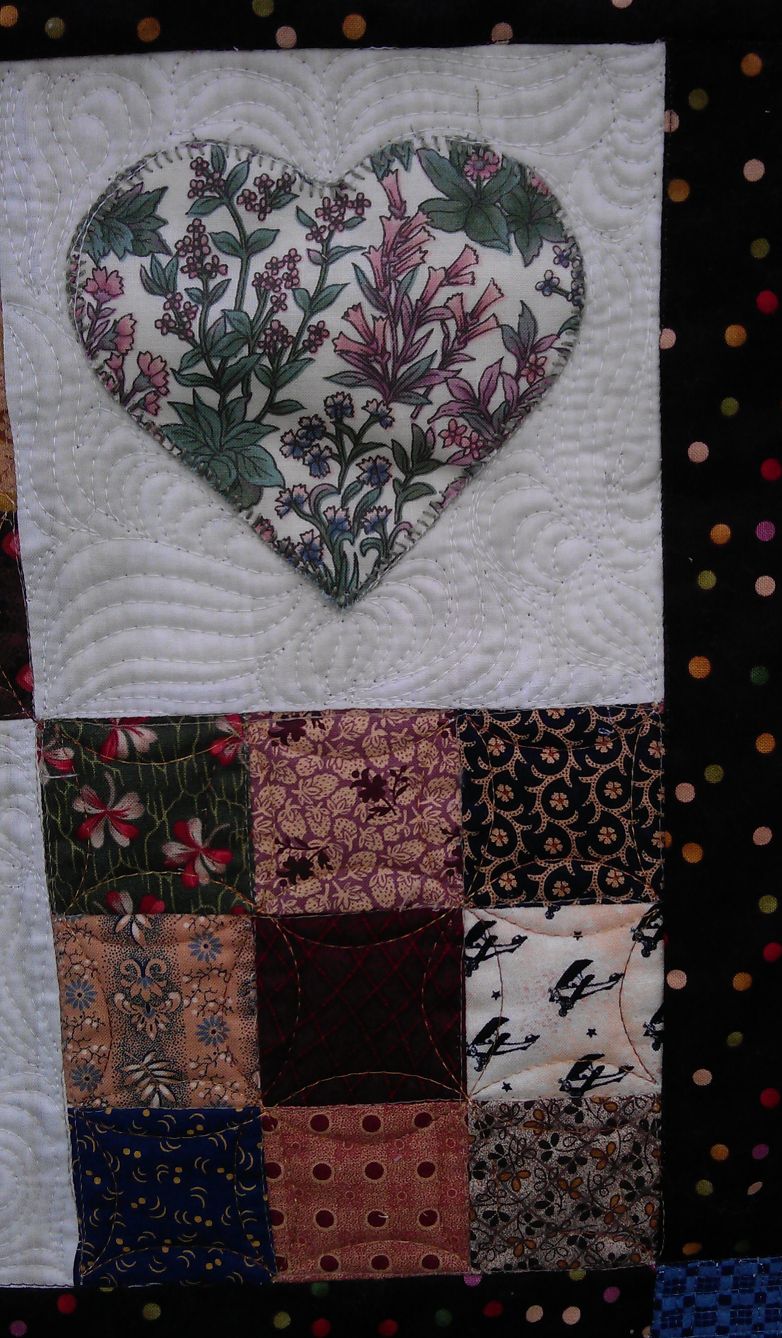
Next, I tackled the heart blocks, McTavishing around each heart in an off-white/cream thread. I left the hearts unstitched so they would puff. I also left the dark brown sashing unstitched. Then I changed to a variegated brown thread and did cathedral windows in the 9-patch blocks. Finally, I did some large and small stars in the centre 9-patch blocks, also in the variegated brown thread.

(Click on a photo to view it larger)

quilt140_01

Centre block:

quilt140_03

quilt140_02 Border:

quilt140_05

quilt140_04

The back:

quilt140_06

Threads used:

  • Top: Dark brown: Robison-Anton ‘Best Brown’ (40 wt rayon, colour 2566); Variegated brown: Fil-Tec Affinity ‘Brunette’ (40 wt, trilobal polyester, colour 60291); Cream: Superior Masterpiece (50 wt cotton, colour 151); Blue: Isacord (40 wt trilobal polyester, colour FB3842); Tan: Rasant (40 wt poly/cotton, colour 0862)
  • Bottom: Fil-tec Magna Glide pre-wound (white)


Community Quilt 139

3 05 2014

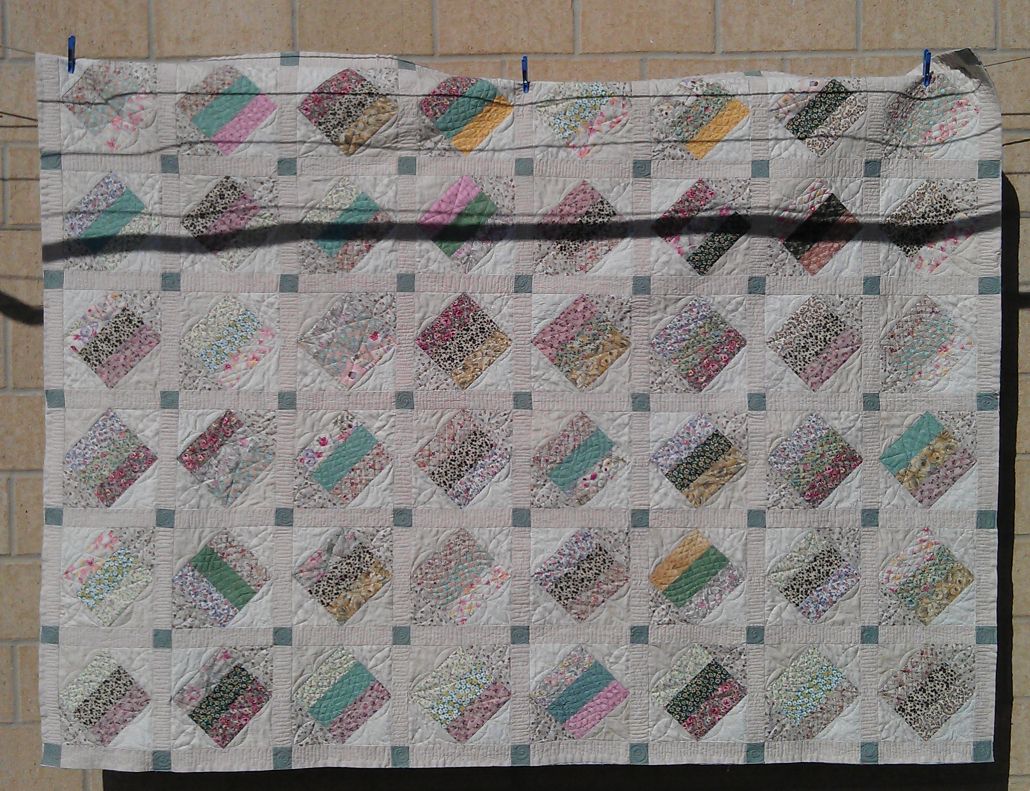
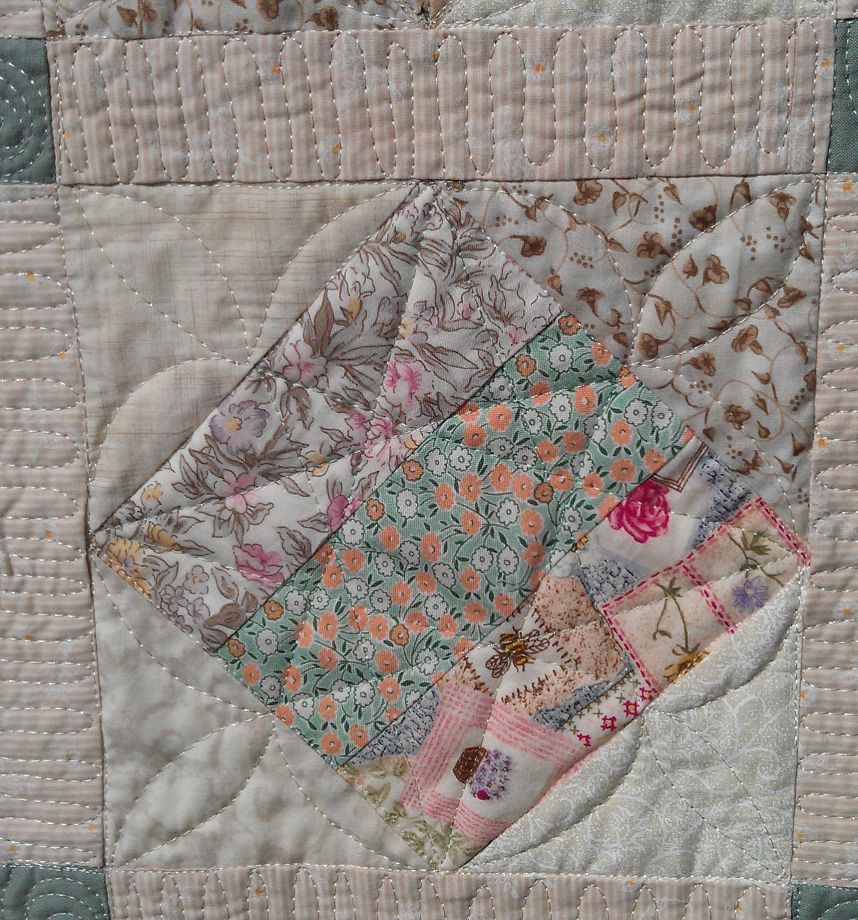
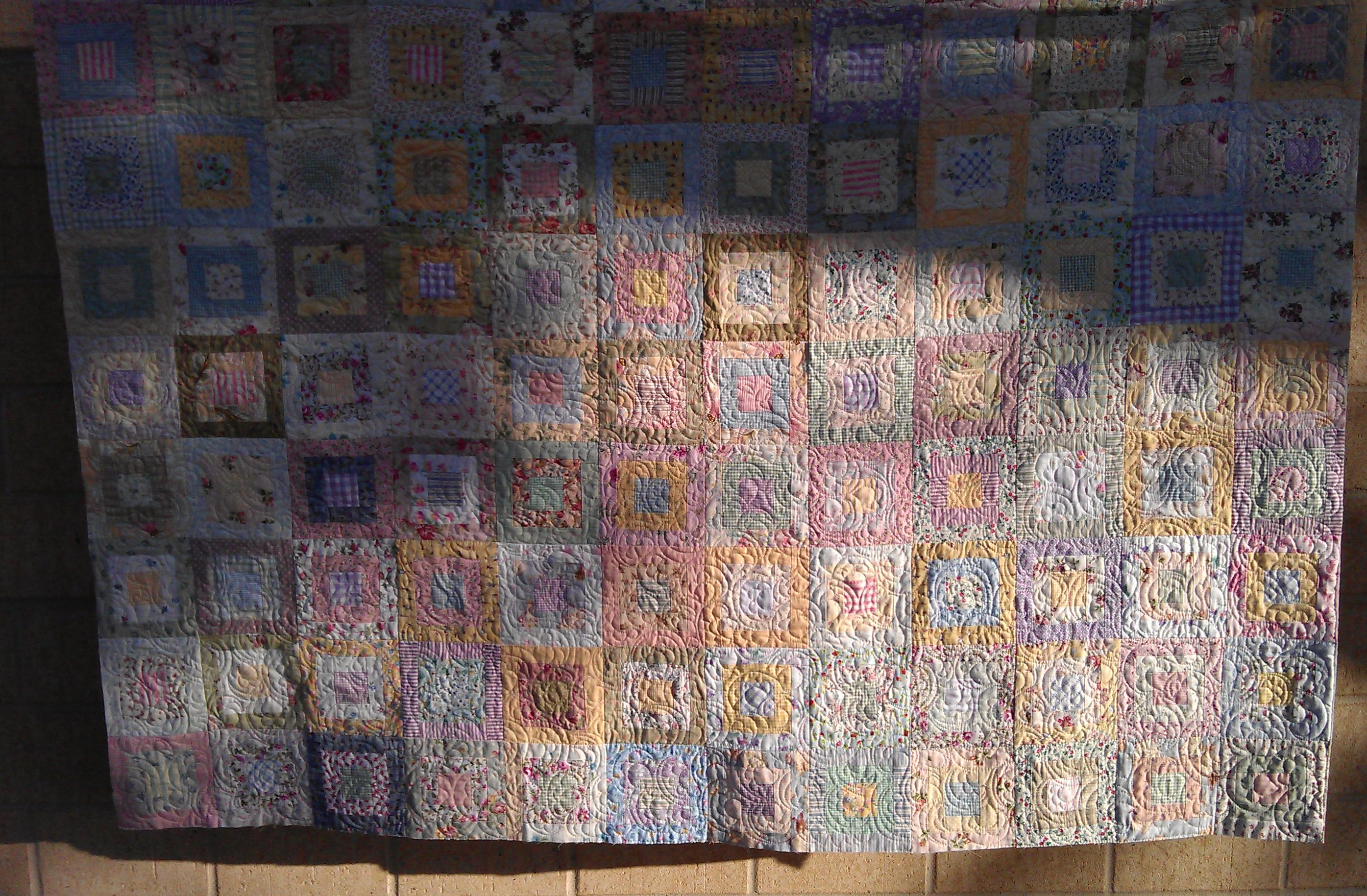
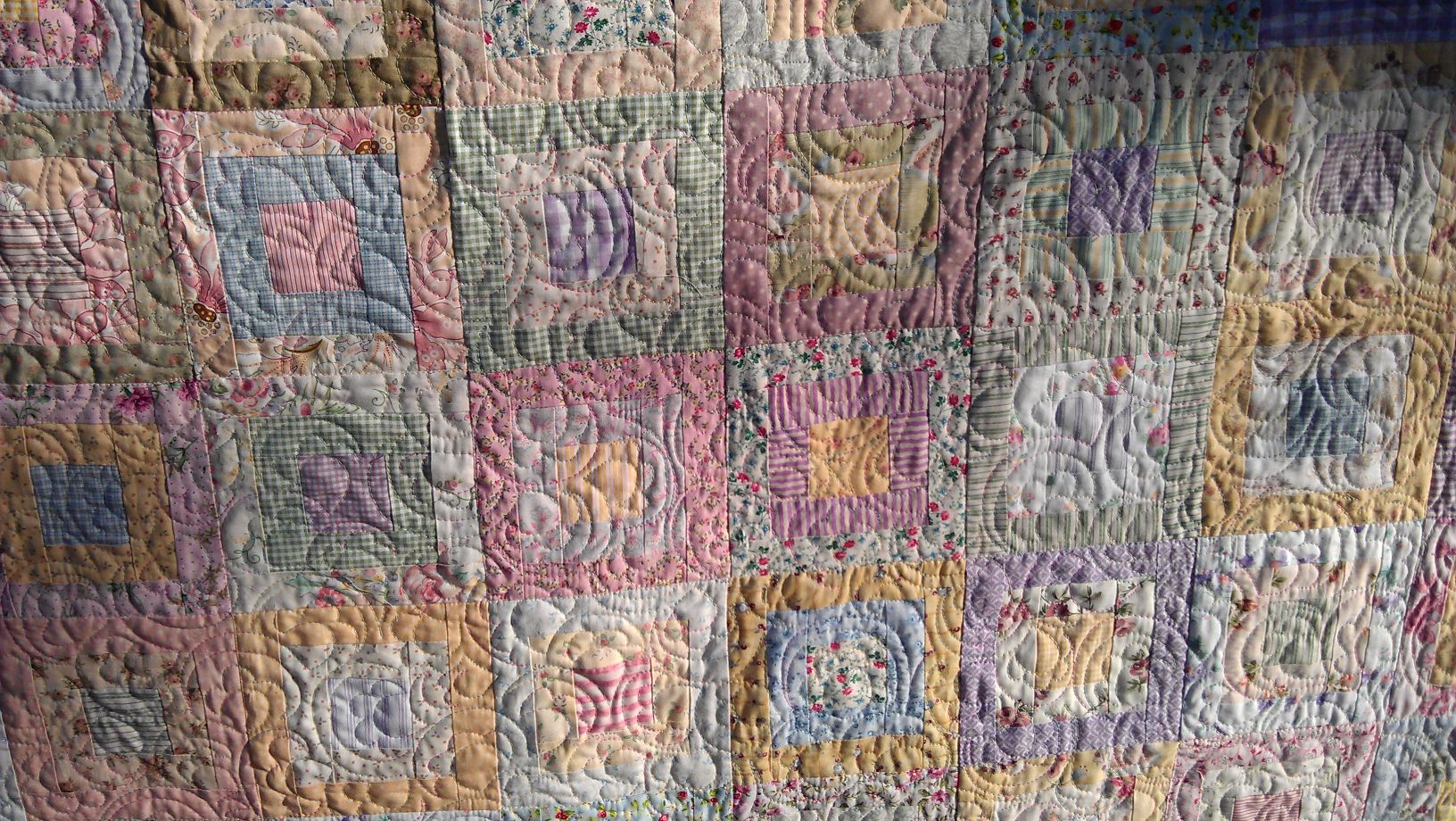
This was a big, pretty quilt. All those soft pastels that matched perfectly, even though when you look closely at the fabrics, you’d wonder how checks and florals and other patterns would go together. But they did.

I quilted this with a variegated pastels cotton thread (and generated a LOT of lint in the process).

My initial thought was to do square and round spirals in alternating blocks, but I ended up doing something more rounded — a variation on the ‘open headband’ motif with flower shapes around each inner arc. I stitched in the ditch around all the blocks first.

(Click on a photo to view it larger)

quilt139_01

quilt139_02

The back:

quilt139_03

Threads used:

  • Top: Fil-Tec ‘Harmony’ (40 wt cotton; ‘Spring’ colour 14062)
  • Bottom: Fil-Tec Magna Glide pre-wound bobbin (white)


Lint. The reason I don’t like cotton thread.

3 05 2014

Some of my favourite threads to use in my Handi Quilter Sweet Sixteen are the trilobal polyesters, specifically Isacord and Fil-tec’s Glide thread. Why? They run through my machine like a hot knife through butter, rarely shred or break, and leave very little lint to gum up the bobbin case, the bobbin area, the tension disks, or the thread path. And thus they are less likely to throw the timing on my machine out, or cause the top or bottom thread to gain or lose tension while I’m in the middle of quilting. However, in my experience, cotton thread leaves a LOT of lint, and it can gum up your machine pretty bad and very quickly, potentially causing all sorts of problems.

Some people swear by cotton thread and won’t use anything else to quilt with, but I’m not in that school. Some also believe that if you have a cotton quilt, then you HAVE to use cotton thread. I’m not in that school either. (And if you want evidence why that ‘belief’ is a fallacy, go to Superior Threads website and take a look at the thread videos by Bob Purcell [Dr Bob]: http://www.superiorthreads.com/videos/thread-therapy-with-dr-bob-educational-videos/.)

I quilted my most recent community quilt with cotton thread as it was the thread with the colour that best matched quilt top. And I had all sorts of tension issues at various times; ALL were related to the accumulated lint from the cotton thread. I had to clean the machine at least five times while I quilted this quilt.

Here are some photos I took of the lint prior to one of these cleaning sessions, with some advice on what bits I cleaned and how.

lint09

I try to clean and brush from the top down, so that any bits of lint and fluff that come off the top areas get swept up when I do the lower areas. I start with the tension disks. Although the thread is in in this photo, I usually remove the thread, loosen the tension disks as far as possible, then give the disks a good brush — and a short sharp blow with my breath (compressed air would work too). This picture doesn’t show a lot of fluff, but one of the cleaning sessions I did earlier had this area heavily coated in fluff.

lint05

Next, I brush up under the metal housing where the lights are, then down the two shafts, around the needle screw, the needle, and the foot. There doesn’t appear to be a lot of lint on these areas, but you’ll be surprised how much comes out with a good brushing.

lint02

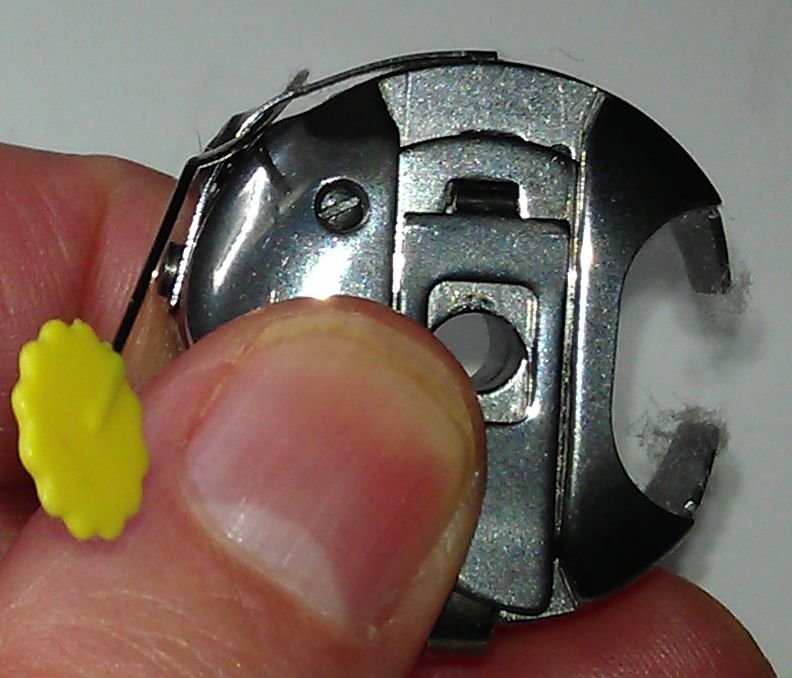
Now I pull out the bobbin. Note the fluff at the opening. What you can’t see is the flattened gunk behind the spring where the thread comes out.

lint01

Another view of the lint inside the bobbin case as seen through the opening.


lint03

I remove the bobbin (and blow off any lint on the bobbin), then slide an old pin in the small gap between the spring and the case (NOTE: A business card works really well too and is less likely to scratch). Jiggle the pin (corner of a business card) around in there and slide it all the way to the right to get out any squashed gunk. You might also have to put the pin inside the bobbin case and run it up the slit as there may be some lint stuck in there too, and that’s bad as it WILL affect your bobbin’s tension.


lint04

View of the small gap where I slide the pin. After cleaning the gap, I brush out the inside of the bobbin case to get rid of the all the accumulated fluff in there.

lint08

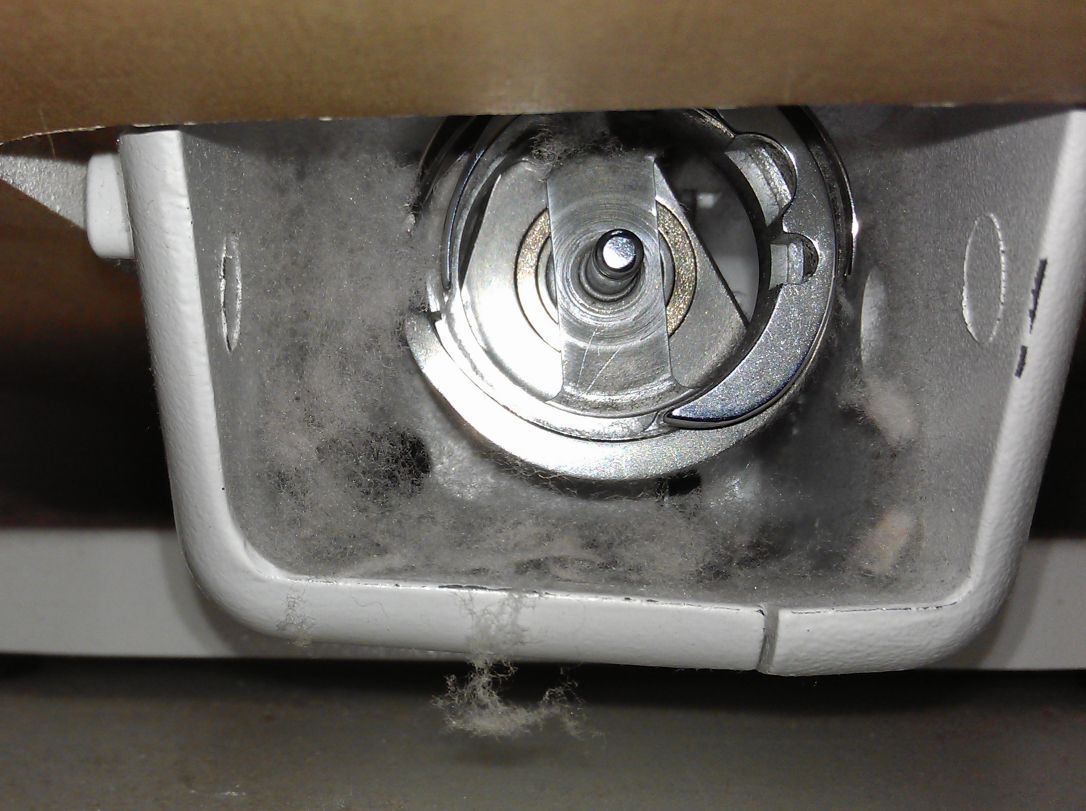
Next, I tackle the area around the bobbin housing. Look at all that nasty lint! I took this photo less than an hour after the previous cleaning. I give the bobbin housing area a good brush from underneath to remove what I can.


lint07

Because there was so much lint/fluff below, there’s likely to be even more inside the bobbin housing area. So remove the needle plate and brush out any visible gunk.

lint06

Gunk seen from above that brushing out from underneath didn’t get. I usually single press the presser foot a couple of times to turn the bobbin housing and get any more that’s hiding underneath.

lint10

The brush gets pretty gunky too, so remove as much as you can by hand.


lint11

However, every so often you’ll have to clean the brush so that all the accumulated gunk doesn’t prevent the brush from doing its job. I run a pin up from the bottom to the top several times to get out the embedded gunk.

You can see why I don’t like quilting with cotton!

See also:


Community Quilt 138

30 04 2014

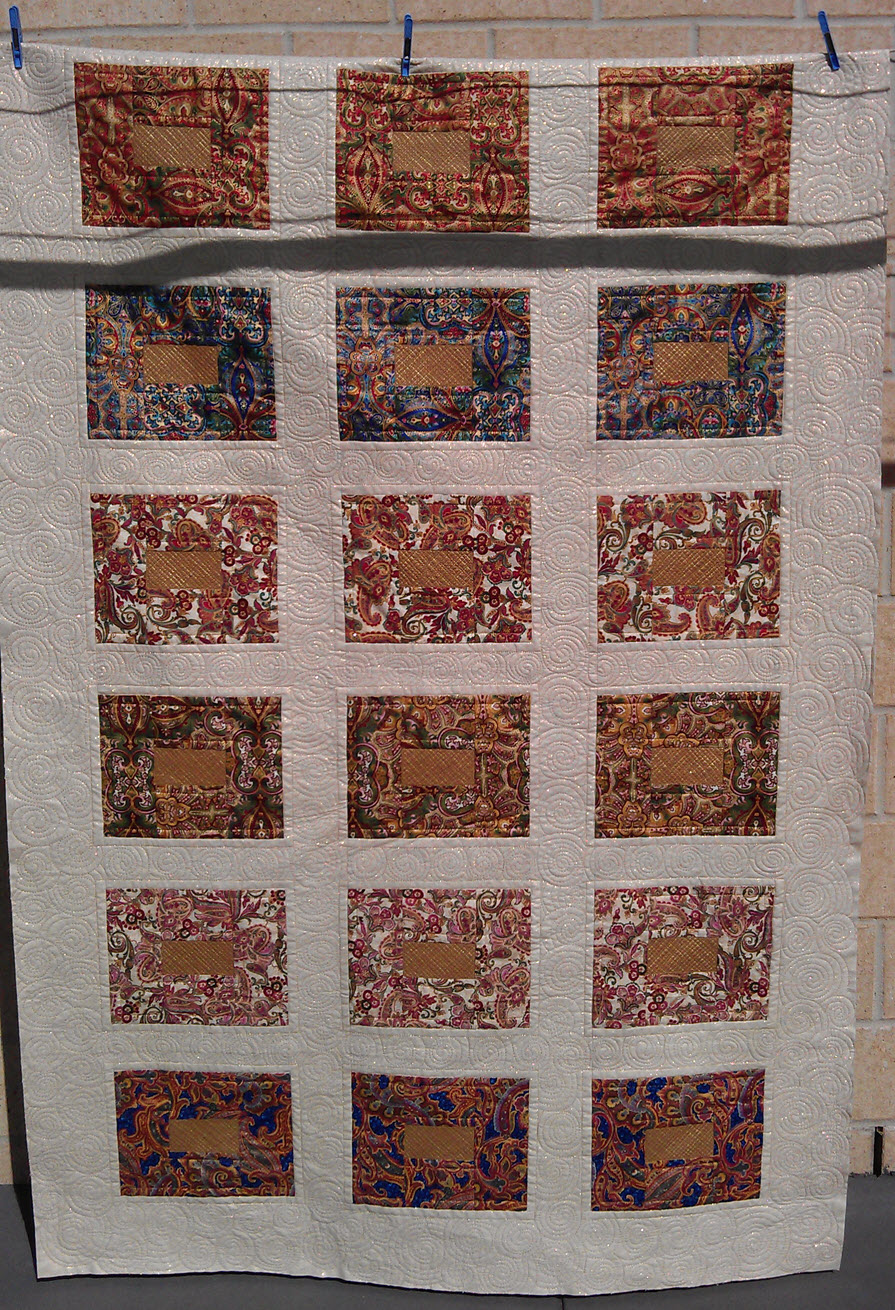
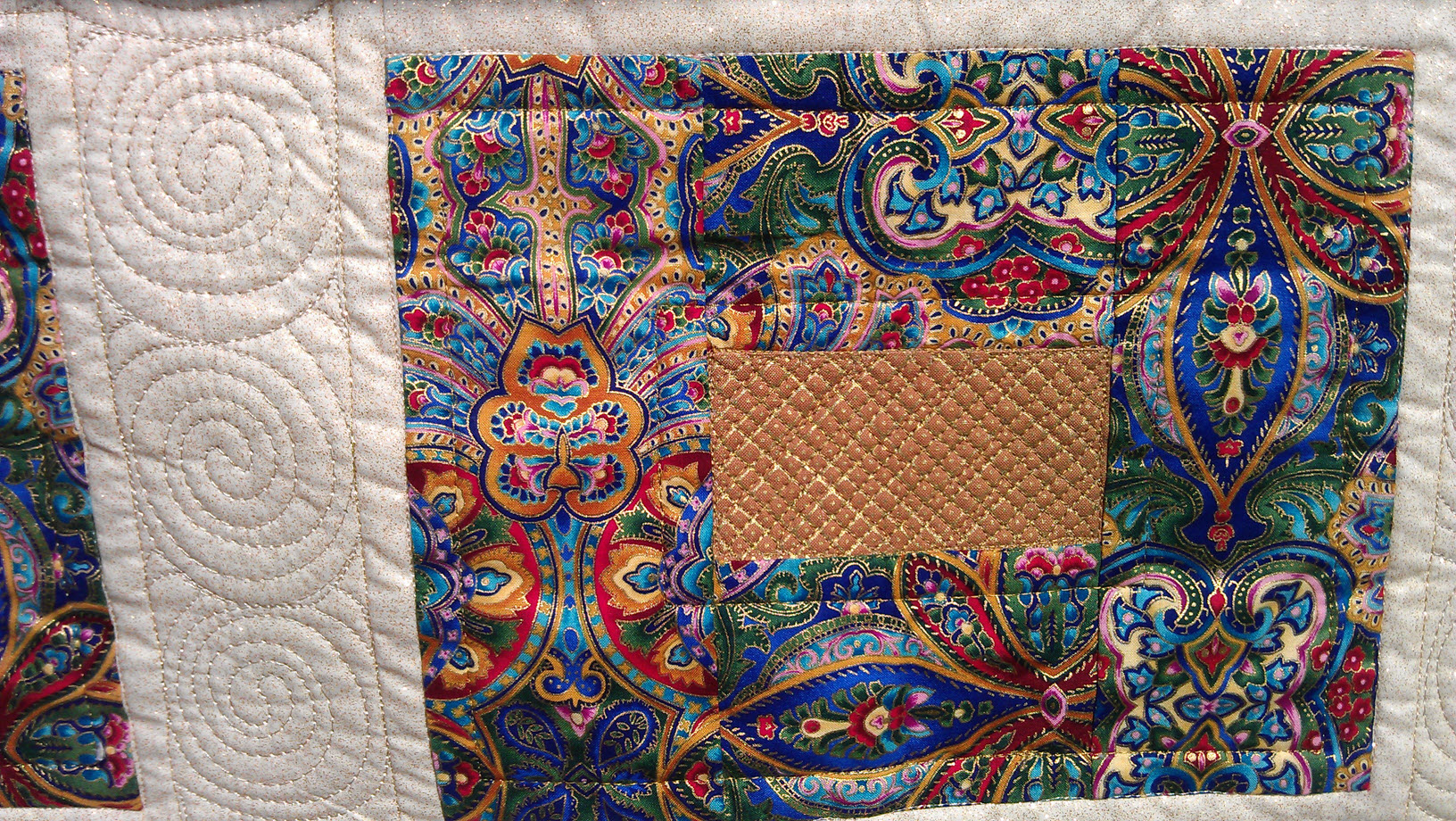
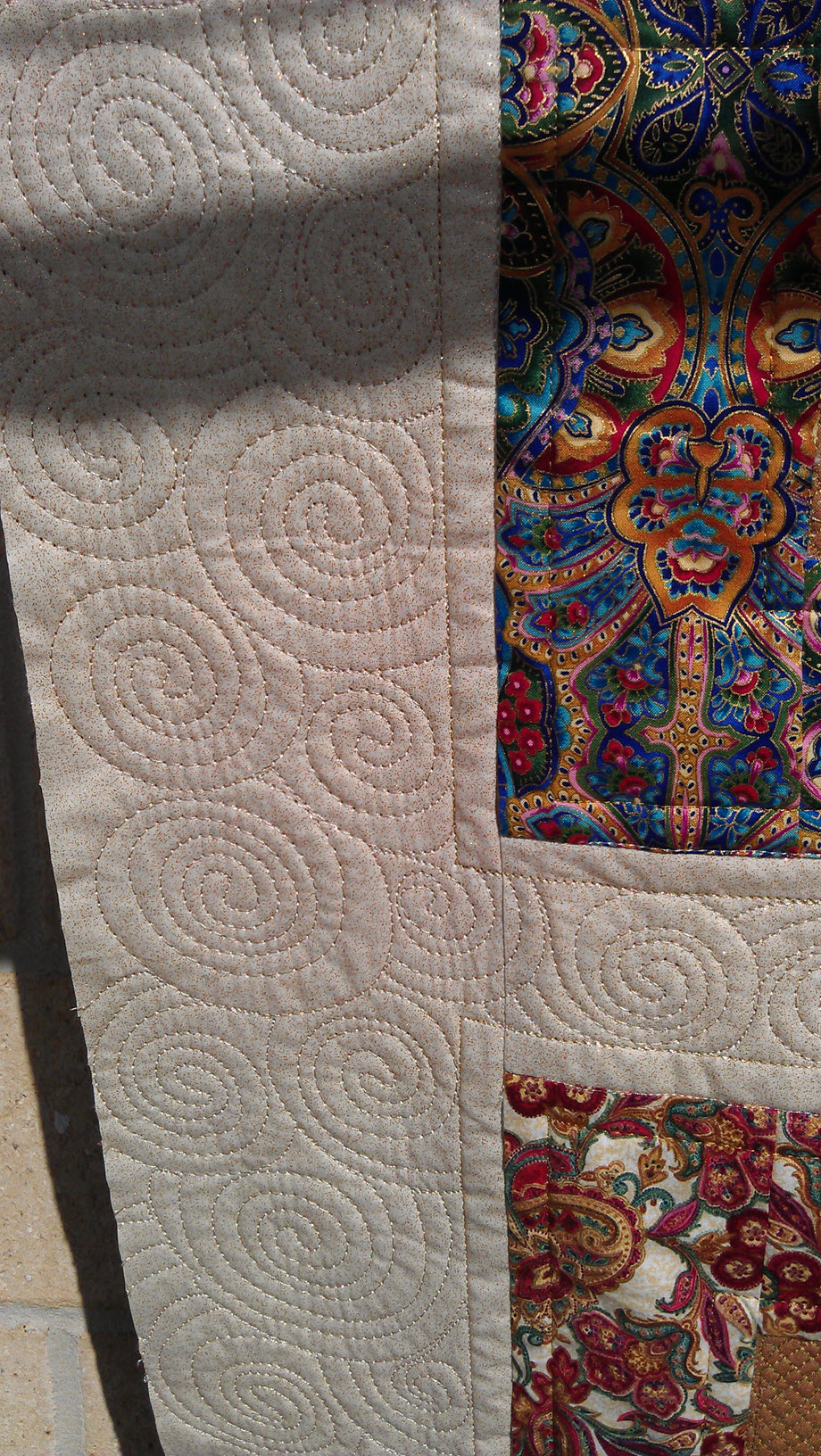
This big quilt offered its share of challenges. It was nice and square, which was great. But the cream fabric used for the sashings and border was very hard, thick, and stiff as it was impregnated with gold flecks — I suspect it wasn’t a ‘quilting cotton’. As a result, all the needle punches through the three layers created fairly large holes, which I hope will close up and ‘self heal’ over time.

How to quilt it? Well, the rich colours of the fabrics in the blocks and the gold flecks in the cream fabric lent itself to gold metallic thread, but I ended up only using that for the outer straight lines around each block as I had trouble with the metallic thread. So I used an ‘old gold’ rayon thread for the in-the-ditch stitching, the inner straight echo lines for each block, and for the cross-hatching inside the centre of each block, which followed the cross-hatching in the pattern of this centre fabric.

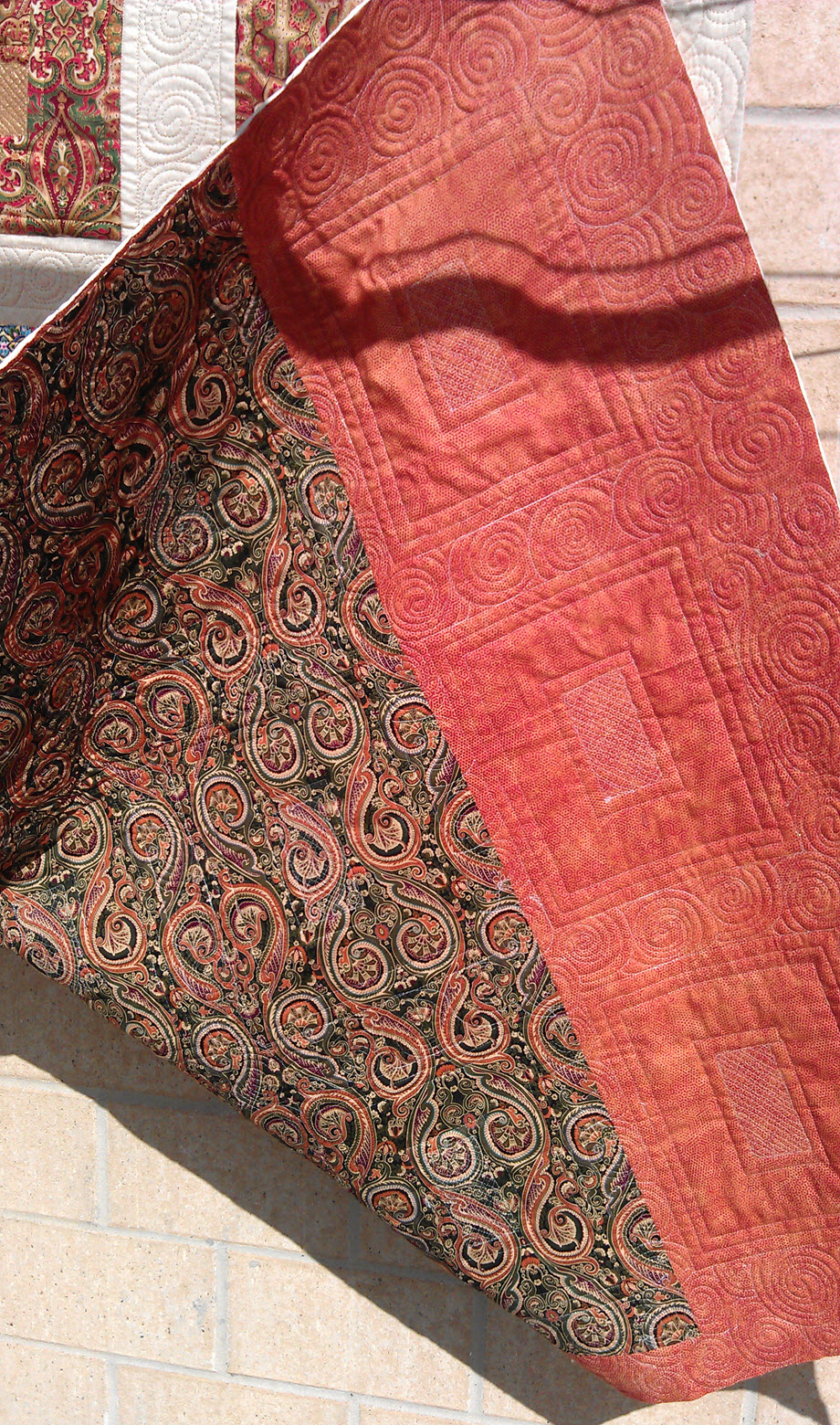
I decided to leave the rich paisley fabrics unquilted, instead stitching the sashings and borders in a fairly dense spiral motif, in a matching cream thread (though it’s called ‘Khaki’ on the thread cone!).  That way the blocks ‘pop’ and add a little puffiness to the quilt.

While I was quilting this quilt, I set up my suspension system and it worked a treat in reducing drag.

(Click on a photo to view it larger)

quilt138_01

quilt138_02

quilt138_03

quilt138_04

quilt138_05

Threads used:

  • Top: Robison-Anton (40 wt, rayon, ‘Old Gold’ colour 2201; used inside the blocks including the cross hatching in the centres of each block); Fil-tec Glisten (metallic, ‘Gold’ colour 60088; only used for the outer straight lines around the large blocks) ; Fil-tec Glide (40 wt, trilobal polyester, ‘Khaki’ colour 24525; used in the sashings and borders)
  • Bottom: Fil-tec Magna Glide pre-wound bobbin (white)


Handi Quilter Sweet Sixteen: Working with metallic threads

29 04 2014

sewers_aid_metallic

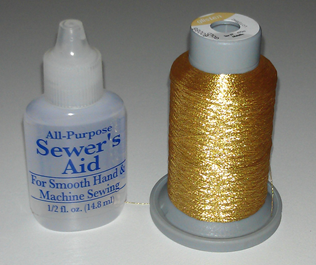
I don’t have a good history with metallic threads. They are oh so pretty, but many’s the time I’ve wanted to throw the thread in the trash as it just won’t work for me in either my domestic sewing machine or my Sweet Sixteen. I follow all the rules and guidelines, and occasionally… just occasionally, it will work. And then there will be several months before I’m willing to try it again, knowing that there will be frustration and that angry words will be spoken 😉 I’ve watched Helen Godden demo HQ machines at quilt fairs and she often uses metallic thread and she seems to have no issues with it so I figure it has to be tamed somehow.

My latest foray into metallics was using a Fil-tec ‘Glisten’ metallic thread in gold. It was such a pretty thread and the quilt top begged to be stitched in gold… I had Fil-Tec Magna Glide in the bobbin.

But I went crazy trying to get this metallic thread to work without snapping every inch or so or stitching.

Here’s my litany of frustrations and what I tried, as I emailed to my dealer:

Top thread settings and things I tried:

  • one hole only in the 3-hole thingy
  • loosening top tension to the point that I had to unpick as I had scrunchies on the back
  • horizontal spool holder and upright (it’s a cross-wound spool), with and without a thread net.
  • slowing down from 50% to 25%
  • Size 18 Groz-Beckert needle set at 5:30 and then 6:30 position (I have very little success with ANY threads at 6:00 position). HQ’s website says the size 18 needles ‘work well with metallic thread’.

I’m trying to use it with a ruler but it keeps snapping. If I’m lucky I get to stitch about 2 inches, then SNAP. Changing from 5:30 to 6:30 helped a bit, but not for long.

My test piece worked fine – no ruler for that though, and it was only to check tension. However, I need to use the ruler as I need to get straight lines around 18 blocks. I haven’t even finished ONE block after nearly an hour….

I don’t have much luck with monofilament either, but that’s not today’s issue.

While I was waiting for her reply, I checked the archives of the forum I’m on and found that some people had luck with putting a few drops of Sewer’s Aid onto the spool of thread. I had some of that, so I tried it and it worked SO much better. Not perfect, but a LOT better, though not enough for me to continue with the metallic thread after I’d finished the outside stitching around each block. By dribbling three drops of Sewer’s Aid onto the spool, I was able to complete the ruler lines around a block without a single break – it took 2 minutes instead of the hour of frustration for the first block! I put another two sets of three drops in total for the rest of the blocks, so this isn’t a one-off fix — you do have to reapply it. But it worked so much better than doing nothing.

My dealer also got back to me with these suggestions:

I quilt all the time with metallic both FMQ and with rulers.  I don’t have any troubles.  Here is what I do:

  • Use a thread net.
  • Reduce the tension in my bobbin slightly so that I can back off the tension on the top
  • I usually quilt at around 35-45% depending on what I am doing.
  • I will use either size 16 or 18 needle (whatever is in usually suits)
  • Mainly I use 2 holes (but have gone to 1 if thread performance is questionable)
  • I don’t look at my needle position – whatever position it is in is fine.

Recently at Helen’s workshop she demonstrated in metallic.  Of course everyone wanted to sew with that.  Most people had trouble.  But honestly the thing that will tame metallic thread is a thread net!!  It is an essential when using metallic in my book (cannot be used on horizontal spool holder though).

The thread net will add tension however, so you will have to compensate with the tension and reduce it a little.  If you are getting looping underneath, then back the tension off on the bobbin case.  You can tweak this a fair bit.  Each wrap in the 3-hole guide will also add tension, so you might find that with all of the above you still have to drop back to threading through one hole.

Also, you must consider wadding types.  Thread performance is also affected by different types of wadding.  Was your sample piece the same as your quilt you were working on?

After all that.. I am out of ideas.  I would have to sit and work with the thread myself to get it going… Sometimes – the thread just has to be filed.. in File 13 (trash!)

I have no trouble with monofilament either – but see if the abovementioned helps you to use mono as well.  All the same principles apply.


Improvise! Bungee cord system to hold up quilt

27 04 2014

One of the ladies on my quilting forum has designed a system for holding up quilts to prevent drag when the quilt falls off the edge of the table, as any large quilt will do unless you have a HUGE work area. You can buy her system from here: http://www.jennoop.com/suspenders.html. However, because the shipping costs for such as system to Australia would be HUGE, she’s also suggested that we develop our own. So I did.

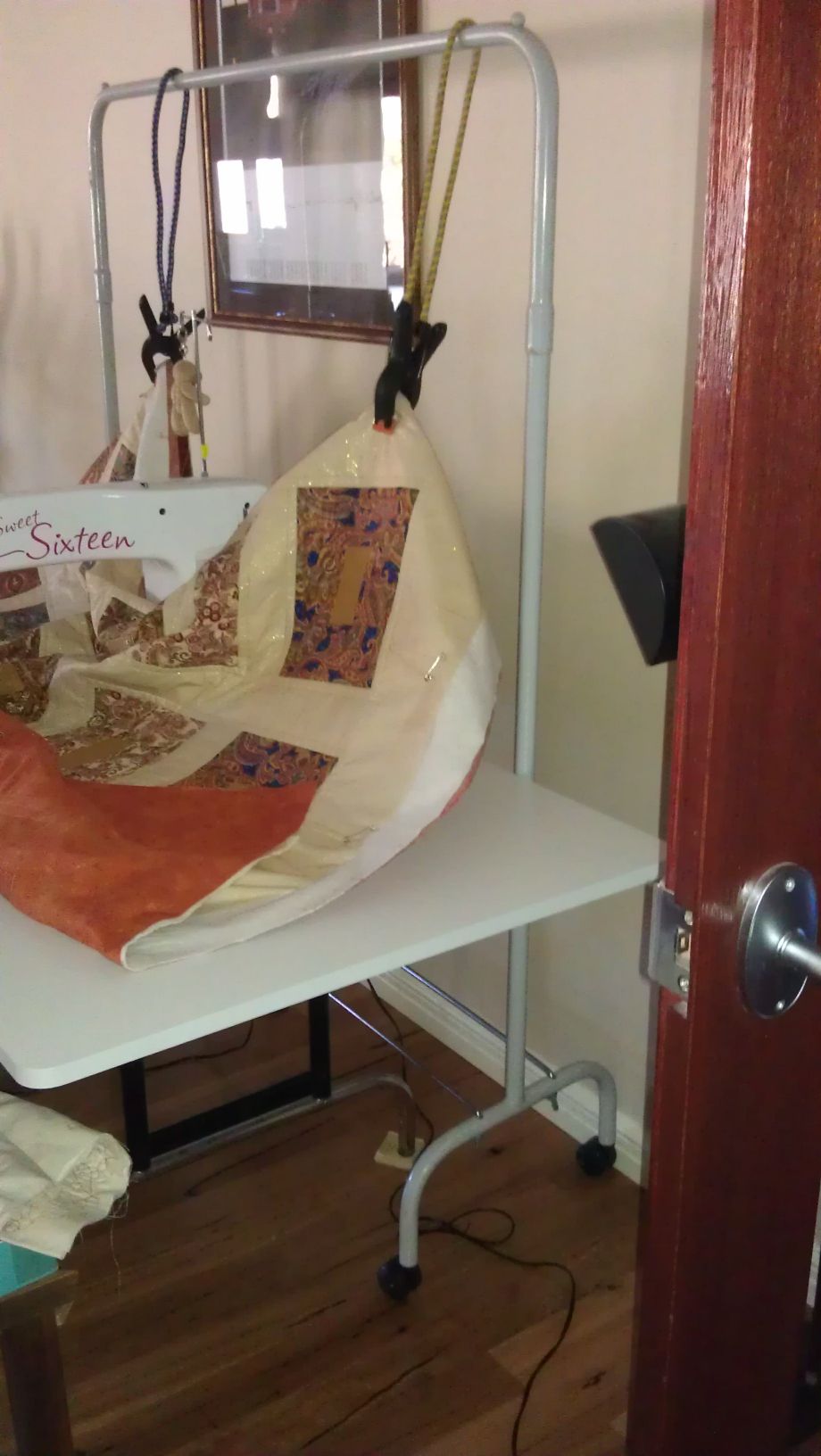
I remembered that we had an old portable hanging rack that we’d dragged around from previous houses, and that had been very useful in the day. But I didn’t know where it was as we’d either given it away or stored it after we last moved some four years ago. But my husband said that it should be in the shed (I’d looked) if we hadn’t given it away, and he thought we might have dismantled it. After some hunting around in the shed, I found it in pieces on top and behind a couple of storage racks. He also said we had bungee cords in the stuff for the bike rack, so I found those too, and grabbed two of the clamps I use on my basting table, and voila! I had a suspension system for my large quilts made from stuff I already had.
Here’s my setup after I’d finished putting it together (30 minutes to find the stuff, 10 minutes to put it together).

bungee03

bungee02

bungee01

The only downside is that I had to move the table out from the wall about 6 inches to accommodate the legs (my Sweet Sixteen is in the main living room). I’ve yet to use it, but will report back once I have. If it doesn’t work for me, then I’ll just dismantle everything again and put it back in the shed 😉

And yes, that’s an Eagles ‘Hotel California’ poster on the wall. And note the 1980s grey of the hanging rack 😉

Update later the same day: Well, these are brilliant! I didn’t realise how much drag I had put up with, as I thought I puddled my quilts pretty well. But once the drag was taken away, the quilt moved effortlessly across the table top/sewing bed without much shoulder/neck/arm movement and no death grip grabbing and pushing/pulling. Yes, I had to reposition the clamps every so often, but I had to reposition the ‘puddle’ much more when I was doing it that way. This is a winner!!