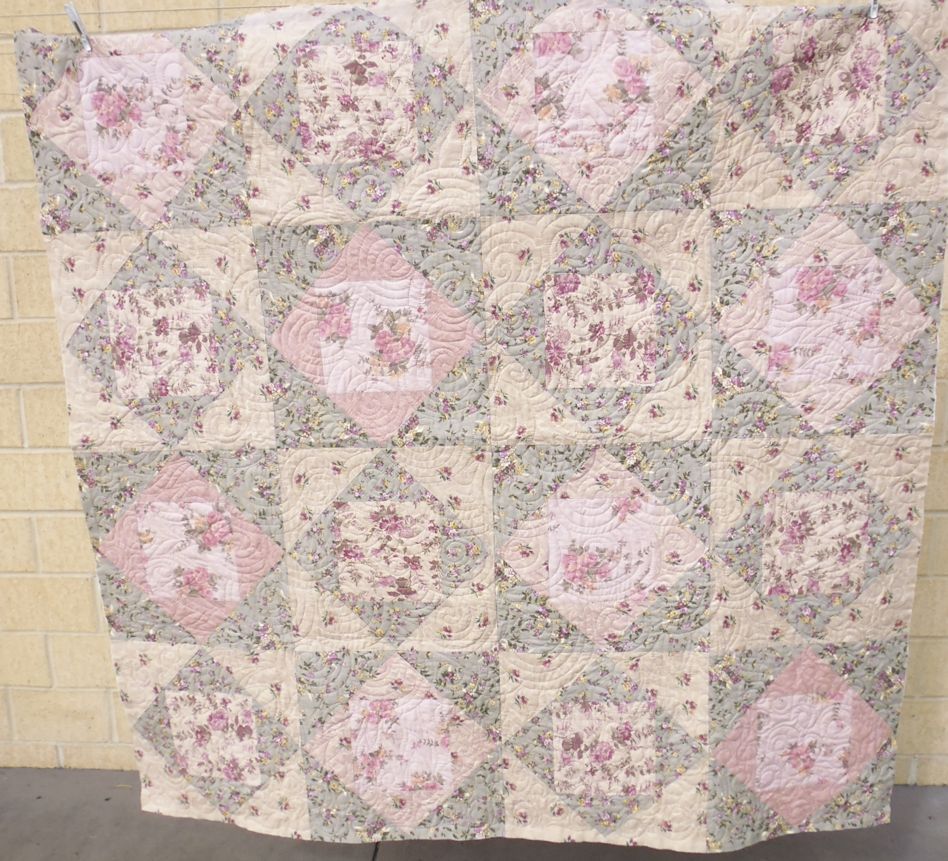
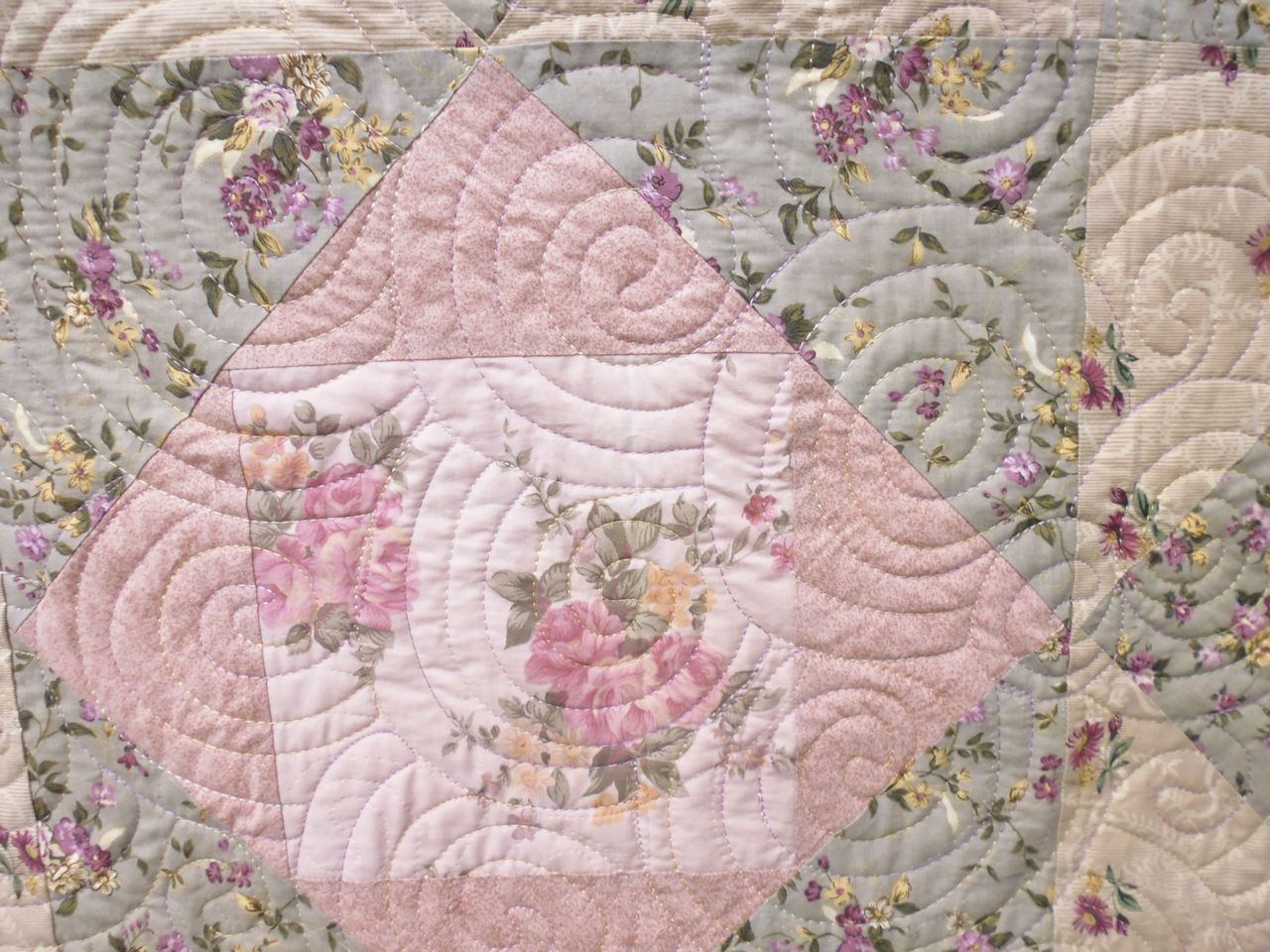
Another quilt that I stitched with an all-over spiral.
(Click on a photo to view it larger)
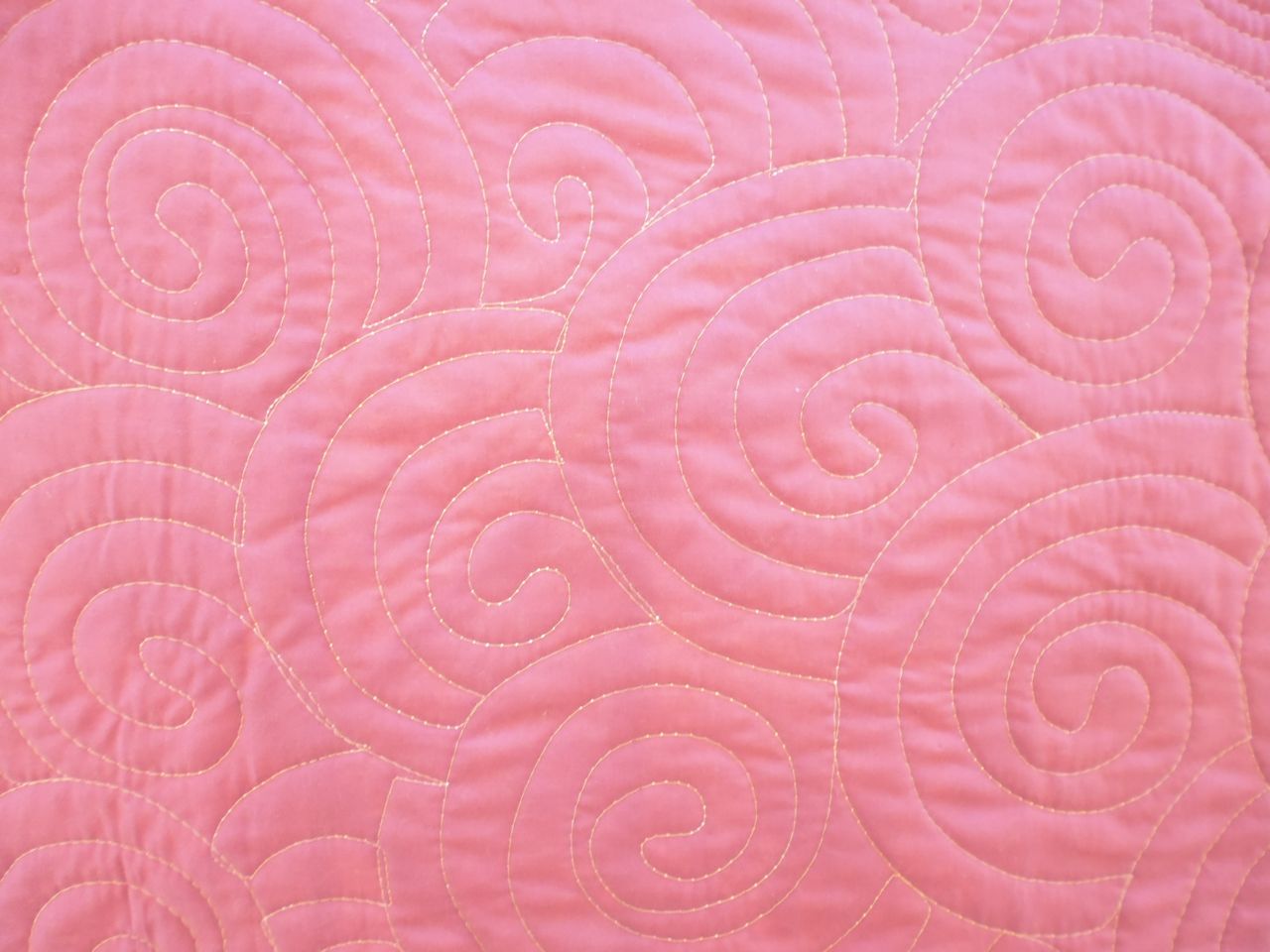
Back:
Threads used: (no information on threads as I did this quilt a while ago and can’t remember what I used!)
Another quilt that I stitched with an all-over spiral.
(Click on a photo to view it larger)
Back:
Threads used: (no information on threads as I did this quilt a while ago and can’t remember what I used!)
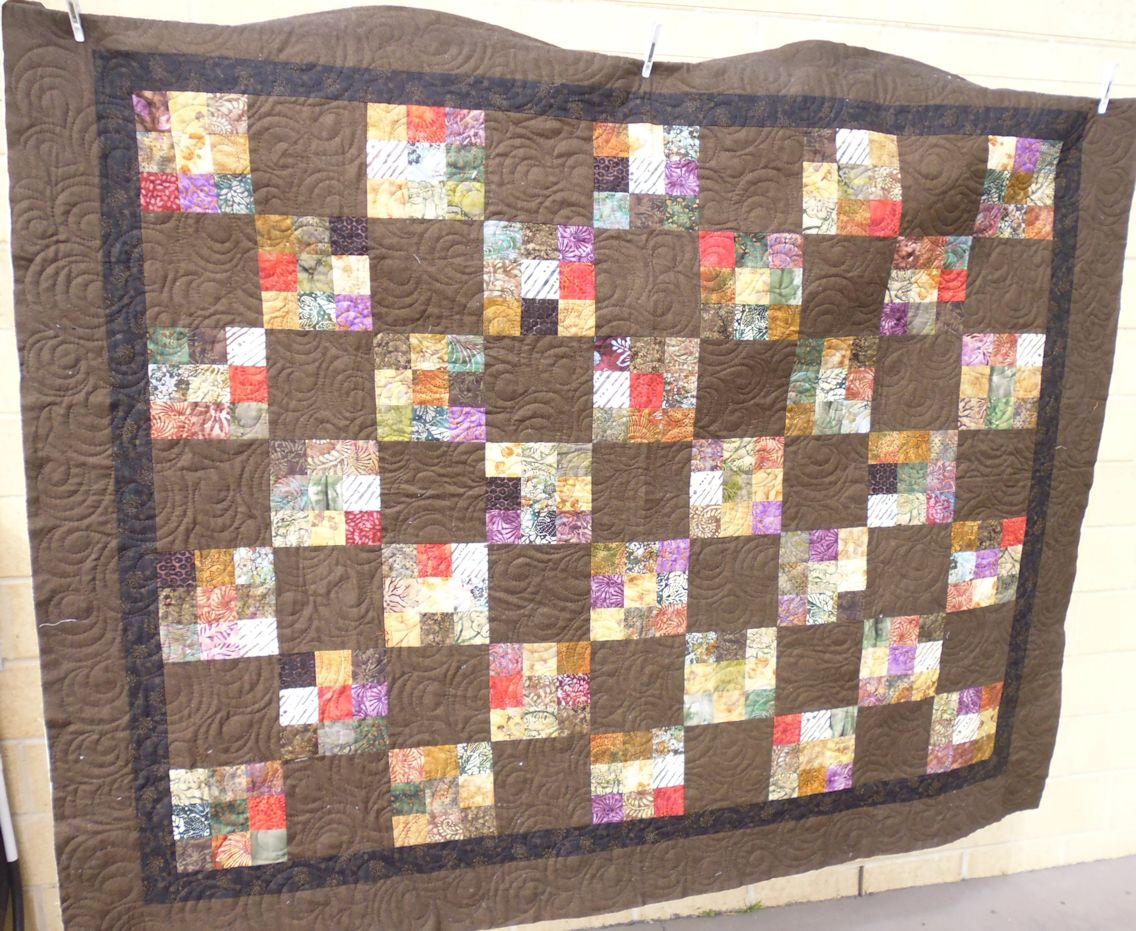
Another huge quilt! I stitched it with an all-over ‘open headband‘ motif, one of my ‘go to/muscle memory’ motifs.
(Click on a photo to view it larger)

Back:
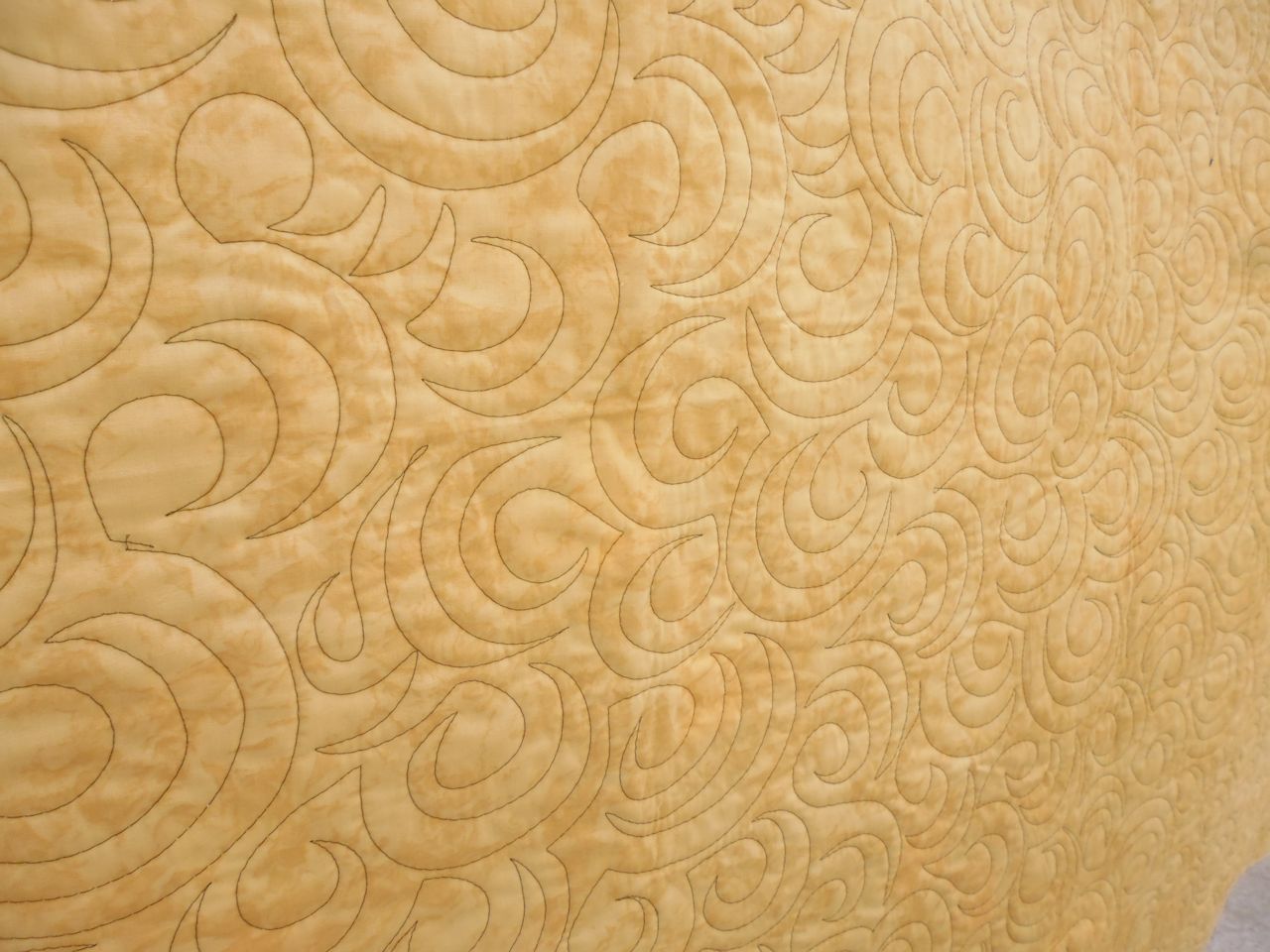
Threads used: (no information on threads as I did this quilt a while ago and can’t remember what I used!)
This was a really big quilt, and my aim was to stitch the layers together in a way that held without going over the top with the quilting. I first stitched in the ditch around all the blocks, then simple straight lines (using my favourite Line Tamer ruler!) bisecting the blocks horizontally and vertically.
(Click on a photo to view it larger)


Threads used: (no information on threads as I did this quilt a while ago and can’t remember what I used!)
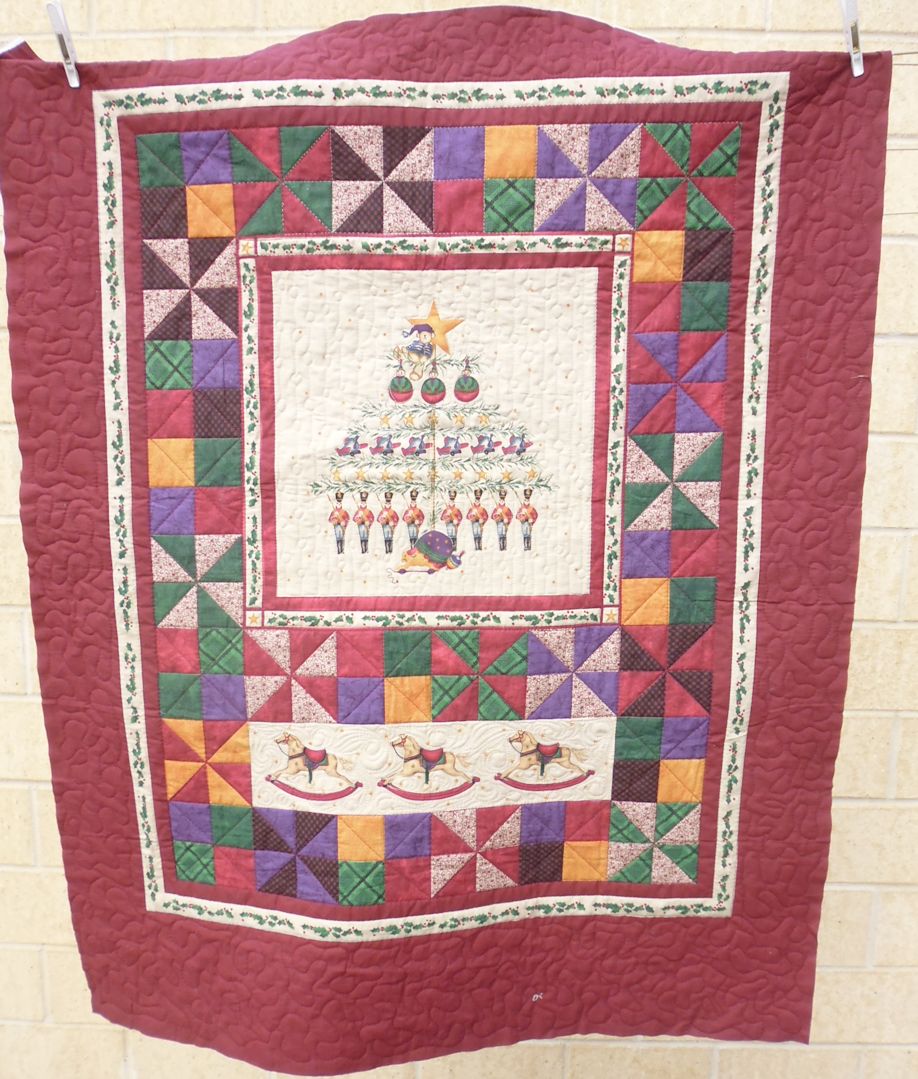
This next quilt was a Christmas panel. How to quilt it? I started by stitching in the ditch around all the elements of the panel, did cross-hatching on the diagonal in all the ‘border’ blocks, with some MacTavishing surrounding the rocking horses, and some stitching resembling Christmas baubles in the background to the tree, finishing up with a meandering stipple in the outer border.
(Click on a photo to view it larger)


Threads used: (no information on threads as I did this quilt a while ago and can’t remember what I used!)
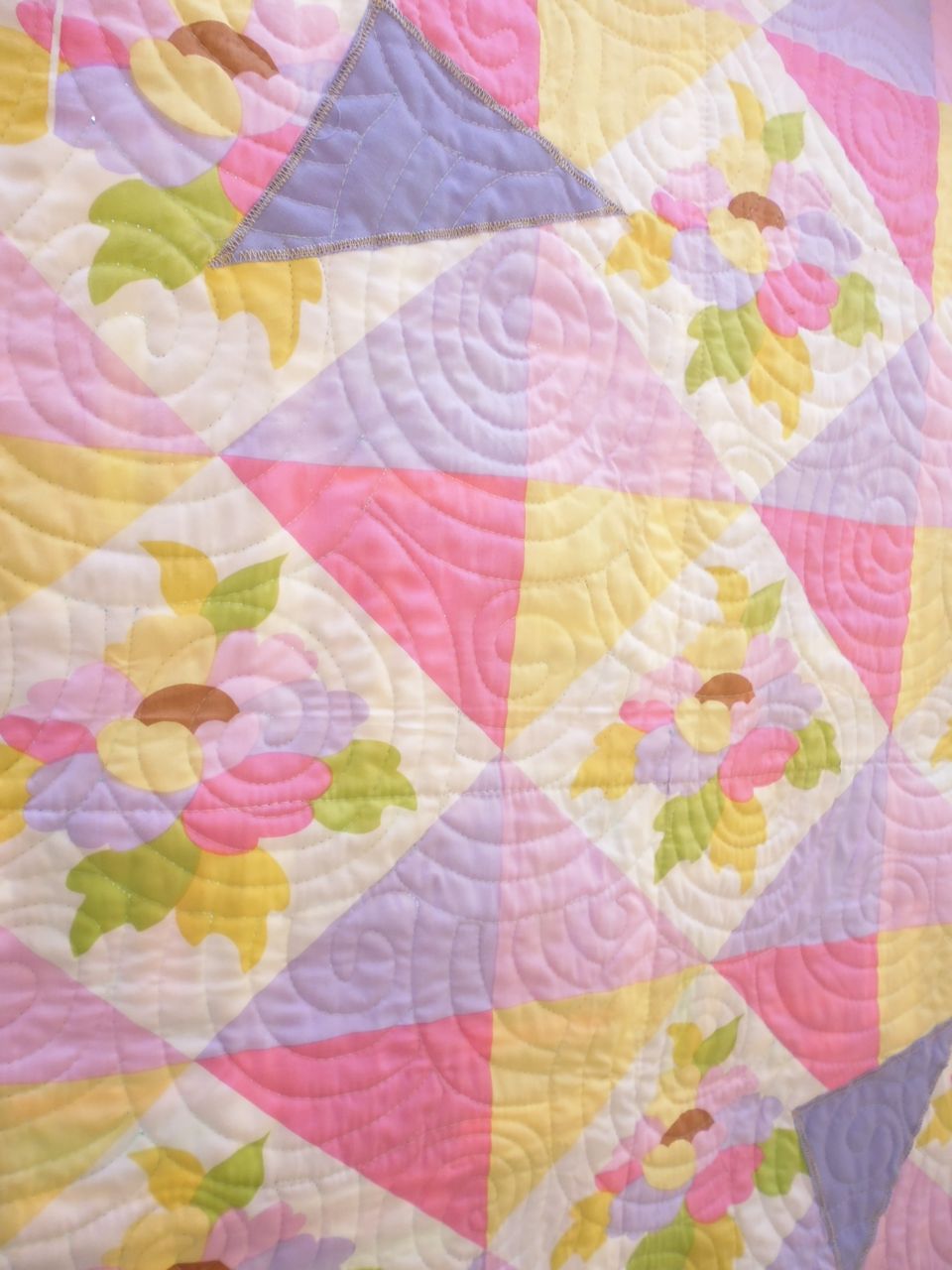
To counterbalance the very geometric rail fence blocks, I stitched large spirals all over this quilt.
(Click on a photo to view it larger)


Back:
Threads used: (no information on threads as I did this quilt a while ago and can’t remember what I used!)
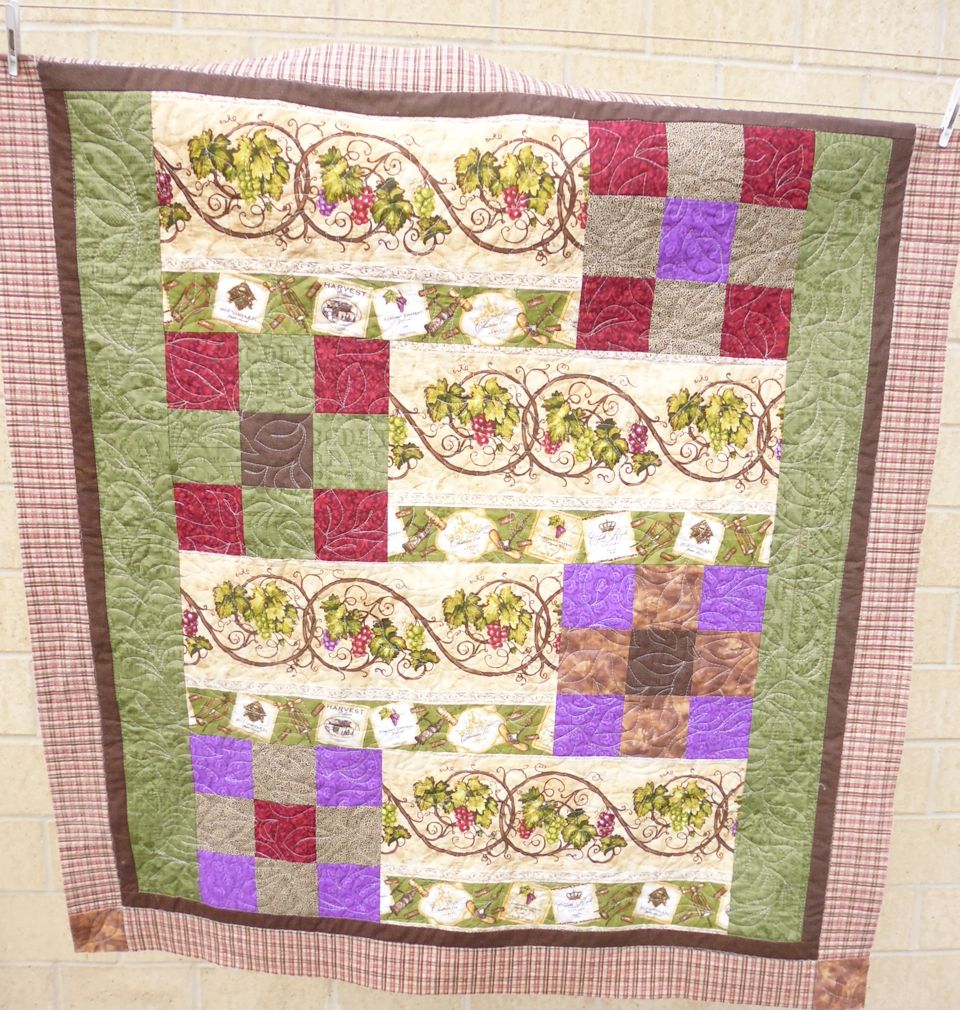
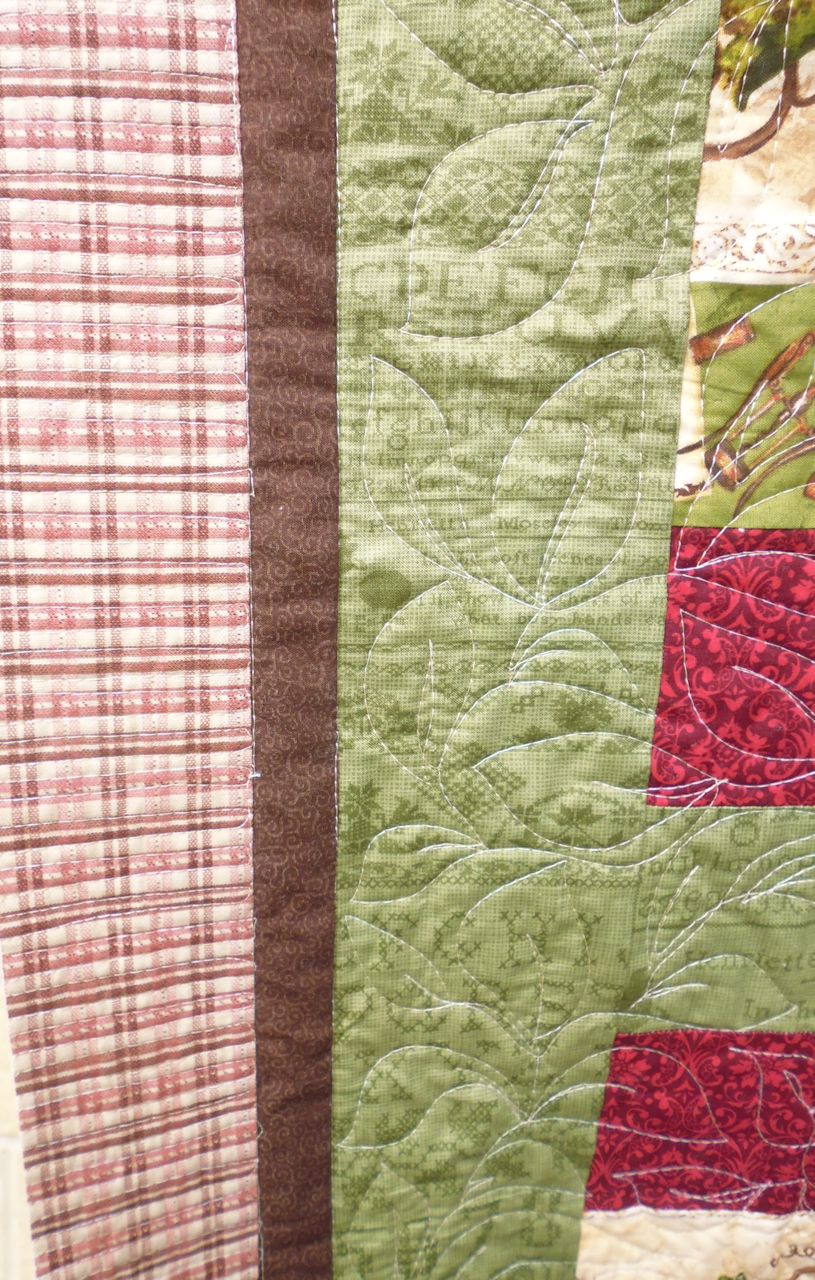
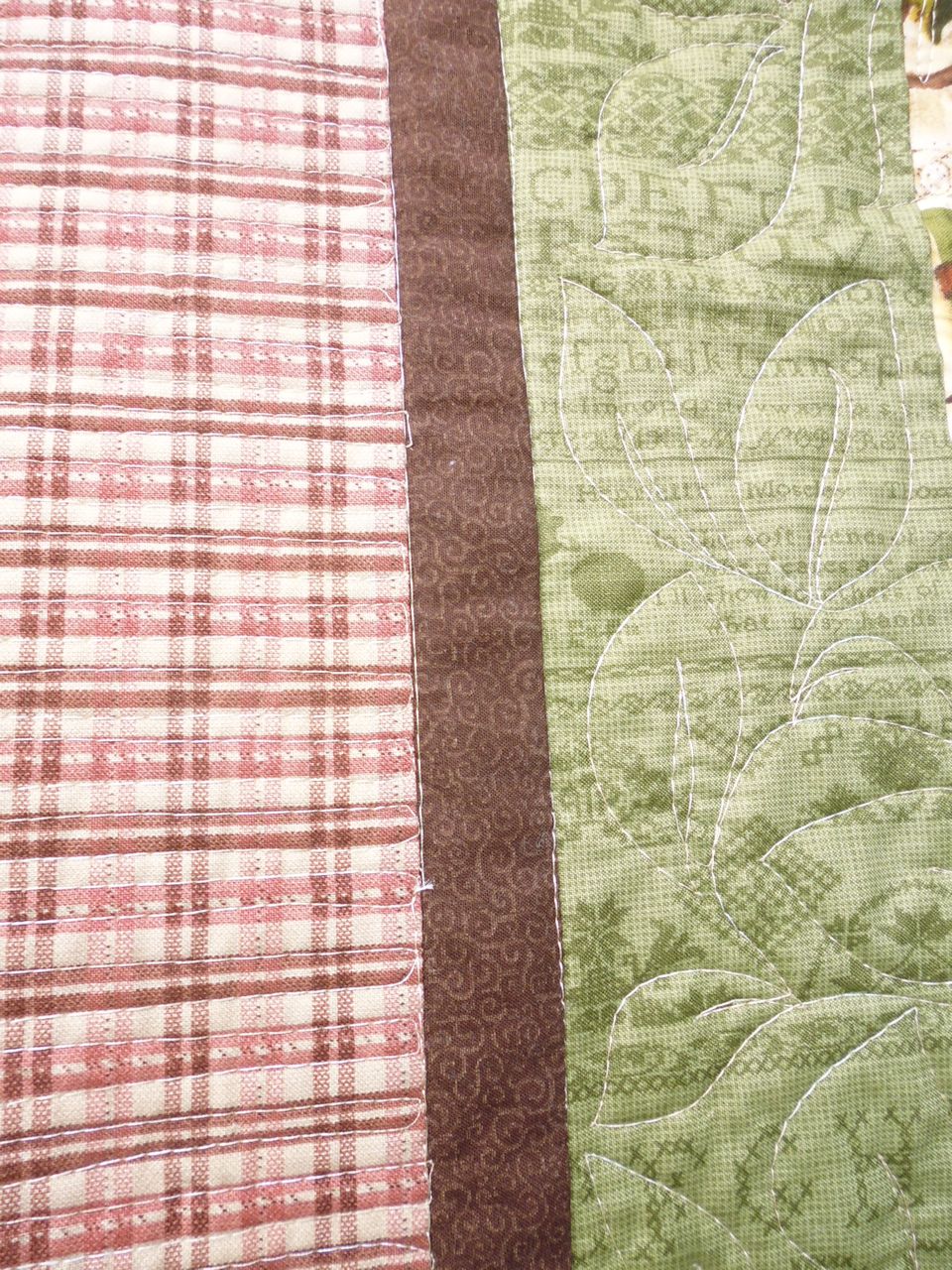
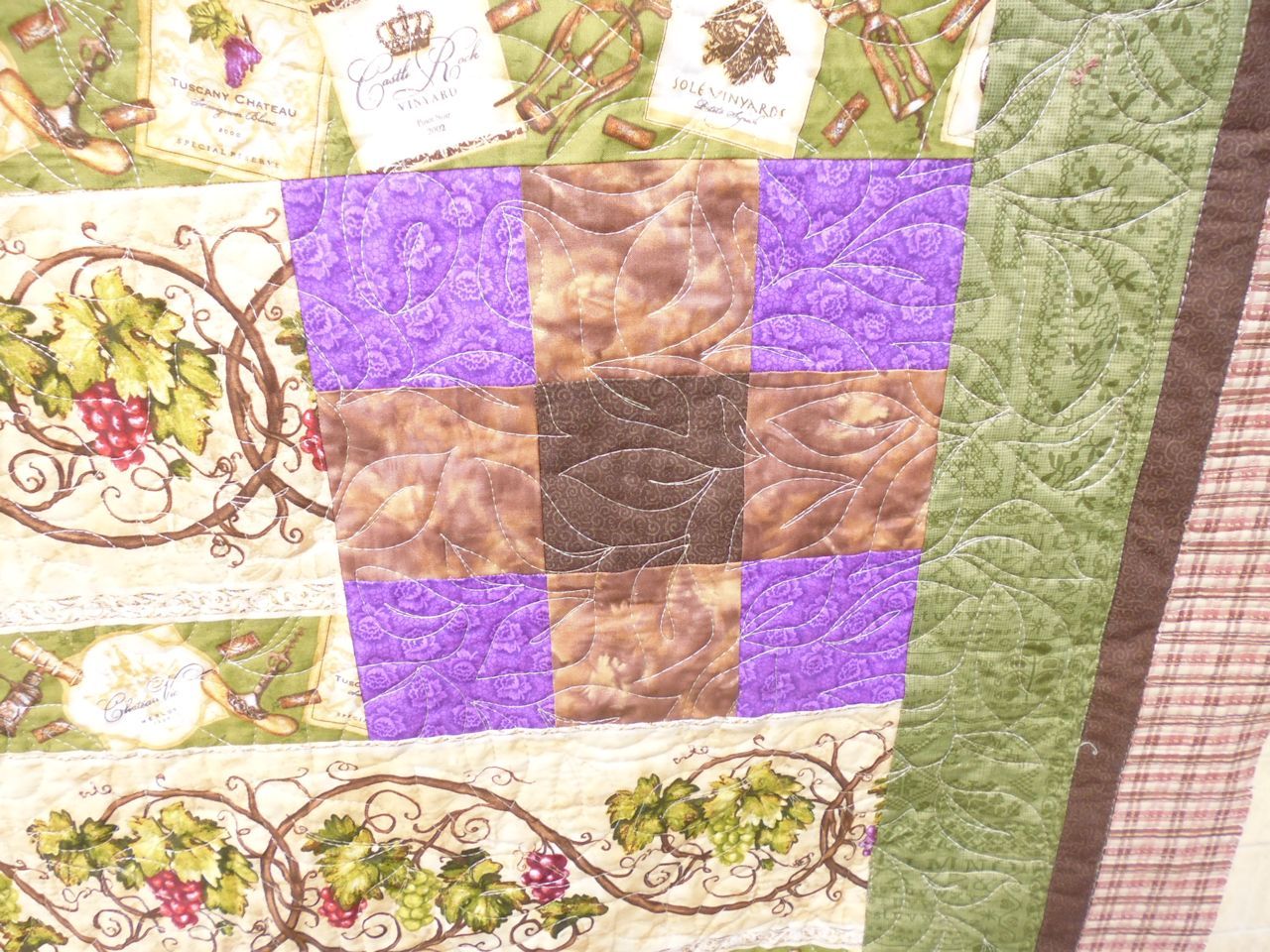
How to quilt this quilt made from fabrics that featured grapes, wine etc.? Easy! Stitch an all-over leaf design in the main part of the quilt top. I then stitched narrow piano keys in the plaid border.
(Click on a photo to view it larger)
Threads used: (no information on threads as I did this quilt a while ago and can’t remember what I used!)
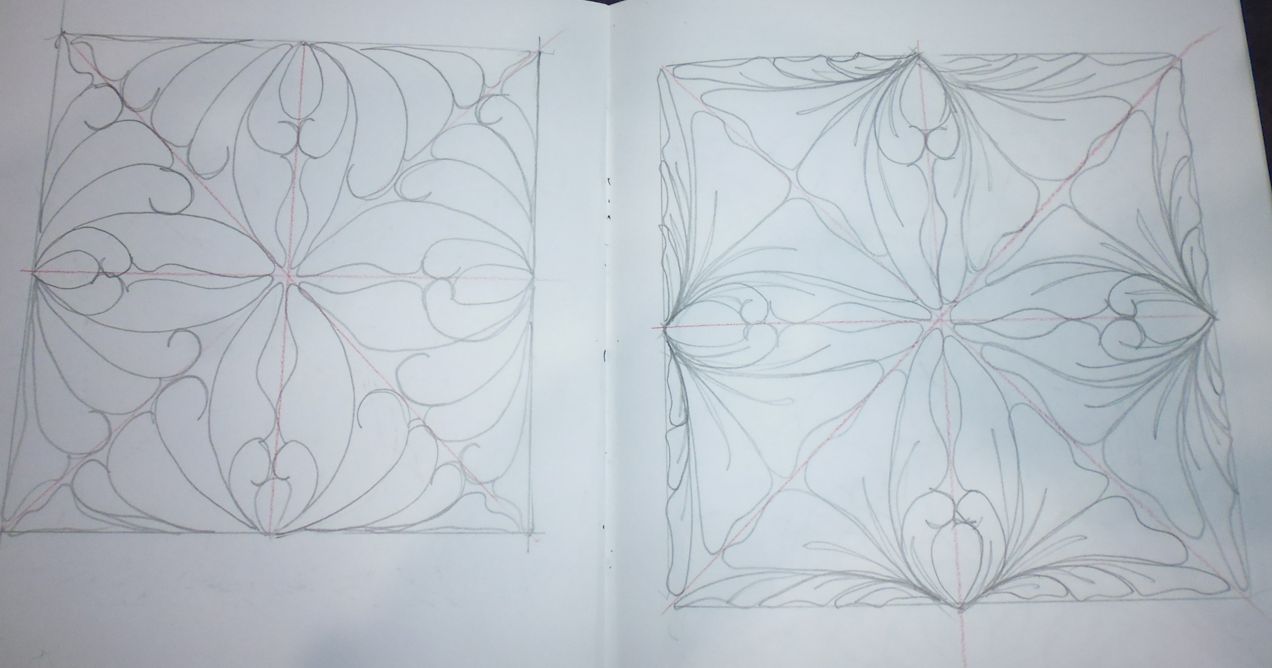
I attended a two-day workshop (no sewing!) at Handcrafters House in mid-August. This time our tutor was the lovely Jamie Wallen, who took us from scratchy feather designs to mini works of art. We focused on feathers and grids and how to take them from boring to magical.
Our tools were paper and pencil and for two days we learnt, sketched, drew, and amazed ourselves with our progress in coming up with designs for free motion quilting. Inspirational, and definitely worth doing if you ever have the opportunity. It’s not often you can just sit and doodle for two full days! I’ve already used one of the designs in a couple of quilts.
The photos below show my progress from the first feathers (far left of the first photo) to the last design.




I’m a bit behind in doing my blog posts! July was filled with quilting workshops and retreats, plus my trip to Vermont. Oh, and work. August had another quilting workshop (with Jamie Wallen), plus work, plus quilting Community Quilts, plus four full days (over weekends) thoroughly cleaning EVERYTHING in the shed to get rid of the rat scat, body marks left behind as they used out shed as their luxury winter apartment. So, I have a few blog posts to catch up on!
The first weekend in July was spent in Perth at Handcrafters House doing a great workshop with the lovely Melissa Sobotka, an award-winning art quilter famous for her immaculate attention to detail in her photo-realistic applique work. Take a look at some of her pieces here: http://www.msfiberart.com/
Because it was only a 2-day workshop, we all worked on the same piece — a bunch of tulips, cut from fabric, fused, and enhanced with Tsukineko All-purpose Inks (part of the workshop fee was a kit with the fabric range, Soft Fuse, and access to Melissa’s inks). But before we started on the tulips, Melissa taught us some basics of using the Tsukineko inks (liquid and blocks) and watercolour pencils to apply colour, shadow, depth etc. We used paintbrushes with the inks, not the Fantastix applicators that are traditionally used with them.

Then on the tulips. I’m going to reach back into my memory to see if I can recall the steps we did. The first step was to trace an outline of the main shapes and colour areas — light, medium, and dark — onto freezer paper, and label each one with its tonal value (e.g. ML for medium light).


After doing this, we put our master photo underneath the tracing and taped it down, laying and lightly taping the tracing on top.
Next, we started looking at how various parts of our first tulip hid behind and overlapped other pieces, and cut out the freezer paper bits for each part one at a time. It’s important not to cut everything out unless you have another tracing that shows which bit goes where and number the pieces — it’s super easy to get messed up, so Melissa’s advice was to do one small section at a time, using the photo underneath the tracing as your reference. After cutting out the freezer paper pieces for one tulip, we fused them to the FRONT of our selected fabrics, leaving about a 1/4-inch of extra fabric along all edges (rough cut — some of this gets cut off soon). On the back of the fabric we fused some soft fusible (e.g. Soft Fuse, Misty Fuse).

Cut and fused pieces for one tulip, the photo of which is showing through the hole in the freezer paper made when cutting out the individual parts of the flower
Next, we cut the excess fabric off each piece EXCEPT WHERE ANOTHER PIECE WOULD OVERLAP IT and fused the pieces together, starting from the piece representing the area furthest away. After several hours, we had one tulip done and could remove the freezer paper from the front of it. We continually referred to the photo to get it right.
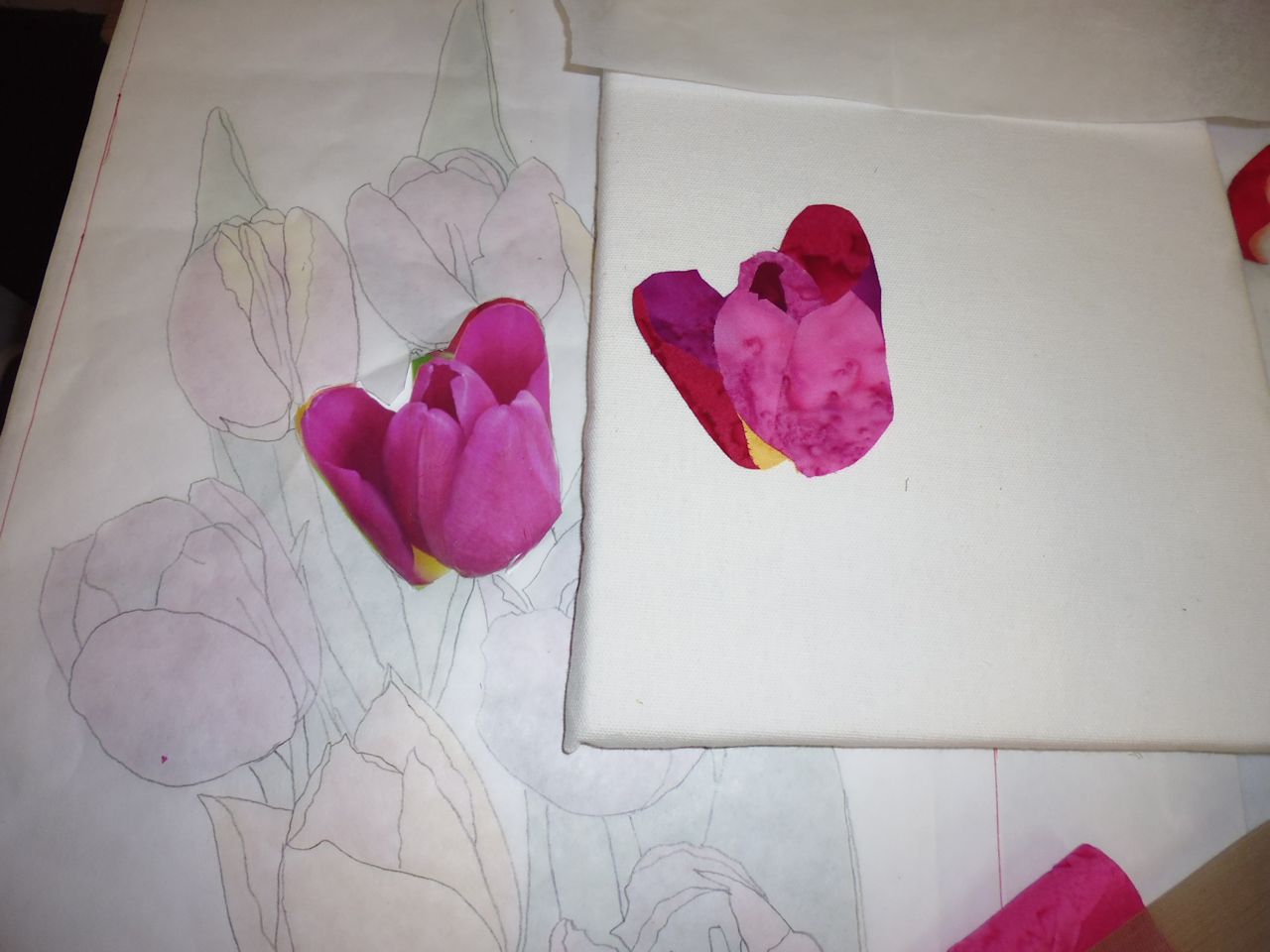
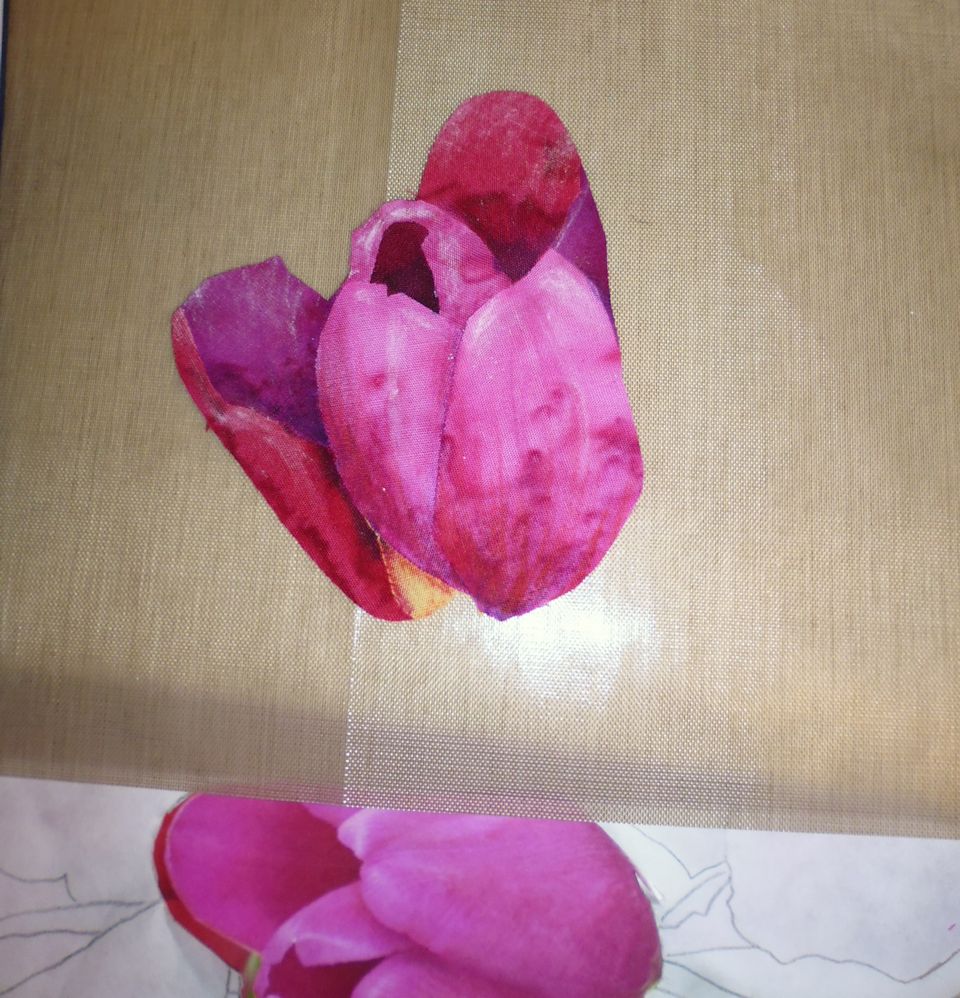
At this point, the tulip looks pretty flat. The colours are there in the fabric, but it doesn’t have much depth and shadow yet. This is where the inks come in. After applying various shades and colours my first tulip started to come to life.

With so many tulips to do, I decided to try some leaves next, just to have a change of pace and to take advantage of asking Melissa any questions if I got stuck. Same process as for the tulips — cut, fuse, rough cut, fuse, ink.
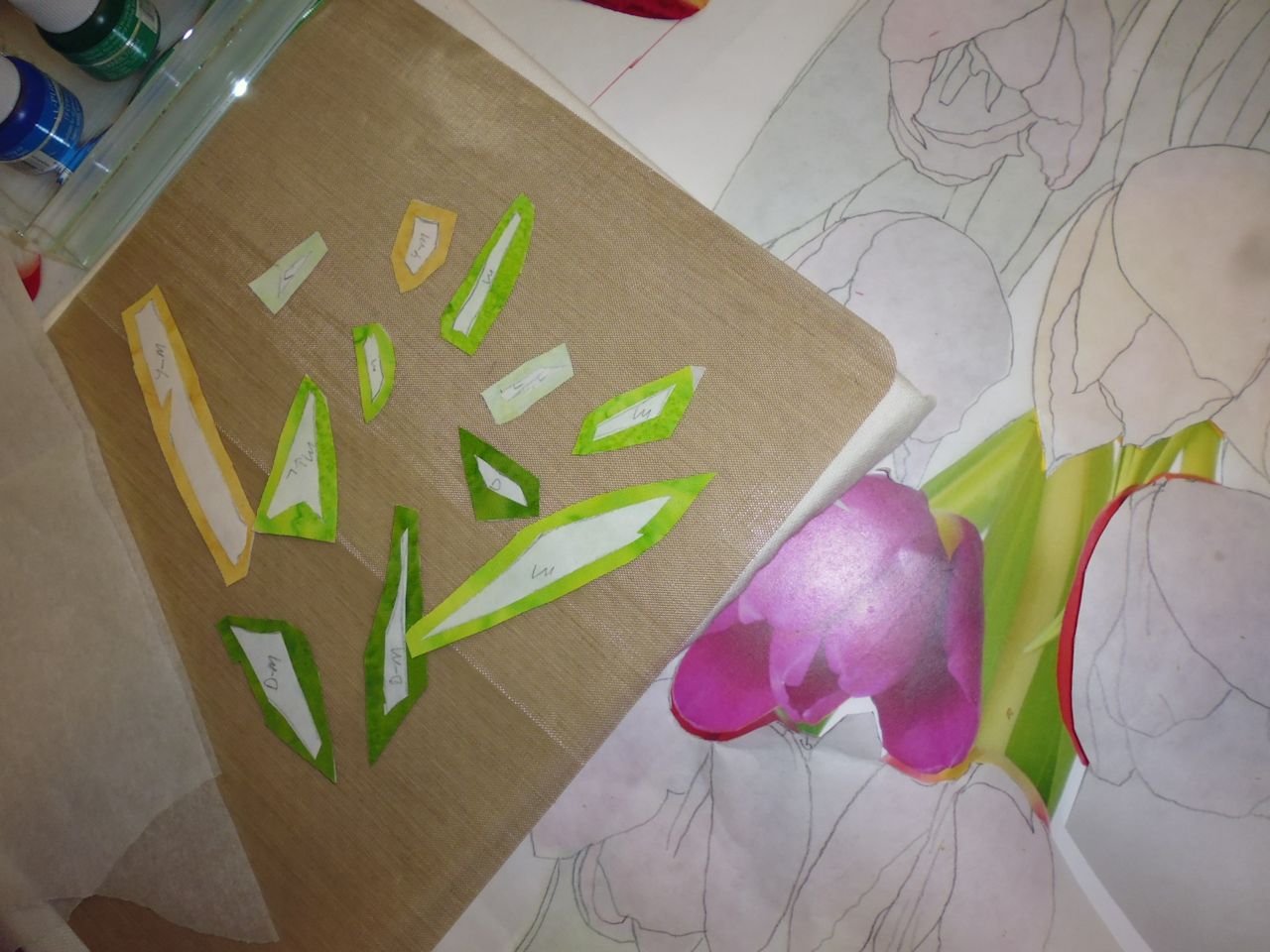
By the end of the second day, I had two tulips I was happy with, a bunch of green stems joining them, and a tulip I definitely wasn’t happy with — so much so, I threw it in the bin! (However, one of my friends grabbed it and it was proudly displayed on her design wall when I went there the following weekend for my annual retreat!)
I haven’t finished the piece, and doubt that I will. In fact, I think I gave my finished tulips and stems to my friend as it’s doubtful I’ll ever finish it or have the patience to do so. I enjoyed learning the technique (it was similar to Lenore Crawford’s technique I learnt in 2012), but it’s too fiddly and precise for me. And it takes an enormous amount of time.
Melissa’s award-winning pieces are HUGE and take her up to a year to create. She must have the patience of Job! I certainly don’t…
How to quilt this very geometric and colourful scrappy quilt? I thought about straight line ‘modern’ quilting, then decided to do a variation of ‘graffiti’ quilting. I started in the centre with large overlapping spirals, then a whole slew of flame-style stitching, finishing at the outer edges with a open headband motif. I used a variegated thread in blues, greens, yellows, and purples to match the vibrant colours of the squares.
(Click on a photo to view it larger)

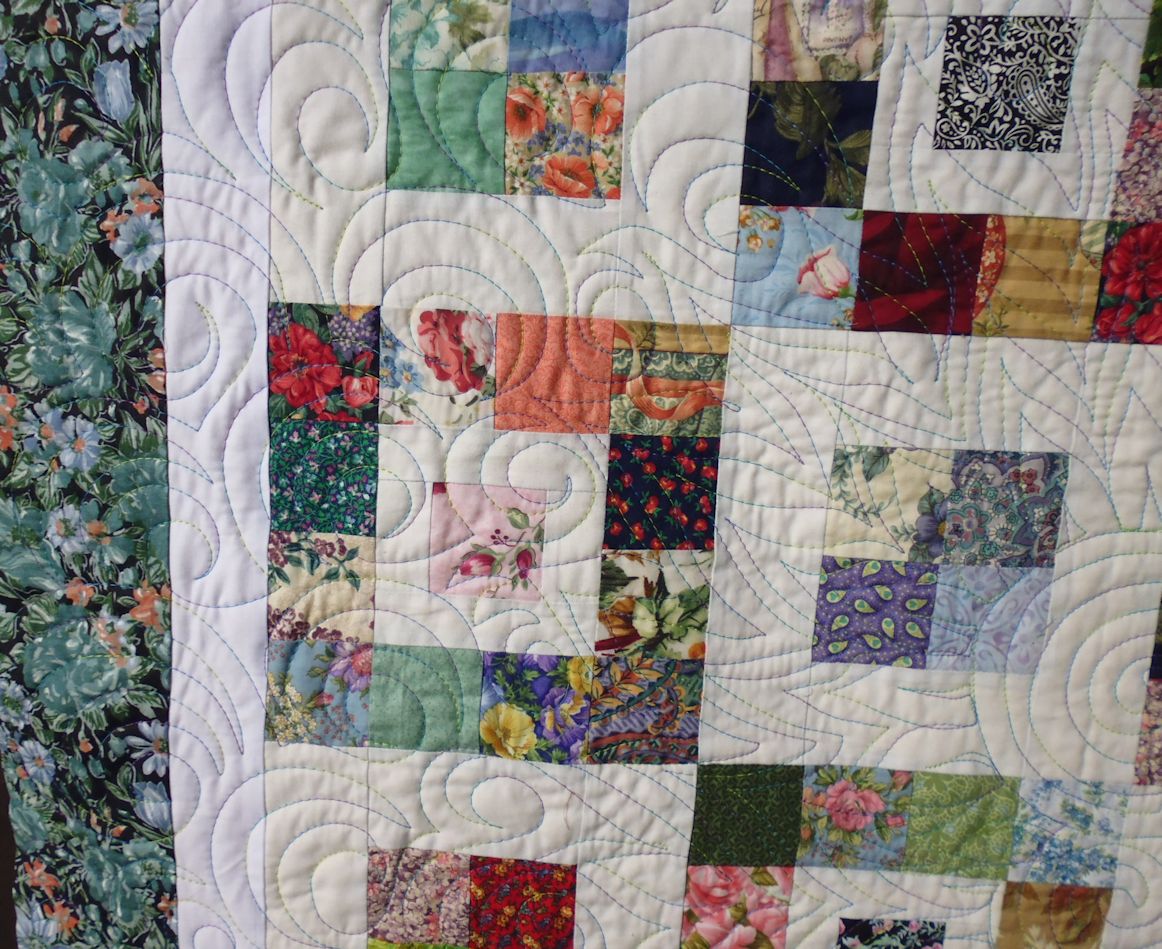
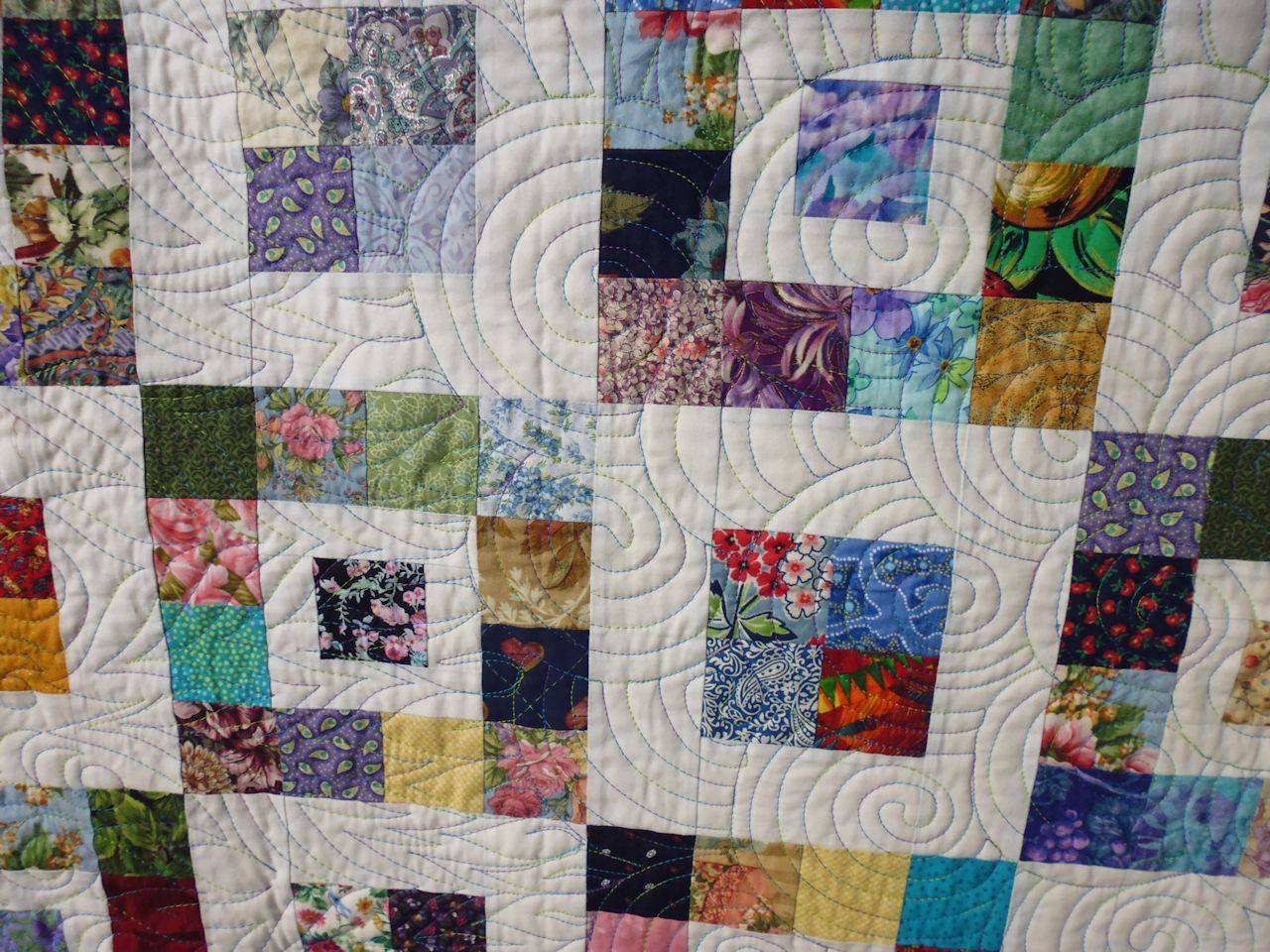
Threads used:
Hexies! Lots and lots of hexies! But how to quilt hexies like this???
I decided to do arcs, as per a cathedral window motif, using matching thread colours for each hexagonal ‘flower’. The inner dark green hexies were too puffy after doing this, so I stitched them down too. And for the outer border, I just did a meandering stipple in a variegated dark green thread.
(Click on a photo to view it larger)


Threads used:


 Rhonda Bracey: At Random