Oops! Spilled milk…

2 07 2009

It was cold today — 0.8C overnight, only 3.9C at 9:00am. So I decided to make a cup of hot Milo, made with milk (the BEST and ONLY way to enjoy Milo!). My husband makes his coffee with milk (no water), and I know he zaps it in the microwave for 2 minutes 10 seconds. So in went my Milo and I set the microwave to 2 minutes.

Look what happened… I guess 2 minutes was too long, huh?

Messy, sticky, goopy Milo

Messy, sticky, goopy Milo


I found another cockroach…

15 06 2009

… and it’s already on its way to the Australian Museum!

I popped out at lunchtime today and when I came home I saw a native cockroach on its back right near the front door. I thought it was dead, but it still had a little movement in its legs. So I hightailed it inside, found a small box, gathered up some leaf litter, put the cockroach in the box (I didn’t even draw breath to find out if it was a male or female or to take a photo of it), added some air holes and sealed the box.

Then it was back to the Post Office to send it Express Post to the researcher at the Australian Museum. He should get it by Wednesday or Thursday.

I doubt if it will still be alive by then — it looked pretty well done in when I found it (we’ve had the outside of the house sprayed for Portuguese millipedes and I suspect that most invertebrates coming into contact with the residual poison aren’t coping too well).

Still, the researcher will get a specimen and hopefully will be able to tell me whether it is a new species or a geographic variation of any existing one. Who’d have thought I could get excited by a cockroach!?!

Update: I’ve since found a couple more and sent them off to the Museum. The latest (November 2009) was a healthy female, completely intact. The researcher hopes she has eggs, and has taken her home to watch over her — just in case. When she dies, she will go into the entomology section.


Controlled burn scheduled

14 06 2009

After the January fires close to our town, I’ve become quite paranoid about the bush block behind and below our house (we’re near the top of a steep hill). It’s a really big block with some very large trees that tower over our house some 10 to 20 metres further up the hill, and according to the locals it has not been burned for 15+ years, which means the fuel load is pretty nasty.

Well, after a little bit of agitating and sending off emails etc. to the owners of the block (a state government department) and the local shire ranger and emergency and fire people, we got a flyer in the letterbox last week saying that they intend undertaking a controlled burn of this block over two days this coming week. Assuming it goes ahead (obviously if there’s a lot of rain it won’t happen then), I’ll hopefully sleep a little easier this summer.

Here’s a picture of the trees on this block — what you can’t really see here is the degree of slope, but take my word for it — these trees are a long way down from us, but are higher than our house. The controlled burn won’t burn the trees, just the 15+ years of undergrowth and accumulated logs, leaf litter, etc. on the ground.

Towering eucalypts on bush block behind our house

Towering eucalypts on bush block behind our house


I love the smell of a new hotel!

13 06 2009

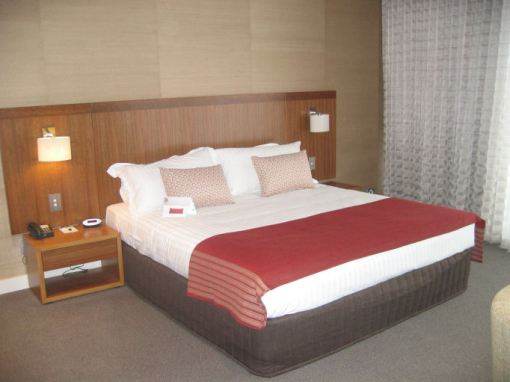
We travelled to Bunbury yesterday for my shoulder injections and to do a bit of shopping. After an excellent and cheap lunch at the Marlston Chinese Restaurant in Bunbury, we drove on to Mandurah to stay overnight at the just-opened Sebel Hotel, on the spot where the old Peninsula Hotel used to be.

The Sebel is doing some excellent opening deals at the moment. It was my husband’s birthday last Sunday, so why not? We got one of the bigger rooms for an opening special price of $122 for the night — an EXCELLENT price for a 4+ star hotel.

The Sebel Mandurah

The Sebel Mandurah

The fittings and finishings were what I’d expect from this star level hotel, and quite minimalist as is the fashion these days. And although there’s no restaurant in the hotel, there’s one in the same building on the ground floor. We didn’t eat there though — instead we walked along the boardwalk into town and had a light meal at Murphy’s Irish Pub, followed by some good music from Billy Neal(e), a one-man-band guy.

More photos of the room and its fittings are here: http://community.webshots.com/album/560805818gSdWUQ?start=120


Shoulder to shoulder

13 06 2009

I had to have a steroid injection in the bursa of both shoulders yesterday. My memories of taking my Mum to get a Cortisone injection in her elbow (?) several years ago were causing a bit of anxiety — Mum said the pain of the shot was worse than the pain she had the shot for!

Well, something’s changed since then.

Initially the clinic said they wouldn’t do both shoulders as I would have limited movement for two days — I’d have to have one now and come back for the other. After a little rant about already travelling an hour each way to have these shots and explaining that my doctor said ‘two shoulders’, and that I wasn’t willing to travel again unless ABSOLUTELY necessary, the assistant went back to the doctor who said she’d do them both.

They prepped my shoulders with some local anaesthetic, then after a couple of minutes the doctor said I could get up. I asked when she was going to do the injections and she said she’d already done them! Seems she follows the local almost immediately with the steroid injection — and I felt almost nothing except the pin prick of the local anaesthetic injection. That was easy!

I walked out of the clinic within 15 minutes, much to my husband’s surprise — he thought I hadn’t even had the procedure. We went to lunch and I waited for the local to wear off and the pain to kick in. After 30 mins, nothing; after an hour, nothing; after six hours, nothing; after 12 hours; nothing; after 24 hours, nothing. It’s now been close to 30 hours since I had the injections and I have had no pain whatsoever. That said, I haven’t done anything strenuous (as per the advice given by the clinic people), and I haven’t needed to lift my arms over my head.

But so far, so good! After all the gloom and doom stories — and the reluctance of some people to talk about the likelihood of pain except with enough hints to indicate there WOULD be pain — everything appears to be hunky dory. I’m pretty happy about that.

(And in breaking news, I just learned that a very good friend of mine has come through major surgery OK, which is an absolute relief. My shoulders were a very minor blip on the radar compared to the procedure she’s just had.)



Here’s the deal with the cockroach

14 05 2009

Well, you learn something new everyday! Today I learned a lot.

I learned how to tell male and female native cockroaches apart (it’s called ‘sexing cockroaches’). I learned that ‘my’ native cockroach might be a new species or possibly an undocumented geographic variation. I also learned that diurnal cockroaches (those that hang out in the daylight hours, like ‘my’ native cockroach) are pretty rare and that scientists are researching their properties for sunblock applications, amongst other things!

So how did I learn all this? Martyn, from the Australian Museum in Sydney, replied to my email giving me a whole lot of info about this cockroach and why he wants me to send him any more that I might find. Here are some excerpts from his email:

I have an interest in the diurnal native cockroaches. Australia is very unusual in having a number of species which are not only active by day but are fond of basking in the sunlight. Overseas cockroaches (and many other Australian species) die if exposed to UV light for any length of time. Some of our native species are creating interest as they seem to produce a natural ‘sunblock’ which may have a commercial application…(Actually the sunblock cockroaches are in a different genus Anemesia – so they’re about as closely related to yours as dogs are to foxes – still there are other compounds of use found every day in the natural world – e.g. leech spit is used in bruise ointments. Who knows what could be in your cockroach?)

The genus Polyzosteria is one where all members of that genus are diurnal and often colourful. There are only about a dozen known species. Yours seem to be a member of that same genus but I cannot be sure of the species although it is very similar to Polyzosteria cuprea…

This means it is either a new species to science, or a geographical variation of a known species (P. cuprea), or it is one where the colours change after death so the live ones look superficially different to the dead ones until you get down to comparing the numbers of leg spines, genitalia, size etc. At this stage it is a bit of a mystery.

Should you find any more we would be interested in some specimens. If dead, please remember to include any legs etc. which drop off as they are important too – as is a slip of paper with all the details of its finding like where, when, and your name and contact details. In this way if it proves to be something new they can get back in contact with you and include this information on the record for the species (whether it is a known one or not, your details will be linked to that specimen as the collector for as long as the specimen exists – maybe a century or more).

If it is alive the system is pretty much the same except that the specimen/specimens will need to be packed in a slightly larger plastic container with some small ventilation holes and a few pieces of bark or dead leaves included so the contents won’t slide or rattle around during transit. Express Post is preferred in this case.

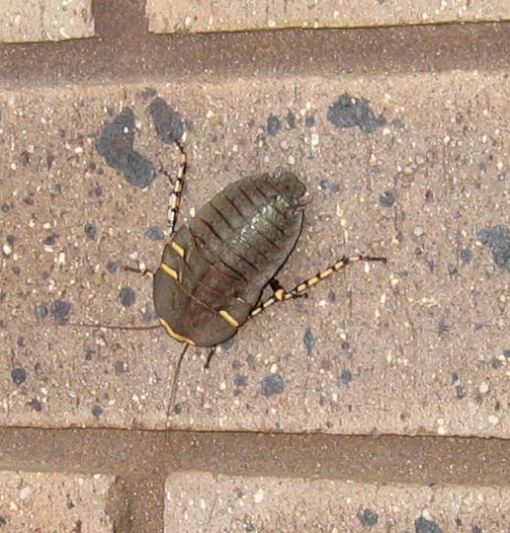
Once again all details of the collection should be included as the specimen, once it dies, will be included in the entomology reference collection pending what it turns out to be. For the record your photo shows a female as you can see the last body segment on the tail end has a cleft in it making it look a bit like the letter ‘m’. In the males this cleft is missing. Below is a photo of a female of the Polyzosteria species local to the Sydney region. Notice the cleft on the last abdominal segment matches the shape of the one in your photo: http://davidavid.blogspot.com/2006/04/diurnal-cockroach-polyzosteria-limbata.html and the male ’end’ looks like this – ignore the fact that it is another species – just look at the shape of the end edge of the last abdominal segment: http://agspsrv34.agric.wa.gov.au/Ento/images/P_mitchelli.jpg.

So there you have it! ‘My’ cockroach could be a new species and my details as a collector could be kept for 100 years or more!! Who’d have thought a pretty cockroach on a wall could be so interesting?

Oh, and here’s the picture that started all this:

Female native cockroach on house wall

Female native cockroach on house wall


What does the Australian Museum want with a cockroach?

14 05 2009

A couple of years back I found this strange looking cockroach-type thing on the outside wall of our house. I took a photo, much to my husband’s chagrin and head shaking wondering why.

I also tried to find out what it was and had a little success, but not a lot. And I posted the photo to Webshots where I store all my digital photo albums, then promptly forgot about it.

Last night I got a comment on my photo — someone from the Australian Museum wants to get in touch with me and for me to hang on to any more that I find! I don’t know why yet — maybe I found a rare species? But how cool is that!

I’ll let you know more after the person responds to my email and I find out why he wants me to hang on to any more that I find.

See also: https://sandgroper14.wordpress.com/2009/05/14/heres-the-deal-with-the-cockroach/


Just wondering why…

10 05 2009

Why would Google.com.au have two different images for Mothers Day? Classic Google has this one:

mothers_day_google_classic

But if you have a personalised home page (iGoogle), you get this fuzzy one:

mothers_day_igoogle

Just wondering…


Ironing quote

6 05 2009

Great quote from Cara BL!

Ironing is utterly at odds with my religious principles. Wrinkles in clothing were put there by the Almighty. Far be it from me to interfere with his plan.


Be Kind to Animals week

5 05 2009

Two friends of mine in the US are very involved in animal rescue — one rescues guinea pigs; the other, greyhounds. Animal rescue organisations rely on volunteers such as my friends to take in and hopefully place animals that have been abandoned by their owners. Perhaps the owners can no longer care for them financially or physically, maybe they no longer want them, or maybe they just want to get rid of them because the novelty wore off for precious little Dakota or Heathcliff.

In the US, May 6 through 12 is National Pet Week and also Be Kind to Animals Week.But even if you’re not in the US, you can still participate.

You can help by spreading the message of kindness, compassion, responsibility, and stewardship. Or perhaps you can drop off some supplies at a rescue or shelter, donate money to an animal organisation, or talk on your own blog, MySpace page, or FaceBook profile about the animal causes closest to your heart.

As my friend Whitney says: “Maybe…just maybe…we can start making some changes on this planet we call home.”

(If you’re a quilter reading at this blog, consider using some of your stash, scrap fabrics, spare batting etc. to make small quilts for your local animal shelter, as I did earlier this year. It’s a great way to use up leftover fabric, to practice free motion quilting, and your gift will be appreciated by the humans who care for the animals and the animals themselves.)